
Solana drops below $72 and is back at its late-June level
Solana loses around 11 percent on November 14, 2026, and falls to $71.37, putting its lowest daily close since late June within reach. The trigger is a broad sell-off with liquidations above $1.2 billion, one day before the Breakpoint conference in London.


Which topics should we dive deeper into?
Select what genuinely interests you. Your picks feed directly into our editorial planning.
Crypto news that's actually worth your time.
Weekly. 60 seconds. Carefully curated by our editors: no hype, no promo flood, no spam.
The Solana price fell below $72 on Saturday, November 14, 2026. At around 9:50 pm German time in the evening, SOL traded at $71.37 on Binance, roughly 11 percent lower than 24 hours earlier. That is about €64.77. If the price holds at this level until midnight, it would be the lowest daily close since June 27. Solana is falling far harder than bitcoin and ranks among the biggest losers of the 25 most valuable cryptocurrencies.
There is no known trigger specific to Solana. The drop is part of a broad sell-off in which leveraged positions worth more than $1 billion were forcibly closed within 24 hours. A date adds to the picture: on Sunday, Solana's Breakpoint conference opens in London, and so far the market is not treating it as support. This article puts the numbers in context, shows the next levels on the chart and explains what matters for investors when buying, staking and trading with leverage.
Solana price on November 14: down 11 percent in 24 hours
Binance reported a 24-hour range for SOL/USDT between a high of $80.20 and a low of $71.13. In the evening the price was therefore sitting close to the bottom of that range. According to CoinGecko, the price at the same time was $71.60 and market capitalisation about $42.4 billion. Over seven days Solana has lost a good 20 percent according to CoinGecko, and around 32 percent over 30 days.
Trading volume rose sharply. By the evening, SOL worth around $263 million had changed hands on Binance's SOL/USDT pair. Over the previous seven days the average was around $165 million a day. Traders often read higher turnover during falling prices as a sign that many market participants are actively selling, or being forced to sell, rather than buyers simply being absent.
If you want to follow the move as it happens, you will find the price, market capitalisation and trading volume on our Solana price page.
Liquidations above $1.2 billion: why altcoins fall harder
A liquidation is the forced closure of a leveraged position once the deposited capital no longer covers the losses. The exchange then sells automatically, and that sale pushes the price down further. The result is a chain reaction: every closed position can trigger the next one.
According to CoinGlass data reported by the news site Cryptotimes on November 14, positions worth $1.26 billion were liquidated across the crypto market within 24 hours. A total of 173,014 traders were affected. Long positions, meaning bets on rising prices, accounted for $1.08 billion, or 86.4 percent. The site cites rising expectations of a US Federal Reserve rate hike in December and continued outflows from US bitcoin ETFs as the backdrop.
Altcoins such as Solana are usually hit harder by such a wave than bitcoin. Their order books are thinner, while leverage in derivatives trading on large altcoins is widespread. When many long positions are wiped out in a short time, the buy side lacks the depth to absorb the selling. Bitcoin itself fell almost 5 percent to $65,451 on Saturday according to CoinGecko, breaking below its 200-week line; we cover that in our article Bitcoin price breaks below the 200-week line from November 14.

Solana vs bitcoin: the SOL/BTC ratio loses almost 6 percent
The SOL/BTC pair shows whether Solana is doing better or worse than bitcoin. On Binance it fell 5.9 percent on Saturday to 0.001093 BTC. Solana has therefore lost ground not only in dollar terms but also against the largest cryptocurrency.
For investors this ratio is revealing because it strips out the general market decline. Many investors read a falling SOL/BTC ratio in a downturn as a sign that capital is pulling out of the riskier assets first. Ethereum also fell harder than bitcoin, by 6.4 percent according to CoinGecko, while other large altcoins such as Cardano, Avalanche and NEAR Protocol lost between 11 and 15 percent.
 Find an exchange for your SOL
Fear index at 13 and rate worries: the backdrop for Solana
The Fear & Greed Index from alternative.me measures sentiment in the crypto market on a scale from 0 to 100. Readings below 25 count as extreme fear. On November 14 the index stands at 13, against 20 the day before and 32 on November 10. Sentiment has therefore deteriorated markedly within four days.
A reading this low describes the situation; it does not predict what comes next. Historically, phases of extreme fear sometimes coincided with later lows, while at other times the selling pressure lasted for weeks. If you use the index, read it as a pointer to an overheated selling mood, not as a buy signal.
Then there is the interest rate environment. When expectations of a US rate hike rise, safe assets become more attractive and risky assets such as cryptocurrencies lose demand. As an asset with high volatility, Solana is particularly exposed.
Breakpoint in London: the Solana conference opens on November 15
According to the Solana Foundation, the annual Breakpoint developer conference takes place from November 15 to 17, 2026, in London for the first time, at the Olympia exhibition centre. Breakpoint is the most important gathering of the Solana ecosystem; developers and projects traditionally use it to present new products, partnerships and technical progress.
Whether the conference will support the price is an open question. Breakpoint begins in a market shaped by forced selling and poor sentiment. Conference announcements often have only a brief effect in such phases. Investors are better served by concrete news with a date and a number, such as network upgrades or new applications, than by the hope that a date on the calendar will turn the price on its own.
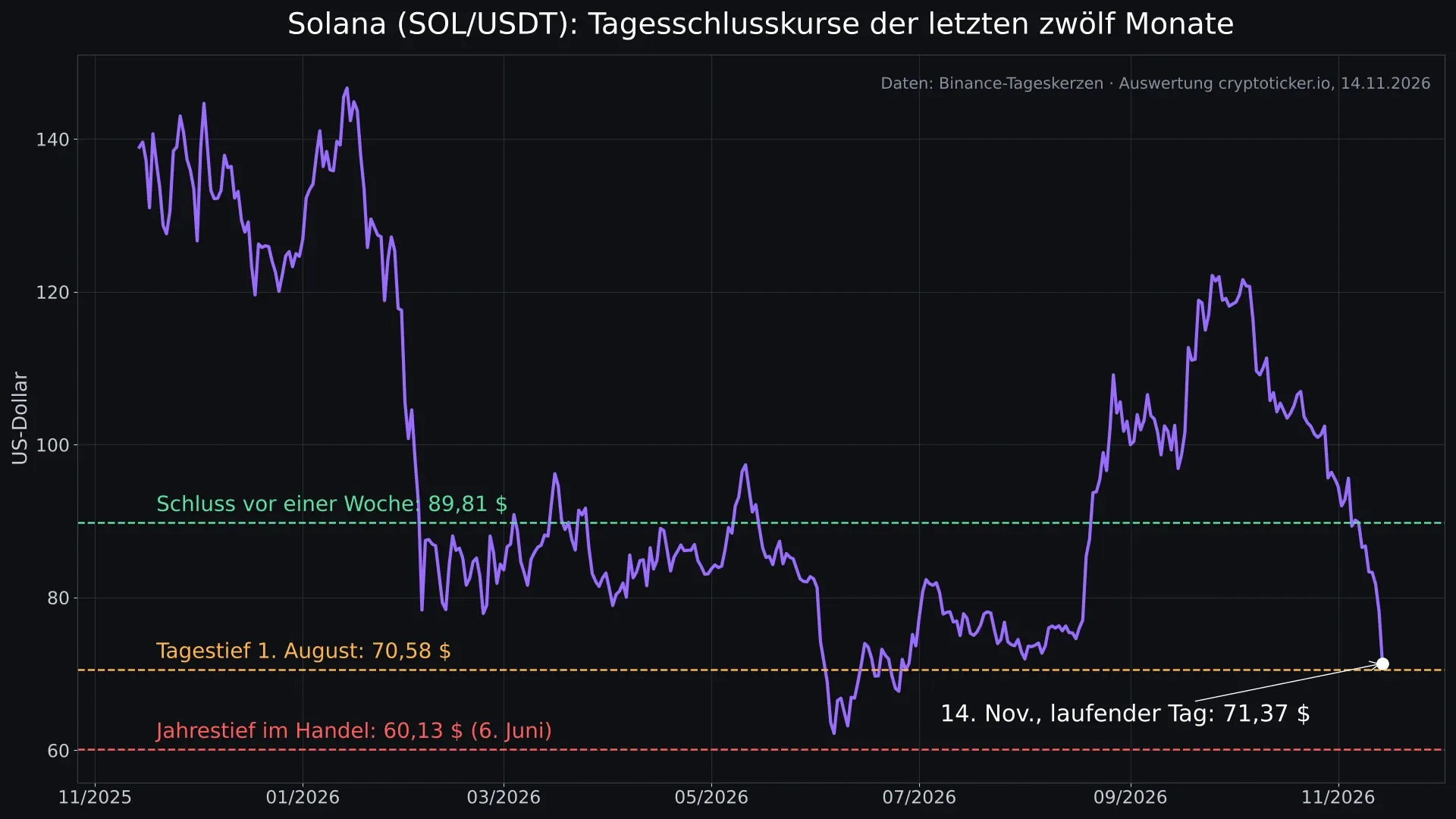
Solana chart over twelve months: the $70.58 and $60.13 levels
To identify the levels, cryptoticker.io analysed 1,000 daily candles of the SOL/USDT pair on Binance from February 19, 2024, to November 14, 2026. cryptoticker.io compiled this analysis itself on November 14, 2026.
The result: on Saturday Solana fell as low as $71.13 in trading. The last time the price stood lower was on August 1, with a daily low of $70.58. That is the first level to the downside. Below it lies the late-June zone, when daily closes ranged between $67.72 and $71.90. The 2026 low is $60.13, reached on June 6.
The way up is long. A week ago, on November 7, Solana still closed at $89.81. The autumn high, a daily close of $122.15 on September 25, is around 42 percent above the current price. SOL opened the year at $124.64; since then it is down almost 43 percent. According to CoinGecko, Solana is around 76 percent below its record high of $293.31 from January 2025.
Chart levels are reference points where many purchases or sales took place in the past. Whether they hold is decided by the market. The price targets analysts give for SOL and their reasoning are collected in our Solana price prediction.
 Track your Solana losses with a crypto tax tool
Buying Solana in the EU: MiCA licence and euro trading
If you are considering buying after the slide, check the provider first. The EU's MiCA regulation (Markets in Crypto-Assets) sets out which companies may sell and hold cryptocurrencies for customers in the EU. Such a provider is called a crypto-asset service provider, or CASP. The regulation's transitional periods expired across the EU in July 2026, so a provider serving EU customers needs a licence. Whether a provider is licensed is shown in the public register of the EU securities regulator ESMA. You will find a selection of licensed providers in our comparison of regulated crypto exchanges.
Trading in euros also matters. Buying Solana directly against the euro saves you the detour via a stablecoin and the double fees. In sharp price moves, look at the gap between the buy and sell price, the so-called spread. In hectic phases it can be considerably wider in simple app purchases than in an exchange's order book.
If you do not want to buy everything at once, you can spread your entry over several dates. That reduces the risk of investing the whole amount at an unfavourable price, but it does not guarantee a profit.
Losses realised before December 31 can matter for your tax return, depending on where you live; a tool that records every purchase and sale with date, amount and price is covered in our comparison of crypto tax software.
Solana staking in a sell-off: the reward does not offset the price loss
With staking, SOL holders commit their coins to secure the network and receive new SOL as a reward. That reward is paid in SOL, not in euros. If the price falls 20 percent in a week, as it just did for Solana, the loss is many times greater than what staking earns over a whole year.
If you stake, you should also know the unstaking period: on Solana, deactivating a stake usually takes until the end of the current epoch, a network accounting period that can last several days. In a fast market that is a noticeable wait. Our overview of staking platforms compares providers and terms.
Leverage on SOL: how the liquidation price is set
If you trade Solana with leverage, you put up only part of the position's value as collateral. With 10x leverage, a price drop of around 10 percent is enough in theory to wipe out the collateral; with 5x leverage it takes around 20 percent. In practice the liquidation price sits somewhat closer to the entry price because of fees and the required maintenance margin. A day like November 14, with an 11 percent drop, is therefore enough to close many leveraged long positions.
On top of that comes the funding rate on perpetual futures, known as perpetuals. This rate is a regular balancing payment between the long and short sides that keeps the futures price close to the spot price. If you keep a position open for a long time, you pay or receive it on an ongoing basis. How platforms for such contracts compare on fees, leverage limits and collateral is shown in our comparison of the best perp DEXs.
Solana at $71: below $70.58 the June level comes into view
With the slide below $72, Solana has given up most of its autumn recovery. No reason specific to Solana is apparent; the pressure comes from liquidations and a mood of extreme fear across the market. The next level is the August 1 daily low of $70.58, followed by the late-June zone. The Breakpoint conference from November 15 is the next date on which fresh news from the Solana ecosystem is expected.
- Check the provider: buy SOL only from a provider with a MiCA licence and euro trading; a selection is in our comparison of regulated crypto exchanges.
- Limit leverage: work out the liquidation price before every leveraged trade and compare fees and collateral at the perp DEXs.
- Put staking in context: allow for the unstaking period when you deactivate a stake and compare the terms of staking providers.
(As of November 14, 2026. This article is not investment advice. Prices and fee structures change; check the terms with the provider before you buy.)
Frequently asked questions about Solana
Partner links: some links on this page are partner links. If you become a customer through one of them, we may earn a commission at no extra cost to you. Selection, ratings and ranking are decided independently by our editorial team. Ethics and Independence · Ownership and Funding
Transparency note: This article was produced with the assistance of artificial intelligence and reviewed by our editorial team before publication. All figures and claims were checked against the primary sources linked in the text. The feature image was generated with AI.
For later? Save this article and find it again in your profile.
More on Solana: All Solana news at a glance
Related articles
- Solana price prediction: 15 percent below the 200-day line, can Breakpoint help?
- Bitcoin on Friday the 13th: weekend panic builds as traders eye $60,000
- Why Is Crypto Crashing? The 3 Reasons Behind This Brutal Sell-Off
- Crypto news, November 13: bitcoin down 6%, over $1.3 billion liquidated
- Solana price at a three-month low: will the $75 level hold?
Which topics should we dive deeper into?
Select what genuinely interests you. Your picks feed directly into our editorial planning.
Crypto news that's actually worth your time.
Weekly. 60 seconds. Carefully curated by our editors: no hype, no promo flood, no spam.

November 13, 2026 5:15 AM

Bitcoin price falls below $70,000 as $1.3 billion in leveraged bets are wiped out
Bitcoin dropped below $70,000 overnight into Friday for the first time since August, and more than $1.3 billion in leveraged positions were liquidated within 24 hours. The price levels, the triggers and what investors should consider on leverage, custody and record-keeping.
November 10, 2026 11:36 PM

Crypto crash live: Solana and Aave lead the sell-off as markets price a December Fed hike
Hot US inflation data turned a slow slide into a flush: Bitcoin touched its lowest level since August, Solana has lost a quarter of its value in 30 days and Aave fell almost three times as hard as Bitcoin. The live timeline, the reasons and the levels that matter now.
November 7, 2026 9:46 AM

Crypto Crash: Why Bitcoin, Ethereum, XRP and Solana Fell This Week and What Comes Next
Bitcoin lost its post-election gains, ETH hit a 10-week low and XRP led the losses. The four drivers behind this week's crypto crash and the levels to watch.

November 5, 2026 9:12 PM

Solana Price Slides to $89, First Test of the 200-Day Line Since August
The Solana price fell 6.4 percent to around $89 on November 5 and touched its 200-day line for the first time since August. A chip sell-off on the Nasdaq set it off, amplified by more than $1 billion in liquidations and ongoing ETF outflows.
November 5, 2026 5:13 PM

Bitcoin falls below $77,000 as a Nasdaq chip sell-off sets off a liquidation wave
Bitcoin (BTC) dropped from $78,767 to $75,986 within an hour on November 5, and Ether lost more than 6 percent. A sell-off in chip stocks on the Nasdaq set it off, and forced liquidations of more than $560 million deepened the slide.
November 4, 2026 3:15 PM

Solana price prediction: SOL tests the 200-day line at $88.88 ahead of Breakpoint London
Analysis: eleven days before the Breakpoint conference in London, Solana fell to $89.77, almost touching its 200-day moving average. Our review of the last three conferences shows how strongly the price moved before and after.
November 2, 2026 7:33 PM

US Midterms Tomorrow: 5 Scenarios for Bitcoin, XRP and Solana
America votes on Tuesday and crypto has over 170 million dollars riding on it. Five election outcomes and what each one would mean for Bitcoin (BTC), XRP and Solana (SOL) prices.

October 31, 2026 12:48 AM

Crypto Weekly Recap: Binance Hack, Wall Street Crash and Gold Under Pressure
The largest crypto theft in history, Wall Street's worst day since June and a Fed that turns hawkish: week 44 of 2026 in numbers, the five events that mattered, winners and losers among the top coins and what crypto investors should watch next week.
October 29, 2026 9:55 PM

Solana Crash: SOL Falls Below $100. Is $80 Next?
Solana lost 3.3% within an hour after the Binance hack and slid to $95.64, although not a single SOL was stolen. Why Solana falls anyway, why it was already weak before and which price levels matter now.
October 29, 2026 9:49 PM
Is This the End? How Low Bitcoin Could Fall After the Binance Hack
About $2.8 billion left a Binance hot wallet and Bitcoin slid below $79,000. Whether this turns into a real crash depends on one question. Three scenarios, the key price levels for Bitcoin, Ethereum and Solana and what to do now.
October 29, 2026 9:40 PM

Crypto Crash After Binance Hack: $628 Million Liquidated in One Hour
At 20:24 UTC a Binance hot wallet was drained of about $2.8 billion. Within an hour Bitcoin fell below $79,000 and BNB lost 6.3%. Here is the minute-by-minute timeline, the prices of all major coins and what could come next as Asia wakes up.
October 27, 2026 5:23 PM

China AI Bubble Bursts: $480 Billion Gone, So Why Is Bitcoin Not Crashing?
China’s AI stock bubble has burst, erasing $480 billion as the STAR50 drops 40%. Here is why it happened and what it means for Bitcoin and crypto.
October 25, 2026 10:51 AM
Crypto Crash: Why the Top Cryptos Lost Up to 4% in One Week
Crypto crash week: the largest cryptos lost up to 4% in seven days. We break down why crypto prices are falling and what to watch next.
October 24, 2026 10:16 AM

Solana price prediction: $30.3 million out of the SOL ETFs in five trading days: what to watch now
Analysis: in the five trading days to October 22, the US funds on Solana gave up a net $30.3 million, more than in the week that had counted as a record. The price stands at $101.83 on Saturday morning, 1.5 percent above the monthly low.
October 23, 2026 1:18 PM
JPMorgan Brings Tokenized Funds to Solana: Why Solana Price Still Fell 3%
JPMorgan just launched two tokenized money market funds on Solana. Big news for SOL, yet Solana price slipped 3%. Here is what the market is really saying.
October 20, 2026 10:16 PM
Solana: a Nasdaq company sells all 2 million SOL, and $107.51 is the level that decides
SkyAI has sold its entire holding of just over 2 million SOL and is offering shareholders $201.3 million in a buyback. The exit price of $107.51 is the level the Solana price now has to measure itself against.
October 11, 2026 10:20 AM
Crypto Price Today: Bitcoin Slips Under $85,000 as Markets Brace for a Big Week
Bitcoin trades near $83,000 after a red week for crypto. Here is the crypto price today, who is bleeding, who is pumping, and what to watch next.
October 8, 2026 5:06 PM
Crypto Crash Reason: Why Bitcoin Fell Below $81,000 and Altcoins Bled Even Harder
Bitcoin slid under $81,000 and Ethereum lost 9% in a week. Here is every crypto crash reason behind the October 2026 selloff explained.
October 8, 2026 4:38 AM

Crypto Market Slides: Bitcoin Loses 4.2 Percent and $651 Million of Long Bets Are Liquidated
Bitcoin has lost 4.2 percent since Tuesday afternoon, and ether and XRP more still. Three reasons can be documented: outflows from the US ETFs, $651 million of forcibly closed long bets and Fed minutes holding out the prospect of another rate rise. A crash it is not, and what to check before buying more is set out here.
October 7, 2026 10:15 PM

6.3 Percent Down, the 20-Cent Level Tested: What You Can Do Now About Stellar (XLM)
Stellar falls 6.27 percent to $0.20048 on October 7, 2026, and has traded below the round 20-cent mark for the first time at the day's low. A market-wide pullback with a liquidation wave in the futures market carries the decline; at Stellar itself there is no trigger of its own.
September 29, 2026 10:38 AM
Bitcoin Falls Toward $83,000 as Trump Rejects Iran Ceasefire Deal
Bitcoin slipped toward $83,000 after Trump rejected Iran's Hormuz proposal, sending oil above $100 and wiping out $478 million in crypto liquidations.
September 27, 2026 7:14 PM

Solana Price at $121.93: What to Check on Staking Yield, Unstaking and Tax
SOL stands at $121.93 on September 27 at 16:42 UTC, after a 12.7 percent gain over seven days. More important than the weekly move is a calculation almost nobody makes: of the staking yield usually quoted, roughly a quarter is left in real terms, and the epoch decides when you can reach your coins again.
September 27, 2026 11:28 AM

Crypto Prices Today: Bitcoin Holds $84,000 After Its Best Week Since January
Bitcoin at $84,600, ETH at $2,700, NEAR up 56 percent on the week. Crypto prices today, what drove the rally, and what could move the market next.
September 26, 2026 10:12 PM

Solana Price Above $120: What to Check on Staking Yield, Holding Period and Spread
Solana is trading at $121.00 on September 26, 2026, 8.6 percent above its level a week earlier. What a self-measured staking yield of 5.27 percent is worth, how the one-year holding period applies to staked SOL, and what an order in euros really costs.
September 23, 2026 7:22 PM

Solana Price Holds $114: What Holders Check Five Days Before Alpenglow
SOL stands at $114.55 on September 23, after a 17.7 percent gain in seven days and a 2.2 percent loss on the day. Two deadlines matter more than the daily move: Alpenglow opens on September 28, and every purchase made this week starts a holding period of its own.
More from CryptoTicker