
Crypto Crash Reason: Why Bitcoin Fell Below $81,000 and Altcoins Bled Even Harder
Bitcoin slid under $81,000 and Ethereum lost 9% in a week. Here is every crypto crash reason behind the October 2026 selloff explained.





Which topics should we dive deeper into?
Select what genuinely interests you. Your picks feed directly into our editorial planning.
Crypto news that's actually worth your time.
Weekly. 60 seconds. Carefully curated by our editors: no hype, no promo flood, no spam.
Crypto Crash Reason Hunt: What Actually Happened Today?
The crypto market is deep in the red on Thursday, 8 October 2026, and almost nothing in the top 13 escaped. $Bitcoin is trading at $80,986, down 2.9% in 24 hours, 3.7% over seven days and now 7.5% below where it started the year. Total Bitcoin market cap has slipped to $1.62 trillion.
Altcoins took the harder hit. $Ethereum is at $2,432 after a 5.3% daily drop and a brutal 9.3% weekly slide, pushing its year-to-date loss to 18%. XRP is down 6.2% on the day and 27% for the year. Solana sits at $108, Dogecoin at $0.083, and Chainlink lost 7.9% in a single session. Even Zcash, the year's breakout privacy coin, gave back 15.6% in 24 hours and 18.6% on the week, though it remains up 119% since January.
The only green on the board is the stablecoin pair, with USDT and USDC flat as expected. That pattern, with Bitcoin falling less than everything around it, is the classic signature of a risk-off rotation rather than a Bitcoin-specific problem. So what is the crypto crash reason this time? There is not one answer but three, and they stack on top of each other. You can track all of these prices live on the CryptoTicker crypto prices page.
Crypto Crash Reason #1: Did the Fed Just Kill the Rate Cut Dream?
The biggest crypto crash reason sits in Washington, not on a trading screen. The Federal Reserve raised its target range by 25 basis points to 3.75% to 4.00% on 16 September, and the minutes of that meeting landed on Wednesday, 7 October. The message was not what risk assets wanted to hear: most participants expect another hike to be appropriate before year-end, depending on incoming data.
That single line reframes the whole year. Markets had spent months treating the September move as a one-off. The minutes suggest it could be the start of a tightening cycle instead. HashKey Group researcher Tim Sun warned that a second hike in October would make investors read September as the opening act rather than a blip.
Higher rates hit crypto through two channels. First, Treasury yields rise, and a risk-free 4%+ return makes a volatile, zero-yield asset like Bitcoin less attractive by comparison. Second, the dollar strengthens, and Bitcoin has historically moved inversely to the greenback. Add elevated oil prices driven by renewed US and Iran tensions, which feed inflation expectations and reinforce the case for tighter policy, and you get the macro cocktail that pushed every asset on your screen into the red.
The next checkpoints are already circled: the US CPI print on 14 October and the FOMC meeting on 27 and 28 October. Until those pass, the market is trading the fear of a hike as much as the hike itself.

Crypto Crash Reason #2: How Did Half a Billion in Leverage Vanish in 20 Minutes?
The macro news explains the direction. Leverage explains the speed. Bitcoin spent the first week of October trapped between $83,000 and $87,000, failing at the top of that range again and again. Each rejection stacked more leveraged long positions underneath the market, and traders kept betting on an Uptober breakout that never came.
On Friday, 3 October, a rejection at $87,000 wiped out $433 million in positions. Then early on Wednesday, 7 October, Bitcoin dropped roughly $1,765 in about 20 minutes, from $85,341 to $83,790, taking more than $400 million in longs with it in a single hour. Over the full 24 hours, CoinGlass counted around $546 million in liquidations across the market, with 88% of them longs and more than 100,000 traders wiped out.
This is what analysts call a leverage flush. LVRG Research's Dan Khus described it as crowded long bets being mechanically forced out rather than a genuine change in trend. The important detail from Bitfinex is that open interest stayed stable even as longs were liquidated, which means fresh short positions were opening at the same pace. The market did not just deleverage. It flipped net short.
The timing adds a psychological layer. Friday, 10 October, marks one year since the largest liquidation day in crypto history, and traders remember it. Liquidation heatmaps had already flagged a dense cluster of leveraged longs near $82,600 before Wednesday's drop. Thursday's slide to $80,986 ran straight through it, which is exactly why the second leg down was so sharp.
Crypto Crash Reason #3: Why Are ETFs and Uncle Sam Both Selling?
The third crypto crash reason is about who is on the other side of the trade. For most of 2026, spot Bitcoin ETFs have been the structural buyer that absorbed every dip. In late September they were still pulling in nearly $1 billion in a single day. That bid has now reversed.
US spot Bitcoin ETFs recorded roughly $487 million in net outflows on 7 October, their heaviest single-day withdrawal in weeks, according to SoSoValue data. ARK 21Shares and Fidelity led the redemptions, while BlackRock's IBIT was the only major fund still attracting money. Ethereum ETFs are bleeding too, with about $161 million leaving on the same day. When the institutional buyer steps back at the exact moment leveraged longs are being liquidated, there is nobody left to catch the falling knife.
On top of that came an unwelcome on-chain signal. Arkham data shows wallets linked to the US government moved more than 11,000 BTC, worth roughly $900 million at current prices, to Coinbase Prime over two days. Transfers to an exchange do not automatically mean a sale, but the market has learned to treat government wallet activity as a selling risk, and it reacted accordingly.
None of these three reasons would have produced a crash on its own. A hawkish Fed with no leverage in the system is a slow grind. A leverage flush with ETFs still buying is a 20-minute wick that recovers. It is the combination that turned a pullback into Thursday's broad-based selloff.

Crypto Crash Reason for Altcoins: Why Did Ethereum and XRP Fall Twice as Hard?
Look at the 24-hour column on your market table and a pattern jumps out. Bitcoin lost 2.9%. Ethereum lost 5.3%, XRP 6.2%, Solana 7.0%, Dogecoin 7.0%, Chainlink 7.9%. Almost every major altcoin fell roughly twice as far as Bitcoin, and the gap is even wider on the weekly and year-to-date numbers.
There are three mechanical reasons for this. Altcoins have thinner order books, so the same dollar amount of selling moves the price further. Altcoin perpetual markets carry proportionally more retail leverage, so liquidation cascades hit harder. And in a risk-off rotation, capital does not just leave crypto; it also consolidates within crypto, flowing from smaller tokens into Bitcoin and stablecoins first. Bitcoin dominance rises during a crash precisely because it is treated as the least risky crypto asset.
Ethereum carries an extra burden. ETH is now down 18% on the year while Bitcoin is down only 7.5%, and the ETH ETF outflows on Wednesday were proportionally larger than Bitcoin's. XRP, down 27% year-to-date, has been losing the $1.50 battle for weeks and failed there again before this drop. For anyone looking for the altcoin-specific crypto crash reason, it is simple: altcoins never built the institutional floor that Bitcoin did, so when that floor cracks, they fall through it faster. Track the dominance shift on the CryptoTicker charts page.
Which Coins Are Beating the Crypto Crash in 2026?
Not everything on the board is a loser. Four names in the top 13 are still green on the year, and they tell you where the market's conviction actually lives.
$Hyperliquid is the standout at +228% year-to-date, even after a 5.9% daily drop. HYPE is the native token of the dominant on-chain perpetuals exchange, and ironically a leverage flush is good for its business: more liquidations mean more fees.
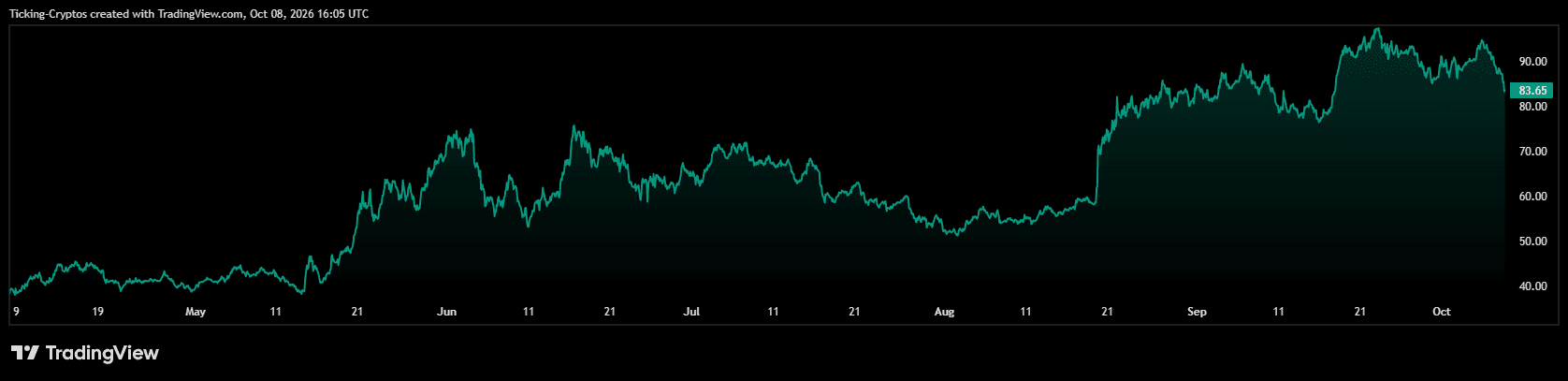
$Zcash is up 119% in 2026 on the privacy coin revival, though it is also the most volatile name here with an 18.6% weekly drop, a reminder that what rallies hardest also corrects hardest.
$Monero, the other privacy heavyweight, is up 22% and fell just 2.2% on the week, the smallest decline of any non-stablecoin in the table.
$TRON rounds out the list at +17% and down only 0.7% on the day. TRX benefits from stablecoin settlement volume, which does not care whether the market is up or down, and that makes it behave like a defensive asset in a crash.
The common thread is clear. The coins that held up are the ones with real, measurable revenue or a strong narrative independent of Bitcoin's price. The coins that fell hardest are the ones whose main story was "beta to Bitcoin." That is worth remembering the next time someone asks what the crypto crash reason is for their particular bag.
Related articles
- Why Is Crypto Crashing Today: US Strikes on Iran and a Collapsing Ceasefire
- Is the Crypto Crash Manipulated? Bitcoin and ETH Shed Billions
- Crypto Crash Reason: Why Are Crypto Prices Down Today?
- Crypto Market Slides: Bitcoin Loses 4.2 Percent and $651 Million of Long Bets Are Liquidated
- Crypto Price Today: Why is the Crypto Market Crashing? BTC, ETH, SOL and XRP Price Update
Which topics should we dive deeper into?
Select what genuinely interests you. Your picks feed directly into our editorial planning.
Crypto news that's actually worth your time.
Weekly. 60 seconds. Carefully curated by our editors: no hype, no promo flood, no spam.

May 23, 2026 5:28 PM

Crypto Market Crash Deepens as Bitcoin Breaks Below $75K
Crypto market crash deepens as Bitcoin falls below $75K, Ethereum nears $2K, and altcoins slide amid liquidations and macro fears.
May 8, 2026 9:32 AM

Crypto Crash Today: Why Is Bitcoin Crashing below 80K?
Bitcoin price has slipped below $80,000 as geopolitical tensions and profit-taking trigger a crypto crash today. Here are the market dynamics behind the BTC drop.
May 16, 2026 10:50 AM

Crypto Crash: Bitcoin Slips to 78k as Market Reverses Friday Pump
Crypto prices face a sharp downturn after a brief Friday pump. Bitcoin hovers at 78k, threatening a deeper crash if macro support breaks.
March 26, 2026 1:23 PM

Crypto Ignores Bullish News as War Risk Takes Over — Why Bitcoin and Ethereum Are Falling Anyway
Bitcoin and Ethereum fall despite bullish crypto news as war risks, oil spikes, and macro pressure dominate market sentiment.
June 25, 2024 12:18 PM

After Bitcoin Crash, Will Altcoins Gains Reach 500%?
In the latest Bitcoin News today, and mainly after the Bitcoin Crash, crypto analysts predict a major shift towards altcoins with market corrections near the end and BTC dominance drop. Will the altcoins gain reach 500%?
April 7, 2025 11:06 AM

Why are Cryptos Crashing Today?
The cryptocurrency market experienced a significant downturn with Bitcoin falling to $76,300 and Ethereum plunging to $1,490. Here's why cryptos are crashing.
July 27, 2024 2:34 PM

Why Is The Crypto Market Up TODAY?
With the Bitcoin 2024 Conference taking place now in Nashville, the crypto market is showing bullish signals, intriguing traders around the future of Bitcoin and Altcoins.
July 8, 2024 7:51 AM

Crypto Market Crash News As BTC Price Crash Back To 56K
With the crypto market crash, and Bitcoin price drop to below 56k with recent dormant BTC whales activity, what comes next: a correction or further crash soon?
June 4, 2026 9:52 AM

Why is Crypto Down Today? Market Liquidation Erases Billions
The cryptocurrency market is facing severe downward pressure today. Bitcoin fell over 5% while altcoins like Solana and Ethereum incurred heavier losses.
September 15, 2026 4:24 PM

Why Is Crypto Crashing Today? Bitcoin Slides to $76,000 as the CLARITY Act Vote Wobbles
Bitcoin slid to $76,000 and the entire top 20 turned red as CLARITY Act odds collapsed before today's Senate vote. Here is what is really driving it.
January 30, 2026 10:12 AM

Crypto Crash Reason: Why is Bitcoin Crashing Today and Key Supports
The crypto market is facing a sharp correction. What are the crypto crash reasons today, and what are Bitcoin support levels, and how are macro factors hitting prices?

May 13, 2026 6:52 PM

Why Did Bitcoin Price Crash below 80k Today?
The crypto market is in turmoil as Bitcoin and Ethereum lose critical support levels. What triggered the sudden price collapse?
June 5, 2024 5:03 PM

Crypto Market Up: Bitcoin Breaches $71K, Altcoins Follow Suit, Eyes on New Highs
Cryptocurrencies are experiencing a surge, with Bitcoin leading the charge by surpassing $71,000. This bullish trend extends to altcoins, igniting optimism across the market. Will Bitcoin reach new highs?
July 25, 2024 12:35 PM

Ethereum Price Analysis: Why is Ethereum Price Down?
Here is the impact of the recent Ethereum ETF launch on the crypto market, leading to a significant sell-off and a $300 million liquidation event. Not what was expected?
May 28, 2026 1:02 PM

Trump Attempts to Salvage Crypto with Bullish Promises, But Crypto Crashes Hard Anyway
Donald Trump made a major push to salvage crypto market sentiment by promising he will "never let crypto down," but Bitcoin and major altcoins crashed anyway.
June 24, 2026 6:50 PM

Crypto Crash Reason: Why Bitcoin Just Smashed Below $60,000
Bitcoin has crashed below $60,000 and the entire market is bleeding red. Here's the real reason behind the crypto crash — and what's dragging everything down.
March 3, 2026 5:40 PM

US Stock Market Volatility: Will Crypto Prices Crash Next?
US markets face uncertainty as geopolitical tensions rise. Discover if a stock market correction will trigger the next major crypto price crash.
November 5, 2025 1:16 PM

$1 Trillion Wiped: Risk-Off Storm Engulfs Stocks & Crypto
Global markets plunge as tech stocks and crypto crash, wiping over $1 trillion in value amid AI bubble fears and investor risk-off panic.
July 25, 2026 11:27 AM

Crypto Price Today: Market Slides Again as Bitcoin Fails at $67,000
Bitcoin slipped back under $64,000 after tapping $66,990. Oil, ETF outflows and Fed nerves are dragging the whole crypto market lower.
June 2, 2026 6:13 PM
Bitcoin Crash to $67,400 as Google and Berkshire Team Up for Massive $80B AI Fund
Bitcoin fell 5.6% to $67,400 as a massive $80B AI capital raise backed by Berkshire Hathaway triggered an institutional capital rotation out of crypto.
February 26, 2025 5:36 PM

Crypto News: Will The Crypto Market Crash Further or Recover NEXT?
The crypto market crash has taken its toll on Bitcoin and other major altcoins, with a general market cap decrease of over $0.3T. So, what comes next?
February 24, 2026 7:51 AM
Crypto Crash Reasons: Why Bitcoin Just Plunged Below $63k
Bitcoin has fallen below the $63,000 mark as a massive crypto crash wipes out millions in liquidations. Here is why the crypto market is down today.
February 12, 2026 4:35 PM
Bitcoin Price Crashes Below $66,000 as Liquidations Pass $50M
Bitcoin falls below $66,000 following a massive liquidation cascade and a bearish report from Standard Chartered. Regulatory hurdles further dampen the mood.
September 29, 2026 10:38 AM

Bitcoin Falls Toward $83,000 as Trump Rejects Iran Ceasefire Deal
Bitcoin slipped toward $83,000 after Trump rejected Iran's Hormuz proposal, sending oil above $100 and wiping out $478 million in crypto liquidations.
November 6, 2025 8:00 PM

Why Is the Crypto Market Flat Today? November 6, 2025
Crypto prices remain steady as Bitcoin holds above $101K and Ethereum slips below $3.4K. Whales keep buying ETH while ETF outflows weigh on BTC.


More from CryptoTicker