
How Much Would It Take to Bankrupt Binance? The $6 Billion Hack Explained
Binance lost $6.3 billion in the biggest crypto hack ever. How much would it take to bankrupt the exchange, and what does it mean for the crypto market?





Which topics should we dive deeper into?
Select what genuinely interests you. Your picks feed directly into our editorial planning.
Crypto news that's actually worth your time.
Weekly. 60 seconds. Carefully curated by our editors: no hype, no promo flood, no spam.
Six billion dollars gone in a single afternoon, and Binance says nobody loses a cent. That is the headline from Thursday, October 29, when the world’s largest crypto exchange was drained of roughly $6.3 billion in the biggest hack the industry has ever seen. The obvious question is not whether the money is gone. It is how much it would actually take to bankrupt Binance, and whether this hack came anywhere close.
To answer that, you need three numbers: what was stolen, what Binance can absorb, and what it would take to break the trust that keeps a centralized exchange alive.
How Much Did Binance Lose in the Hack?
Binance puts the total impact at around $6.3 billion, with about $3 billion already frozen on-chain. Deposits and withdrawals were suspended while the exchange works with law enforcement and completes a security overhaul, and withdrawals are expected to resume by Sunday.
The attack did not come through a smart contract or a leaked wallet key. According to Binance’s initial investigation, the attacker compromised the laptop of a DevOps engineer, gained access to a service container and used it to submit unauthorized withdrawal transactions. Binance says it has found no evidence of private key leaks.
The outflows were spread across chains: roughly $3.78 billion on Ethereum, $1.44 billion on Bitcoin, $628 million on Tron, $290 million on the XRP Ledger, $94 million on Solana and about $61 million combined across Arbitrum, Avalanche, Optimism and Base. That is four times the previous record, the $1.5 billion Bybit hack of 2025, and blockchain analysts point at North Korea’s Lazarus Group for both.
The stablecoin issuers cut the damage in half. Tether froze about $971 million and Circle about $823 million, roughly $1.8 billion combined, and together with other partners the frozen total now sits around $3 billion.
Will Binance Cover the Losses?
Yes, and it said so within hours. Binance has committed to covering all losses from its SAFU fund and the company’s own funds, and will publish an updated Proof of Reserves once remediation is complete.
Here is what that means in practice. $6.3 billion drained, about $3 billion frozen, leaves a net hole of roughly $3.3 billion before further recovery. SAFU, the Secure Asset Fund for Users set up in 2018 to protect customers against security breaches, has historically held about $1 billion. Binance converted it entirely into Bitcoin in early 2026 and committed to topping it back up if it ever fell below $800 million. So SAFU covers about a third of the net loss. The remaining $2 billion or so comes straight out of Binance’s own treasury.
That is the first answer to the question: $6.3 billion was not enough to bankrupt Binance, because half of it never left the blockchain and the rest fits inside the company’s insurance fund plus its own balance sheet.
How Big Is Binance?
Big enough that this hurts without being fatal. Binance held roughly $144 billion in assets on its platform before the hack, and its year-end 2025 proof of reserves showed around $163 billion in user assets backed across 45 tokens. The hack amounts to roughly 4 percent of what was sitting on the exchange.
One distinction matters for the bankruptcy question. Those $144 billion are customer assets, not Binance’s money. Binance is a private company and does not publish a balance sheet. What is known is that it has run the highest trading volumes in the industry for years and has collected fees on trillions of dollars of volume, which is why a $2 billion cheque from the treasury surprises nobody.
It also has a track record. In 2019, SAFU covered a breach of about 7,000 BTC without touching user balances. In 2022, an attacker minted two million BNB worth about $570 million, though Binance’s intervention cut the actual loss to roughly $115 million. Binance has absorbed hacks before. It has just never absorbed one this big.

So How Much Would It Take to Bankrupt Binance?
A hack does not bankrupt an exchange. Insolvency does. An exchange dies when it owes customers more than it holds and cannot close the gap, or when customers believe that is the case and run for the exit before anyone can check. So the real number is not “how much can be stolen” but “how much can Binance backfill before customer balances stop being fully backed, and before people stop believing they are”.
Think of it as three lines, in rising order of danger:
- The SAFU line, around $1 billion. Anything below this is covered by the insurance fund and barely registers on the company. Every previous Binance hack sat under this line.
- The treasury line, several billion. Between SAFU and its own reserves, Binance can absorb a multi-billion loss, which is exactly what it is doing right now. Where this line ends is the most important unknown in crypto today, and the upcoming proof of reserves is where the market will look for it.
- The run line. The fatal scenario is a hack too large to backfill, followed by users rushing to withdraw. That is the FTX playbook: not the loss itself, but the hole plus the panic. With roughly $144 billion in custody, a theft in the tens of billions with little recovered is the kind of event no exchange treasury plausibly absorbs. A $6 billion hit with half of it frozen is nowhere near that.
The honest answer: it would take a hack several times larger than this one, with no stablecoin freezes and no recovery, to put Binance’s solvency in question on paper. What could get there much faster is a collapse in trust. Binance is very likely too big to be killed by this theft. It is not too big to be killed by a bank run.

What Does the Binance Hack Mean for the Crypto Market?
The first repercussion was immediate. $Bitcoin fell below $80,000 within hours, more than $1 billion in leveraged positions were liquidated in a day, and BNB dropped nearly 10 percent before recovering part of the move. Live prices are on our crypto prices page, and market-wide liquidation data on the charts page.
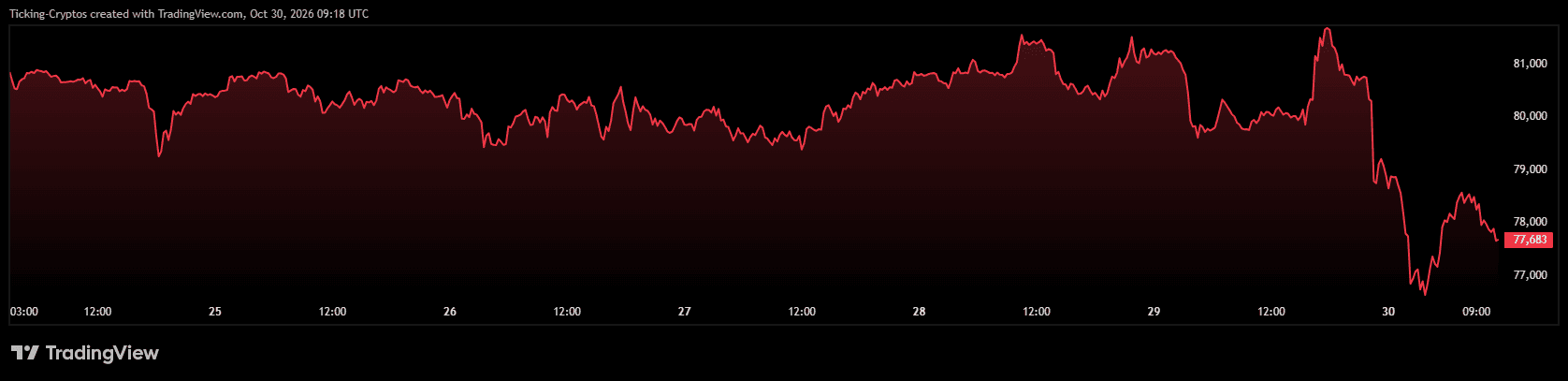
The second is a flight from exchanges. Institutional investors began pulling funds off trading platforms almost immediately. When the biggest custodian in the industry is breached through a single laptop, every allocator revisits counterparty risk, and self-custody and regulated custodians win by default.
The third is liquidity. Binance is the deepest pool in crypto, and with its withdrawals paused, spreads widen and market makers pull back. The market will not find a new base until the frozen assets are released and the full technical picture is out. A bigger hack, or a slower recovery, would have turned a correction into a liquidity crisis.
The fourth is regulatory. Regulators in the EU under MiCA, in the US and across Asia now hold the strongest argument they have ever had for mandatory security audits, segregated custody and real-time reserve attestations. Expect the pressure on centralized exchanges to rise sharply, and expect Binance to be the case study.
And a fifth, less comfortable one. The damage was halved because Tether and Circle could freeze $1.8 billion of stablecoins at the push of a button. That saved Binance a fortune. It also reminded everyone how centralized the plumbing of crypto has become.
Related articles
- Is This the End? How Low Bitcoin Could Fall After the Binance Hack
- Bitcoin Price After Binance Hack: Only 2% Down. What Comes Next?
- Crypto Crash After Binance Hack: $628 Million Liquidated in One Hour
- Crypto Crash Today: Why Is Bitcoin Stuck Below $82,000?
- Why Is Crypto Crashing Today: US Strikes on Iran and a Collapsing Ceasefire
Which topics should we dive deeper into?
Select what genuinely interests you. Your picks feed directly into our editorial planning.
Crypto news that's actually worth your time.
Weekly. 60 seconds. Carefully curated by our editors: no hype, no promo flood, no spam.

October 25, 2026 10:51 AM

Crypto Crash: Why the Top Cryptos Lost Up to 4% in One Week
Crypto crash week: the largest cryptos lost up to 4% in seven days. We break down why crypto prices are falling and what to watch next.
May 23, 2026 5:28 PM

Crypto Market Crash Deepens as Bitcoin Breaks Below $75K
Crypto market crash deepens as Bitcoin falls below $75K, Ethereum nears $2K, and altcoins slide amid liquidations and macro fears.
May 8, 2026 9:32 AM

Crypto Crash Today: Why Is Bitcoin Crashing below 80K?
Bitcoin price has slipped below $80,000 as geopolitical tensions and profit-taking trigger a crypto crash today. Here are the market dynamics behind the BTC drop.
July 27, 2024 2:34 PM

Why Is The Crypto Market Up TODAY?
With the Bitcoin 2024 Conference taking place now in Nashville, the crypto market is showing bullish signals, intriguing traders around the future of Bitcoin and Altcoins.
June 24, 2024 8:16 PM

Bitcoin News Today: Bitcoin CRASH OVER or MORE Down To Go?
Bitcoin Price Crash below 60k, and the crypto market follows. Why this decline and how low can it go?

August 10, 2026 6:52 PM

Why Is Crypto Down Today? Iran Shuts the Door on US Talks Until 2029
Crypto gave back its morning gains after Iran ruled out talks with Washington until 2029. Bitcoin lost $65,000, oil jumped 5% and altcoins bled again.
October 8, 2026 5:06 PM

Crypto Crash Reason: Why Bitcoin Fell Below $81,000 and Altcoins Bled Even Harder
Bitcoin slid under $81,000 and Ethereum lost 9% in a week. Here is every crypto crash reason behind the October 2026 selloff explained.
June 2, 2026 6:13 PM
Bitcoin Crash to $67,400 as Google and Berkshire Team Up for Massive $80B AI Fund
Bitcoin fell 5.6% to $67,400 as a massive $80B AI capital raise backed by Berkshire Hathaway triggered an institutional capital rotation out of crypto.
February 26, 2025 5:36 PM

Crypto News: Will The Crypto Market Crash Further or Recover NEXT?
The crypto market crash has taken its toll on Bitcoin and other major altcoins, with a general market cap decrease of over $0.3T. So, what comes next?
September 29, 2026 10:38 AM

Bitcoin Falls Toward $83,000 as Trump Rejects Iran Ceasefire Deal
Bitcoin slipped toward $83,000 after Trump rejected Iran's Hormuz proposal, sending oil above $100 and wiping out $478 million in crypto liquidations.
February 25, 2025 12:38 AM

Why Are Cryptos Crashing? Reasons You Might NOT Know
The crypto market is crashing hard! Bitcoin nears a critical level, and altcoins are plummeting. Here are the hidden reasons behind the crash.
June 3, 2026 11:05 AM

Crypto Price Today: Why is the Crypto Market Crashing? BTC, ETH, SOL and XRP Price Update
Total crypto market cap drops below $2.5 trillion as Bitcoin dips under $70,000. Discover the major macro and institutional reasons driving crypto down today.
March 26, 2026 1:23 PM
Crypto Ignores Bullish News as War Risk Takes Over — Why Bitcoin and Ethereum Are Falling Anyway
Bitcoin and Ethereum fall despite bullish crypto news as war risks, oil spikes, and macro pressure dominate market sentiment.

October 29, 2026 9:59 PM

BNB Crash: Binance Coin Drops 6% After the Hack. Is This Another FTT Moment?
BNB fell 6.3% within 35 minutes after a Binance hot wallet was drained, the worst performer of the top ten cryptocurrencies. Not one BNB was stolen. Why the token falls anyway, how it compares with FTT in 2022 and which price levels matter now.
November 5, 2025 1:16 PM

$1 Trillion Wiped: Risk-Off Storm Engulfs Stocks & Crypto
Global markets plunge as tech stocks and crypto crash, wiping over $1 trillion in value amid AI bubble fears and investor risk-off panic.
June 18, 2026 7:03 PM

Bitcoin Got the Wrong Crash: Oil Fell, But Crypto Took the Hit
Oil crashed after peace headlines, a move that should have helped Bitcoin. Instead, BTC fell below $63K, ETH dropped under $1,700, and crypto longs were wiped out.
October 27, 2026 5:23 PM

China AI Bubble Bursts: $480 Billion Gone, So Why Is Bitcoin Not Crashing?
China’s AI stock bubble has burst, erasing $480 billion as the STAR50 drops 40%. Here is why it happened and what it means for Bitcoin and crypto.
June 4, 2026 9:52 AM

Why is Crypto Down Today? Market Liquidation Erases Billions
The cryptocurrency market is facing severe downward pressure today. Bitcoin fell over 5% while altcoins like Solana and Ethereum incurred heavier losses.
June 16, 2026 1:03 PM

Oil Crashes Below $81 as US–Iran Deal Reopens Hormuz — Bitcoin and Top 10 Cryptos Rally on the Week
Oil crashed nearly 5% on the US–Iran peace deal while Bitcoin and the top 10 cryptos climbed over the past 7 days. Here's the full breakdown.
March 1, 2025 2:14 PM

Bitcoin March 2025 Price Prediction: After the WORST February for BTC Price in 11 years - How Will March Unfold?
February 2025 saw Bitcoin's sharpest decline in over a decade. Explore the factors behind this downturn and the potential for a market rebound.
June 25, 2024 12:18 PM

After Bitcoin Crash, Will Altcoins Gains Reach 500%?
In the latest Bitcoin News today, and mainly after the Bitcoin Crash, crypto analysts predict a major shift towards altcoins with market corrections near the end and BTC dominance drop. Will the altcoins gain reach 500%?
September 15, 2026 4:24 PM

Why Is Crypto Crashing Today? Bitcoin Slides to $76,000 as the CLARITY Act Vote Wobbles
Bitcoin slid to $76,000 and the entire top 20 turned red as CLARITY Act odds collapsed before today's Senate vote. Here is what is really driving it.
April 17, 2026 6:32 PM

Strait of Hormuz Reopens: Bitcoin Hits $78K as Crypto Market Adds $50B in 1 Hour
Bitcoin hits $78K as the Strait of Hormuz reopens, triggering a $50B crypto surge. Is this a real breakout or a short-term relief rally?
January 30, 2026 10:12 AM

Crypto Crash Reason: Why is Bitcoin Crashing Today and Key Supports
The crypto market is facing a sharp correction. What are the crypto crash reasons today, and what are Bitcoin support levels, and how are macro factors hitting prices?
July 28, 2026 11:53 AM

Why Is Crypto Down Today? The Reasons Behind Every Crypto Sell-Off
Why crypto is falling today, updated with every major move: the current trigger, the six forces behind almost every crypto sell-off, a five-minute checklist and a timeline of the 2026 drops.


More from CryptoTicker