
Why Is Crypto Down Today? Iran Shuts the Door on US Talks Until 2029
Crypto gave back its morning gains after Iran ruled out talks with Washington until 2029. Bitcoin lost $65,000, oil jumped 5% and altcoins bled again.





Which topics should we dive deeper into?
Select what genuinely interests you. Your picks feed directly into our editorial planning.
Crypto news that's actually worth your time.
Weekly. 60 seconds. Carefully curated by our editors: no hype, no promo flood, no spam.
The crypto market is red again, and this time the trigger arrived in the middle of what was shaping up to be a decent session. Bitcoin traded above $65,000 this morning on reports that Iran might cut a deal with Oman to reopen the Strait of Hormuz. Hours later that optimism was gone. BTC now changes hands near $63,890, down 1.98% on the day, after Tehran signalled it has no intention of negotiating with the Trump administration at all before 2029.
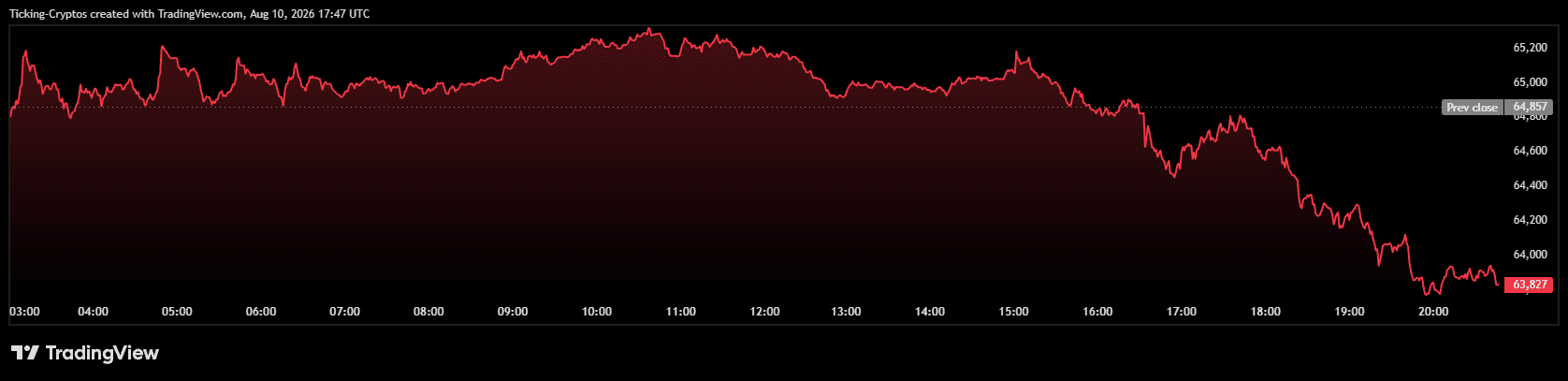
Oil did the rest. WTI crude jumped roughly 5% back to $80 a barrel, and every risk asset on the board felt it.
Iran War News: What exactly did Iran say?
The comments came from Majid Shakeri, an adviser to Iranian Parliament Speaker Mohammad Bagher Ghalibaf. His position, circulated widely through Iranian outlets and then amplified across financial media, is that Tehran should stop pursuing any agreement with Washington and simply outlast the current US administration until its term ends in January 2029.
The framing he used matters for markets. He described the winning strategy as neither war nor a deal, but the deliberate management of a state in between the two, built on denial, ambiguity and patience. He also argued that publicly confirming negotiations with the United States would be a mistake.
Two caveats belong here, because they change how much weight this should carry. First, Shakeri is an adviser, not a head of state or a foreign ministry spokesman, so this is influential commentary rather than a formal declaration of policy. Second, Iran's official conditions for any settlement have not changed and remain maximalist, including compensation claims, the release of frozen assets, the lifting of sanctions and a US military withdrawal from the region.
But markets do not wait for formal confirmation. They price the direction of travel, and the direction of travel this morning went from "Hormuz might reopen" to "Hormuz stays shut for another two and a half years" inside a single session.
Why did the market reverse so fast?
Because the rally that preceded it was built on exactly the story that just got contradicted.
Bitcoin climbed above $65,000 earlier in the day partly on Iran-Oman deal speculation, with global equities near record levels and a softer dollar helping. That is a positioning trade, not a conviction trade. When the underlying premise flipped, the positions unwound immediately.
The oil move is the transmission mechanism that crypto traders sometimes underrate. A closed Strait of Hormuz keeps a permanent risk premium in crude. Higher crude feeds into headline inflation. Higher inflation expectations push out rate cut timing. And a market that has spent this year hoping for easier financial conditions treats delayed cuts as a direct hit to risk assets. Bitcoin sits at the far end of that chain, which is why a Middle East headline moves a decentralised asset that has nothing to do with the Middle East.
How far did the top 15 fall?
The damage was broad but shallow, which tells you this was a repricing rather than a panic.
| Asset | Price | 24h % | 7d % | YTD % | Market cap |
|---|---|---|---|---|---|
| Bitcoin ($BTC) | $63,890.76 | -1.98% | +0.20% | -28.00% | $1.28T |
| Ethereum ($ETH) | $1,873.86 | -2.55% | +0.40% | -37.55% | $225.98B |
| $BNB | $599.38 | -1.50% | +1.29% | -30.55% | $79.81B |
| $XRP | $1.02 | -2.17% | -5.62% | -45.66% | $63.80B |
| Solana ($SOL) | $75.90 | -1.69% | +3.17% | -40.12% | $44.18B |
| TRON ($TRX) | $0.3308 | +0.38% | +0.57% | +15.48% | $31.40B |
| Hyperliquid ($HYPE) | $54.82 | -0.10% | +0.60% | +126.56% | $13.85B |
| Dogecoin ($DOGE) | $0.06970 | -1.32% | -0.82% | -44.97% | $10.83B |
| UNUS SED LEO | $9.65 | -0.77% | -0.99% | +0.90% | $8.88B |
| Zcash ($ZEC) | $496.18 | -3.80% | +1.23% | -5.48% | $8.34B |
| Monero ($XMR) | $390.88 | -0.97% | +7.80% | -6.84% | $7.34B |
| Cardano ($ADA) | $0.1955 | -1.27% | +1.92% | -45.10% | $7.14B |
| Chainlink ($LINK) | $8.25 | -0.87% | +0.19% | -34.38% | $6.17B |
Three things stand out.
- TRON was the only asset in the top 13 to hold a gain on the day, and it remains the only large cap besides Hyperliquid that is positive for the year, up 15.48%.
- Zcash took the heaviest 24-hour hit at 3.80%, but Monero is the strongest performer of the entire group over seven days, up 7.80%. Privacy assets catching a bid during a sanctions-driven geopolitical escalation is not a coincidence, and it is a pattern worth watching if the confrontation extends.
- XRP remains the standout laggard. It is down 5.62% on the week while Solana gained 3.17% and Bitcoin held marginally positive, and its year-to-date loss has now widened to 45.66%.
Why does the Strait of Hormuz matter for Bitcoin?
Roughly a fifth of global oil supply normally moves through that waterway. With it closed, the pricing of energy stops being a supply and demand question and becomes a geopolitical one, and every barrel carries a war premium.
For crypto specifically, the chain runs through inflation and central bank policy. US CPI data lands this week, and it is the single most important scheduled event on the calendar. A crude price that just jumped 5% does not show up in this week's print, but it absolutely shapes how traders read the next few. If the market concludes that energy costs will keep headline inflation sticky into the autumn, the case for near-term rate cuts weakens, and the bid under risk assets weakens with it.
There is also a direct crypto angle to this conflict that gets very little coverage. Washington widened its Iran crypto crackdown earlier this month with sanctions targeting two exchanges, part of an effort to close off digital asset channels being used to move value around the blockade. As the conventional Iranian economy seizes up, that enforcement pressure is likely to increase rather than ease.

What about Iran's currency collapse?
The rial has been in freefall, and it is a genuine part of this story, though the specific numbers circulating on social media should be treated carefully.
Iran operates multiple exchange rates simultaneously, so the official rate, the remittance rate and the open market rate can differ substantially, which is why screenshots claiming a precise all-time low often disagree with each other. What is not in dispute is the trend. The rial traded near 800,000 to the dollar before the June 2025 conflict with Israel and has since collapsed past 1.6 million, with open market quotes in recent sessions running well above that.
For a crypto audience the relevant point is behavioural. When a national currency stops functioning as a store of value, domestic demand for dollars, gold and crypto rises regardless of what the government permits. That is precisely why sanctions enforcement has moved toward exchanges.
Is this only about Iran?
No, and treating it that way would be a mistake.
The CLARITY Act failed to reach a Senate floor vote before the August recess and has been pushed to the autumn, removing the regulatory catalyst a lot of positioning was built around. Strategy, the largest corporate holder of Bitcoin, disclosed the sale of 1,690 BTC while raising $653 million through share issuance, an unusual direction of travel for a company whose entire thesis has been accumulation. And Bitcoin's implied volatility recently hit its lowest level since 2025, with options demand collapsing even as downside protection stayed expensive.
That last detail is the most instructive. A market with compressed volatility and expensive puts is a market where nobody expects a big move but everybody quietly wants insurance. Those conditions make sharp, headline-driven reversals like today's more likely, not less.
What should traders watch this week?
Start with US CPI, which will do more for direction than any Middle East headline unless there is actual military escalation. Then watch whether Bitcoin can reclaim $65,000, the level it lost today and the one it has repeatedly failed to hold since mid-July. Below that, the $61,800 area has acted as support through the summer.
On the geopolitical side, the thing to monitor is not rhetoric but the Strait itself. Any credible movement on an Oman-brokered reopening would reverse today's move quickly, because the market has already demonstrated this morning that it is willing to buy that story. Any confirmation from Tehran at an official level that talks are formally dead would push in the opposite direction.
Transparency note: This article was produced with the assistance of artificial intelligence and reviewed by our editorial team before publication. All figures and claims were checked against the primary sources linked in the text.
Related articles
- Why Is Crypto Crashing Today: US Strikes on Iran and a Collapsing Ceasefire
- Bitcoin Falls Toward $83,000 as Trump Rejects Iran Ceasefire Deal
- Crypto Ignores Bullish News as War Risk Takes Over — Why Bitcoin and Ethereum Are Falling Anyway
- Bitcoin Price Explodes Past $77,000 as Trump Discloses Near-Final Iran Peace Deal
- Strait of Hormuz Reopens: Bitcoin Hits $78K as Crypto Market Adds $50B in 1 Hour
Which topics should we dive deeper into?
Select what genuinely interests you. Your picks feed directly into our editorial planning.
Crypto news that's actually worth your time.
Weekly. 60 seconds. Carefully curated by our editors: no hype, no promo flood, no spam.

July 12, 2026 10:17 AM
Why Is Crypto Holding Steady as US-Iran Strikes Escalate?
Bitcoin is barely moving even as the US strikes Iran again and Tehran closes the Strait of Hormuz. Here is what is driving the crypto market today.
March 27, 2026 4:45 PM

Iran-Israel War Escalation: Why the Crypto Market is Crashing Today
Why are cryptos crashing? Reports of intensified missile exchanges between the United States, Israel, and Iran have affected cryptos. Here's the crypto news today.
April 12, 2026 11:07 AM
Bitcoin Price Drops to $71,500 as US-Iran Peace Talks Collapse in Islamabad
Bitcoin retraces to $71,500 after failed US-Iran peace talks in Pakistan. Geopolitical tensions resurface, impacting the global crypto market sentiment.
March 22, 2026 11:46 AM
Crypto Market Crash: Why Prices Plummeted After Trump’s Iran Oil Threat
The crypto market faced a sharp decline following President Trump’s announcement regarding Iranian oil targets. Explore how BTC, ETH, and SOL performed.

June 16, 2026 1:03 PM
Oil Crashes Below $81 as US–Iran Deal Reopens Hormuz — Bitcoin and Top 10 Cryptos Rally on the Week
Oil crashed nearly 5% on the US–Iran peace deal while Bitcoin and the top 10 cryptos climbed over the past 7 days. Here's the full breakdown.
July 17, 2026 3:24 PM
$1 Trillion Wiped From US Stocks at Open as Iran Strikes US Bases — Is Crypto Next?
US equities shed ~$1T at the open as Iran hits US bases across the Gulf. Oil is surging, Bitcoin already slipped — here's what it means for crypto.
March 1, 2026 6:32 PM

Iran Strikes Oil Tankers in Strait of Hormuz: Will Crypto Prices Crash on Monday?
Iran claims strikes on US and British tankers in the Strait of Hormuz. Here is how Bitcoin and crypto markets might react on Monday's open.
May 23, 2026 5:28 PM

Crypto Market Crash Deepens as Bitcoin Breaks Below $75K
Crypto market crash deepens as Bitcoin falls below $75K, Ethereum nears $2K, and altcoins slide amid liquidations and macro fears.
March 27, 2026 9:48 PM

$900 Billion Surge — But Markets May Be Pricing a Peace That Doesn’t Exist
$900B added to US stocks as Bitcoin surges and oil crashes after Trump’s Iran statement—but is the market pricing a false peace?
June 20, 2026 4:18 PM

Crypto Prices on Edge as Iran Claims Strait of Hormuz Closure — Again
Iran says it's closed the Strait of Hormuz again; the US denies it. Here's the latest crypto prices and how the geopolitical yo-yo could move markets.
June 4, 2026 9:52 AM
Why is Crypto Down Today? Market Liquidation Erases Billions
The cryptocurrency market is facing severe downward pressure today. Bitcoin fell over 5% while altcoins like Solana and Ethereum incurred heavier losses.
June 3, 2026 11:05 AM

Crypto Price Today: Why is the Crypto Market Crashing? BTC, ETH, SOL and XRP Price Update
Total crypto market cap drops below $2.5 trillion as Bitcoin dips under $70,000. Discover the major macro and institutional reasons driving crypto down today.
March 21, 2026 7:32 PM

Why Bitcoin Is Ignoring the Iran War — Markets Are Sending a Strange Signal
Bitcoin holds steady despite Iran war tensions and rising oil prices. Why is crypto ignoring geopolitical risk?
February 28, 2026 10:20 AM
BREAKING NEWS: Crypto Crash as US and Israel Strike Iran
Crypto markets crashed as the US and Israel launched joint strikes on Iran. Bitcoin fell below $64,000 amid mass liquidations and rising geopolitical tension.
September 17, 2026 12:32 PM

Trump Says Oil Will Tumble When the Iran War Ends: What That Would Mean for Crypto
Trump expects the Iran war to end after the midterms and oil to fall hard. Oil is near a four-month high instead. Here is why crypto should still care.
March 16, 2026 4:13 PM

Trump Speech Today as Oil Drops and Stocks Surge — Will Bitcoin Be the Next Market Mover?
Oil falls and U.S. stocks surge ahead of President Trump’s speech on the Strait of Hormuz. Could Bitcoin become the next market mover?
July 28, 2026 11:53 AM

Why Is Crypto Down Today? The Real Reasons Behind The Crypto Crash
Bitcoin slipped under $64,000 as a Chinese chip breakthrough crashed the Kospi and traders de-risked before the Fed. Here is what is really driving it.
April 12, 2026 1:00 PM
Saudi Arabia Restores East-West Pipeline: Why This Is a Medium-Term Win for Crypto
Saudi Arabia restores its 7M bpd East-West pipeline, bypassing the Strait of Hormuz. We explore how this energy stability could catalyze a medium-term crypto rally.
January 30, 2026 10:12 AM

Crypto Crash Reason: Why is Bitcoin Crashing Today and Key Supports
The crypto market is facing a sharp correction. What are the crypto crash reasons today, and what are Bitcoin support levels, and how are macro factors hitting prices?
July 27, 2024 2:34 PM

Why Is The Crypto Market Up TODAY?
With the Bitcoin 2024 Conference taking place now in Nashville, the crypto market is showing bullish signals, intriguing traders around the future of Bitcoin and Altcoins.
June 24, 2024 8:16 PM

Bitcoin News Today: Bitcoin CRASH OVER or MORE Down To Go?
Bitcoin Price Crash below 60k, and the crypto market follows. Why this decline and how low can it go?
March 27, 2026 9:51 PM

Why is XRP Price Crashing? Here are the Main Reasons...
XRP price is tumbling alongside Bitcoin as geopolitical tensions in the Middle East and a massive options expiry trigger a broad crypto market sell-off today.
June 10, 2026 5:18 PM
Trump Warns Iran Will "Pay the Price" After Helicopter Downing: Crypto and Global Markets React
Donald Trump warns Iran will pay the price after a US helicopter downing, triggering military strikes and volatility across crypto and global markets.
June 21, 2026 12:08 PM
Crypto Price Today: Bitcoin Holds $64K as Strait of Hormuz Tensions Put Market on Alert
Crypto price today: Bitcoin trades near $64K as Iran’s Strait of Hormuz move raises volatility risks for cryptocurrencies.
February 20, 2026 6:00 AM
Top 3 Reasons Why Cryptos Might Crash Hard Soon: Geopolitics and Macro Risks
Is a crypto crash coming? Explore the top 3 reasons why Bitcoin and altcoins could face a major sell-off, from Middle East tensions to Fed policy.

More from CryptoTicker