
Ethereum price $2,504 as the base fee drops to a sixth: will the $2,495 level hold?
Ethereum traded at $2,504 on Sunday afternoon, with the daily range down to 0.63 percent. More telling than the chart is the block data: the base fee is 0.0673 gwei, a sixth of the weekly average, and the burn now offsets just 0.49 percent of new issuance.


Which topics should we dive deeper into?
Select what genuinely interests you. Your picks feed directly into our editorial planning.
Crypto news that's actually worth your time.
Weekly. 60 seconds. Carefully curated by our editors: no hype, no promo flood, no spam.
The Ethereum price stood at $2,504 on Sunday afternoon, or 2,237 euros. Over 24 hours that is a move of three dollars, 0.15 percent. The real movement this time sits in the block data rather than the chart: the base fee per unit of gas, the minimum price every Ethereum transaction has to pay, averaged 0.0673 gwei over the past 24 hours. Across the past seven days the average was 0.4210 gwei. The network is running at a sixth of last week's price.
There are two sides to that if you hold ether. Sending ether costs a fraction of a cent today, so whoever already planned to move holdings off an exchange and into their own wallet is paying about as little as they ever will. At the same time the network's ether consumption, which normally offsets part of the new issuance, has all but disappeared. Both effects belong together, and both are set out below with figures.
Ethereum price $2,504: the daily range narrows to 0.63 percent
Today's low of $2,495.23 and high of $2,510.93 are $15.70 apart, which is 0.63 percent. Compare that with the four trading days before, measured on the daily candles of the Coinbase exchange: October 8 spanned 7.53 percent, October 7 spanned 6.48 percent, October 9 still spanned 1.99 percent and October 10 spanned 1.34 percent. The range has contracted on four consecutive days, and today is the tightest session since October 6.
Across the full rolling 24-hour window, which takes in yesterday evening as well, the range runs from $2,495.23 to $2,517, or 0.87 percent. A market moving that little either has no trigger or is waiting for one. This week brings the US consumer price release on Wednesday.

The base fee per gas stands at 0.0673 gwei
Gas is the unit in which Ethereum measures the work a transaction requires. A simple ether transfer consumes 21,000 gas, whatever the amount sent. The base fee is the price per unit of gas that the protocol sets itself, measured in gwei, or billionths of an ether. That price moves from block to block with network load.
The figures for the past 24 hours, taken from the block data at ultrasound.money on October 11: an average of 0.0673 gwei, a lowest block of 0.0510 gwei and a highest block of 0.1551 gwei. The weekly average is 0.4210 gwei and the monthly average 0.3812 gwei. Since the base fee was introduced in August 2021, the average has been 18.827 gwei.
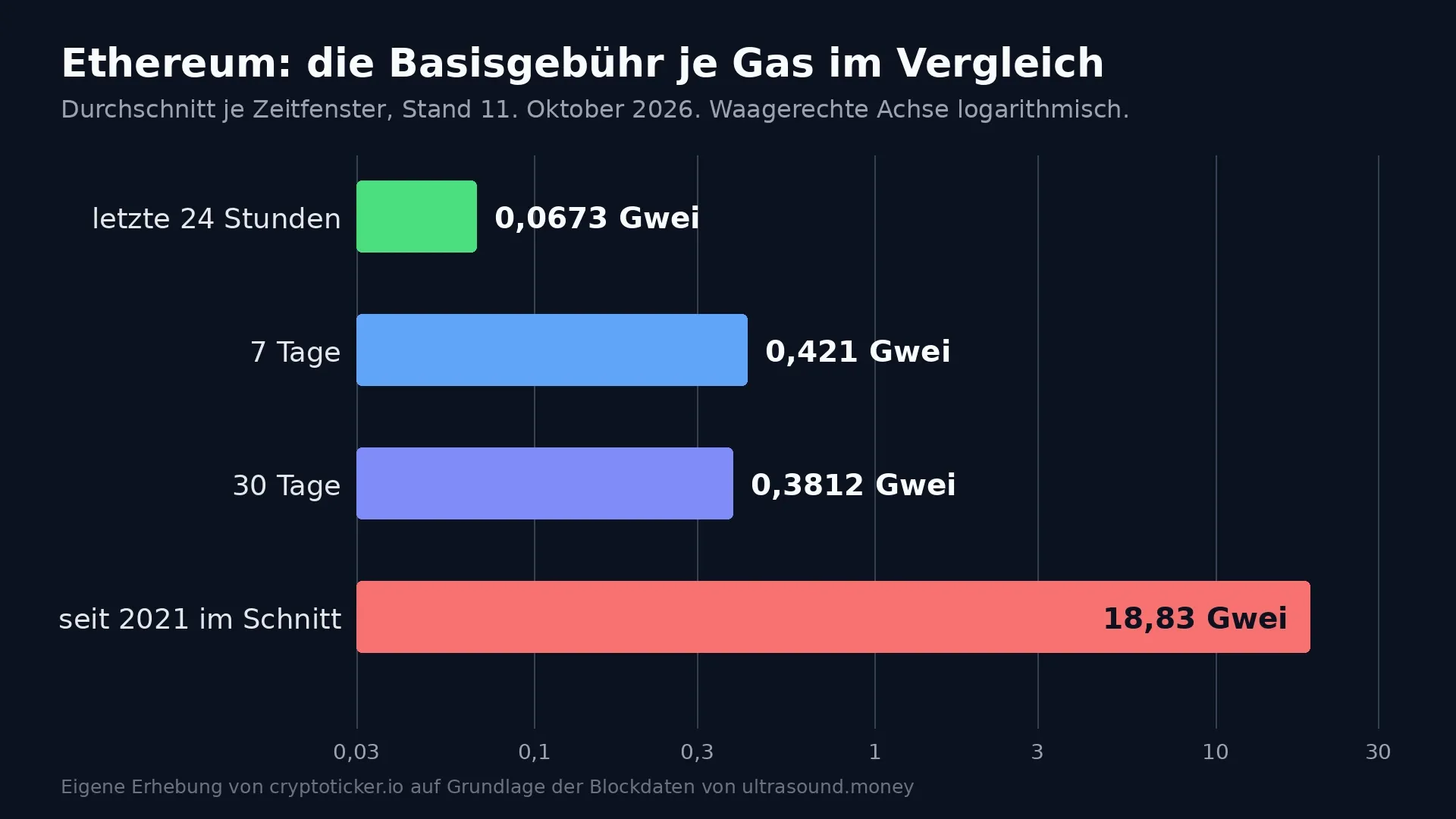
The live reading sits a little above the daily average: an Ethereum node queried directly reported a gas price of 0.077 gwei on Sunday afternoon, which is the base fee plus the customary tip to the validator. The all-time low for the base fee is 0.0087 gwei, set in block 23,937,362. The network is some way off that, but the gap to its own monthly average is considerable.
Half-empty blocks push the base fee down automatically
The base fee follows a fixed rule from the protocol change EIP-1559, in force since August 2021. If a block is more than half full, the base fee for the next block rises by up to 12.5 percent. If it is less than half full, it falls by up to 12.5 percent. The rule can be read in the text of the change itself at eips.ethereum.org. A fee of 0.0673 gwei therefore means one thing only: blocks have been running half empty on average for days.
That is demand at work rather than a defect. Little trading on decentralised exchanges, little movement in stablecoins, little minting and selling of NFTs: each of those activities fills blocks. Take them away and gas costs next to nothing. The narrow price action above and the cheap fee here are two readings of the same thing.
 Compare crypto exchanges and fees
The burn now offsets just 0.49 percent of new issuance
The base fee never reaches the validator. It is destroyed instead, and that burn is the reason the ether supply can shrink when the network is busy. At 0.0673 gwei, very little of it accumulates.
Measured on October 11: 0.0102 ether per minute was burned over the past 24 hours. The seven-day average is 0.0636 ether per minute and the monthly average 0.0569. Annualised, today's figure gives 5,365 ether burned against 1,087,004 ether issued to validators. The burn offsets 0.49 percent of that. On the weekly average it was 3.07 percent, on the monthly average 2.77 percent.
Supply is growing at 0.886 percent a year as a result. In absolute terms, read from the same source: the ether supply stood at 122,116,611 ether at 14:43 on October 10 and at 122,119,572 at the same time on October 11. That is a net addition of 2,960.61 ether in 24 hours. At a price of $2,504 that amounts to roughly $7.4 million of new supply in a single day.

Some context, so the number does not look bigger than it is: 0.886 percent annual growth is low by historical standards. Under the old mining regime, issuance would run at 4,930,875 ether a year and growth at 4.03 percent. The switch to proof of stake in September 2022 removed most of the dilution, and the burn was always the fine adjustment on top. Judging the situation by slogans such as ultra sound money measures the wrong quantity.
The staking queue since October 10
Our report yesterday recorded that the buffer in the staking entry queue had shrunk by 252,402 ether, at a price of $2,507. The price has moved three dollars lower since then, and today's narrow range shows that no direction has come of it. The $2,500 mark, which fuelled the debate as recently as October 9, has held in both directions for three days.
What is new in the 24 hours in between is set out above: the base fee has fallen to a sixth of the weekly average, and the burn with it. Whoever tracks the ether supply has one more figure on the list, and it points the opposite way to the staking queue. The queue locks ether up, while the low fee leaves more of it in circulation.
Compare MiCA-regulated crypto exchanges0.077 gwei in euros: what a transfer costs today
Converting the daily average of 0.0673 gwei into money, at $2,504 and 2,237 euros per ether:
- A simple ether transfer at 21,000 gas: 0.00000141 ether, around 0.35 US cents or 0.32 euro cents.
- A transfer of an ERC-20 token such as a stablecoin, roughly 65,000 gas: around 1.1 US cents.
- A swap on a decentralised exchange, roughly 150,000 gas: around 2.5 US cents.
The gas figures for the token transfer and the swap are guide values; actual consumption depends on the contract. The price per gas, by contrast, is measured. For comparison: at the all-time average of 18.827 gwei the same simple transfer would have cost around 99 US cents, and at the weekly average around 2.2 cents.
Network fees before you send: what you can do now
A low network fee changes nothing about whether ether is a good buy. Cheap gas only changes the cost of a transaction you intended to make anyway. Three cases where it counts in practice today:
Moving to self-custody. Pulling holdings off an exchange to hold them yourself costs fractions of a cent on the chain right now. The catch lies elsewhere: exchanges often charge a flat withdrawal fee of their own, independent of the network and untouched by the cheap gas. Check your exchange's withdrawal fee before you rely on the gas price. Which venues charge what is set out in our crypto exchange comparison, and which device makes sense for custody is compared in our hardware wallet comparison.
Tidying up your holdings. If small amounts have accumulated on several addresses over the years, consolidating them normally costs more than the remainders are worth. At 0.077 gwei that calculation shifts. Work out before each transaction whether the sum carries the effort.
Pending contract business. Revoking a contract approval or unwinding a staking arrangement is cheaper today than on the weekly average. That is no reason to rush it, and a good reason to stop putting it off.
Holding period and proof when moving to your own wallet
For investors in Germany, the one-year rule under section 23 of the Income Tax Act still applies to private disposals: hold crypto assets for more than a year before selling and the gain carries no income tax. The Bundestag rejected scrapping that period on October 9, 2026 by 445 votes to 132, as we reported the same day.
What counts in practice when moving between your own addresses is the paper trail. The tax authorities expect transfers between an investor's own addresses to be documented, so that the acquisition date and the acquisition cost can be assigned later. If you use today's cheap gas to move holdings, the safest course is to save the transaction hash, the date and time and both the source and the destination address straight away. Which tools record that automatically is set out in our overview of crypto tax software and portfolio trackers. The individual case remains a matter for a tax adviser.
Three levels decide the range: $2,495, $2,517 and $2,555
The nearest level below is $2,495.23, today's low, which also sits just under the round $2,500 threshold. If it gives way, the weekly low of $2,404.60 from October 8 is the next stop, more than four percent lower.
Above, the 24-hour high of $2,517 caps the narrow band the price has held since Friday. Beyond it, at some distance, lies the 50-day line, which runs at $2,555.47 on the daily closes of the past 50 trading days, around two percent above the current level. The weekly high of $2,737.55 from October 4 is 9.3 percent away.
Far below runs the 200-day line at $2,133.72. The gap of 17.4 percent to the upside shows that the longer-term trend is intact despite a weak week. All four values are calculated from the daily candles of the same exchange, as of October 11.
Our view: cheap gas is no buy signal
In the editorial team's view, the low network fee will turn up in some coverage over the coming days as a good sign for ether. The figures above argue against it. A base fee of 0.0673 gwei arises because blocks are half empty, which is to say because little is happening on the chain. It is evidence of weak demand, not strong. The burn falls in the same move to 0.49 percent of new issuance, which leaves the supply side growing less restrained than it was the week before.
On the other side of the ledger, a cheap chain makes the network easier to use, and 0.886 percent annual growth is still modest next to the 4.03 percent of the old mining regime. Direction will be settled elsewhere in any case: in fund inflows, in Wednesday's US consumer prices, and in whether the $2,495 mark holds. The fee is a thermometer rather than an engine. The reading tells you how warm it is, and nothing about where the price is going.
Network fee at 0.077 gwei: cheap only if you had a reason to send
Three steps to make use of today's situation without taking a directional bet:
- Check the withdrawal fee, not just the gas price. The chain costs less than a cent, the exchange often a multiple of it. Which venues levy which flat fee is set out in the crypto exchange comparison.
- Settle custody before you send. A transfer to an address whose keys you do not securely hold is no progress at all. The devices in the hardware wallet comparison differ above all in recovery.
- Keep the records as you go. The transaction hash, the timestamp and both addresses belong in your archive while they are still to hand. Tools that record this themselves are listed in the overview of tax software and portfolio trackers.
(As of October 11, 2026. This article is not investment advice. Prices and fee structures change; check the terms with the provider before you buy.)
Frequently asked questions about the Ethereum network fee
Partner links: some links on this page are partner links. If you become a customer through one of them, we may earn a commission at no extra cost to you. Selection, ratings and ranking are decided independently by our editorial team. Ethics and Independence · Ownership and Funding
Transparency note: This article was produced with the assistance of artificial intelligence. Figures and claims are based on the primary sources linked in the text. The feature image was generated with AI.
For later? Save this article and find it again in your profile.
More on Ethereum: All Ethereum news at a glance
Related articles
- Ethereum price at $1,735: lowest daily value since July as ETF outflows continue
- Ether climbs back toward $1,800 after the Fed minutes as ETFs lose another $39.8 million
- Ethereum price: ETF outflows for a second day as ether holds $1,800 ahead of the Fed minutes
- Whales Are Buying the Ethereum Dip While ETFs Dump $400 Million: Who Is Right?
- Buterin backs EIP-8037: new Ethereum accounts would cost 7 times more gas
Which topics should we dive deeper into?
Select what genuinely interests you. Your picks feed directly into our editorial planning.
Crypto news that's actually worth your time.
Weekly. 60 seconds. Carefully curated by our editors: no hype, no promo flood, no spam.

November 14, 2026 7:36 PM

Ethereum price falls to $1,830, its lowest since July, as the Foundation sells 7,500 ETH
Ether fell 5.7 percent to around $1,830 on Saturday, its lowest level since mid-July. The Ethereum Foundation keeps selling, US ETFs are closed until Monday, and liquidation levels move into focus for holders.
November 13, 2026 7:19 PM

Ethereum price prediction: Foundation wallet sells for a fourth time, ETF outflows 87 times larger
Analysis: a wallet attributed to the Ethereum Foundation sold another 2,000 ETH on November 13. Set against the outflows from US ether ETFs that is a footnote, and with the price below $2,000 other levels matter more.

November 13, 2026 1:27 PM

Ethereum Price Crashes Below $2,000: How Low Can ETH Go?
Ethereum just lost $2,000 for the first time since August. Our ETH chart analysis maps the next support levels and the rebound targets to watch.
November 13, 2026 9:32 AM

WhiteBIT Coin falls below $67 while Whitechain's Layer 2 launch is still pending
WBT has lost 5.9 percent to $66.66 and is falling with the whole crypto market. Whitechain has been running as an Ethereum Layer 2 since October 26, and the public launch is due in November.

November 12, 2026 11:15 PM

Ethereum price below $2,000: record staking meets ETF outflows
Analysis: Ether dropped below $2,000 on Thursday for the first time since August, while 36.51 percent of all ETH is now locked in staking, a record. Why that slows the slide but cannot reverse it.
November 12, 2026 7:25 PM
Ethereum price prediction: Huang's exit pushes ETH below $2,000 as ETF outflows hit day five
Analysis: The surprise resignation of Nvidia CEO Jensen Huang also hit ether on Thursday, with ETH falling as low as $1,983. On top of that came $144.8 million in ETF outflows on the fifth day in a row; which levels count now and what investors can do.
November 10, 2026 3:21 PM

Ethereum price prediction: Buterin bets on store of value as Bitmine adds 9,587 ETH
Analysis: Vitalik Buterin wants Ether valued as a store of value rather than a fee-burning token, and Bitmine now holds 4.97 percent of all ETH. Why the price still sits below the 200-day moving average at $2,154 and which levels matter until Friday's expiry.
November 9, 2026 1:17 PM

Ethereum falls below $2,100: weakest against bitcoin since July
Ether fell 5.3 percent on November 9, 2026, to around $2,119, losing almost three times as much as bitcoin. One ether now buys only 0.0283 bitcoin, the lowest since July, as long liquidations and ETF outflows add to the pressure.
November 8, 2026 7:15 PM

Ethereum Price Prediction: 2,982 New ETH in a Day, Only 10 Burned
Analysis: Ethereum's fee burn has almost died out, and supply is growing by 0.86 percent a year. What that means for the price, staking yield and tax, and which levels matter now.
November 7, 2026 7:12 PM

Ethereum price holds €2,000 as ether ETFs log a sixth straight week of outflows
Analysis: Ether is hovering around €2,000 on Saturday evening after the US spot ETFs lost money for a sixth consecutive week. Which figures are confirmed, why the euro level matters more than the dollar price for investors in Germany, and which steps you can check now.
November 4, 2026 7:23 PM

Ether ETF buyers sit at an average of $3,200: the Ethereum price levels that count until then
Analysis: According to an estimate by Bloomberg Intelligence, buyers of the US Ether ETFs paid just under $3,200 on average, while Ether trades at $2,425 after the election jump. We recalculate the funds' paper loss, put the outflows in context and show which levels count on the way to the cost basis.
November 4, 2026 5:20 PM

Ethereum price jumps above $2,400: why Ether is outpacing Bitcoin after the US midterms
Ether (ETH) has recovered almost 8 percent in twelve hours from its US election-night low and is rising faster than Bitcoin (BTC). What is driving the move, which chart levels matter now and what investors in Germany should consider on buying, tax and custody.
November 3, 2026 8:59 AM

Ethereum Price Below $2,300: Is $2,000 Next or Is This the Bottom?
Ethereum price slips toward $2,250 as $3 billion leaves DeFi. Whales are buying the dip. Does ETH hold $2,200 or test $2,000 next?
November 1, 2026 9:29 PM

Uniswap takes fees from seven outside pools: the next step
Since October 22 the Uniswap web app has also routed swaps through seven outside liquidity sources, and these trades pay a protocol fee that flows into the UNI burn. What is behind it, what it means for the price, and what you as a holder in Germany have to factor in.
November 1, 2026 12:18 AM

Ethereum price prediction: Glamsterdam upgrade delayed, what matters now
Analysis: the developers have halted the Glamsterdam activation on the Hoodi testnet, and there is no new date. A different number matters more for the price: the base fee stands at 0.058 Gwei, and supply is growing again as a result.

October 29, 2026 9:50 PM

Ethereum Crash: The Binance Hacker Sits on 195,000 ETH. Is a Sell-Off Coming?
Ether fell 2.6% within an hour after the Binance hack. The bigger risk: about 195,460 ETH sit with the attacker and, unlike stablecoins, cannot be frozen. How big the selling pressure really is, which price levels matter and why Ethereum itself was not hacked.
October 25, 2026 6:13 PM

Ethereum price prediction: 9.7 ETH burned as supply keeps growing
Analysis: The data shows that Ethereum burned 9.7 ETH in fees over the past 24 hours, while supply grew by 2,956 ETH over the same period. Our assessment follows below: the scarcity mechanism that many ether holders pin their expectations on is, in practical terms, currently switched off.
October 24, 2026 1:20 PM

Canton (CC): universal burn approved, burning starts under the 2027 roadmap
The Super Validators of the Canton Network approved proposal CIP-0129 on October 21: dedicated synchronizers will no longer pay a licence fee to Digital Asset but will burn Canton Coin for their traffic. Under the roadmap this takes effect only in 2027, and the network currently mints about twice as much CC as it burns.
October 18, 2026 4:29 PM

XRP price prediction: 398 XRP burned in a day against 1 billion from the escrow
The XRP Ledger destroyed 398.19 XRP for good on Sunday, measured by the difference between two ledgers. On November 1 the escrow releases 1 billion XRP. What that ratio means for the price and which level at $1.28 now counts.
October 17, 2026 10:33 PM

Ethereum forecast: 2,955 new ETH a day, only 13.6 burned, next target: $2,552
Ethereum's supply grew by 2,955 ETH over the past 24 hours, while only 13.6 ETH were burned. What that finding means for the levels between $2,417 and $2,552, and what investors in Germany can take from it.
October 14, 2026 1:21 AM

BNB zero fees for USDC and USD1 until October 31: what changes for investors in Germany
On the BNB Smart Chain, withdrawals and wallet transfers in USDC, USD1 and U cost no gas until October 31. The 37th auto-burn is also due, and total supply still sits 33.16 million tokens above the target of 100 million.
October 12, 2026 7:32 PM

WhiteBIT Coin (WBT): Lightning Brings Bitcoin Withdrawals at 0.15 Percent, What You Can Do Now
The crypto exchange WhiteBIT has accepted Bitcoin over the Lightning Network since October 8 and pays it out the same way, for 0.25 and 0.15 percent respectively. Because both rates are percentages, the size of your withdrawal decides whether the new route is cheaper than the main chain.
October 12, 2026 1:25 AM

Shiba Inu after the 151 percent rebound: Shibarium is back to 1,142 transactions a day
Several outlets reported a 151 percent recovery on Shibarium. Our own query of the chain data shows that one day later 1,142 transactions are left. What the figures mean for the SHIB burn and for your tax return.
October 6, 2026 4:40 PM

Ethereum price prediction: Glamsterdam live on Sepolia with 64 million gas instead of 200, and why the gap matters
Ethereum's next big upgrade has been running on the Sepolia test network since Tuesday afternoon. The much-quoted gas limit of 200 million is not in place there yet, and the gap says more about the mainnet date than any price target estimate.
September 29, 2026 1:35 PM

Seven Days of Waiting: Base, Basescan and the Cheapest Way Onto Coinbase's Network
You get onto the Base network in minutes for fractions of a cent; getting back to Ethereum takes seven days. We walk through the chain ID, the fees, Basescan and the traps in bridging.
September 29, 2026 1:20 PM

Ethereum Gas Around 1 Gwei: Why an ETH Transfer Now Costs Six Cents
Ethereum is trading at $2,711 on Tuesday morning and the network fee sits at around 1 Gwei. A simple transfer therefore costs about six cents. What that window means for self-custody, the holding period and the Sepolia date on October 6.
September 28, 2026 7:16 AM

Ethereum Gas at One Cent: What Gwei and Etherscan Mean for Your ERC20 Transfers
An ether transfer cost around one cent on September 27, 2026, while a swap on a decentralised exchange cost eight. This guide explains how gas is billed in gwei, what to look up on Etherscan and which three mistakes are the most common in an ERC20 transfer.
More from CryptoTicker