
Buying Ethereum with PayPal: a 72-hour withdrawal lock is the real price of the convenience
PayPal does not trade crypto-assets in Germany, yet it still works as a deposit route at a crypto exchange. What arrives in ether out of 100 euros, why the fee appears only on the final page and what the 72-hour lock means for your ETH.




Which topics should we dive deeper into?
Select what genuinely interests you. Your picks feed directly into our editorial planning.
Crypto news that's actually worth your time.
Weekly. 60 seconds. Carefully curated by our editors: no hype, no promo flood, no spam.
Anyone searching for “buy Ethereum with PayPal” usually expects a button in the PayPal app. In Germany there is none. PayPal does not trade crypto-assets here, and nothing about that changed at the start of October 2026 either. What does work is a detour: you top up a crypto exchange with euros from your PayPal account and buy Ethereum there. That detour costs you two things an ordinary bank transfer does not: a fee you do not know before you click, and three days during which your ETH may not leave the exchange.
This article works through both. It shows what actually arrives in ether out of 100 euros along the three routes SEPA, debit card and PayPal, why the lock-up period weighs more heavily for Ethereum than the difference in fees, and what can go wrong when you move the coins on to a wallet of your own. We have already answered the same question for Bitcoin: buying Bitcoin with PayPal. With Ethereum two points come on top that do not arise in that form with Bitcoin, namely the choice of network and the question of what staking does to the holding period.
PayPal does not sell crypto-assets in Germany
The distinction matters, because many guides blur it: PayPal as a dealer in crypto-assets and PayPal as a payment route are two different things. The first exists in the United States, the second in Germany.
That can be established from PayPal's own presence. The product page for buying and selling cryptocurrencies exists on PayPal's US site. On the German site the corresponding address leads nowhere. More telling still is a look at the terms of use: in the German version, last updated on September 7, 2026 and a good 150,000 characters long, the word cryptocurrency does not appear at a single point. A service a provider does not mention in its own contractual documents is a service it does not offer.
For you that means: every page promising you can buy ether “directly at PayPal” either describes the US market, or it describes the detour via an exchange and names it imprecisely. There is no third case.
The only route runs through a euro deposit at a crypto exchange
The actual process has four steps, and PayPal is involved in only one of them. You open an account at a crypto exchange and verify your identity. You deposit euros and choose PayPal as the payment route. You buy ether with the euro balance. And if you want to hold the coins yourself, you then transfer them to a wallet of your own.
Crypto exchange here means a trading venue that swaps crypto-assets for euros and holds the balance for you. In this process PayPal is neither dealer nor custodian, only the till at the door. That division of roles explains most of the peculiarities that follow: the exchange determines what the purchase costs and when you may move your coins, not PayPal.
PayPal appears as a deposit route at several providers. The position is only verifiable, though, where the provider publishes its fees and deadlines in full. Kraken does so with a table anyone can inspect and which was last updated on August 17, 2026. That is why this article works with those figures. At other houses, contradictory statements circulate on comparison portals, from “free since July 2025” to “2 percent”; anyone wanting to deposit there should check the terms with the provider before buying. Which trading venues come into question in Germany at all is shown in our comparison of providers with PayPal deposits.
The 72-hour lock is the real price of the PayPal deposit
The point missing from most guides is stated expressly in Kraken's fee table: after a deposit by PayPal, a withdrawal lock of 72 hours sits on the account. The lock applies not only to euros but to all withdrawals, crypto-assets included. For three days your freshly bought ETH therefore stay on the exchange, whether you like it or not.
The reason for that is not harassment but chargeback risk. A PayPal payment can be disputed after the fact. If the coins bought could be withdrawn immediately, the exchange would be left without any counter-value in a dispute. The same logic applies to card payments, but not to the SEPA transfer: there the table shows no lock.
Withdrawal lock does not mean your balance is frozen. You can trade straight away, you simply cannot get out of the building. For an investor who leaves their ETH on the exchange anyway, that has no consequences. For anyone holding by the principle of “not your keys, not your coins”, it is three days of counterparty risk they would not have had with a transfer. The year 2026 has served as a reminder, through several exchange incidents, that those three days are not a theoretical risk.

At Kraken the PayPal fee appears only on the final confirmation page
For every other type of deposit the table names a figure. SEPA from the European Economic Area: free, minimum amount 1 euro, credited within zero to three banking days or instantly. Debit card: minimum amount 10 euros, 0.25 euros plus 3.75 percent, credited almost instantly. A transfer over the international SWIFT network: 3 euros, one to five banking days.
For PayPal, the word “processing fees” stands in place of the figure, together with a footnote: the fees depend on the region and are displayed on the final confirmation page. Minimum amount 1 euro, credited almost instantly, lock 72 hours.
That is the most remarkable finding of this research, and it is no reproach to a single provider but a property of the payment route: of all the deposit types, PayPal is the only one whose price cannot be looked up beforehand. You learn it at the moment when all that is left is to confirm. Anyone wanting to compare has to run the process through to the final page and break off there.
 Find the right exchange for your tokens
100 euros in ETH via SEPA, debit card and PayPal: the cost calculation
Let us work the purchase through once, with the published figures and an ether price of around 2,367 euros, as it stands on October 1. On top of the deposit fee comes the trading fee in every case: Kraken charges 1 percent on instant purchases and recurring purchases, and 1.5 percent on orders you place yourself.
Via SEPA, a full 100 euros out of 100 euros arrive in the exchange account, because the transfer costs nothing. The purchase takes off 1 percent, so 1.00 euro. What goes into ether is 99.00 euros, around 0.0418 ETH.
Via the debit card, the deposit costs 0.25 euros plus 3.75 percent, 4.00 euros together. That leaves 96.00 euros, from which 1 percent trading fee comes off, so 0.96 euros. What goes into ether is 95.04 euros, or around 0.0402 ETH. Against the transfer, 3.96 euros are missing, which converts to around 0.0017 ETH.
Via PayPal, this line cannot be filled in. The deposit fee is not known beforehand. If it is zero, the result matches the SEPA route; if it is at card level, around four euros are missing. Nothing more can seriously be said, and that is exactly the point: on a purchase of 100 euros it is a single-digit euro amount, on a purchase of 5,000 euros a three-digit sum that you see only on the final page.
The spread sits in the purchase price and appears in no fee line
The calculation above is deliberately incomplete, because it captures only the stated fees. For instant purchases, Kraken expressly points out that a spread is additionally contained in the price displayed.
The spread is the distance between the price at which the exchange buys and the one at which it sells. It never appears on a statement as an item of its own, because it already sits in the price you confirm. To you it works like a fee, but it turns up in no fee overview.
In practice that means two things. First, any comparison that merely sets the stated percentages side by side is calculated too favourably, and that holds for every provider. Second, it pays to look at the difference between the convenient instant purchase and an order you place yourself in the trading area: the trading fee is stated higher there at 1.5 percent, but the spread falls away because you set the price yourself. With larger amounts the relationship therefore often reverses. There is no generally valid threshold, because the spread fluctuates with market conditions.
The network fee for the ETH transfer runs to fractions of a cent
Many newcomers put off the transfer to their own wallet because they fear expensive network fees. That worry comes from the years when a simple Ethereum transfer could cost double-digit euro amounts. Nothing of that is left at present.
At the start of October, the base fee in the Ethereum network sits at about 0.12 gwei. Gwei is the usual unit of account for network fees, a billionth of an ETH. A simple transfer of ether consumes 21,000 gas units. That produces around 0.0000025 ETH, less than a cent at today's price.
The catch: what the exchange charges you for a withdrawal is not that network fee but a rate of its own, which it sets itself and which appears on the confirmation page. It can lie considerably above. The network fee is therefore good as a lower bound, not as an expectation. What remains is the all-clear: the network is no longer the reason to leave coins on the exchange.
ERC-20 or layer 2: the wrong network costs you your ETH
Here lies the difference from Bitcoin, and it is the most expensive mistake in this whole process. On a withdrawal the exchange asks which network it should send over. Alongside the Ethereum mainnet, several layer-2 networks are on offer, that is, side chains which bundle transactions and settle them more cheaply, such as Arbitrum or Base.
The address looks the same in all of these networks. Every one of these addresses begins with 0x and has 42 characters. Precisely there lies the trap: if you choose a different network when sending from the one your wallet expects, the transfer is carried out all the same. The money lands at the same address on another chain. In the favourable case you get it back by setting up that network in your wallet. In the unfavourable case, for instance with an address belonging to an exchange that does not support the chain in question, the amount is lost.
The rule against that is plain: the network chosen when sending has to be the same one set at the top of your wallet. If in doubt, send a small amount first and wait for it to be credited before the rest follows. By the calculation above, the cost of that test lies in the range of fractions of a cent, the benefit in the range of the entire purchase amount. Which devices and programs are suitable for custody is set out in the hardware wallet comparison.
PayPal buyer protection does not cover financial products and investments
A widespread misunderstanding holds that the detour via PayPal brings additional protection with it. The opposite is true. The terms of PayPal buyer protection in the version of April 15, 2025 contain a list of transactions the protection does not cover. Alongside payments for gold and cash equivalents such as gift cards, that list expressly includes financial products and investments.
Buying ether through an exchange falls into that group. If the price falls, if the exchange goes down or if you mistype the address, there is no reimbursement on that basis. Buyer protection is intended for purchases of goods, not for capital investments.
Conversely, the chargeback route very much does apply, and that is exactly why the 72-hour lock exists. Anyone disputing a legitimate deposit in order to end up with both coins and money risks having the exchange account blocked, and civil consequences. The lock is the exchange's answer to that risk, and it hits all customers equally.
 Find the right hardware wallet for your coins
Holding period and threshold: what Section 23 EStG prescribes for your ETH
For tax purposes, buying ether counts among private disposals. Section 23 of the Income Tax Act regulates them in subsection 1 number 2: a disposal is taxable in the case of assets where not more than one year lies between acquisition and sale. If you sell your ETH later than one year after buying, the gain is free of income tax, whatever its size.
Within the year a threshold applies. Under subsection 3 sentence 5, gains remain tax-free where the total gain from all private disposals in the calendar year comes to less than 1,000 euros. Threshold here means: if the amount is exceeded, the entire gain is taxable, not only the excess part. At a gain of 999 euros you pay nothing; at 1,001 euros you pay tax on the full 1,001 euros at your personal rate.
For the PayPal question only one detail matters, and it is regularly misunderstood: the one-year period begins with the acquisition, meaning on the day of purchase, not at the end of the 72-hour lock and not on the day of the transfer to your own wallet. The lock shifts the start of the period by not a single day. Anyone buying several times needs the individual date for each part-purchase; tools for that are in the comparison of tax and portfolio programs.
Staking does not extend the holding period to ten years
With Ethereum a question arises that does not come up with Bitcoin: what happens to the holding period if you stake your ETH? The reason for the worry sits in the same section. Under subsection 1 number 2 sentence 4, the period extends to ten years where income is earned in at least one calendar year from the use of an asset as a source of income.
Staking means depositing your ETH in the network to help secure transactions, and receiving ongoing returns for it. That sounds like a source of income. The tax administration does not, however, apply the ten-year period to crypto-assets. The Federal Ministry of Finance confirmed this in its circular of March 6, 2025 on the income tax treatment of certain crypto-assets, file reference IV C 1 – S 2256/00042/064/043. The holding period accordingly stays at one year even after staking or lending.
The treatment of the returns themselves is unaffected by that: ongoing staking rewards are taxable in the year they are received, separately from the later gain on sale. Anyone dealing with such returns for the first time should settle the classification with a tax adviser; this article is no substitute for advice in the individual case.

MiCA authorisation: how to recognise an authorised provider
Since the European crypto regulation MiCA, trading venues need authorisation as crypto-asset service providers in order to serve retail clients in the EU. For you that is not a sticker on the wall but an entry in a register, and it can be looked up in two minutes.
Two directories help further: BaFin's company database for providers with German authorisation, and the register of the European securities supervisor ESMA for authorised service providers from all member states. A route via another EU country is normal in this and no warning sign: an authorisation from Ireland or Malta is valid across Europe.
What matters is matching the exact company name. Exchanges frequently run their European business through a company of their own whose name differs from the brand. If you find the operator in neither of the two registers, do not pay money in there, however convenient the PayPal button looks. Vetted trading venues are in our comparison of crypto exchanges.
Buying Ethereum with PayPal: Your next three steps
- Establish whether you really need the convenience. On the terms examined here, a SEPA transfer is free, has no lock-up period and is in many cases credited instantly as well. PayPal pays off above all where your money is sitting there anyway. An overview of the trading venues is in the exchange comparison.
- Run the deposit process through to the final page before you confirm. That is the only place the PayPal processing fee appears. Add it to the trading fee of 1 percent and compare the result with the 100 euros that arrive in full via a transfer.
- Allow for the 72 hours before you take custody of the ETH yourself. Once the lock has elapsed, transfer a small amount first and make sure the network you choose matches your wallet. Suitable devices are shown by the hardware wallet comparison.
The sources for this article: the fees, minimum amounts and lock-up periods come from Kraken's public overview of deposit options.
(As of October 1, 2026. This article is not investment advice. Prices and fee structures change; check the terms with the provider before you buy.)
Frequently asked questions about Ethereum and PayPal
Transparency note: This article was produced with the assistance of artificial intelligence and reviewed by our editorial team before publication. All figures and claims were checked against the primary sources linked in the text. The feature image was generated with AI.
More on Ethereum: All Ethereum news at a glance
Related articles
- Buying Bitcoin With PayPal in Germany: What Really Works and What It Costs
- Bitcoin for a gift card: what paying with crypto means for your holding period
- 2,598 dollars and a sixth day of ETF outflows: will Ethereum hold the 2,500 line?
- Take Ethereum Profits or Wait Out the Holding Period? What the Price Jump Means for Your Tax Bill
- Ethereum Price Prediction: What to Check on Staking, Leverage and Where You Buy After Three Attempts at $2,800
Which topics should we dive deeper into?
Select what genuinely interests you. Your picks feed directly into our editorial planning.
Crypto news that's actually worth your time.
Weekly. 60 seconds. Carefully curated by our editors: no hype, no promo flood, no spam.

September 24, 2026 10:12 AM

XRP Falls 9.7 Percent: What to Check on Holding Period and Buying Route
XRP is down around 9.7 percent on the morning of September 24, twice as much as the typical large crypto asset. Our count of 18 coins shows who the pullback hits and which three things hold true regardless of the price.

October 19, 2026 10:15 PM
Ethereum price at $2,396 and €2,137: next target €2,176
The Ethereum price stands at $2,396 and at €2,137. Over twelve months, 2.2 percentage points lie between the two calculations. For Annex SO and the holding period, only the euro amount counts.

December 4, 2021 4:13 PM
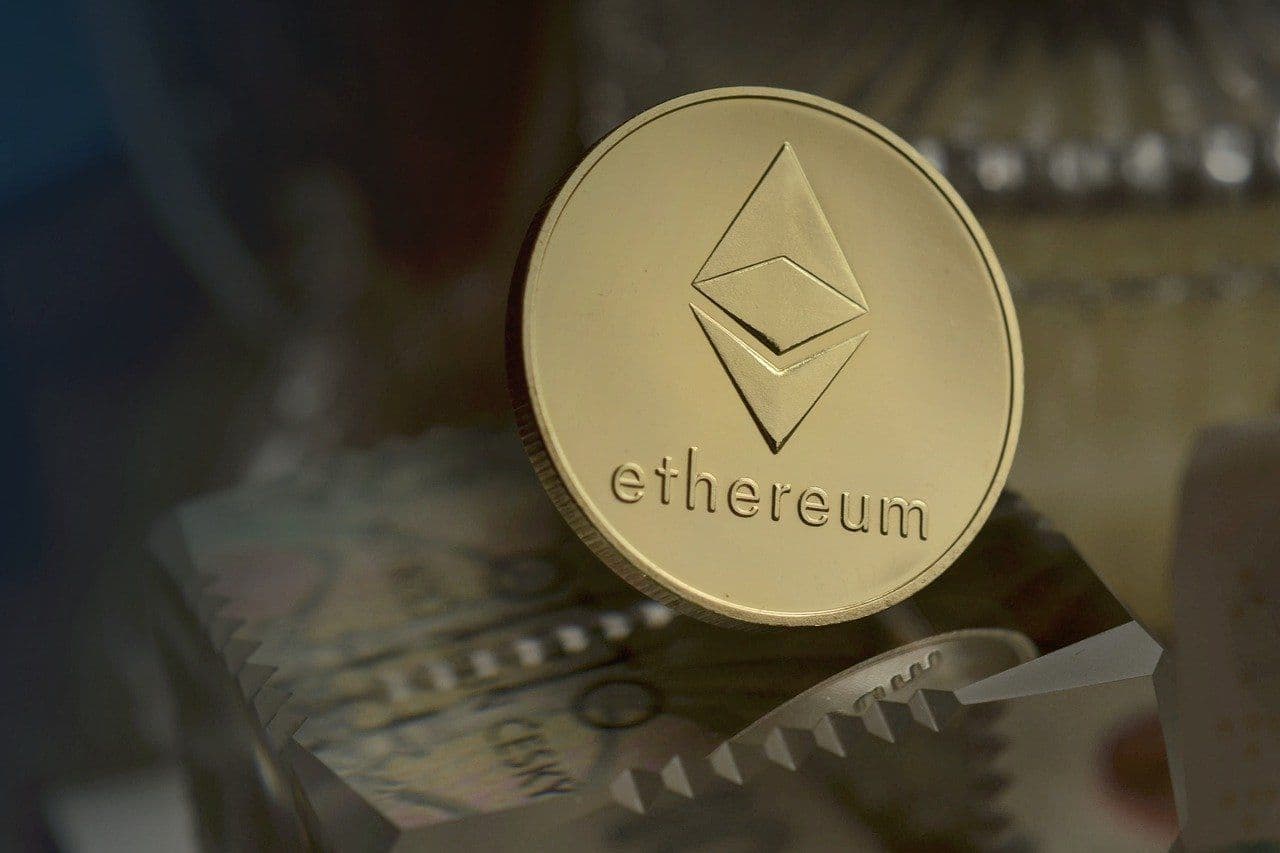
Looking to Buy the Dip? Here’s a Quick Guide on How to Buy ETH post-Crash
Is it the right time to Buy Ether after the crypto crash? In this article, we're going to quickly recap how to Buy Ether from Kraken.
October 2, 2026 4:40 PM

Ethereum price prediction: Citi raises its twelve-month target to $3,028, and what you can do now
Citi has raised its twelve-month target for Ethereum from $2,240 to $3,028. Anyone following that horizon also decides the tax on the gain with the purchase date.
September 22, 2026 7:20 PM
ETH Price Prediction: What to Check at the $2,800 Mark Now
Ether stands at $2,735.96 on September 22, 2026, right below the zone at which it has failed repeatedly. Instead of a target number, you get four checks that count before your next order: holding period, buying route, the staking line and the distance to liquidation.

September 21, 2026 4:13 AM
How to Buy XRP in Germany: Exchange, Destination Tag and Tax
Buying XRP works through a crypto exchange with MiCA authorisation, through a broker, or through an ETP in your securities account. This guide shows what matters on fees, the destination tag, custody and the German holding period.
September 8, 2026 10:21 PM

Crypto Holding Period and Grandfathering: Why December 31, 2026 Becomes the Cut-Off in Germany's Draft Bill
A ministerial draft bill from Germany's finance ministry names a cut-off date for the first time: crypto assets acquired after December 31, 2026 are to fall under the flat-rate withholding tax. What that means for legacy holdings, running savings plans and staking income, and why nothing has been decided yet.
September 22, 2026 4:12 PM

Nearly $1 Billion Into Bitcoin ETFs: What to Check on ETNs, Portfolio and Holding Period
US spot bitcoin ETFs took in a net $999 million on September 21, the third consecutive day of inflows. German investors cannot reach these funds: what ETNs, the holding period and your buying route mean for you.
September 21, 2026 1:13 PM

Ethereum Rises While ETF Money Leaves: What ETH Holders Should Check Now
US ether funds lost $140 million in the week to September 18, ending four weeks of inflows. The ETH price still gained a good 5 percent.
September 29, 2026 1:20 PM
Ethereum Gas Around 1 Gwei: Why an ETH Transfer Now Costs Six Cents
Ethereum is trading at $2,711 on Tuesday morning and the network fee sits at around 1 Gwei. A simple transfer therefore costs about six cents. What that window means for self-custody, the holding period and the Sepolia date on October 6.
September 26, 2026 1:19 AM
Germany’s Crypto Holding Period Is Wobbling: What to Check Before December 31
A CDU member of the Bundestag makes it plain: the coalition agreement does not guarantee that the one-year holding period for crypto assets will survive. What that means for purchases made before the planned cutoff date of December 31, 2026.
September 9, 2026 4:22 PM
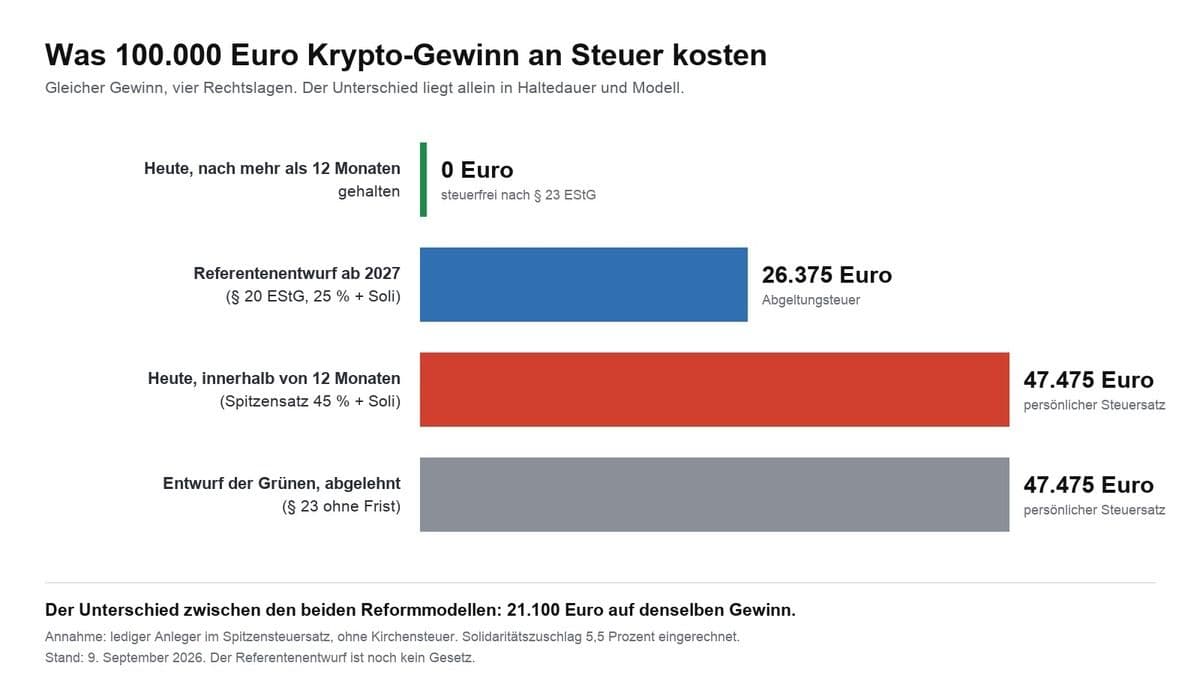
Crypto Tax in Germany: What Applies in 2026 and What Is Set to Change in 2027
Crypto gains are tax-free after twelve months; before that your personal tax rate of up to 45 percent applies. What triggers tax, how the holding period is calculated, what happens with staking and losses, and what the draft bill would change from 2027.
October 9, 2026 7:21 AM
Ethereum savings plan: twelve instalments averaged 1,981 euros, the lump sum 3,318
Twelve monthly instalments of 100 euros in Ether worked out at an average price of 1,981 euros, while a lump sum on the starting day cost 3,318 euros. The twelve-month calculation, the two quirks that set it apart from a Bitcoin savings plan, and the tax consequences of twelve separate purchases a year.
September 27, 2026 4:12 AM
Bitcoin ETF Inflows Turn 2026 Positive: How to Tell If the Demand Holds
US spot Bitcoin ETFs took in roughly $2.4 billion in the week to September 25, the strongest week since October 2025, and that turns the 2026 year-to-date balance positive. Why the daily inflow fell 87 percent within the same week, and what to check on buying route, holding period and custody.
September 24, 2026 4:20 PM

Litecoin Jumps by Double Digits While the Market Falls: Check Buy Route, Holding Period and Leverage Now
Litecoin gains 11.29 percent in a day while Bitcoin, Ether and XRP give ground. What sits behind the jump, and the three points you as an investor in Germany should check right now.
September 22, 2026 1:15 AM

Memecoin Rally: Why Memecoins Are Rising and What to Check Before You Buy
The memecoin sector stands 9.01 percent higher, the overall market only 2.90 percent. The arithmetic behind it shows that two tokens carry three quarters of the move and that the sector has no occasion of its own.
August 24, 2026 10:29 AM
Buying More Bitcoin at $77,000: Savings Plan or Lump Sum
Bitcoin stands at $77,256 after gaining 22.78 percent in a week. This guide shows you how to buy more cleanly at this price and which method fits which starting position.
October 9, 2026 10:50 AM

Crypto holding period: the Bundestag rejects abolition by 445 votes to 132: what investors need to know
On 8 October the Bundestag rejected the Greens' bill to abolish the crypto holding period in a recorded vote, and the Left's motion fell too. The result by parliamentary group, the official speech from the media centre, and why it was the SPD that gave investors the real signal in the debate.
September 27, 2026 1:17 PM
Dogecoin Price: What to Check on Holding Period and Custody Before the Year End
The Dogecoin price stands at $0.0977 on September 27, 2026 and has barely moved in a day. That calm is exactly the moment to work through the holding period, the reporting duty from 2026 and custody without any time pressure.
May 30, 2024 2:46 PM
How to Buy Ethereum (ETH) on eToro: A Comprehensive Guide
How to buy Ether (ETH) on eToro is made simple, with our step-by-step guide. From account creation to making your first purchase, we cover all you need to know...
September 9, 2026 1:15 AM

Germany's Crypto Tax: 160 Million Euros for a 555-Billion Budget
The German finance ministry's draft bill puts a figure on the crypto tax for the first time: 160 million euros from 2028. What that number means in the 2027 federal budget, how 11.4 billion became 160 million, and what investors can read from it.
October 20, 2026 1:33 PM

60.6 percent down in twelve months and only 12th by market value: what to check before your purchase anniversary
Dogecoin has lost 60.6 percent over twelve months, more than twice as much as Bitcoin, and now ranks only 12th by market value. For investors in Germany the calendar matters more than the next price level: the anniversary of the purchase decides whether a gain stays tax free and whether a loss still counts at all.
October 16, 2026 7:25 PM

Crypto holding period for Bitcoin: “That remains to be seen,” says the finance ministry
The federal cabinet did not adopt the draft abolishing the one-year crypto holding period on October 14, 2026; it is still stuck in inter-ministerial consultation. This overview sets out what applies today, which dates follow and why the December 31, 2026 cutoff has no force of law so far.
October 15, 2026 4:13 AM

Crypto holding period: the cabinet date passes without a decision, December 31 stays the cut-off
Germany's federal cabinet did not adopt the expected decision of October 14, 2026 to abolish the one-year crypto holding period; the draft is still in interdepartmental consultation. Until new rules arrive, gains stay tax free after one year of holding, and the December 31, 2026 cut-off named in the draft separates old holdings from new ones.
April 6, 2026 6:24 PM
Ethereum Price Analysis: ETH Consolidates Between $1,800 and $2,100, What’s Next?
Ethereum price is stuck in a tight range between $1,800 and $2,100. Analysts warn of a decisive breakout or breakdown as volatility reaches a boiling point.
September 9, 2026 4:13 PM

Bitcoin 29 Percent Below Last Year: Which Crypto Losses You Can Still Use Before the One-Year Holding Period Expires
Nine out of ten major crypto assets trade lower today than exactly twelve months ago, Bitcoin alone by 29.2 percent. We measured the price series ourselves and show why the purchase date alone decides the tax value of your loss.
September 8, 2026 1:19 AM

Germany's Crypto Holding Period: What Happens Now Signing for Petition 201716 Closed on September 15
Recap as of September 27, 2026: the signature period for German parliamentary petition 201716, which asks for the one-year crypto holding period to be preserved, closed on September 15, 2026. This article explains what ended that day, how the petitions committee proceeds and why no investor has to sell because of it.
More from CryptoTicker