
Bitcoin Price Prediction: 140,844 BTC Expire on October 30, and What Matters Now at $80,000
On October 30, 140,844 Bitcoin contracts worth $11.69 billion run out, and two thirds of them are bets on higher prices. At both expiry dates the largest hedge sits at $80,000.





Which topics should we dive deeper into?
Select what genuinely interests you. Your picks feed directly into our editorial planning.
Crypto news that's actually worth your time.
Weekly. 60 seconds. Carefully curated by our editors: no hype, no promo flood, no spam.
On October 30, 140,844 Bitcoin contracts expire on the options exchange Deribit. At a price of $82,977 on Saturday afternoon that is $11.69 billion in notional value, and two thirds of it are bets on higher prices. The largest of them sits at $95,000, a good 14 percent above today's level. Arithmetically, an expiry at $78,000 would be cheaper for the other side. The rest of the month plays out between those two numbers, and the level where the direction is decided is $80,000.
An options expiry is not an event that moves the Bitcoin price by itself. It does change how expensive hedging is and how many contracts the option writers still carry on their books as the date approaches. Anyone buying, selling or hedging over the coming three weeks meets a market whose positioning is already visible today. This article reads that positioning off the open contracts instead of guessing it.
140,844 Bitcoin options expire on October 30, worth $11.69 billion
Deribit handles the bulk of global trading in Bitcoin options. In its public statistics the exchange reports for every expiry date how many contracts are still open. The reading from October 10, queried in the afternoon: 140,844 contracts for October 30, of which 95,165 are calls and 45,680 puts.
A call gives its holder the right to buy Bitcoin at a fixed price. It gains value when the price rises. A put is the counterpart and gains when the price falls. The ratio of puts to calls for this date is 0.48. For every dollar betting on falling prices there are therefore a good two dollars betting on rising ones.
For comparison: at 140,844 contracts the monthly expiry is 9.4 times the size of the next weekly one on October 16, which comes to 15,037 contracts. The large addresses position themselves on a monthly horizon, not a weekly one. For price formation, October 30 therefore carries more weight than any date before it.
Why the biggest call wall sits at $95,000 while the price sits at $82,977
The distribution across strike prices says more than the total. Three strikes alone account for 54,750 of the 95,165 open calls:
- $95,000: 25,031 contracts, 14.5 percent above the current price
- $90,000: 15,158 contracts, 8.5 percent above it
- $100,000: 14,562 contracts, 20.5 percent above it
Among the puts the picture is different. There the largest single position is the $70,000 strike with 3,212 contracts, followed by $80,000 with 2,791 and $72,000 with 2,531. The hedges therefore sit much closer together and further down, while the call bets cluster in a narrow band far above.
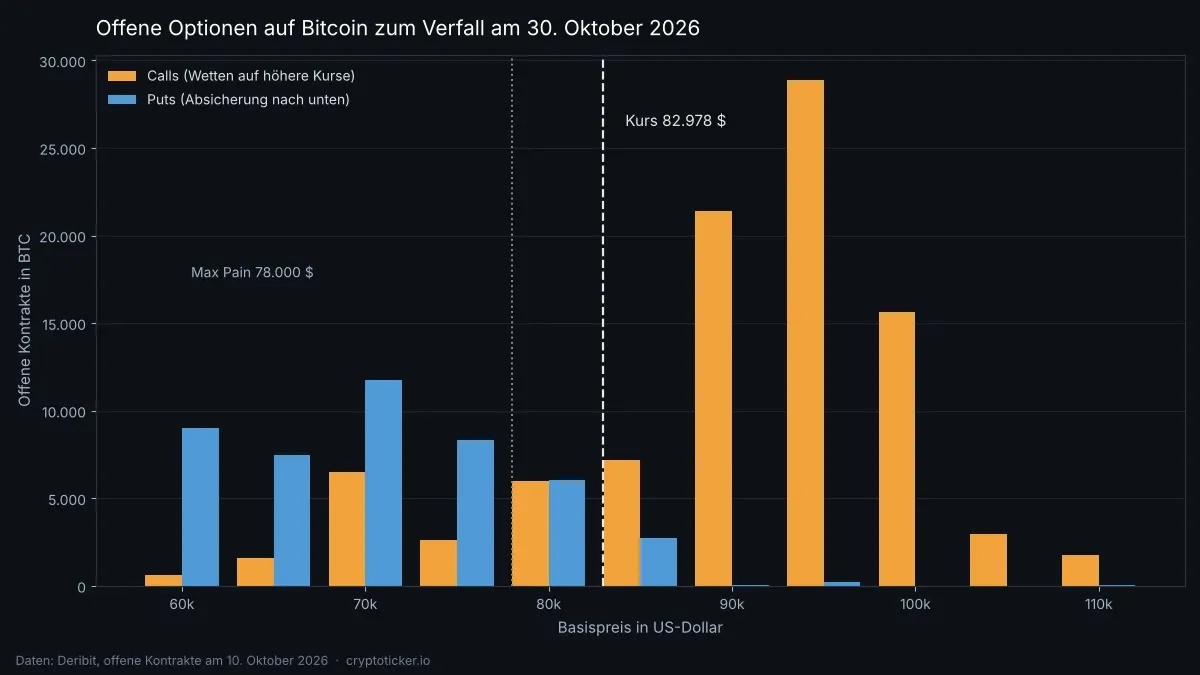
This pattern has a plain explanation, and it has little to do with conviction. A call far out of the money costs little. Anyone holding a large portfolio who does not want to miss the upside buys a cheap option at $95,000 rather than Bitcoin at the full price. The height of the call wall therefore measures how much money stands ready, not how many market participants actually expect $95,000.
 Perpetual contracts: providers compared
Max pain at $78,000, and what that number does not do
From the same distribution you can calculate the point at which the sum of all payouts to options buyers would be smallest. That point is called max pain and for October 30 it sits at $78,000, 6 percent below today's price. If Bitcoin expired there, the bulk of the open contracts would expire worthless and the writers would keep the premiums they collected.
Caution is in order here. Max pain is an accounting figure derived from today's positioning, not a forecast and not a price target. The number changes with every newly opened contract, and it assumes that the writers leave their books untouched. Studies of max pain theory on equity options show no reliable link to the actual expiry price. What the number does deliver is a weighting: the value shows where in the price range most contracts sit.
More consequential in practice is the writers' hedging. Anyone who has sold options holds an offsetting position in the spot market and adjusts it continuously. As the price approaches a strike with many open contracts, that adjustment grows. In the final trading days before an expiry this can dampen price moves as long as the price stays in the zone with many contracts, and amplify them as soon as it leaves. The densest zone currently lies between $78,000 and $80,000, where 5,262 put contracts are open in total.
The weekly expiry on October 16 turns the ratio around
The next date is considerably smaller, but it tells the opposite story. For October 16, 15,037 contracts are open, of which 9,025 are puts and 6,012 calls. The ratio of puts to calls is 1.50 instead of 0.48. The largest single position there is a put at $80,000 with 2,262 contracts.
The same level thus appears at both dates as the largest hedge below the price. Over the short term investors are insuring against a slide below $80,000, over the monthly horizon they are betting on $95,000 and above. That is not a contradiction but the usual division of labour between insurance and wager: nobody wants to come through the next two weeks unprotected, and the month is still meant to run higher.
What has moved since the forecast of October 9
On October 9 this slot carried the assessment by the major bank Standard Chartered, which had reaffirmed its target of $100,000 by year-end while $729 million flowed out of the spot ETFs within two days. Since then the price has recovered from $81,686 on Thursday to $82,977, a gain of 1.58 percent. The $80,000 level was not tested in that period.
What is new is the futures-market view of the same target. The $100,000 that Standard Chartered names is covered on the options market with 14,562 contracts for October 30, the $95,000 with 25,031. The analyst target therefore does not stand alone: on the futures market more money sits one step below it than on the round number itself. Anyone holding the bank's forecast against the positioning sees the same optimism, only with a slightly nearer target.
The daily range stays narrow in the meantime. Between $82,229 and $82,987 there were only $758 over the past 24 hours, which is 0.9 percent. Over 30 days the range runs from $75,590 to $86,597; the current price sits 1.07 percent above the monthly average of $82,097 and 4.2 percent below the monthly high.
Funding at 0.00595 percent: the perpetual shows no greed
Alongside the options there is the second futures market, the perpetual contracts. These contracts never expire and are kept in line with the spot price through a balancing payment, the funding rate. When it is high, long positions pay the short positions, and the market is top-heavy to the upside.
On Deribit this rate for the Bitcoin perpetual stands at 0.00595 percent per eight hours, so 0.0179 percent per day and around 6.5 percent per year. That is an unremarkable value. At tenfold leverage, merely holding the position costs 0.18 percent of the stake per day, so 3.6 percent over the 20 trading days until the expiry, before the price has moved at all. Open interest in the perpetual there amounts to $829.2 million.
The reading from this: the options side is positioned optimistically, the leverage side is not. An overheated funding rate would be the warning signal for a wave of liquidations. At 6.5 percent per year that signal is missing.

Difficulty rises by 3.03 percent, of all days on October 16
A third angle comes from the chain itself. Every 2,016 blocks the Bitcoin network adjusts its difficulty so that a block is found every ten minutes on average again. According to data from mempool.space, 920 blocks are still missing until the next adjustment, and it comes out at 3.03 percent to the upside. It is expected around October 16, the day of the weekly expiry.
Computing power in the network stands at around 1.0 zettahash per second, the current difficulty at 132.72 trillion. A rising difficulty means that miners have added capacity despite the price decline of recent weeks instead of switching off. For the direction of the price that is no signal; for context it is: production costs per Bitcoin rise with difficulty, and miners who have to sell to pay their electricity bill then tend to sell more rather than less.
 Where to buy and store Bitcoin
How to check your position before the expiry
For investors in Germany, more hangs on the question of which instrument you hold Bitcoin through than just the return. Directly held coins fall under private disposal under Section 23 of the Income Tax Act, with the familiar one-year deadline. Options, futures and perpetuals are forward transactions and are treated as investment income under Section 20 of the Income Tax Act. The one-year deadline does not apply there, and gains are taxable from the first euro above the saver's allowance.
That has a practical consequence which tends to get lost before an expiry date: hedging your coins with a put does not cost you the one-year deadline on the coins themselves, because the hedge and the holding are two separate transactions. Selling your coins and getting back in later through a perpetual, by contrast, means you have disposed of the holding and the deadline starts at zero. Which variant is more favourable for tax depends on the acquisition date, and that is in your own records. A tax tool with a portfolio tracker works through both cases for you before you trade.
Three points can be checked today without pre-empting a direction. First, your entry date: if it is more than twelve months back, a sale would be tax-free, and a sale shortly before the deadline expires is rarely the better choice. Second, your funding costs if you are leveraged: 0.18 percent per day at tenfold leverage adds up to 3.6 percent by October 30. Third, your trading venue. A provider of perpetual contracts reports the funding rate and the liquidation price differently, and the differences become expensive precisely when things have to happen fast.
From the newsroom's view: the call overhang is not yet a price signal
Our assessment of this data: the ratio of 0.48 puts per call is frequently read as confidence, and that is exactly what we consider too short-sighted. The evidence for that is in the distribution. 54,750 of the 95,165 calls sit at $90,000 and above, that is at strikes which cost little today and only become worth something on a move of more than 8 percent in three weeks. Positions like that are cheap lottery tickets and make poor sentiment gauges.
What argues against turning that reading against the confidence: the funding rate of 6.5 percent per year shows no overheated leverage, and the price has recovered 1.58 percent since October 9 without testing the $80,000 level. A market that does not head for the most important hedging zone is not in panic. Our reading is therefore the sober one: the positioning is friendly but thin, and the robust information lies not in the direction but in the $80,000 level, where both expiry dates carry their largest hedge. We derive no price prediction from that.
Expiry on October 30: below $80,000 the call camp loses its cushion
The situation in three steps you can work with:
- Note the $80,000 level. That is where 2,262 put contracts sit for October 16 and 2,791 for October 30, in both cases the largest hedge below the price. If the price falls below it, the call side loses its cushion and the writers' hedging transactions amplify rather than dampen. Where you buy or sell Bitcoin is something you compare in the exchange comparison, before it comes to that.
- Keep an eye on the funding rate. If it rises markedly from today's 0.00595 percent per eight hours, the risk of a wave of liquidations before the expiry grows. The current values by trading venue are in the comparison of perpetual providers.
- Look up your acquisition date. Whether a sale before October 30 would be tax-free or not depends on it. A portfolio tracker with a tax function pulls the deadlines out of your transactions.
(As of October 10, 2026. This article is not investment advice. Prices and fee structures change; check the terms with the provider before you buy. Trading crypto assets, and leveraged forward transactions all the more so, can lead to the total loss of the capital employed.)
Frequently asked questions about the Bitcoin options expiry
Transparency note: This article was produced with the assistance of artificial intelligence and reviewed by our editorial team before publication. All figures and claims were checked against the primary sources linked in the text. The feature image was generated with AI.
Related articles
- Bitcoin Options Expiry of September 25: What Holders of Leveraged Positions Should Know in Hindsight
- Massive BTC & ETH Options Expiry Today – What It Means for the Market
- Bitcoin Price Prediction: BTC Price Over $100,000 AGAIN Soon?
- Bitcoin Price Prediction: Can BTC Price Fall Below 50K?
- Bitcoin Awaits FOMC Decision as Gold Cools Off: Will Crypto See an Inflow of Capital?
Which topics should we dive deeper into?
Select what genuinely interests you. Your picks feed directly into our editorial planning.
Crypto news that's actually worth your time.
Weekly. 60 seconds. Carefully curated by our editors: no hype, no promo flood, no spam.

September 9, 2025 6:43 PM

3 Reasons Why Bitcoin Price Can Reach $150,000 Before 2026
Bitcoin is holding above $110K despite macro uncertainty. With bond yields crashing, global liquidity injections, and Fed rate cuts ahead, BTC could target $150K by 2026.
September 14, 2024 12:01 PM

Bitcoin Surges Past $60K: The Start of a Major Rally or Just Another Bull Trap?
Bitcoin has surged past $60,000, sparking optimism among investors. But with looming market volatility and whale activity, is this the start of a new rally or just another bull trap?
September 6, 2026 11:19 AM

Bitcoin Price Today: BTC Holds Firm Before The Biggest Week Of The Month
Bitcoin sits near $80,000 after a jobs report killed a four-month high. CPI, the Fed and a Senate vote all land in the next ten days.

September 22, 2026 4:12 AM

Open Interest Climbs After the Short Squeeze: Why the Longs Are Paying Now
The short squeeze of September 21 wiped out $648 million in bearish bets, yet open interest rose instead of falling. A survey of our own across four exchanges shows the funding rate is positive on 24 of the 25 largest bitcoin perpetuals.

January 15, 2024 6:37 AM

Is Bitcoin (BTC) Price Poised to Hit $1 Million within Days to Weeks? – Max Pain Theory Factor?
With the impending Bitcoin halving in April, experts hold varying opinions on the prospective trajectories of Bitcoin price.
August 28, 2024 6:12 PM

Breaking News: Will This Volatile Summer End With Bullish Signs For Bitcoin Price?
Bitcoin price summer volatility continues! Will it break out or fall further? Get expert analysis, key levels to watch, and industry leader predictions.
August 15, 2025 11:54 AM

Massive Crypto Moves: $7.9B in Options Expire, $2B USDT Minted in 24 Hours
The crypto market is heating up with $7.9B in Bitcoin and Ethereum options expiring and a record-breaking $2B in USDT minted as whales buy the dip. Could this trigger a major rally?
July 8, 2024 7:51 AM
Crypto Market Crash News As BTC Price Crash Back To 56K
With the crypto market crash, and Bitcoin price drop to below 56k with recent dormant BTC whales activity, what comes next: a correction or further crash soon?
December 12, 2024 11:28 AM
Bitcoin Hits $100K Again – But a Crash to $60K Might Be Next
Bitcoin is back at $100K after dropping to $94K, but concerns are growing as BTC faces strong resistance at $104K. Will the bullrun continue, or is a major crash coming in January?
July 7, 2024 6:40 PM

Will BTC Price Crash Again After The Dormant Bitcoin Whale Move?
A decade dormant Bitcoin Whale just moved 140 BTC. Is it a sign of a new BTC price crash or surge soon? What is there to know...
December 16, 2024 5:11 PM

Bitcoin Price Prediction: Can Bitcoin Reach $110,000 After Today's New ATH near $107K?
Bitcoin price has hit a record-breaking ATH of $106,803 fueled by Trump's proposal for a U.S. Bitcoin reserve. This has the crypto market sparking with Bitcoin price predictions.
March 27, 2026 9:47 PM

Gold vs Bitcoin Analysis 2026: Why Both Are Dropping Despite Geopolitical Risks
Gold and Bitcoin prices are facing a sharp 2026 correction. Why is the correlation between XAU and BTC shifting amid Fed hawkishness and Middle East risks?
November 11, 2025 10:25 AM

US Government Reopens After 41 Days – What It Means for Bitcoin, Crypto, and Global Markets
The US government reopens after a record 41-day shutdown. Rate cuts, QT ending, and new crypto laws could reshape markets—here’s what investors must know.
August 21, 2025 4:58 PM
Bitcoin Price About To CRASH as Fed Pushes Back on September Rate Cut
A Fed official dismissed the case for a September rate cut, sending shockwaves through markets. With Bitcoin showing a familiar topping pattern, is a crash next?
August 17, 2024 2:55 AM

Bitcoin Price Prediction: How Will BTC Price Move Following Gold's Surge?
Will Bitcoin break through resistance and rally, or are there further declines on the horizon, for the second half of August? This is the latest analysis of Bitcoin’s price...
May 15, 2024 6:05 PM

Bitcoin Price Prediction: 60K CRITICAL LEVEL, What Next?
After a recent crash, the crypto market has shown resilience, with Bitcoin surging over 3% in the past day. What's next for BTC as it hovers around $60,000?
August 12, 2025 2:05 PM

Crypto Market Outlook After US Inflation Data: Bitcoin Eyes $125K as CPI Hits 2.7%
US CPI lands at 2.7%, boosting hopes for September rate cuts. Bitcoin eyes $125K while altcoins prepare for possible rallies.
May 16, 2025 12:36 PM

Bitcoin Price Prediction 2025: $200K SOON?
Bitcoin continues to dominate headlines, with institutional giants and world leaders embracing its potential. Can Bitcoin price hit $200K soon in 2025?
February 21, 2026 4:00 PM

Bitcoin Price Prediction: Can BTC Break the $70,000 Resistance This Week?
Bitcoin tests key resistance levels as bulls eye a return to $70,000. Analyze the technical triggers and market sentiment driving the next BTC move.
December 10, 2024 12:30 AM

Bitcoin Price Drops Below $100K – Is a Bigger Crash Coming?
Bitcoin has fallen below $100K, triggering a broader market correction of over 8% in the last 24 hours. With profit-taking and large sell-offs hitting the market, could Bitcoin drop to $90K or lower?
April 22, 2026 9:11 AM
Bitcoin Price Hits $78,000 as Ceasefire Extension Ignites Bullish Momentum
Bitcoin breaches $78,000 following the US-Iran ceasefire extension and a $2.5 billion MSTR purchase. Here is the weekly BTC chart for key 2026 price targets.
January 9, 2025 3:30 PM

2025 Bitcoin Price Prediction: What if BTC Price breaks below $90K Support?
The 2025 Bitcoin price prediction hinges on its critical $90,000 support level. Will it hold, or could we see declines to lower levels? Explore key insights shaping the short-term Bitcoin trajectory.
March 15, 2025 5:40 PM

Bitcoin Price Prediction March 2025 with FOMC and TRUMP in Play
Bitcoin price prediction for March 2025 is one to expect, ahead of the upcoming FOMC meeting and Trump's strategic crypto reserve. What to expect for BTC price?
September 3, 2024 10:19 AM

How Important Is The $70k Level For BTC Price Bullish Momentum?
Bitcoin's $70k level is highly important to keep its bullish momentum, but will BTC Price keep its uptrend this September?
July 1, 2024 9:20 AM

Bitcoin News Today: Why Is Bitcoin Price Up Starting July?
Starting July, recent market movements, political debates, and court rulings are shaping the future of Bitcoin and the broader crypto market. Here are the latest insights and analysis...
October 9, 2026 10:32 PM

Bitcoin Cash Recovers Only 16 Percent of the Slide, Bitcoin 88 Percent: The Level That Decides
Bitcoin Cash is down 7.3 percent at $273.80 while Bitcoin recovers almost all of the October 8 slide. There is no news specific to BCH, and the exchange ratio against Bitcoin falls by 7.9 percent.


More from CryptoTicker