
Circle Lends Against Bitcoin via cirBTC: Why the Wrapper Can Cost You the German Holding Period
Circle launched loans against deposited bitcoin on September 21, 2026. In Germany, the detour through the cirBTC token is very likely a swap, and a swap restarts your one-year holding period.





Which topics should we dive deeper into?
Select what genuinely interests you. Your picks feed directly into our editorial planning.
Crypto news that's actually worth your time.
Weekly. 60 seconds. Carefully curated by our editors: no hype, no promo flood, no spam.
If you do not want to sell your bitcoin but still need liquidity, you have had one more option since September 21, 2026: USDC issuer Circle has launched a lending route called Digital Asset-Backed Borrowing, in which deposited bitcoin serves as collateral and USDC is paid out against it. For you as a German investor, one step in that process matters more than the loan itself, and it sits in the fine print. Before the bitcoin can serve as collateral, it is converted into a different token. In Germany, that conversion is very likely a taxable event, and it starts your one-year holding period again from zero.
The American marketing around this product frames it differently. It promises liquidity without triggering a taxable event. Under US tax law that is a defensible reading. It does not carry over to German income tax law, and anyone who adopts it risks a tax bill on gains they could long since have realised tax-free. This article therefore keeps three things apart: what Circle actually launched, what of that is documented, and what you should check in your own holdings even if you will never deal with Circle at all.
What Circle launched with Digital Asset-Backed Borrowing
Circle is the issuer of the USDC stablecoin and, since its June 2025 listing, a publicly traded company. On September 21, 2026, it switched on a lending function inside Circle Mint, its business client portal, which Cointelegraph and crypto.news both describe as Digital Asset-Backed Borrowing, or DABB.
The process has three steps, which Circle bundles into a single operation. A client delivers bitcoin. From it, cirBTC is minted, a token that mirrors the bitcoin one to one. That token then moves as collateral into the lending market of a third-party protocol, and USDC flows back from there to the Circle Mint account. When the loan is repaid, the protocol releases the collateral again.
Two restrictions belong in the same breath. The offer is open exclusively to verified institutional clients of Circle Mint; retail investors cannot use it. Clients domiciled in the US state of New York are excluded on top of that. Morpho is the first lending market connected, Aave is to follow according to the company, and no date has been named. The function runs on Ethereum and on Arc, Circle's own chain, which only launched its mainnet on September 16, 2026.
One point matters for who carries the risk: Circle provides the interface and the custody of the deposited bitcoin. The loan terms, the interest rates and the threshold at which a position is force-closed are set by the third-party protocol. Anyone borrowing here leaves the regulated part of the chain at exactly the point where the risks live.
What cirBTC is: wrapped bitcoin held by a US trust bank
cirBTC is what the market calls a wrapper. A wrapper is a token on a smart contract chain that stands for a deposited amount of another cryptocurrency and is tradable and programmable in its place. Bitcoin itself can do nothing inside a lending contract on Ethereum, because the Bitcoin blockchain does not know such contracts. A wrapper closes that gap: someone holds the real bitcoin in custody and issues a representation against it.
For cirBTC, that custody sits with Circle National Trust, the group's trust company. According to Cointelegraph the token has existed on Ethereum since June 2026 and reached its second chain with the Arc launch this week. For the stock at the time of the announcement, crypto.news cites 951.2586 bitcoin backing 948.7508 cirBTC in issue, worth roughly $77 million. For a sense of scale: the bitcoin price stood at $85,400 on September 22, 2026.
The fact that a wrapper needs a custodian is not a side note but its core risk. You no longer hold bitcoin, you hold a claim against a company that holds bitcoin for you. Which variants exist and how you tell which one you are dealing with is something we took apart in our explainer on wrapped and staked bitcoin.
The decisive step: bitcoin becomes a different asset
For tax purposes, the German tax office cares less about what you use a token for and more about whether you gave up one asset in exchange for another. And this is where the American and the German reading part ways.
The operation contains a swap. You hand over bitcoin and you receive cirBTC. Both are tradable crypto assets in their own right, each with its own market price, its own contractual framework and its own counterparty risk. The bitcoin then sits with the custodian, and what sits in your wallet is a token on a different chain. Economically it feels like packaging. Legally it is the surrender of one asset against another.
The German Federal Ministry of Finance set out the groundwork in its letter of March 6, 2025, which replaces the older 2022 version and for the first time contains detailed record-keeping and cooperation duties. Crypto assets count there as other assets within the meaning of Section 23 of the German Income Tax Act. Swapping one crypto asset for another is accordingly a disposal of the asset given up and an acquisition of the one received.
Section 23 EStG and the holding period: why a swap resets the clock
Private disposal transactions in Germany carry a one-year period. If you sell within that year at a profit, the gain is taxed at your personal income tax rate as soon as the sum of all private disposal gains in a year reaches the €1,000 exemption limit. If more than a year lies between acquisition and disposal, the gain stays tax-free.
If moving into a wrapper is a disposal, two consequences land at once. First, a gain or loss is realised at the moment of the swap, measured by the market value of your bitcoin on that day minus your acquisition costs. Second, a fresh one-year period starts for the new token. Someone who has held their bitcoin for eleven months and goes into a wrapper a month before the finish line pushes the tax exemption out by eleven months and pays on the gain accrued up to that point on top.
A worked example shows the order of magnitude without being a forecast. Someone who acquired 1 bitcoin at €40,000 and moves it into a wrapper at a value of €72,000 realises a gain of €32,000. At a marginal tax rate of 42 percent that is a good €13,400 in income tax, before the solidarity surcharge and church tax. The same operation one month later, after the one-year period has run, costs nothing.

The counterargument: is there a case for wrapping being tax-neutral?
This is where the honest caveat belongs. The Ministry letter does not name wrapping explicitly. It governs the swapping of crypto assets in general, and from that the prevailing advisory practice derives a tax liability. A dissenting view argues from economic identity: if you can swap back one to one at any time and carry the same price risk throughout, you have economically given nothing up. No Federal Fiscal Court ruling deciding this question for wrappers is known.
What follows for you is a sober balancing act rather than a certainty. The cautious treatment is the one the tax authorities will very likely apply, and it is also the expensive one. Anyone who wants to argue the dissenting view should involve a tax adviser and disclose the facts in their tax return. Building it silently into your own statement is the worst route. A transaction the tax office later classifies differently, and which you never explained, is a different problem from a defensible, disclosed legal position.
WBTC, cbBTC, cirBTC: which wrappers in your portfolio raise the same question
cirBTC is the occasion for this article, but it is the smallest part of the problem. The same question arises with every wrapped bitcoin you already hold, and many investors hold one without having registered the operation as a swap.
Three cases matter in practice. Wrapped Bitcoin, WBTC for short, is the oldest and most widespread wrapper on Ethereum. Coinbase Wrapped BTC, cbBTC for short, is issued by the exchange Coinbase and sits in the top 25 by market capitalisation at around $85,400 per unit. Circle's cirBTC is the newcomer. On top of that come the bitcoin representations on individual chains that arise when bridging.
The point you should check is always the same: does your transaction history contain an event in which BTC went out and a different token came in? If so, the tax office sees an acquisition date and a disposal date there. Whether a tax charge follows depends on the price that day and on your holding period, but the event itself exists and it belongs in your documentation.
That is precisely where most statements fail. Many portfolio programs book a wrap as an internal transfer, because bitcoin appears to flow in and bitcoin appears to flow out, and simply carry the original holding period forward. It looks tidy in the overview and may well be wrong for tax purposes. A look at the crypto tax software and portfolio trackers and at how they treat wrapping is therefore worth the time before you transfer the report into your tax return unchecked.
Borrowing instead of selling: how the loan itself is taxed
Up to here this has been about the packaging alone. The loan is the second layer, and it is considerably friendlier. Taking out a loan against deposited collateral is not in itself a disposal. You receive money you have to pay back, and you have not given up your asset. That is why borrowing is a topic at all for investors who do not want to destroy their holding period.
The finer points of this construction, above all the question of when a pledge becomes a transfer after all, we covered at length in our piece on borrowing against bitcoin instead of selling it. The short version: it comes down to whether the lender is allowed to reuse your coins. A lender permitted to lend out, pledge or deploy the collateral in its own business has economically received more than a pledge.
Anyone even considering this route should lay the terms side by side rather than signing with the first provider they find. Interest rate, loan-to-value limit and the treatment of collateral differ sharply; our crypto lending comparison ranks the offers accessible to German users on exactly these points.

Liquidation at 86 percent: the point where the loan becomes a sale
A collateralised loan is only harmless for tax purposes as long as it exists. If the price of the collateral falls far enough for the loan-to-value ratio to reach the agreed threshold, the protocol closes the position and sells the collateral. For you that is a disposal, with everything attached to it: a realised gain or loss, a running holding period, and a moment in time you did not choose.
For the connected Morpho market on Arc, crypto.news cites a liquidation threshold of 86 percent of collateral value, alongside $18.86 million in loans drawn and $157.85 million in available liquidity at the time of the announcement. A threshold of 86 percent sounds comfortable as long as you read it as the loan amount. It is in fact the line above which the position is force-closed, and anyone approaching it has no buffer left for an ordinary day's swing.
From that follows the practical rule, which holds regardless of provider: the loan-to-value ratio you start with is not the one that counts. What counts is the distance to the liquidation threshold after a price drop that you write down as a number beforehand. At a bitcoin price of $85,400, anyone building a position that cannot survive a thirty percent decline has not taken out a loan in this market, they have agreed to a sale in instalments.
Will the offer reach Germany? MiCA, Circle Mint and the retail investor
The short answer is: not at present. Digital Asset-Backed Borrowing is open to verified institutional clients of Circle Mint, and retail investors are expressly not among them. If you are based in Germany and hold an account with a bank or an exchange, you cannot book this product.
Nor is that an oversight. An offer aimed at retail clients in the EU falls within the scope of the European crypto regulation MiCA and therefore needs an authorisation along with the associated disclosure and custody duties. Since January 1, 2026, every provider of crypto services in Germany needs a permission from BaFin or a valid notification from another member state. As long as a product is open only to institutional counterparties, that apparatus does not bite to the same depth.
Something still remains for you. Institutional credit lines against wrapped bitcoin are the route by which wrapped bitcoin comes into existence at scale, and the questions about custody and redeemability concern every holder of a wrapper in the end. And the tax question this article deals with already applies to you today, because you can hold WBTC or cbBTC without Circle being involved at all.
What to check in your portfolio tracker now
The check is done in half an hour and is worth doing before the next turn of the year makes the deadlines hard to read. Take the transaction history of every address and every account on which you have been active in DeFi applications.
Look there for events in which bitcoin went out and a different token with a similar name came in. For every hit, record four details: the date, the amount, the price on that day and your original acquisition costs. Then check how your tax software booked the event, and whether it restarted the holding period on the swap date or silently carried it forward.
If the booking departs from the cautious treatment, you have two options. You correct the booking and accept the tax charge, or you document the dissenting legal position and disclose it. What you should not do is leave the question open and hope the event goes unnoticed. With the providers' reporting obligation, which covers the 2026 reporting year and reaches the tax office from 2027, that hope will be hard to sustain.
Bull and bear case for tokenised bitcoin collateral
Two evidenced lines can be drawn for how this market segment develops, and they point in different directions. Both are assessments, not forecasts.
The infrastructure speaks for the friendly reading. A regulated custodian with a trust charter, a representation with demonstrable backing and a lending market with open terms add up to more transparency than the lenders of past cycles offered. If large holders can raise liquidity without selling, that takes selling pressure out of the market.
The break in the middle speaks for the sceptical reading. Custody is regulated, the lending market is not, and liquidation is decided by a contract that neither Circle nor the client controls. A stock of roughly $77 million is small measured against the bitcoin market; robust statements about how such positions behave in a fast downturn do not yet exist for this product.
cirBTC and the holding period: your takeaways
- Treat every wrap as a swap until someone proves you otherwise. Go through your history for BTC-to-token events and have your software show you which acquisition date it assigns to the wrapper. Which programs map this cleanly can be seen in our comparison of crypto tax software and portfolio trackers.
- Before a collateralised loan, compare the liquidation threshold, not the interest rate. Work out which price drop closes your position, and write the number down. The accessible providers and their terms are in our crypto lending comparison.
- If you really want to protect the holding period, leave the coins where they are. Holdings in your own custody trigger no swap and know no forced closure. The devices for that and how they differ can be found in our hardware wallet comparison.
(As of September 22, 2026. This article is not investment advice. Prices and fee structures change; check the terms with the provider before you buy.)
Transparency note: This article was produced with the assistance of artificial intelligence and reviewed by our editorial team before publication. All figures and claims were checked against the primary sources linked in the text. The feature image was generated with AI.
More on Bitcoin: All Bitcoin news at a glance
Related articles
- Borrowing Against Bitcoin Instead of Selling: When German Tax Still Applies
- Germany's Crypto Holding Period: What Happens Now Signing for Petition 201716 Closed on September 15
- Bitcoin for a gift card: what paying with crypto means for your holding period
- Bitcoin 29 Percent Below Last Year: Which Crypto Losses You Can Still Use Before the One-Year Holding Period Expires
- Germany's Crypto Holding Period Faces Abolition: What Petition 201716 and the Draft Bill Mean for Your Tax
Which topics should we dive deeper into?
Select what genuinely interests you. Your picks feed directly into our editorial planning.
Crypto news that's actually worth your time.
Weekly. 60 seconds. Carefully curated by our editors: no hype, no promo flood, no spam.

September 25, 2026 10:26 PM

Selling bitcoin privately: the tax in Germany and the records you need
A direct sale to a private individual falls under the same one-year rule as an exchange sale, but there is no tax report to go with it. This guide walks through the calculation, the 1,000 euro threshold and the records the tax office wants to see.
September 24, 2026 1:13 AM

Solana DEX Trades Overtake the NYSE: What to Check on Swaps, Tax and Oversight
Solana's decentralised exchanges settled roughly 208 million trades in a single week and overtook the New York Stock Exchange for the first time. The figure is real, but it measures something other than the comparison suggests, and for German investors it carries tax duties that no provider takes on.
September 8, 2026 10:21 PM

Crypto Holding Period and Grandfathering: Why December 31, 2026 Becomes the Cut-Off in Germany's Draft Bill
A ministerial draft bill from Germany's finance ministry names a cut-off date for the first time: crypto assets acquired after December 31, 2026 are to fall under the flat-rate withholding tax. What that means for legacy holdings, running savings plans and staking income, and why nothing has been decided yet.
August 20, 2026 4:12 AM

Wrapped Bitcoin in Austria: Is Converting BTC to WBTC Tax-Neutral?
Swapping BTC for Wrapped Bitcoin: when the move to WBTC can be tax-neutral in Austria, and which tax risks investors should know about. Acquisition costs carry over, but the classification of the token decides the outcome.
October 9, 2026 1:18 PM

Bitcoin Tax: One Year Past the $126,080 Peak, Losses No Longer Count
Bitcoin trades at $82,558 on Friday morning, 34.5 percent below an all-time high that is now a good year old. Anyone who bought back then loses more than the prospect of a quick recovery when the one-year period expires: the tax value of the loss goes with it.
September 18, 2026 10:13 AM

Bitcoin and the German Exit Tax: What Applies When You Move Abroad
Anyone emigrating with Bitcoin expects an exit tax on unrealised gains and finds nothing of the sort in the statute. Where the real risks sit is decided at four points: residence, the holding period, the legal form of your investment, and automatic reporting from 2026.
September 7, 2026 7:22 AM

German Crypto Holding Period Set to Go After All: A Separate Draft Targets Purchases From 2027
Correction of 8 October 2026: The Income Tax Reform Act 2027, adopted by the German federal cabinet on 2 September, does not cover crypto assets. That did not mean the holding period stays. A separate draft bill from the Federal Ministry of Finance, dated 30 September, would abolish it for anything acquired after 31 December 2026. The cabinet is due to decide on 14 October.
September 26, 2026 1:19 AM

Germany’s Crypto Holding Period Is Wobbling: What to Check Before December 31
A CDU member of the Bundestag makes it plain: the coalition agreement does not guarantee that the one-year holding period for crypto assets will survive. What that means for purchases made before the planned cutoff date of December 31, 2026.
October 6, 2026 10:24 PM

Germany's Crypto Holding Period Before the Petitions Committee on October 12: What Matters Now
The Bundestag's petitions committee debates the crypto holding period on Monday, October 12, 2026, from 12 noon in a public sitting, with federal government representatives on hand for questions. Two days later the cabinet is to decide on the draft bill that removes the one-year period for purchases from 2027.
September 17, 2026 10:22 PM

Selling Bitcoin at a Loss and Buying It Straight Back: What That Does to Your Holding Period
Germany has no wash sale rule: the loss stays deductible even if you buy back immediately. The buyback, however, restarts the one-year period for every new unit.
September 25, 2026 4:20 AM

Crypto as a Down Payment for a German Mortgage: What Banks Require
Since April 2023 a house in Germany can no longer be paid for in Bitcoin; section 16a of the Money Laundering Act bans it outright. Your crypto holdings still work as a down payment, provided you take the route through the euro and prove the origin without gaps.

September 27, 2026 1:17 PM

Dogecoin Price: What to Check on Holding Period and Custody Before the Year End
The Dogecoin price stands at $0.0977 on September 27, 2026 and has barely moved in a day. That calm is exactly the moment to work through the holding period, the reporting duty from 2026 and custody without any time pressure.
August 12, 2026 6:24 PM

Tokenized Stocks and Tax in Germany: When the One-Year Holding Period Applies and When the Flat Tax Bites
If you buy a tokenized stock, you often apply the crypto rule: hold for a year, then the gain is tax-free. For these products that assumption usually does not hold, and this article shows from the wording of the law which feature decides the tax regime and how to find it in the issuer documents.
October 2, 2026 4:39 AM

Donating bitcoin: when does the full market value count, when only the purchase price?
A bitcoin donation to a charitable organisation is deductible as a donation in kind, and the donation itself produces no taxable gain. The size of the deduction turns solely on whether a sale would have been taxable on the day of the transfer.
August 21, 2026 4:24 AM

Forced Sale on a Crypto Exchange: Which Moment Counts for the Holding Period and What You Must Document
At Luno, Kraken and Valour the deadlines are running out, after which the provider realises the remaining holding itself. For tax purposes that is a disposal, and what governs it is the exchange's timestamp.
September 9, 2026 4:22 PM
Crypto Tax in Germany: What Applies in 2026 and What Is Set to Change in 2027
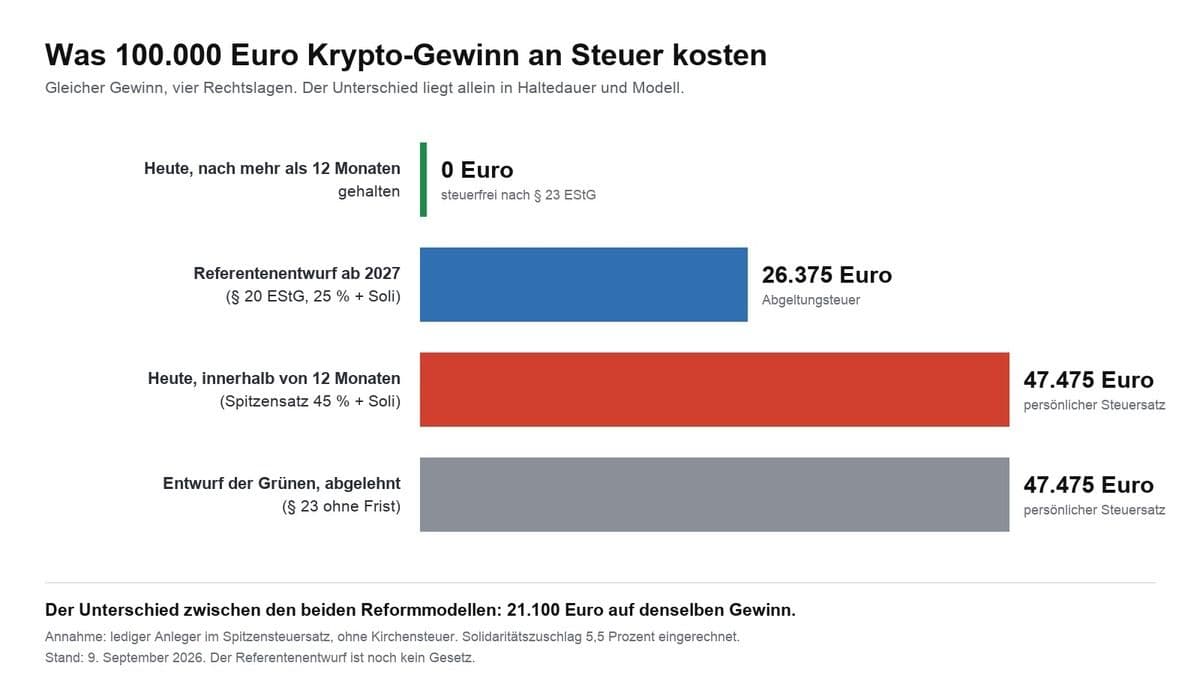
Crypto gains are tax-free after twelve months; before that your personal tax rate of up to 45 percent applies. What triggers tax, how the holding period is calculated, what happens with staking and losses, and what the draft bill would change from 2027.
September 22, 2026 1:37 AM

Swapping Bitcoin for Gold: What Happens for Tax in Germany
Moving from coins into gold is a sale in the eyes of the tax office, and the one-year period decides the bill. Where bars, gold ETCs and tokenised gold diverge for tax, and which records you need.
September 10, 2026 1:13 AM

Staking Taxes in Germany: The Inflow, the 256-Euro Threshold and the Holding Period
Staking is taxed twice: once when the reward arrives and once when you sell it later. This article explains both moments, the threshold of 256 euros, the separate twelve-month period and what applies to liquid staking, restaking and staking ETPs.
October 9, 2026 10:50 AM

Crypto holding period: the Bundestag rejects abolition by 445 votes to 132: what investors need to know
On 8 October the Bundestag rejected the Greens' bill to abolish the crypto holding period in a recorded vote, and the Left's motion fell too. The result by parliamentary group, the official speech from the media centre, and why it was the SPD that gave investors the real signal in the debate.
September 17, 2026 7:12 PM

Gifting Bitcoin to Children: Allowance, Holding Period and the Tax Office Report
Transferring Bitcoin to your child hands over your holding period and your entry price along with the coins. This guide sets out what really applies in Germany on the allowance, the reporting deadline, representation and custody.
September 16, 2026 1:20 PM

Crypto Loss Carryforward in Germany: What Happens to Old Losses Under the 2027 Tax Plan
Losses from crypto sales land in a ring-fenced pot and can only be set against gains of the same kind. The draft bill for 2027 moves future gains into a different pot, and we show you what that means for your assessed carryforward and what your tax notice should say.
September 19, 2026 7:26 AM

Offsetting Crypto Losses Against Share Gains: What Is Really Allowed in Germany
Crypto losses and share gains sit in separate loss buckets in Germany, and there is no offsetting between them. Where the line runs, why crypto derivatives are the exception, and how you can still use losses through carryback and carryforward.
August 16, 2026 6:14 AM
Crypto Credit Card Tax in Germany: Why Every Payment Is a Disposal
Paying with a crypto credit card means disposing of your coins for tax purposes. What that means for the holding period, the exemption threshold and your record-keeping duties, and which card design keeps the effort small.
September 10, 2026 7:14 AM

Bitcoin Loan Liquidated: Tax Consequences in Austria
If a lender liquidates Bitcoin pledged as loan collateral, a taxable capital gain can arise in Austria. That holds even when the investor never chose to sell.
September 27, 2026 10:35 AM

Crypto Exchange Tax Report Wrong: How to Correct It Before the Tax Office Does
Missing acquisition costs, transfers booked as sales, holding periods restarted: your exchange's report is an aid and not proof. How to check it, how to correct it and which deadline is running.
September 4, 2026 1:34 PM

Bitcoin as Loan Collateral: When No Tax Applies in Austria
Pledging Bitcoin as collateral for a loan? As long as the coins are not realised, no sale arises in Austria in principle.
August 14, 2026 6:23 AM

Bitcoin Savings Plan and Tax: How the Holding Period, FIFO and the Exemption Limit Interact on Monthly Buys
Every savings plan instalment is a separate acquisition for tax purposes, with a holding period of its own. How the exemption limit, the order of disposal and record-keeping duties interact on monthly Bitcoin buys, with the sources from the statute and the Ministry of Finance circular.
More from CryptoTicker