
Bitcoin as Loan Collateral: When No Tax Applies in Austria
Pledging Bitcoin as collateral for a loan? As long as the coins are not realised, no sale arises in Austria in principle.





Which topics should we dive deeper into?
Select what genuinely interests you. Your picks feed directly into our editorial planning.
Crypto news that's actually worth your time.
Weekly. 60 seconds. Carefully curated by our editors: no hype, no promo flood, no spam.
Bitcoin as Loan Collateral: When No Tax Arises in Austria
Owning Bitcoin, needing liquidity, and yet not wanting to sell the coins: crypto loans promise exactly that model. The investor pledges Bitcoin as collateral and receives euros or stablecoins as a loan in return. For tax purposes, the decisive question is what actually happens to the Bitcoin.
A mere pledge, in which the investor remains the beneficial owner and the coins are neither sold nor exchanged for another asset, does not in principle trigger a taxable realisation event.
Tax on Bitcoin generally arises on a realisation
Austrian crypto tax law captures in particular the following events:
- a sale for euros,
- an exchange for foreign currencies,
- an exchange for other assets,
- use as payment for services.
An exchange of one crypto asset for another, by contrast, remains tax-neutral in principle. Where Bitcoin is merely pledged as security or technically locked, and beneficial ownership does not pass to anyone else, such a sale or exchange is in principle absent.
The loan paid out is not automatically Bitcoin proceeds
An example:
- Bitcoin value: €50,000
- the investor pledges the coins as collateral
- loan amount: €20,000
The €20,000 is in principle not sale proceeds for the Bitcoin but the disbursement of a loan that has to be repaid later. The Bitcoin price gains accrued up to that point are therefore in principle not yet realised by the mere act of taking out the loan.
 To the Tax Tools Comparison
A Bitcoin liquidation is where it gets critical
That picture can change if the Bitcoin price falls and the lender realises the coins that were pledged as security. Where the Bitcoin is sold in the course of a liquidation or definitively transferred to the lender, a taxable realisation event can arise.
Example:
- acquisition cost of the pledged BTC: €15,000
- value at liquidation: €40,000
- economic realisation of the BTC to repay the loan
A taxable Bitcoin gain of €25,000 can then arise in principle. For taxable new assets the special tax rate of 27.5 percent applies in principle.
The terms of the Bitcoin loan contract are decisive
Not every product that is marketed as a “Bitcoin-backed loan” works the same way in legal terms.
The following in particular should be examined:
- Does the customer remain the beneficial owner of the BTC?
- Is the Bitcoin merely pledged or actually transferred?
- May the lender reuse the coins?
- Is there a claim to the return of the same coins or only of an equivalent quantity?
- What happens in a margin call?
- When may the collateral be liquidated?
Where the investor economically exchanges their Bitcoin for another asset as early as the start of the contract, the tax assessment can turn out differently from the outset.
To the Tax Tools ComparisonInterest is not part of the Bitcoin acquisition cost
The interest on the loan relates in principle to the financing of the arrangement and not to the acquisition of the Bitcoin that is already held. For private investment assets, the deduction of financing costs is in principle heavily restricted. A Bitcoin loan should therefore not be regarded as an instrument of tax structuring on account of possible interest costs alone.
Conclusion on Bitcoin as loan collateral in Austria
Pledging Bitcoin as loan collateral does not in principle trigger a taxable Bitcoin gain in Austria, provided the coins merely serve as security and no sale or tax-relevant change of ownership takes place. It becomes critical for tax purposes above all on a later liquidation, or under a contract structure in which the Bitcoin is economically transferred beforehand.
Transparency note: This article was produced with the assistance of artificial intelligence and reviewed by our editorial team before publication. All figures and claims were checked against the primary sources linked in the text.
More on Bitcoin: All Bitcoin news at a glance
Related articles
Which topics should we dive deeper into?
Select what genuinely interests you. Your picks feed directly into our editorial planning.
Crypto news that's actually worth your time.
Weekly. 60 seconds. Carefully curated by our editors: no hype, no promo flood, no spam.

August 10, 2026 5:15 PM

Bitcoin Lending in Austria: When Tax Falls Due
Lending Bitcoin and earning interest: when lending income is taxed at 27.5 percent in Austria and which exchange rate counts.
September 2, 2026 1:39 PM

Bitcoin as Salary in Austria: Which Taxes Arise?
Paid in Bitcoin? In Austria wage tax falls due on the value first. Later Bitcoin price gains can become taxable on top of that.
September 16, 2026 7:12 PM

Borrowing Against Bitcoin Instead of Selling: When German Tax Still Applies
Posting Bitcoin as collateral for a loan is not a sale in Germany, because section 39 of the Fiscal Code keeps the coins attributed to you for tax purposes. Tax arises only when the collateral is liquidated, and then the one thing that decides the bill is how long you held the coins beforehand.
August 18, 2026 7:13 AM

Bitcoin Tax Reporting in Austria 2026: What Applies
Bitcoin tax reporting in Austria: which data investors can request from crypto exchanges in 2026, and when the report matters for the tax return.
August 16, 2026 9:11 PM

Swapping Bitcoin for Stablecoins: Does Austria Charge Tax?
Anyone swapping bitcoin for USDT or another stablecoin usually pays no tax in Austria yet. When the swap does become taxable after all.
August 26, 2026 10:25 PM

Selling Bitcoin at a Loss: Loss Offsetting in Austria
Sold Bitcoin at a loss? Austria allows the loss to be offset against certain investment income. When loss offsetting is possible and which limits apply.
August 27, 2026 10:16 AM
Bitcoin Tax Return in Austria: When You Must File
Even with a crypto exchange, a tax return can still be necessary in Austria. Foreign platforms, missing capital gains tax withholding and cross-provider losses are the typical triggers.
August 21, 2026 1:33 PM

Bitcoin With No Cost Basis: How Austria Taxes the Sale
Bitcoin purchase price no longer provable? How Austria works out the capital gains tax, when a flat-rate cost basis applies and what investors can do.
September 11, 2026 10:18 AM

Bitcoin Tax Audit: What Proof Austria Requires
Which bitcoin records can the Austrian tax office examine? Purchase dates, wallet transfers, acquisition costs and sale proceeds are what count.
August 22, 2026 4:47 PM

Offsetting Bitcoin Losses Against Stock Gains in Austria
Offset bitcoin losses against gains on shares? Austria allows it in principle, but only under certain conditions and usually via the tax return.
September 1, 2026 1:25 PM

Bitcoin Tax Report Wrong: What Austrian Investors Can Do
Errors in a Bitcoin tax report are not unusual. This is the data Austrian investors should check, and how a wrong capital gains tax deduction is put right.
August 11, 2026 5:14 AM

Bitcoin Bought Before March 2021: Is the Sale Tax-Free in Austria?
Bought Bitcoin before March 2021? Why legacy holdings can still be sold tax-free in Austria in 2026, and which exceptions apply.
August 28, 2026 10:15 AM

Selling Bitcoin Privately: What Tax Applies in Austria
Selling bitcoin directly to another person? In Austria, private sales can still trigger 27.5 percent tax on the realised gain.
August 18, 2026 4:22 AM

Bitcoin for gold: is the swap taxable in Austria?
Swapping bitcoin directly for gold? In Austria this can already trigger 27.5 percent tax on the capital gain. What investors should know.
August 24, 2026 10:26 AM
Bitcoin Savings Plan in Austria: How the Purchase Price Is Calculated
Bought bitcoin through a savings plan? For multiple purchases Austria applies the moving average price as a matter of principle when working out taxable gains.
September 7, 2026 10:24 AM

Gifting Bitcoin to Children: Tax Rules in Austria
Giving bitcoin to your children? When a gift notification is required in Austria, and which acquisition costs the child takes over.
August 20, 2026 4:12 AM

Wrapped Bitcoin in Austria: Is Converting BTC to WBTC Tax-Neutral?
Swapping BTC for Wrapped Bitcoin: when the move to WBTC can be tax-neutral in Austria, and which tax risks investors should know about. Acquisition costs carry over, but the classification of the token decides the outcome.
September 8, 2026 1:25 PM

Bitcoin Mining in Austria: How Mining Rewards Are Taxed
Bitcoin mining in Austria: when mining rewards are taxed at 27.5 percent, and when a commercial activity brings the progressive income tax rate into play.
August 22, 2026 7:31 AM

Bitcoin Exit Tax in Austria: Which Value Counts?
Anyone emigrating from Austria with Bitcoin can trigger exit tax. What is decisive in principle is the market value at the moment the taxing right is lost.
August 17, 2026 10:24 PM

Bitcoin Capital Gains Tax in Austria: When Exchanges Withhold 27.5 Percent
When Austrian crypto exchanges deduct 27.5 percent capital gains tax automatically, which Bitcoin gains are affected and when investors have to declare the income themselves.
September 8, 2026 10:12 PM

Bitcoin at $78,741: How to Calculate When Your Crypto Loan Gets Liquidated
Anyone who borrowed against their Bitcoin instead of selling it faces the same question with every drop: at what price does the lender seize the collateral? We retrieved the published liquidation thresholds of eleven providers and show how to work out your own limit in two lines.
September 14, 2026 1:27 PM

Bitcoin Lost to a Scam: What Counts as a Tax Loss in Austria
Lost bitcoin to a scam? Why Austria generally does not recognise the damage as a tax loss for privately held assets, and when compensation payments start to matter.

August 20, 2024 3:00 PM

New US Senate Proposal Submitted For Crypto Tax Exemption
The US Senate has recently submitted a new proposal to exempt crypto transactions from federal taxes. Here are more details of this submission, and a list of exempted countries it could be joining...
September 3, 2026 10:21 AM

Bitcoin Lost in a Wallet Hack: What Tax Applies in Austria?
Bitcoin lost to hackers? In Austria, the theft of privately held coins generally does not create a capital loss you can use for tax. Only a later payout can change that.
September 9, 2026 4:22 PM
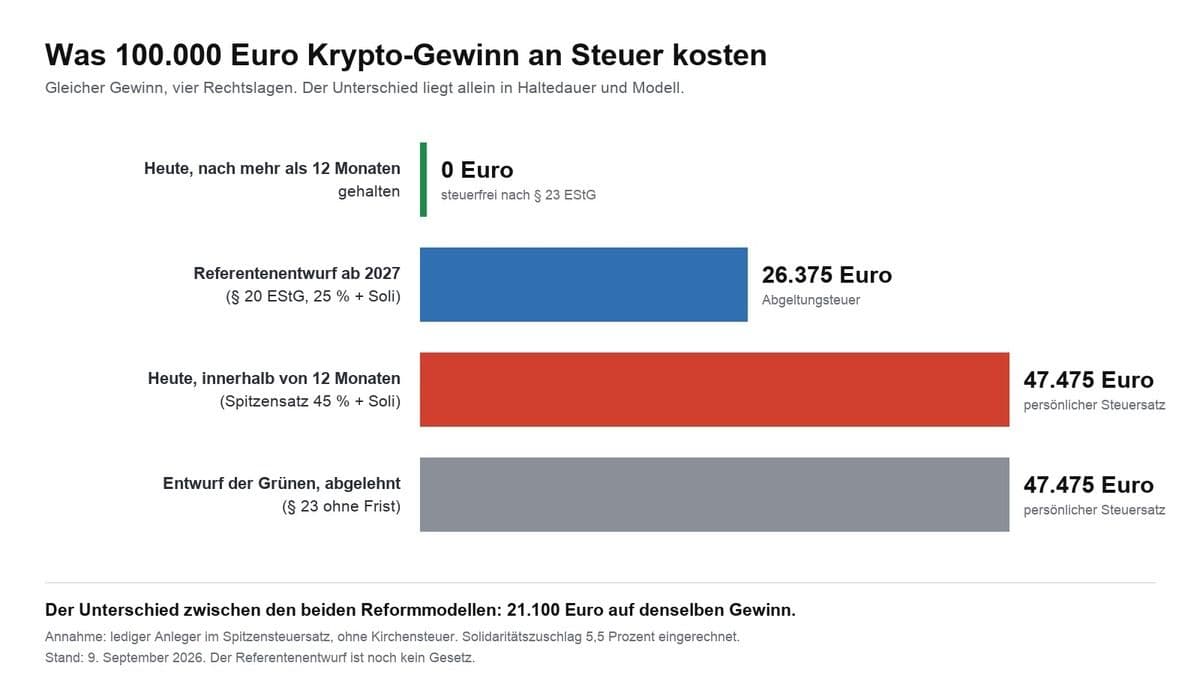
Crypto Tax in Germany: What Applies in 2026 and What Is Set to Change in 2027
Crypto gains are tax-free after twelve months; before that your personal tax rate of up to 45 percent applies. What triggers tax, how the holding period is calculated, what happens with staking and losses, and what the draft bill would change from 2027.
October 9, 2026 1:18 PM

Bitcoin Tax: One Year Past the $126,080 Peak, Losses No Longer Count
Bitcoin trades at $82,558 on Friday morning, 34.5 percent below an all-time high that is now a good year old. Anyone who bought back then loses more than the prospect of a quick recovery when the one-year period expires: the tax value of the loss goes with it.
August 31, 2026 10:30 PM

Taxing Crypto Lending: Your Personal Rate Instead of Withholding Tax, and the Right Federal Fiscal Court Case Number
According to the only tax court ruling so far, income from crypto lending falls under Section 22(3) of the German Income Tax Act and therefore under your personal tax rate. The appeal is pending at the Federal Fiscal Court under VIII R 22/25, not under the case number given in many professional articles.
More from CryptoTicker