
Bitcoin Savings Plan in Austria: How the Purchase Price Is Calculated
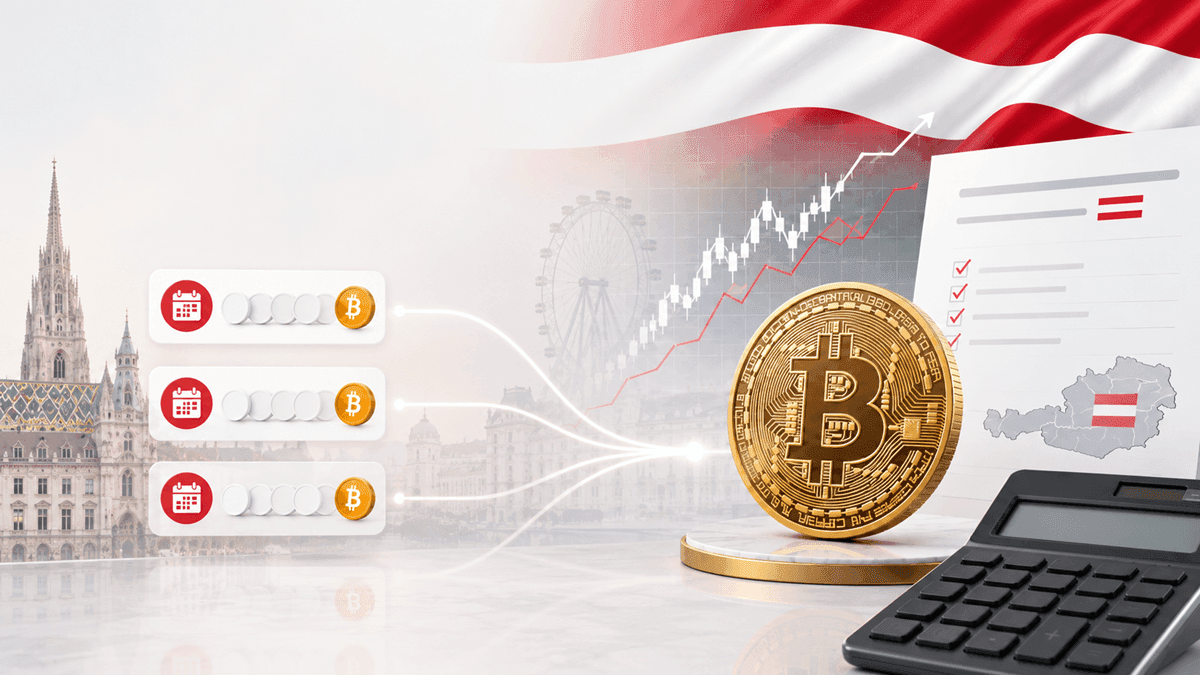
Bought bitcoin through a savings plan? For multiple purchases Austria applies the moving average price as a matter of principle when working out taxable gains.




Which topics should we dive deeper into?
Select what genuinely interests you. Your picks feed directly into our editorial planning.
Crypto news that's actually worth your time.
Weekly. 60 seconds. Carefully curated by our editors: no hype, no promo flood, no spam.
Bitcoin Savings Plan in Austria: How the Moving Average Price Is Calculated for Tax
Bitcoin savings plans spread the purchase across many individual transactions. Anyone investing 200 euros a month, for instance, inevitably buys their bitcoin at different prices. For the later tax calculation the question therefore arises: which purchase price applies when only part of the coins is sold?
Austria uses the moving average price for this as a matter of principle. Where units of the same cryptocurrency are acquired one after another and held at the same crypto address, their acquisition costs are merged into a single average price. With a wallet, the wallet as a whole can serve as the relevant reference unit instead.
How the Calculation Works
An investor buys through a savings plan:
- 0.01 BTC for 300 euros
- 0.01 BTC for 400 euros
- 0.01 BTC for 500 euros
In total they then hold 0.03 BTC with acquisition costs of 1,200 euros.
The moving average price therefore comes to:
1,200 euros ÷ 0.03 BTC = 40,000 euros per BTC
If the investor subsequently sells 0.01 BTC, acquisition costs of 400 euros are as a rule attributed to that portion.
What is not decisive, then, is whether the bitcoin sold are the ones bought first, last or at a particular price.
Every New Savings Plan Purchase Shifts the Average
The average price is not fixed for good. Every further purchase of the same cryptocurrency at the same relevant address or wallet changes it.
Anyone buying a further 0.01 BTC for 600 euros, for example, then holds:
- 0.04 BTC
- total acquisition costs: 1,800 euros
- new average price: 45,000 euros per BTC
At the next taxable sale this updated average price is used as a matter of principle. The Austrian crypto asset regulation prescribes this method both for the capital gains tax deduction and for the income tax assessment.
 To the Tax Tools Comparison
Several Wallets Can Carry Different Average Prices
Anyone spreading their savings plan holdings across several wallets should note that not all of a person's bitcoin are automatically merged into a single average price. The Austrian rules attach in principle to the respective crypto address or wallet. As a result, two wallets holding bitcoin belonging to the same person can carry different acquisition costs for tax purposes.
With an Austrian provider obliged to withhold capital gains tax, that provider may determine whether the individual address or the wallet as a whole is used as the reference unit. Once used, this reference unit is then also decisive for the assessment.
Legacy Bitcoin Holdings Are Treated Separately
One important exception concerns bitcoin acquired up to and including February 28, 2021. Such legacy assets are not included in the moving average price of the newer holdings. Bitcoin for which flat-rate acquisition costs were applied because tax data was missing likewise do not feed into the normal average price. Despite regular savings plan purchases, investors may therefore face a tax separation between older and newer holdings.
To the Tax Tools ComparisonWhen Does Tax Actually Arise?
The savings plan purchase itself does not as a rule trigger income tax on price gains. The holding becomes relevant for tax purposes above all on a later realisation, for instance on a sale for euros. For bitcoin acquired after February 28, 2021, realised gains are as a rule subject to the special tax rate of 27.5 percent. The holding period plays no role in principle.
Example:
- average acquisition costs: 40,000 euros per BTC
- sale of 0.1 BTC at a price of 70,000 euros
- sale proceeds: 7,000 euros
- acquisition costs: 4,000 euros
- taxable gain: 3,000 euros
At 27.5 percent this produces a tax of 825 euros as a matter of principle.
Conclusion
With a bitcoin savings plan, Austria does not work out the acquisition price for tax separately for each unit sold. For bitcoin of the same kind acquired one after another at the same relevant address or wallet, the moving average price applies in principle. Every new savings plan purchase shifts that average. Legacy holdings from before March 2021 and certain flat-rate valued holdings, by contrast, are treated separately. With long-running savings plans in particular, investors should therefore document purchase history, wallet transfers and the tax cost basis used in each case on a lasting basis.
(As of August 24, 2026. This article is not investment advice. Prices and fee structures change; check the terms with the provider before you buy.)
Transparency note: This article was produced with the assistance of artificial intelligence and reviewed by our editorial team before publication. All figures and claims were checked against the primary sources linked in the text.
More on Bitcoin: All Bitcoin news at a glance
Related articles
Which topics should we dive deeper into?
Select what genuinely interests you. Your picks feed directly into our editorial planning.
Crypto news that's actually worth your time.
Weekly. 60 seconds. Carefully curated by our editors: no hype, no promo flood, no spam.

August 18, 2026 7:13 AM

Bitcoin Tax Reporting in Austria 2026: What Applies
Bitcoin tax reporting in Austria: which data investors can request from crypto exchanges in 2026, and when the report matters for the tax return.
September 11, 2026 10:18 AM

Bitcoin Tax Audit: What Proof Austria Requires
Which bitcoin records can the Austrian tax office examine? Purchase dates, wallet transfers, acquisition costs and sale proceeds are what count.
October 6, 2026 1:23 AM

50 euros a month in Bitcoin, 118 instalments since 2017: savings plan vs lump sum
118 monthly instalments of 50 euros since January 2017 add up to €5,900 paid in and around €54,500 today. The same instalment since January 2024 is up only 14.5 percent, and since October 2025 the savings plan beats the lump sum by almost 39 percentage points.
August 11, 2026 5:14 AM

Bitcoin Bought Before March 2021: Is the Sale Tax-Free in Austria?
Bought Bitcoin before March 2021? Why legacy holdings can still be sold tax-free in Austria in 2026, and which exceptions apply.
August 22, 2026 7:31 AM

Bitcoin Exit Tax in Austria: Which Value Counts?
Anyone emigrating from Austria with Bitcoin can trigger exit tax. What is decisive in principle is the market value at the moment the taxing right is lost.
September 24, 2026 10:19 PM

Bitcoin for Retirement: What Applies from 2027 and What You Decide Now
Bitcoin is not permitted in any state-subsidised retirement product, including the new retirement savings account from 2027. Anyone who still wants to use crypto assets for their own pension goes through private assets, and there a cutoff date at the end of 2026 is shifting the tax rules right now.
August 12, 2026 9:12 AM

Bitcoin Losses and Dividends in Austria: How the Tax Offset Works
Can a Bitcoin loss be offset against dividends? This is how loss offsetting works in Austria. It also shows when a tax return is needed for it.

September 20, 2026 1:11 PM

Bitcoin Golden Cross: What Twelve Signals Since 2014 Really Show
Bitcoin's 50-day line has crossed its 200-day line. We evaluated all twelve golden crosses since 2014 ourselves and measured what happened afterwards. The result argues against the common reading of the signal.
August 14, 2026 6:18 PM

Bitcoin From a Foreign Exchange to Austria: Which Tax Data You Need
Transferring Bitcoin from a foreign exchange to an Austrian platform: which tax data can be missing for the withholding tax. And what investors need to watch out for.
August 26, 2026 10:25 PM
Selling Bitcoin at a Loss: Loss Offsetting in Austria
Sold Bitcoin at a loss? Austria allows the loss to be offset against certain investment income. When loss offsetting is possible and which limits apply.
September 19, 2026 7:12 PM

Bitcoin Sold Without Austrian Tax Withheld: What to Do Next
Sold Bitcoin but no Austrian capital gains tax was withheld? That does not make the sale tax free. When investors have to declare the gain themselves at 27.5 percent.
August 27, 2026 10:16 AM
Bitcoin Tax Return in Austria: When You Must File
Even with a crypto exchange, a tax return can still be necessary in Austria. Foreign platforms, missing capital gains tax withholding and cross-provider losses are the typical triggers.
August 22, 2026 4:47 PM

Offsetting Bitcoin Losses Against Stock Gains in Austria
Offset bitcoin losses against gains on shares? Austria allows it in principle, but only under certain conditions and usually via the tax return.
September 10, 2026 7:14 AM

Bitcoin Loan Liquidated: Tax Consequences in Austria
If a lender liquidates Bitcoin pledged as loan collateral, a taxable capital gain can arise in Austria. That holds even when the investor never chose to sell.
September 4, 2026 1:34 PM

Bitcoin as Loan Collateral: When No Tax Applies in Austria
Pledging Bitcoin as collateral for a loan? As long as the coins are not realised, no sale arises in Austria in principle.
August 31, 2026 10:23 AM

Bitcoin Abroad: The Tax Duty Austrian Investors Carry Themselves
Sold bitcoin through a foreign platform? When Austrian investors have to declare gains themselves and account for the 27.5 percent tax rate.

August 20, 2024 3:00 PM

New US Senate Proposal Submitted For Crypto Tax Exemption
The US Senate has recently submitted a new proposal to exempt crypto transactions from federal taxes. Here are more details of this submission, and a list of exempted countries it could be joining...
September 18, 2026 10:14 PM

Bitcoin Back Above $80,000: Buy More, Hold or Take Profits? What to Check Now
Bitcoin is back above $80,000, for the first time since September 7. Whether you buy more, hold or take profits depends less on the daily price than on three things you can check yourself: your holding period, the way you buy, and where your coins are kept.
August 24, 2026 10:29 AM

Buying More Bitcoin at $77,000: Savings Plan or Lump Sum
Bitcoin stands at $77,256 after gaining 22.78 percent in a week. This guide shows you how to buy more cleanly at this price and which method fits which starting position.
August 18, 2026 4:22 AM

Bitcoin for gold: is the swap taxable in Austria?
Swapping bitcoin directly for gold? In Austria this can already trigger 27.5 percent tax on the capital gain. What investors should know.
August 17, 2026 10:24 PM
Bitcoin Capital Gains Tax in Austria: When Exchanges Withhold 27.5 Percent
When Austrian crypto exchanges deduct 27.5 percent capital gains tax automatically, which Bitcoin gains are affected and when investors have to declare the income themselves.
September 14, 2026 1:27 PM

Bitcoin Lost to a Scam: What Counts as a Tax Loss in Austria
Lost bitcoin to a scam? Why Austria generally does not recognise the damage as a tax loss for privately held assets, and when compensation payments start to matter.

September 24, 2026 1:34 PM

Cardano Slides Below $0.24: What ADA Holders Should Check on Leverage, Liquidation and Holding Period
Cardano has given back its move above $0.25 and trades around seven percent below the high of the past 24 hours. What that means for leveraged positions, the holding period of your tranches and the buying route under MiCA.
October 19, 2026 4:15 AM

Crypto FIFO across several exchanges: each wallet counts on its own in Germany
Hold bitcoin on several exchanges and in wallets of your own, and the holding period is calculated per pot, not across the total holding. What paragraph 62 of the BMF guidance orders, and why 31 December 2026 hangs on it.
October 19, 2026 7:22 AM

Bitcoin price at $82,769 after two days on a third of the turnover: the level that decides
Bitcoin opens the week at $82,769, 1.6 percent above Friday's close. The gain was built over two days running on a good third of the usual turnover, and that is exactly why the level at $81,501 now decides.


More from CryptoTicker