
Bitcoin Exit Tax in Austria: Which Value Counts?
Anyone emigrating from Austria with Bitcoin can trigger exit tax. What is decisive in principle is the market value at the moment the taxing right is lost.





Which topics should we dive deeper into?
Select what genuinely interests you. Your picks feed directly into our editorial planning.
Crypto news that's actually worth your time.
Weekly. 60 seconds. Carefully curated by our editors: no hype, no promo flood, no spam.

Emigrating from Austria With Bitcoin: Which Value Counts for Tax
Anyone leaving Austria and taking sizeable Bitcoin holdings along does not have to sell first for a tax question to arise. If Austria loses its right to tax a later Bitcoin gain because of the departure, the so-called exit tax, or deemed disposal taxation, can apply.
For tax purposes the calculation is then made, in principle, as if the Bitcoin concerned had been sold at the moment of departure. The deemed sale proceeds are the fair value, that is in principle the market value, at that moment.
What Counts Is Not the Original Purchase Price on the Day of Departure
Suppose an investor bought Bitcoin for €20,000. At the point of departure from Austria that is decisive for tax, the coins are worth €70,000.
In simplified terms this gives:
- acquisition cost: €20,000
- market value on departure: €70,000
- increase in value accrued up to departure: €50,000
For exit taxation it is in principle this increase in value, accrued up to the loss of the Austrian taxing right, that is considered. For taxable new crypto assets the special tax rate of 27.5 percent applies in principle. Cryptocurrencies are expressly among the assets covered by the Austrian deemed disposal rules.
Which Day Determines the Bitcoin Price?
It is not necessarily the day of the flight, the deregistration or the change of home that decides.
What matters in principle is the moment at which Austria loses its right to tax a later disposal gain. That can happen in particular through a change of tax residence. Double taxation treaties regularly assign the right to tax disposal gains to the state of residence.
For Bitcoin investors it is therefore important to document the relevant moment cleanly. That includes in particular the holding, the acquisition costs and a verifiable Bitcoin market value on that date.
Moving Within the EU or the EEA: Tax Can Be Deferred
Where a private individual departs to an EU or EEA state, an important relief is available.
In the Austrian tax return it is in principle possible to apply for the tax arising from the departure not to be assessed for the time being. Taxation is thereby regularly deferred until a later triggering event, in particular an actual disposal.
That means: even though the increase in value is in principle determined at departure, the tax does not necessarily have to be paid immediately in the case of a privileged EU or EEA departure.
 To the tax tool comparison
Departure to a Third Country Can Look Different
If, on the other hand, the investor moves to a state outside the EU and EEA area, non-assessment under this rule is in principle not available.
The departure can then lead to the increase in value accrued up to that point being captured for tax immediately. The Austrian finance ministry explains this principle for departures to the United Kingdom after Brexit, for example: because the EU and EEA conditions are no longer met, the increase in value is in principle taxable at once.
With large Bitcoin holdings in particular, the choice of the new country of residence can therefore have a considerable effect on liquidity.
Stricter Proof Obligations Have Applied Since July 2026
Austria tightened its exit taxation in 2026.
For new non-assessments decided after 30 June 2026, a recurring obligation to provide proof applies to larger amounts. Where the income determined on departure, or on a comparable transfer, totals more than €100,000, it must regularly be demonstrated that no event has yet occurred that would trigger the later assessment of the tax.
According to the legislative materials, suitable account, custody or comparable confirmations can serve as proof. With cryptocurrencies, verifiable wallet and transaction documentation will be correspondingly important in practice.
Where a prescribed recurring proof obligation is not met, this can itself trigger the assessment of the tax previously not assessed.
A Later Fall in Price Can Become Relevant
Exit taxation is in principle intended to capture the increase in value that arose while the Austrian taxing right applied.
Where non-assessment has been applied for and a sale follows later, the further development in value can therefore also become relevant. The Austrian income tax guidelines contain examples in which, where the later sale price is lower, the increase in value present at the time of departure is not in every case taxed unchanged.
The actual calculation, however, depends on how the departure was structured and on the later disposal.
What Applies to Legacy Bitcoin Holdings?
A departure should be examined with particular care where the Bitcoin was acquired up to and including 28 February 2021.
Such coins count in principle as legacy holdings and do not automatically fall under the Austrian crypto tax regime in force since 2022. Whether a taxable hidden reserve actually exists on departure therefore also depends on whether a later sale would have been taxable in Austria at all.
For new assets acquired after 28 February 2021 the situation is clearer: realised gains in value fall in principle under the modern crypto tax regime at 27.5 percent.
To the tax tool comparisonThese Records Should Be Secured Before Departure
Anyone emigrating from Austria with larger Bitcoin holdings should document the following in particular before changing tax residence:
- Bitcoin quantity at the relevant moment
- all wallets and exchange accounts
- original acquisition costs
- date of acquisition
- legacy or new holding status
- Bitcoin market value on departure
- the price source used
- earlier crypto-to-crypto swaps
- transaction histories and wallet addresses
- later sales after the departure
For an application for non-assessment in particular, this documentation can still be relevant years after the move itself.
Conclusion
Anyone emigrating from Austria with Bitcoin should not keep an eye on the later sale alone. If Austria loses its taxing right because of the departure, the departure itself can already be treated for tax like a deemed disposal.
What is decisive in principle is the market value of the Bitcoin at the moment Austria loses its taxing right.
On departure to an EU or EEA state, non-assessment of the tax can be applied for until a later realisation event. Since July 2026, additional recurring proof obligations apply to non-assessment amounts with income of more than €100,000.
On departure to a third country, by contrast, the tax can in principle already fall due on departure. With Bitcoin holdings that have risen sharply in particular, the tax treatment should therefore be clarified before the change of residence.
(As of August 20, 2026. This article is not investment advice. Prices and fee structures change; check the terms with the provider before you buy.)
Transparency note: This article was produced with the assistance of artificial intelligence and reviewed by our editorial team before publication. All figures and claims were checked against the primary sources linked in the text.
More on Bitcoin: All Bitcoin news at a glance
Related articles
Which topics should we dive deeper into?
Select what genuinely interests you. Your picks feed directly into our editorial planning.
Crypto news that's actually worth your time.
Weekly. 60 seconds. Carefully curated by our editors: no hype, no promo flood, no spam.

September 19, 2026 7:12 PM

Bitcoin Sold Without Austrian Tax Withheld: What to Do Next
Sold Bitcoin but no Austrian capital gains tax was withheld? That does not make the sale tax free. When investors have to declare the gain themselves at 27.5 percent.
August 21, 2026 1:33 PM

Bitcoin With No Cost Basis: How Austria Taxes the Sale
Bitcoin purchase price no longer provable? How Austria works out the capital gains tax, when a flat-rate cost basis applies and what investors can do.
September 11, 2026 10:18 AM

Bitcoin Tax Audit: What Proof Austria Requires
Which bitcoin records can the Austrian tax office examine? Purchase dates, wallet transfers, acquisition costs and sale proceeds are what count.
August 10, 2026 9:15 PM
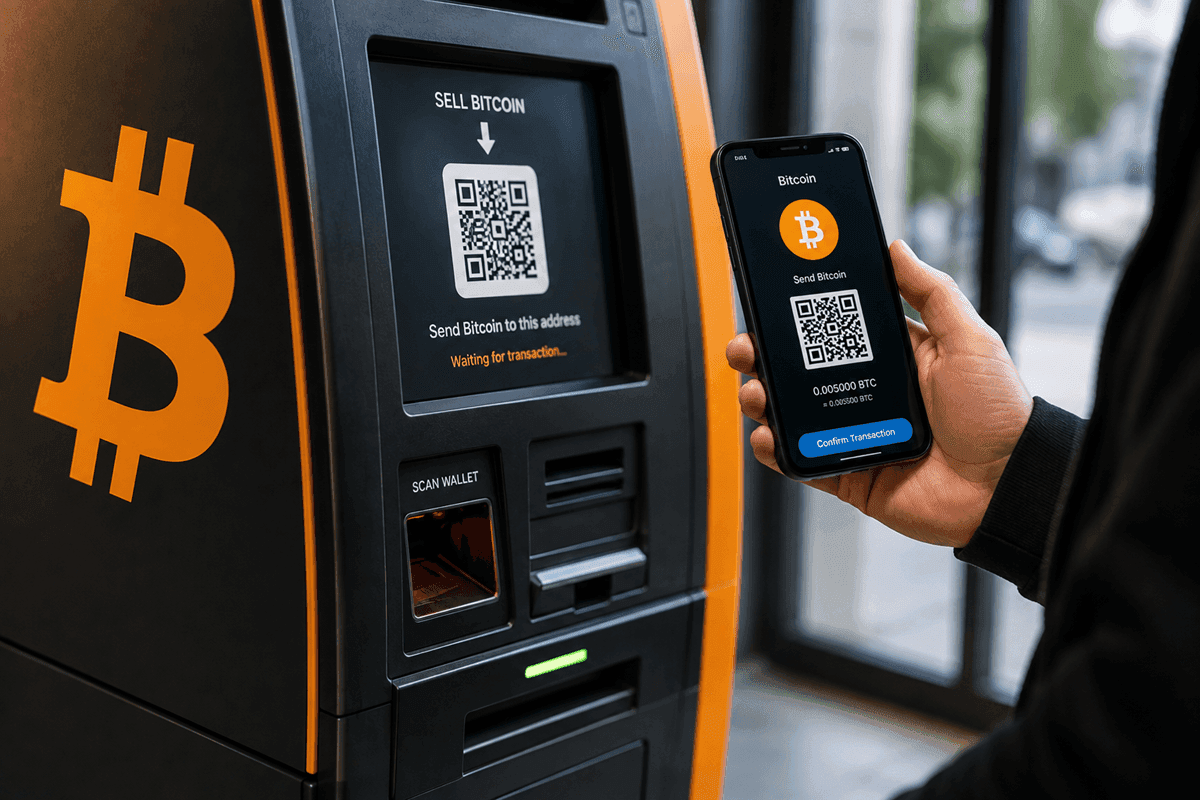
Selling Bitcoin at an ATM: Tax Rules in Austria
Selling bitcoin for cash at an ATM: when the 27.5 percent rate applies in Austria and which records you need to keep.
August 22, 2026 4:47 PM

Offsetting Bitcoin Losses Against Stock Gains in Austria
Offset bitcoin losses against gains on shares? Austria allows it in principle, but only under certain conditions and usually via the tax return.
September 10, 2026 7:14 AM

Bitcoin Loan Liquidated: Tax Consequences in Austria
If a lender liquidates Bitcoin pledged as loan collateral, a taxable capital gain can arise in Austria. That holds even when the investor never chose to sell.
September 1, 2026 1:25 PM

Bitcoin Tax Report Wrong: What Austrian Investors Can Do
Errors in a Bitcoin tax report are not unusual. This is the data Austrian investors should check, and how a wrong capital gains tax deduction is put right.
September 4, 2026 1:34 PM

Bitcoin as Loan Collateral: When No Tax Applies in Austria
Pledging Bitcoin as collateral for a loan? As long as the coins are not realised, no sale arises in Austria in principle.
August 31, 2026 10:23 AM

Bitcoin Abroad: The Tax Duty Austrian Investors Carry Themselves
Sold bitcoin through a foreign platform? When Austrian investors have to declare gains themselves and account for the 27.5 percent tax rate.
September 7, 2026 10:24 AM

Gifting Bitcoin to Children: Tax Rules in Austria
Giving bitcoin to your children? When a gift notification is required in Austria, and which acquisition costs the child takes over.
September 18, 2026 10:13 AM

Bitcoin and the German Exit Tax: What Applies When You Move Abroad
Anyone emigrating with Bitcoin expects an exit tax on unrealised gains and finds nothing of the sort in the statute. Where the real risks sit is decided at four points: residence, the holding period, the legal form of your investment, and automatic reporting from 2026.
August 16, 2026 9:11 PM
Swapping Bitcoin for Stablecoins: Does Austria Charge Tax?
Anyone swapping bitcoin for USDT or another stablecoin usually pays no tax in Austria yet. When the swap does become taxable after all.
August 17, 2026 10:24 PM

Bitcoin Capital Gains Tax in Austria: When Exchanges Withhold 27.5 Percent
When Austrian crypto exchanges deduct 27.5 percent capital gains tax automatically, which Bitcoin gains are affected and when investors have to declare the income themselves.

January 22, 2026 9:59 AM

Netherlands to Tax Unrealized Crypto Gains: What You Need to Know
The Netherlands is moving toward taxing unrealized crypto gains by 2028. Learn how the new "Box 3" system impacts your Bitcoin and digital assets.
September 16, 2026 7:12 PM

Borrowing Against Bitcoin Instead of Selling: When German Tax Still Applies
Posting Bitcoin as collateral for a loan is not a sale in Germany, because section 39 of the Fiscal Code keeps the coins attributed to you for tax purposes. Tax arises only when the collateral is liquidated, and then the one thing that decides the bill is how long you held the coins beforehand.
September 25, 2026 10:14 PM

Sequans sells its last 314 bitcoin: what to check if you hold a treasury stock
Semiconductor maker Sequans has wound down its bitcoin reserve completely, 15 months after setting a target of one hundred thousand coins. What the case reveals about treasury stocks, and which tax rule applies to the share and to the coin.
September 25, 2026 10:26 PM

Selling bitcoin privately: the tax in Germany and the records you need
A direct sale to a private individual falls under the same one-year rule as an exchange sale, but there is no tax report to go with it. This guide walks through the calculation, the 1,000 euro threshold and the records the tax office wants to see.
September 14, 2026 1:27 PM

Bitcoin Lost to a Scam: What Counts as a Tax Loss in Austria
Lost bitcoin to a scam? Why Austria generally does not recognise the damage as a tax loss for privately held assets, and when compensation payments start to matter.
August 20, 2024 3:00 PM

New US Senate Proposal Submitted For Crypto Tax Exemption
The US Senate has recently submitted a new proposal to exempt crypto transactions from federal taxes. Here are more details of this submission, and a list of exempted countries it could be joining...
September 3, 2026 10:21 AM

Bitcoin Lost in a Wallet Hack: What Tax Applies in Austria?
Bitcoin lost to hackers? In Austria, the theft of privately held coins generally does not create a capital loss you can use for tax. Only a later payout can change that.
September 9, 2026 4:13 PM

Bitcoin 29 Percent Below Last Year: Which Crypto Losses You Can Still Use Before the One-Year Holding Period Expires
Nine out of ten major crypto assets trade lower today than exactly twelve months ago, Bitcoin alone by 29.2 percent. We measured the price series ourselves and show why the purchase date alone decides the tax value of your loss.
September 9, 2026 4:22 PM
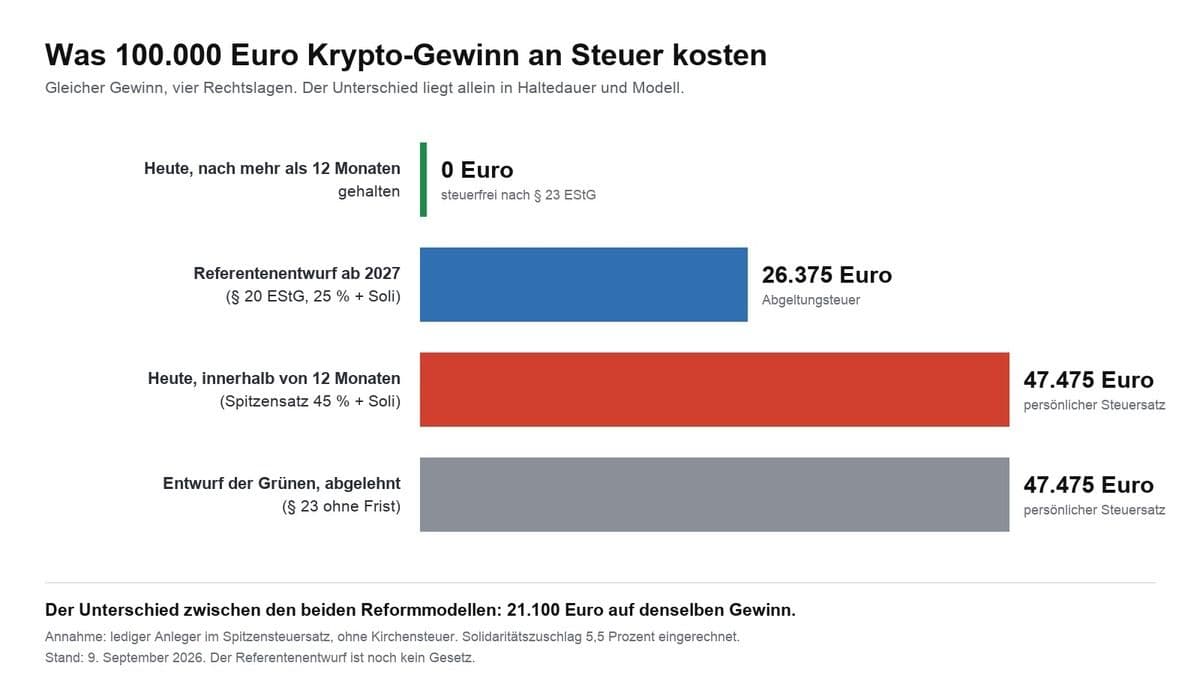
Crypto Tax in Germany: What Applies in 2026 and What Is Set to Change in 2027
Crypto gains are tax-free after twelve months; before that your personal tax rate of up to 45 percent applies. What triggers tax, how the holding period is calculated, what happens with staking and losses, and what the draft bill would change from 2027.
September 8, 2026 1:25 PM
Bitcoin Mining in Austria: How Mining Rewards Are Taxed
Bitcoin mining in Austria: when mining rewards are taxed at 27.5 percent, and when a commercial activity brings the progressive income tax rate into play.
September 2, 2026 1:39 PM

Bitcoin as Salary in Austria: Which Taxes Arise?
Paid in Bitcoin? In Austria wage tax falls due on the value first. Later Bitcoin price gains can become taxable on top of that.
October 9, 2026 1:18 PM

Bitcoin Tax: One Year Past the $126,080 Peak, Losses No Longer Count
Bitcoin trades at $82,558 on Friday morning, 34.5 percent below an all-time high that is now a good year old. Anyone who bought back then loses more than the prospect of a quick recovery when the one-year period expires: the tax value of the loss goes with it.
September 9, 2026 1:15 AM

Germany's Crypto Tax: 160 Million Euros for a 555-Billion Budget
The German finance ministry's draft bill puts a figure on the crypto tax for the first time: 160 million euros from 2028. What that number means in the 2027 federal budget, how 11.4 billion became 160 million, and what investors can read from it.

More from CryptoTicker