
Crypto as a Down Payment for a German Mortgage: What Banks Require
Since April 2023 a house in Germany can no longer be paid for in Bitcoin; section 16a of the Money Laundering Act bans it outright. Your crypto holdings still work as a down payment, provided you take the route through the euro and prove the origin without gaps.





Which topics should we dive deeper into?
Select what genuinely interests you. Your picks feed directly into our editorial planning.
Crypto news that's actually worth your time.
Weekly. 60 seconds. Carefully curated by our editors: no hype, no promo flood, no spam.
No, you cannot buy a house in Germany with Bitcoin. Since April 1, 2023, section 16a of the German Money Laundering Act has banned exactly that: the purchase price for a domestic property may not be settled in cash, nor in crypto-assets, gold, platinum or gemstones, whatever the amount involved. Your Bitcoin holdings still work as a down payment for a mortgage, but only along a single route: you sell them, have the euro amount paid into an account in your own name, and prove to the bank and the notary, without gaps, where the money came from.
That shifts the real task away from the purchase and towards the paperwork. Anyone who has moved coins across several wallets and exchanges over the years rarely fails on the value of the portfolio, and almost always on the missing proof of origin. This article sets out what German banks accept as a down payment, which documents close the chain, how the holding period changes the sum available to you, and in which order to proceed.
Can you pay for a property in Germany directly with Bitcoin?
The short answer is no. The reason lies in an explicit statutory rule, not in the convenience of the banks. The Money Laundering Act, GwG for short, is the German law that requires banks, notaries and other obliged parties to check and document the origin of the assets used. Since 2023 it has contained a prohibition of its own for property transactions.
In practice that means: even if a seller were willing to accept coins, and even if both sides recorded it in the purchase contract, the transaction could not be validly performed. The notary who applies for the transfer of title at the land registry must be shown evidence of the non-cash payment. Without that evidence the transfer cannot proceed, and without the transfer you do not become the owner.
The reverse idea does not hold either. Some buyers hope that part of the purchase price could be settled in coins at the notary's desk and only the remainder through the bank. The prohibition recognises no de minimis threshold. It applies to the obligation as a whole, and therefore to a small part-payment as well.
What section 16a of the Money Laundering Act has banned since April 1, 2023
The provision applies to legal transactions covering the purchase or exchange of domestic property, and to the acquisition of shares in companies whose assets include domestic property. The obligation owed may only be discharged by means other than cash, crypto-assets, gold, platinum or gemstones. The wording can be read at the federal justice ministry in the official text of section 16a GwG.
The consequence of a breach is more unpleasant than many expect. A prohibited payment does not render the purchase contract void, but the payment loses its discharging effect. In legal terms: the seller's claim to the purchase price continues to exist. Anyone who has paid in coins has therefore not paid the price in law and owes it again, while the transferred holdings can only be recovered under the general law of unjust enrichment. For a financing running into several hundred thousand euros, that is a risk out of all proportion to the effort of an ordinary bank transfer.
One detail often gets lost in advice: the rule applies only to legal transactions concluded on or after April 1, 2023. It does not apply to older contracts. Since the provision has now been in force for more than three years, only residual cases are affected today.

What counts as a down payment at the bank and what counts as collateral
Two terms are constantly confused in conversations with the bank, and the confusion costs negotiating position. A down payment is the freely available funds you contribute to the property financing yourself, reducing the loan amount required. Collateral, by contrast, is an asset the bank may seize in an emergency, without it reducing the loan amount. In a classic property loan the collateral is the property itself, registered by way of a land charge.
Crypto holdings can count towards the down payment once converted into euros. As collateral they are of practically no use at German banks. The building society Schwäbisch Hall puts it plainly in its guide on cryptocurrency as equity: Bitcoin as security for a loan has so far been rejected by the banks. As a source of equity, the route is open, but only through conversion into euros.
How large a down payment you need depends on the house, your income and the credit terms. Advisory practice works on the rule of thumb that the incidental purchase costs should come entirely from your own funds, plus roughly twenty percent of the purchase price. Those incidental costs are no sideshow: land transfer tax ranges from 3.5 to 6.5 percent depending on the federal state, notary and land registry account for around 1.5 to 2 percent, and where an agent is involved further percentage points are added. Together that lands at roughly 9 to 15 percent of the purchase price, depending on location and who is involved.
 Where to sell Bitcoin with clean records
Why banks do not accept crypto holdings as collateral
The reason lies in the valuation logic of property financing. Banks work with the mortgage lending value, a deliberately conservative figure that should still be achievable in a weak property market. It regularly sits below the market value of the property. For a residential building, that figure can be derived plausibly through a valuation using comparable properties, replacement cost and income capitalisation.
Crypto holdings resist that logic on several counts at once. The price can move by double-digit percentages within days, which makes any valuation on a thirty-year horizon questionable. Enforcement in the event of default is legally cumbersome, because the bank can realise nothing without the private key. And any realisation would have to run through a trading venue whose liquidity is not guaranteed. A land charge has the land registry behind it; a wallet has no equivalent.
This reticence is no verdict on crypto as an asset class. Deutsche Bank announced custody of Bitcoin, Ether and selected stablecoins for institutional clients from 2026. Custody for large clients and acceptance as loan collateral in retail banking are two different things, though, and the second does not automatically follow from the first.
How crypto holdings become a recognised down payment: the route through the euro
The sequence is unspectacular, and that is precisely its strength. You sell the amount you need on an exchange or through a broker, have the euro equivalent paid out to an account in your own name, and bring that amount into the financing as your down payment. What matters is that the payout goes to your own account and not to a third party's. Every intermediate step through another person tears open the chain of evidence and creates exactly the suspicion the Money Laundering Act is aimed at.
One point deserves more attention than it usually gets: the choice of trading venue. An exchange based and authorised in the EU gives you machine-readable annual statements, trading histories and payout records in a form a bank accepts. A provider without European authorisation often does not, and a later export can turn out to be impossible if an account has been frozen or a service discontinued. So if the sale is still ahead of you, it is worth looking at our crypto exchange comparison with documentation in mind, and not only fees. The difference between two providers here is not measured in tenths of a percent, but in whether the financing goes through.
Allow time as well. Between the sell order, the credit to the reference account and the onward transfer to your own current account, several working days pass depending on provider and amount. With larger sums, checks are added that extend the process.
What proof of source of funds banks and notaries require for crypto
Proof of source of funds is the evidence showing where the money used came from. It is no formality to be dealt with by way of a screenshot. The review is risk-based: the more conspicuous a transaction looks, the deeper the bank and the notary probe. A six-figure euro amount arriving from a crypto exchange shortly before a property purchase reliably falls into the higher risk class.
What is typically required is a closed chain: wallet, then exchange, then your own bank account, then the notary's escrow account or the seller. Each transition needs its own record. Completeness is what counts, not the volume of paper. A single transfer confirmation does not answer the question of origin, because it shows only the final step.
This scrutiny does not only reach you when buying property, incidentally. In the opposite direction, when depositing funds at an exchange, a query about the source of funds can trigger a freeze. How that plays out and which documents help there is described in our article on a crypto deposit frozen over the source of funds. The logic is the same; only the direction of the money flow differs.
Which documents prove the chain from wallet to exchange to account
Gather the records before the first meeting with the bank, not after. An application that goes into a second round for want of documents loses time and often the interest rate initially offered. These are the documents asked for in practice:
- The complete trading history from the exchange as a machine-readable export, not as a screenshot. A CSV export can be checked; a photograph cannot.
- Purchase records for the original acquisition, ideally with date, quantity and euro equivalent.
- Bank statements showing the deposit made to the exchange at the time, that is, the origin of the money originally used.
- Wallet addresses and transaction identifiers for movements that ran outside an exchange.
- The exchange's payout record for the sale, together with the matching statement from your current account.
- For coins from mining, staking or airdrops, the relevant statements, because such inflows are treated differently for tax than a purchase.
A gap is not the end of the world, but it has to be explicable. A discontinued exchange, a lost login or a wallet from the early years all happen. Write such cases up in advance in a short, factual note and attach whatever still exists. A gap that is named openly and explained plausibly is usually accepted; one passed over in silence leads to a query at the worst possible moment.
How the holding period under section 23 of the Income Tax Act decides your available sum
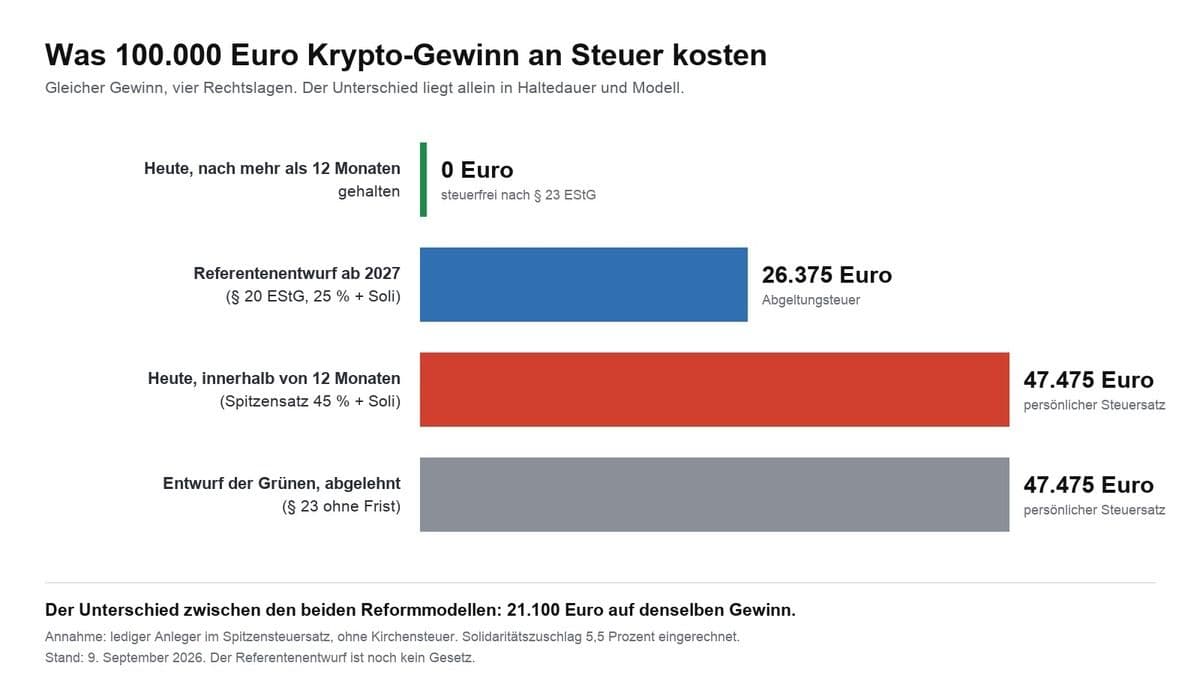
Selling for your own home is, for tax purposes, a private disposal transaction. The governing provision is section 23 of the Income Tax Act, which can be read in the official text of section 23 EStG. The holding period is the span between the acquisition and the sale of a coin position. Where more than a year lies between the two, the gain is entirely tax-free, with no upper limit. Sell within the year and your personal income tax rate applies.
Beneath that sits an exemption limit of 1,000 euros a year. The difference from an allowance is decisive and is constantly confused: with an allowance, that amount would always stay tax-free and only the excess would be taxable. With an exemption limit, the treatment flips as soon as the limit is reached. A gain of 999 euros stays untaxed; a gain of 1,010 euros is taxable in full. For a financing where every available euro counts, that is a figure worth knowing in advance.
The calculation becomes concrete once you run it against your own holdings. Suppose you need 80,000 euros as a down payment and hold positions from two different years. The older ones are past the one-year mark and deliver their amount tax-free. The younger ones trigger a tax charge at your personal rate, falling due the following year, which you have to set aside. Sell the younger ones first and you will later be short of money you had long since earmarked. Which position was acquired when therefore helps determine your financing sum and is no mere bookkeeping question. Anyone who has accumulated many transactions over the years will not get around a clean schedule; a look at the crypto tax software and portfolio trackers saves weeks of manual work here and supplies at once the records the bank and the tax office want to see.
Why the sale belongs before the financing meeting
Banks work with euro amounts sitting in an account. A portfolio carrying price risk does not appear as a down payment in the affordability calculation, because its value on the day the loan is paid out may differ from its value on the day of the meeting. Walking into the advice session with a portfolio statement and planning the sale only after approval means negotiating over funds that do not yet exist for the bank.
The opposite mistake is just as expensive. Selling before a property is even in sight means bearing the tax consequence and giving up any price movement, without gaining planning certainty in return. The sensible moment lies between the two: once a specific property has been found and the financing request is being prepared, but before the documents are submitted. Then the amount is fixed, the records are fresh, and the bank sees a figure rather than an intention.
What the banks' three-month rule means for your bank statements
Many institutions ask for the last three months of bank statements in order to assess income, spending and the origin of the down payment. A larger inflow from a crypto exchange within that window inevitably leads to a query. That is not particular scepticism towards crypto. Every conspicuous inflow is treated this way, a gift or a severance payment included.
From that follows a practical recommendation: if you are planning the sale anyway, carry it out so that the inflow and its record are visible and explained within the review window. An inflow that disappears precisely between two statement periods strikes a case handler as more in need of explanation than a harmless one. Attach the exchange records without being asked. That shortens processing measurably, because the query falls away.
How savings banks and cooperative banks separate crypto trading from credit assessment
One observation causes many customers confusion. The same savings bank that now offers crypto-asset trading in its app still does not treat your crypto holdings as collateral in a credit assessment. What lies behind the institutions' entry into trading is described in detail in our article on the launch of crypto trading at Sparkasse.
The contradiction is only apparent, because two different departments work with two different rulebooks. The securities and custody business sells you access to an asset class and earns fees. The credit department has to secure a claim over decades and is subject to regulatory requirements on the soundness of collateral. That one house offers both says nothing about the second question. So do not count on a portfolio held at your own house bank easing the negotiation. What counts is the euro amount in the account and the quality of your records.
What is different in the United States and why it changes nothing in German practice
In the United States things are genuinely moving. On June 25, 2025, the regulator FHFA directed the two large mortgage financiers Fannie Mae and Freddie Mac to develop a proposal for how crypto holdings can be taken into account as reserves in the risk assessment of residential mortgages, without prior conversion into US dollars. The directive is confined to holdings demonstrably held on a trading platform regulated in the United States, and requires haircuts for price volatility.
Two limitations matter for you. First, the subject there was reserves in the risk assessment, meaning proof of funds held alongside the down payment, and not payment of a purchase price in coins. Second, as of mid-2026 no finally approved guideline for broad application was in place. For a property purchase in Germany it has no bearing in any case: German law applies here, and section 16a GwG rules out payment in crypto-assets. Anyone inferring from American headlines that their German bank will soon calculate along similar lines is planning on a basis that does not exist here.
Which mistakes most often sink the financing
Most refusals in this context trace back to a few readily avoidable patterns:
- Payout to someone else's account. A sale whose proceeds land in the account of a parent or partner breaks the chain. Where family funds are involved, they belong documented as a gift in their own right, not mixed in.
- Screenshots instead of exports. A photograph of an app view is not evidence. What is required is a complete, machine-readable export.
- Tax not set aside. Sell within the one-year period and you have to pay the following year. If that amount is counted into the down payment, it will be missing later for repayments.
- Incidental costs underestimated. Banks usually do not finance land transfer tax and notary fees. Allocate the entire crypto proceeds to the purchase price and you stand before the incidental costs with no funds.
- Documents left too late. Exchange exports going back years take time, and with discontinued providers they are sometimes no longer obtainable. Noticing that only after the property has been secured means losing the deadline.
A last word on expectations: even with clean documents, approval remains a decision on the individual case. Income, term, repayment rate and the valuation of the property weigh more heavily than the question of where the down payment came from. Complete proof of origin removes one obstacle; it does not replace a sound affordability calculation.
Crypto as a down payment: what to take away
- Calculate first, sell afterwards. Go through your positions by acquisition date and separate the holdings past the one-year mark from the younger ones. Only when you know which part is tax-free and what tax charge the rest triggers do you know your real down payment. The practical steps of selling, including payout routes, are set out in our overview on selling Bitcoin.
- Gather the records before you go to the bank. Trading history as an export, purchase records, bank statements for the original deposit, payout record. Check whether your trading venue supplies these documents in a usable form at all; the exchange comparison helps with that assessment, and if you are switching provider, pull the exports beforehand.
- Document the tax side in writing. A traceable schedule of all acquisitions and sales serves two purposes at once, the tax office and the credit case handler. With one of the crypto tax tools you produce it once and use it twice.
(As of September 25, 2026. This article is not investment advice. Prices and fee structures change; check the terms with the provider before you buy.)
Transparency note: This article was produced with the assistance of artificial intelligence and reviewed by our editorial team before publication. All figures and claims were checked against the primary sources linked in the text. The feature image was generated with AI.
Related articles
- Borrowing Against Bitcoin Instead of Selling: When German Tax Still Applies
- Circle Lends Against Bitcoin via cirBTC: Why the Wrapper Can Cost You the German Holding Period
- Bitcoin Tax: One Year Past the $126,080 Peak, Losses No Longer Count
- Germany's Crypto Holding Period: What Happens Now Signing for Petition 201716 Closed on September 15
- Bitcoin for a gift card: what paying with crypto means for your holding period
Which topics should we dive deeper into?
Select what genuinely interests you. Your picks feed directly into our editorial planning.
Crypto news that's actually worth your time.
Weekly. 60 seconds. Carefully curated by our editors: no hype, no promo flood, no spam.

October 2, 2026 4:39 AM

Donating bitcoin: when does the full market value count, when only the purchase price?
A bitcoin donation to a charitable organisation is deductible as a donation in kind, and the donation itself produces no taxable gain. The size of the deduction turns solely on whether a sale would have been taxable on the day of the transfer.
September 18, 2026 10:13 AM

Bitcoin and the German Exit Tax: What Applies When You Move Abroad
Anyone emigrating with Bitcoin expects an exit tax on unrealised gains and finds nothing of the sort in the statute. Where the real risks sit is decided at four points: residence, the holding period, the legal form of your investment, and automatic reporting from 2026.
September 9, 2026 4:13 PM

Bitcoin 29 Percent Below Last Year: Which Crypto Losses You Can Still Use Before the One-Year Holding Period Expires
Nine out of ten major crypto assets trade lower today than exactly twelve months ago, Bitcoin alone by 29.2 percent. We measured the price series ourselves and show why the purchase date alone decides the tax value of your loss.
August 11, 2026 9:13 PM

Germany's Crypto Holding Period Faces Abolition: What Petition 201716 and the Draft Bill Mean for Your Tax
Petition 201716 calls for the one-year holding period for crypto assets to be kept and will be heard in public by the Bundestag's Petitions Committee on 12 October 2026. Correction of 8 October: the reform was not decided by the cabinet in July. A draft bill of 30 September would end the holding period for crypto acquired after 31 December 2026, and the cabinet is due to take it up on 14 October.
September 9, 2026 4:22 PM
Crypto Tax in Germany: What Applies in 2026 and What Is Set to Change in 2027
Crypto gains are tax-free after twelve months; before that your personal tax rate of up to 45 percent applies. What triggers tax, how the holding period is calculated, what happens with staking and losses, and what the draft bill would change from 2027.
September 26, 2026 1:19 AM
Germany’s Crypto Holding Period Is Wobbling: What to Check Before December 31
A CDU member of the Bundestag makes it plain: the coalition agreement does not guarantee that the one-year holding period for crypto assets will survive. What that means for purchases made before the planned cutoff date of December 31, 2026.
September 25, 2026 10:26 PM

Selling bitcoin privately: the tax in Germany and the records you need
A direct sale to a private individual falls under the same one-year rule as an exchange sale, but there is no tax report to go with it. This guide walks through the calculation, the 1,000 euro threshold and the records the tax office wants to see.
September 17, 2026 10:22 PM

Selling Bitcoin at a Loss and Buying It Straight Back: What That Does to Your Holding Period
Germany has no wash sale rule: the loss stays deductible even if you buy back immediately. The buyback, however, restarts the one-year period for every new unit.
September 8, 2026 10:21 PM

Crypto Holding Period and Grandfathering: Why December 31, 2026 Becomes the Cut-Off in Germany's Draft Bill
A ministerial draft bill from Germany's finance ministry names a cut-off date for the first time: crypto assets acquired after December 31, 2026 are to fall under the flat-rate withholding tax. What that means for legacy holdings, running savings plans and staking income, and why nothing has been decided yet.
September 24, 2026 10:29 AM

Bank Closed Your Account Over Crypto: Your Rights and the Route to a Replacement Account
After a withdrawal from a crypto exchange, banks repeatedly end the banking relationship, usually without giving a reason. What the German Payment Accounts Act guarantees you anyway, which notice period applies, and in what order you approach the supervisor, arbitration and the courts.
August 14, 2026 6:23 AM

Bitcoin Savings Plan and Tax: How the Holding Period, FIFO and the Exemption Limit Interact on Monthly Buys
Every savings plan instalment is a separate acquisition for tax purposes, with a holding period of its own. How the exemption limit, the order of disposal and record-keeping duties interact on monthly Bitcoin buys, with the sources from the statute and the Ministry of Finance circular.
October 9, 2026 10:50 AM

Crypto holding period: the Bundestag rejects abolition by 445 votes to 132: what investors need to know
On 8 October the Bundestag rejected the Greens' bill to abolish the crypto holding period in a recorded vote, and the Left's motion fell too. The result by parliamentary group, the official speech from the media centre, and why it was the SPD that gave investors the real signal in the debate.
October 15, 2026 4:13 AM

Crypto holding period: the cabinet date passes without a decision, December 31 stays the cut-off
Germany's federal cabinet did not adopt the expected decision of October 14, 2026 to abolish the one-year crypto holding period; the draft is still in interdepartmental consultation. Until new rules arrive, gains stay tax free after one year of holding, and the December 31, 2026 cut-off named in the draft separates old holdings from new ones.
September 17, 2026 7:12 PM

Gifting Bitcoin to Children: Allowance, Holding Period and the Tax Office Report
Transferring Bitcoin to your child hands over your holding period and your entry price along with the coins. This guide sets out what really applies in Germany on the allowance, the reporting deadline, representation and custody.
August 21, 2026 4:24 AM

Forced Sale on a Crypto Exchange: Which Moment Counts for the Holding Period and What You Must Document
At Luno, Kraken and Valour the deadlines are running out, after which the provider realises the remaining holding itself. For tax purposes that is a disposal, and what governs it is the exchange's timestamp.
September 7, 2026 7:22 AM

German Crypto Holding Period Set to Go After All: A Separate Draft Targets Purchases From 2027
Correction of 8 October 2026: The Income Tax Reform Act 2027, adopted by the German federal cabinet on 2 September, does not cover crypto assets. That did not mean the holding period stays. A separate draft bill from the Federal Ministry of Finance, dated 30 September, would abolish it for anything acquired after 31 December 2026. The cabinet is due to decide on 14 October.
September 27, 2026 10:35 AM

Crypto Exchange Tax Report Wrong: How to Correct It Before the Tax Office Does
Missing acquisition costs, transfers booked as sales, holding periods restarted: your exchange's report is an aid and not proof. How to check it, how to correct it and which deadline is running.
October 6, 2026 10:24 PM

Germany's Crypto Holding Period Before the Petitions Committee on October 12: What Matters Now
The Bundestag's petitions committee debates the crypto holding period on Monday, October 12, 2026, from 12 noon in a public sitting, with federal government representatives on hand for questions. Two days later the cabinet is to decide on the draft bill that removes the one-year period for purchases from 2027.
September 24, 2026 1:13 AM

Solana DEX Trades Overtake the NYSE: What to Check on Swaps, Tax and Oversight
Solana's decentralised exchanges settled roughly 208 million trades in a single week and overtook the New York Stock Exchange for the first time. The figure is real, but it measures something other than the comparison suggests, and for German investors it carries tax duties that no provider takes on.
September 4, 2026 1:34 PM

Bitcoin as Loan Collateral: When No Tax Applies in Austria
Pledging Bitcoin as collateral for a loan? As long as the coins are not realised, no sale arises in Austria in principle.

September 22, 2026 4:12 PM

Nearly $1 Billion Into Bitcoin ETFs: What to Check on ETNs, Portfolio and Holding Period
US spot bitcoin ETFs took in a net $999 million on September 21, the third consecutive day of inflows. German investors cannot reach these funds: what ETNs, the holding period and your buying route mean for you.
August 24, 2026 10:29 AM

Buying More Bitcoin at $77,000: Savings Plan or Lump Sum
Bitcoin stands at $77,256 after gaining 22.78 percent in a week. This guide shows you how to buy more cleanly at this price and which method fits which starting position.
September 22, 2026 1:37 AM

Swapping Bitcoin for Gold: What Happens for Tax in Germany
Moving from coins into gold is a sale in the eyes of the tax office, and the one-year period decides the bill. Where bars, gold ETCs and tokenised gold diverge for tax, and which records you need.
September 9, 2026 1:15 AM

Germany's Crypto Tax: 160 Million Euros for a 555-Billion Budget
The German finance ministry's draft bill puts a figure on the crypto tax for the first time: 160 million euros from 2028. What that number means in the 2027 federal budget, how 11.4 billion became 160 million, and what investors can read from it.
October 1, 2026 10:44 AM

German crypto tax reform: without a receipt, half the sale price is taxed
The Federal Ministry of Finance's draft bill goes to the cabinet on October 14. Anyone who cannot prove their acquisition cost pays tax on 50 percent of the sale proceeds under the substitute assessment.
September 23, 2026 10:27 PM

Crypto in a divorce: what happens to bitcoin in the equalisation of accrued gains
What is divided in a divorce is not the coins but the increase in assets, and it is divided as a sum of money. We set out the three key dates, the duty to disclose wallets and the point at which the equalisation of accrued gains turns into a taxable disposal.
September 10, 2026 1:13 AM

Staking Taxes in Germany: The Inflow, the 256-Euro Threshold and the Holding Period
Staking is taxed twice: once when the reward arrives and once when you sell it later. This article explains both moments, the threshold of 256 euros, the separate twelve-month period and what applies to liquid staking, restaking and staking ETPs.
More from CryptoTicker