
Does swapping Bitcoin for WBTC restart the one-year holding period?
Converting Bitcoin into WBTC triggers a private disposal transaction under one reading and restarts the one-year clock. Under the other the transaction stays tax-neutral: what the statute says, what the Finance Ministry leaves open and which records count either way.





Which topics should we dive deeper into?
Select what genuinely interests you. Your picks feed directly into our editorial planning.
Crypto news that's actually worth your time.
Weekly. 60 seconds. Carefully curated by our editors: no hype, no promo flood, no spam.
Anyone converting Bitcoin into Wrapped Bitcoin usually wants just one thing: to make their holding usable on Ethereum. In tax terms this step has still not been settled in Germany. The short answer to whether swapping into WBTC is taxable is therefore: there are two defensible readings, and they lead to entirely different outcomes. Under one, the switch is a swap and therefore a private disposal transaction that restarts the one-year clock on your coins. Under the other, economic identity is preserved and the transaction stays tax-neutral. Which reading counts in the end depends on what you can document.
This guide sets out the legal position under German law, meaning the Income Tax Act, the administrative view of the Federal Ministry of Finance and the case law of the Federal Fiscal Court. It names the points on which the tax authorities have so far stayed silent, and it says which documents carry the same weight under both readings.
What Wrapped Bitcoin is and why WBTC is needed on Ethereum
Wrapped Bitcoin (WBTC) is a token on the Ethereum blockchain that tracks the value of one Bitcoin. That is the one-sentence definition. Technically, the real Bitcoin sits with a custodian, which issues an ERC-20 token against it at a ratio of 1:1. Only that makes it possible to deploy Bitcoin in applications that know nothing but Ethereum tokens.
The construction has a cost, on a level other than the price: you have to trust the custodian holding the backing, and the smart contract issuing the tokens. In mid-October around 116,100 WBTC were in circulation, which at a Bitcoin price of roughly $81,300 corresponds to a value of a good $9.4 billion. How wrapped and staked holdings differ from one another we set out at length in our piece on whether your Bitcoin is really Bitcoin.
What matters for tax is that WBTC and BTC are two different assets on two different blockchains carrying the same value. That dual nature is precisely where the two readings take hold.
Why section 23 of the Income Tax Act applies to swaps of crypto assets at all
Crypto assets held privately count as other assets. Gains on their sale therefore fall under the private disposal transactions of section 23 of the German Income Tax Act. The provision ties the tax charge to a single period: the transaction is taxable if the interval between acquisition and disposal is "not more than one year". Hold for longer than a year and you sell tax-free.
That one-year period is the core of every crypto tax question in Germany. An exemption threshold applies alongside it: if total gains from all private disposal transactions in a calendar year stay below 1,000 euros, they are tax-free. An exemption threshold is not an allowance. Breach it, and the entire gain is taxable, not merely the part above the line.
Important for the subject of this article: a disposal is not only a sale for euros. Swapping one crypto asset for another is also, in tax terms, a disposal of the one and an acquisition of the other. If you would rather sell Bitcoin for euros outright than wrap it, the venues for that are in our comparison of the best crypto exchanges.
The first reading: the switch into WBTC counts as a swap and therefore a disposal
The obvious classification follows directly from the previous paragraph. You give up Bitcoin and receive a different token that lives on a different blockchain, is issued by a custodian and carries its own risks. Two different assets with one transaction in between: that fits the picture of a swap.
The consequences of this reading are uncomfortably concrete. If the wrap falls within a year of buying the Bitcoin, a taxable gain arises equal to the difference between acquisition cost and market value on the day of the wrap. And the holding period for the new WBTC starts again from that day. Wrapping shortly before the first anniversary of your Bitcoin purchase therefore pushes tax exemption out by another twelve months. How tight that link becomes when a wrapper steps in between is shown by the case around cirBTC and the holding period.
The second reading: identity of the asset under Federal Fiscal Court ruling IX R 31/12
Against the swap reading stands a concept from case law: identity of the asset, known in German as Nämlichkeit. The question is whether the asset acquired and the asset disposed of are essentially the same thing. The Federal Fiscal Court described the standards for this in its ruling of June 12, 2013 in case IX R 31/12. What counts, on that basis, is equivalence of function, of kind and of value. The case itself concerned a plot of land whose heritable building right had been cancelled before the onward sale. The court held partial economic identity to be sufficient there.
On that basis, several law firms specialising in crypto assets argue that the switch from BTC to WBTC should not be a private disposal transaction. The tax firm Winheller writes that the economic identity of the tokens remains "largely intact", because WBTC is backed by BTC and represents the same value; it is therefore likely, in the firm's view, that the swap will not be treated as a private disposal transaction. The firm Ruge Fehsenfeld reaches the same conclusion in its analysis of wrapped tokens and considers the transaction possibly tax-neutral, while expressly urging readers to follow developments and any statements from the tax authorities.
Both are advisers' legal opinions, not confirmed administrative practice. There is as yet no tax court ruling on wrapped tokens and no position from the tax authorities that you could invoke in a dispute.

A worked example shows how far apart the two readings are
The figures in the following example are rounded and freely chosen; the mechanism behind them is not. Suppose you buy one Bitcoin on March 1 for 60,000 euros. On October 1 of the same year you wrap it into WBTC, with the price that day at 70,000 euros.
Under the swap reading you completed a private disposal transaction on October 1. The gain is 10,000 euros, the transaction falls inside the one-year period, and the 1,000 euro threshold is breached by a wide margin. The full amount is charged at your personal income tax rate, and a new holding period begins for the WBTC that only runs out on October 1 of the following year.
Under the identity reading, nothing happened for tax purposes on October 1. The clock keeps running from March 1, and a sale after March 1 of the following year stays tax-free, even though WBTC sat in the account in the meantime. The gap between the two outcomes covers, in this example, the entire tax on a 10,000 euro gain, which at the top rate means a four-figure sum.
 Track holding periods per wallet in a tool
What the Finance Ministry circular of March 6, 2025 says about wrapped tokens
The administrative view on taxing crypto assets is set out in the circular of the Federal Ministry of Finance of March 6, 2025, titled "Individual questions on the income tax treatment of certain crypto assets" (file reference IV C 1 - S 2256/00042/064/043). It replaces the circular of May 10, 2022 and classifies crypto assets by their function. For currency and payment tokens it clarifies, among other things, that the extended disposal period of section 23(1) sentence 1 no. 2 sentence 4 of the Income Tax Act does not apply. Lending or staking your coins therefore does not drop you into a ten-year period.
What is not in it matters more for this article: the circular contains no express statement on wrapped tokens. The tax authorities have so far said nothing on whether a wrap is a disposal. For you that means a case officer can take either reading, and that in case of doubt you have to bring the reasoning yourself.
A second part of the circular concerns duties of cooperation and record-keeping. Those duties are the reason documentation gets so much room further down: the effort involved is the same under both readings.
Why tax software usually books the wrap as a disposal
The common crypto tax reporting programs treat every transaction in which one token leaves and another arrives as a swap by default. A wrap looks exactly like that in the imported data. Winheller points out that in the programs available on the market, representing equivalence of kind without assuming a private disposal transaction means extra work.
That has a practical consequence which surprises many crypto investors: your tax report does not give you the legal position, it gives you a default setting. If you want to rely on the identity reading, you have to flag the transaction accordingly in the tool and justify the departure to the tax office. Not every program allows that intervention, and some discard it at the next import.
The reverse also holds: simply accepting the default means paying too much if the wrap fell inside the first year. A transaction overlooked in the gain calculation therefore feeds straight through to the tax bill.
FIFO applies per wallet, and the wrap shifts the order
If you have bought Bitcoin several times at different prices, the tax office needs a rule for which unit you disposed of first. In Germany that is usually the first-in-first-out method, and it is applied per wallet, meaning per address or account rather than across all holdings. Which unit counts as sold first decides the size of the gain.
A wrap intervenes in that order. When Bitcoin leave a wallet to reappear as WBTC at a different address, the oldest acquisition costs of that wallet leave the calculation with them. Even under the identity reading you have to be able to show which acquisition costs and which acquisition date attach to the new token. Without that evidence, the tax office may estimate the acquisition costs.

DeFi with WBTC creates its own taxable events: lending, staking, liquidity pools
The wrap is rarely the end point. Holders of WBTC generally use it in DeFi applications, and each of those steps can trigger a taxable event of its own. Income from lending or staking in private holdings is regularly other income under section 22 no. 3 of the Income Tax Act and is therefore treated differently from a disposal gain. Such income falls under your personal tax rate and is untouched by the flat withholding tax; it has its own exemption threshold of 256 euros a year.
Depositing into a liquidity pool is a further case: there you hand over WBTC and receive a pool token back, which raises the same disputed question once again, one level higher. To settle the yield side before working through the tax part, the providers are in our comparison of the best staking platforms.
For the holding period of your actual stake, what was said above is reassuring: lending or staking alone does not extend the one-year period under the administrative view.
 Hold your Bitcoin yourself instead of wrapping it
What evidence the tax office wants to see on Wrapped Bitcoin
Private disposal transactions belong in the Anlage SO annex of the tax return. Whichever reading you take, you need four details for every transaction: the acquisition date of the original Bitcoin, the acquisition cost, the date of the wrap and the market value on that day. Add to that the transaction identifiers on both blockchains, with which the route can be traced.
Anyone claiming identity of the asset also carries the reasoning: that the token is backed 1:1, tracks the same value and serves the same function. There is no form for it; you attach the explanation to the return in your own words. Which records support a holding period of more than a year we have described using the example of Bitcoin held for longer than a year.
That the tax office learns of crypto transactions is no longer a matter of conjecture. Trading venues in the European Union report user data to the tax authorities; what is transmitted, and why the reported sum is not your gain, is explained in our article on crypto reporting duties. A wrap on a decentralised application does not show up in those reports, but the preceding purchase on an exchange does.
The way back: what happens for tax when WBTC is unwrapped into Bitcoin
The question applies in mirror image on the way back. Under the swap reading, unwrapping is again a disposal, this time of the WBTC, with a fresh period starting for the Bitcoin received back. Under the identity reading nothing happens again, because economic identity persisted throughout.
From that comes a rule that works under both readings: switching back and forth without compelling reason multiplies the number of transactions you later have to explain. Every wrap and every unwrap is one more date, one more price and one more justification. If you intend to hold your stake for a long time anyway, the easier route is to leave the Bitcoin where they are.
The second point concerns timing. While the question remains open, the day shortly before the first anniversary is the worst moment for a wrap. A few weeks of patience cost nothing and take the sting out of the whole dispute for that holding.
Wrapped Bitcoin: wrap before the anniversary and you pay tax on the gain
The legal position is open; your preparation need not be. Three steps put you in the better position under both readings:
- Gather the acquisition data. Note the purchase date, purchase price and wallet for each Bitcoin holding before you wrap anything. A tool that tracks holding periods per wallet can be found in our comparison of crypto tax tools.
- Check the anniversary before you wrap. If the purchase is less than twelve months ago, the wrap pushes tax exemption out by a full year under the stricter reading. Leaving the holding untouched instead calls for reliable custody; the devices for that are in the hardware wallet comparison.
- Justify the departure if you rely on it. Anyone applying identity of the asset attaches the reasoning to the return and documents the 1:1 backing on the relevant date. Tools with which prices and backing can be evidenced for a given date are collected in the comparison of analytics platforms.
(As of October 17, 2026. This article is not investment advice. Prices and fee structures change; check the terms with the provider before you buy.)
Frequently asked questions about Wrapped Bitcoin
Transparency note: This article was produced with the assistance of artificial intelligence and reviewed by our editorial team before publication. All figures and claims were checked against the primary sources linked in the text. The feature image was generated with AI.
Related articles
- Borrowing Against Bitcoin Instead of Selling: When German Tax Still Applies
- Bitcoin Savings Plan and Tax: How the Holding Period, FIFO and the Exemption Limit Interact on Monthly Buys
- Gifting Bitcoin to Children: Allowance, Holding Period and the Tax Office Report
- Writing Off a Total Crypto Loss: When the Tax Office Recognises Worthless Coins
- Circle Lends Against Bitcoin via cirBTC: Why the Wrapper Can Cost You the German Holding Period
Which topics should we dive deeper into?
Select what genuinely interests you. Your picks feed directly into our editorial planning.
Crypto news that's actually worth your time.
Weekly. 60 seconds. Carefully curated by our editors: no hype, no promo flood, no spam.

September 9, 2026 4:13 PM

Bitcoin 29 Percent Below Last Year: Which Crypto Losses You Can Still Use Before the One-Year Holding Period Expires
Nine out of ten major crypto assets trade lower today than exactly twelve months ago, Bitcoin alone by 29.2 percent. We measured the price series ourselves and show why the purchase date alone decides the tax value of your loss.
September 25, 2026 10:26 PM

Selling bitcoin privately: the tax in Germany and the records you need
A direct sale to a private individual falls under the same one-year rule as an exchange sale, but there is no tax report to go with it. This guide walks through the calculation, the 1,000 euro threshold and the records the tax office wants to see.
August 24, 2026 10:16 AM

Crypto Tax: Why You Have to Secure Your Transaction History Before the Exchange Closes Your Account
Deadlines run out at several crypto exchanges by early September, after which accounts close and holdings are sold off by force. Anyone who does not export the trading record beforehand faces the tax return with no proof of acquisition date and purchase price.
September 9, 2026 4:22 PM
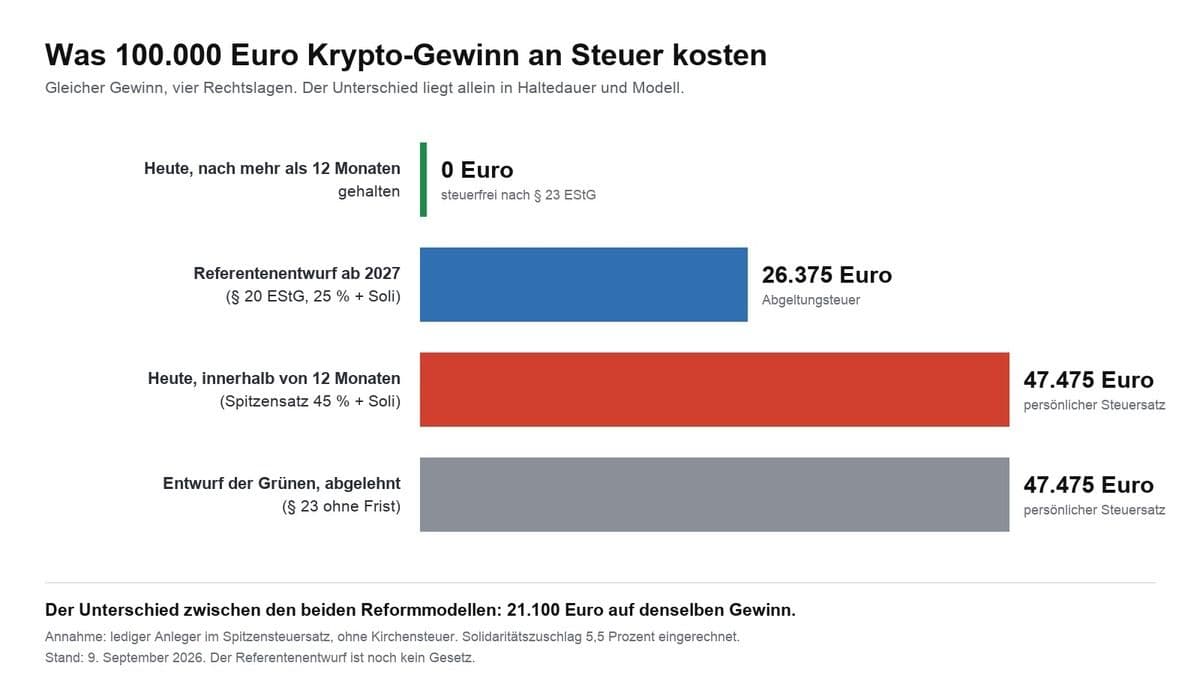
Crypto Tax in Germany: What Applies in 2026 and What Is Set to Change in 2027
Crypto gains are tax-free after twelve months; before that your personal tax rate of up to 45 percent applies. What triggers tax, how the holding period is calculated, what happens with staking and losses, and what the draft bill would change from 2027.
August 24, 2026 4:22 AM

Selling XRP After a 53 Percent Week: What the Holding Period Costs
XRP trades at $1.51 after a weekly gain of a good 50 percent, yet your net proceeds are decided by the purchase date. This article works through the holding period, the exemption limit and FIFO at measured reference-date prices.
October 16, 2026 7:25 PM

Crypto holding period for Bitcoin: “That remains to be seen,” says the finance ministry
The federal cabinet did not adopt the draft abolishing the one-year crypto holding period on October 14, 2026; it is still stuck in inter-ministerial consultation. This overview sets out what applies today, which dates follow and why the December 31, 2026 cutoff has no force of law so far.
October 9, 2026 10:50 AM

Crypto holding period: the Bundestag rejects abolition by 445 votes to 132: what investors need to know
On 8 October the Bundestag rejected the Greens' bill to abolish the crypto holding period in a recorded vote, and the Left's motion fell too. The result by parliamentary group, the official speech from the media centre, and why it was the SPD that gave investors the real signal in the debate.
October 9, 2026 1:18 PM

Bitcoin Tax: One Year Past the $126,080 Peak, Losses No Longer Count
Bitcoin trades at $82,558 on Friday morning, 34.5 percent below an all-time high that is now a good year old. Anyone who bought back then loses more than the prospect of a quick recovery when the one-year period expires: the tax value of the loss goes with it.
September 8, 2026 1:19 AM

Germany's Crypto Holding Period: What Happens Now Signing for Petition 201716 Closed on September 15
Recap as of September 27, 2026: the signature period for German parliamentary petition 201716, which asks for the one-year crypto holding period to be preserved, closed on September 15, 2026. This article explains what ended that day, how the petitions committee proceeds and why no investor has to sell because of it.
October 6, 2026 4:32 AM
Bitcoin for a gift card: what paying with crypto means for your holding period
Paying for a gift card with Bitcoin is a sale for tax purposes. What counts as the disposal proceeds, when the twelve-month holding period bites, and the four records the tax office expects.
October 2, 2026 4:39 AM

Donating bitcoin: when does the full market value count, when only the purchase price?
A bitcoin donation to a charitable organisation is deductible as a donation in kind, and the donation itself produces no taxable gain. The size of the deduction turns solely on whether a sale would have been taxable on the day of the transfer.
September 16, 2026 1:20 PM

Crypto Loss Carryforward in Germany: What Happens to Old Losses Under the 2027 Tax Plan
Losses from crypto sales land in a ring-fenced pot and can only be set against gains of the same kind. The draft bill for 2027 moves future gains into a different pot, and we show you what that means for your assessed carryforward and what your tax notice should say.
September 18, 2026 10:13 AM

Bitcoin and the German Exit Tax: What Applies When You Move Abroad
Anyone emigrating with Bitcoin expects an exit tax on unrealised gains and finds nothing of the sort in the statute. Where the real risks sit is decided at four points: residence, the holding period, the legal form of your investment, and automatic reporting from 2026.
August 11, 2026 9:13 PM

Germany's Crypto Holding Period Faces Abolition: What Petition 201716 and the Draft Bill Mean for Your Tax
Petition 201716 calls for the one-year holding period for crypto assets to be kept and will be heard in public by the Bundestag's Petitions Committee on 12 October 2026. Correction of 8 October: the reform was not decided by the cabinet in July. A draft bill of 30 September would end the holding period for crypto acquired after 31 December 2026, and the cabinet is due to take it up on 14 October.
August 16, 2026 6:14 AM
Crypto Credit Card Tax in Germany: Why Every Payment Is a Disposal
Paying with a crypto credit card means disposing of your coins for tax purposes. What that means for the holding period, the exemption threshold and your record-keeping duties, and which card design keeps the effort small.
September 26, 2026 1:19 AM

Germany’s Crypto Holding Period Is Wobbling: What to Check Before December 31
A CDU member of the Bundestag makes it plain: the coalition agreement does not guarantee that the one-year holding period for crypto assets will survive. What that means for purchases made before the planned cutoff date of December 31, 2026.
September 17, 2026 10:22 PM

Selling Bitcoin at a Loss and Buying It Straight Back: What That Does to Your Holding Period
Germany has no wash sale rule: the loss stays deductible even if you buy back immediately. The buyback, however, restarts the one-year period for every new unit.
September 8, 2026 10:21 PM

Crypto Holding Period and Grandfathering: Why December 31, 2026 Becomes the Cut-Off in Germany's Draft Bill
A ministerial draft bill from Germany's finance ministry names a cut-off date for the first time: crypto assets acquired after December 31, 2026 are to fall under the flat-rate withholding tax. What that means for legacy holdings, running savings plans and staking income, and why nothing has been decided yet.
September 24, 2026 4:28 AM

Crypto Trading Bots and Tax: What Applies With Thousands of Trades a Year
A bot turns one investment decision into hundreds of disposals, and the tax office counts every single one. This guide explains the holding period, FIFO, the exemption limit and the record-keeping duties, and what to set up before the bot makes its first trade.

September 22, 2026 4:12 PM

Nearly $1 Billion Into Bitcoin ETFs: What to Check on ETNs, Portfolio and Holding Period
US spot bitcoin ETFs took in a net $999 million on September 21, the third consecutive day of inflows. German investors cannot reach these funds: what ETNs, the holding period and your buying route mean for you.
August 24, 2026 10:29 AM
Buying More Bitcoin at $77,000: Savings Plan or Lump Sum
Bitcoin stands at $77,256 after gaining 22.78 percent in a week. This guide shows you how to buy more cleanly at this price and which method fits which starting position.
September 22, 2026 1:37 AM

Swapping Bitcoin for Gold: What Happens for Tax in Germany
Moving from coins into gold is a sale in the eyes of the tax office, and the one-year period decides the bill. Where bars, gold ETCs and tokenised gold diverge for tax, and which records you need.
August 20, 2026 4:12 AM

Wrapped Bitcoin in Austria: Is Converting BTC to WBTC Tax-Neutral?
Swapping BTC for Wrapped Bitcoin: when the move to WBTC can be tax-neutral in Austria, and which tax risks investors should know about. Acquisition costs carry over, but the classification of the token decides the outcome.
September 9, 2026 1:15 AM

Germany's Crypto Tax: 160 Million Euros for a 555-Billion Budget
The German finance ministry's draft bill puts a figure on the crypto tax for the first time: 160 million euros from 2028. What that number means in the 2027 federal budget, how 11.4 billion became 160 million, and what investors can read from it.
September 25, 2026 4:20 AM

Crypto as a Down Payment for a German Mortgage: What Banks Require
Since April 2023 a house in Germany can no longer be paid for in Bitcoin; section 16a of the Money Laundering Act bans it outright. Your crypto holdings still work as a down payment, provided you take the route through the euro and prove the origin without gaps.
October 15, 2026 4:13 AM

Crypto holding period: the cabinet date passes without a decision, December 31 stays the cut-off
Germany's federal cabinet did not adopt the expected decision of October 14, 2026 to abolish the one-year crypto holding period; the draft is still in interdepartmental consultation. Until new rules arrive, gains stay tax free after one year of holding, and the December 31, 2026 cut-off named in the draft separates old holdings from new ones.
September 22, 2026 7:23 AM

Gifting Bitcoin to Your Spouse: Allowance, Holding Period and the Report to the Tax Office
Thanks to a 500,000 euro allowance, a gift to a spouse is almost always free of gift tax, and it is not a disposal either. What matters is what travels with it: your purchase date, your purchase price and with them the state of the one-year holding period.
More from CryptoTicker