
Bitcoin price at $82,769 after two days on a third of the turnover: the level that decides
Bitcoin opens the week at $82,769, 1.6 percent above Friday's close. The gain was built over two days running on a good third of the usual turnover, and that is exactly why the level at $81,501 now decides.





Which topics should we dive deeper into?
Select what genuinely interests you. Your picks feed directly into our editorial planning.
Crypto news that's actually worth your time.
Weekly. 60 seconds. Carefully curated by our editors: no hype, no promo flood, no spam.
Bitcoin stands at $82,769 on Monday morning. That is 1.6 percent above Friday's close of $81,501, and the whole gain was built over two days in which exchange turnover ran at a third of its usual level. That is what makes it fragile: buying on a Saturday or a Sunday moves the price with less money than buying on a Tuesday. The level that decides the week therefore sits below the market rather than above it, at $81,501.
This article checks the weekend against our own data: 84 daily candles for the Bitcoin against US dollar pair on the Kraken exchange, collected for the period from July 28 to October 19, 2026. That makes it possible to quantify how much thinner the book really is at the weekend, and what that means for an order sent on a Sunday evening.
Bitcoin starts the week at $82,769
The reading on Monday morning: $82,769. The high of the past 24 hours is $82,774, the low $80,568. Monday opened at $82,002, Sunday's closing price.
The week before was weak. On Thursday, October 15, the price fell to $79,709 during the session and so dropped below the round $80,000 mark, but recovered to $82,134 by the evening. Friday gave part of that back and closed at $81,501. Against that Friday close, Bitcoin now stands $1,268 higher.
On Sunday we looked at the network fees in the mempool in this slot, at a price of $81,685 at the time. Little has changed on the network itself since then; the price has moved $1,084, almost all of it overnight into Monday. The $81,000 mark, which counted as the floor back then, has not been tested a second time.
Saturday and Sunday in numbers: 599 and 987 Bitcoin of turnover
The weekend in detail, daily candles in coordinated universal time, turnover in Bitcoin:
| Day | Close in dollars | Daily range | Turnover in BTC | Trades |
|---|---|---|---|---|
| Friday, October 16 | 81,501 | 2.63 percent | 2,089 | 144,685 |
| Saturday, October 17 | 81,382 | 1.24 percent | 599 | 71,492 |
| Sunday, October 18 | 82,002 | 2.00 percent | 987 | 107,516 |
Saturday was the thinnest day of the entire week: 599 Bitcoin of turnover, less than a third of Friday's, and a daily range of 1.24 percent. Sunday picked up to 987 Bitcoin but stayed below half of Friday's figure. Together the two days turned over 1,586 Bitcoin, less than Friday managed on its own.
The $620 gain that Sunday closed with was therefore built on turnover that would have passed for a quiet half day during the working week. That is not a judgement, it is the basis for everything that follows.

Why the Bitcoin order book thins out at the weekend
The reason does not lie with the crypto exchanges. They trade around the clock, Christmas Eve included. What closes is the other part of the market: the stock exchanges where the Bitcoin funds are listed.
A spot Bitcoin ETF is a fund that holds Bitcoin physically and whose shares trade on an exchange like a stock. When an investor buys a share, the fund can acquire Bitcoin for it; when the share is handed back, the fund can sell. This mechanism is called creation and redemption, and it only works while the exchange is open. New York is open Monday to Friday, and so is Frankfurt. From Friday evening to Monday morning, then, not a single fund share is created or destroyed, and the fund neither buys nor sells any Bitcoin in that time. How this route looks for investors in Europe is set out in our overview of crypto ETFs in Germany.
There is also the professional side of the market. Market makers, the firms that keep buy and sell quotes in the book and so create the narrow gap between bid and offer in the first place, run their positions down over the weekend because they cannot hedge them against futures while the derivatives exchange is closed. Less hedging means less quoted volume. What remains is retail trading, and that is smaller.
The result shows up in the trade counts above. Saturday produced 71,492 trades, Friday 144,685. The number of transactions halves, but turnover in Bitcoin falls to less than a third. Every single trade is smaller at the weekend. The large blocks are missing.
Our own survey: 84 daily candles compared
A single weekend proves nothing. We therefore went through the daily candles of the past twelve weeks, from July 28 to October 19, 2026: 84 days, of which 24 are weekend days and 60 are weekdays. The comparison uses the middle value, the median, because individual outliers such as the slump of October 8 would distort an average.
| Metric, median | Weekend (24 days) | Weekdays (60 days) | Weekend to weekday |
|---|---|---|---|
| Turnover in Bitcoin per day | 912 | 2,559 | 35.6 percent |
| Trades per day | 58,987 | 104,185 | 56.6 percent |
| Daily range | 1.24 percent | 2.61 percent | 47.4 percent |
Weekend turnover therefore comes to a good third of weekday turnover, the number of trades to around 57 percent and the daily range to just under half. At 599 and 987 Bitcoin, the weekend just gone sat below that median of 912, so it was not a quiet exception but a normally thin to below-average weekend.
The ratio between the three figures is the revealing part. If turnover falls to 35.6 percent while the range only falls to 47.4 percent, then a dollar of turnover moves the price further at the weekend than it does on a working day. In arithmetic terms, a third of the money is enough for half of the movement at the weekend. That is the number behind the claim that a thin book is more vulnerable.
 Compare crypto exchange fees and spreads
Spread and slippage: what thin liquidity costs a market order
Two measures matter in practice. The spread is the gap between the best bid and the best offer in the order book. Slippage is the difference between the price you see when you send a market order and the price at which it is actually filled.
Both depend on the depth of the book. A market order works its way up through the available offers until it is filled. If there are offers for ten Bitcoin within $50 at midday on a Tuesday, a purchase of one Bitcoin costs barely any premium. If only three Bitcoin sit in the same price range on a Sunday evening, the same order reaches deeper into the book and pays more.
The figures above quantify how large that difference is on average. At 35.6 percent of weekday turnover the book is not only narrower, it also refills more slowly after a larger order has cleared it. For a position of a few hundred euros this stays a rounding error. For a four-figure sum in one go it is measurable.
Which exchange quotes which spread differs considerably, and at the weekend that difference weighs more heavily than on a working day. We have set the fees and spreads of the providers available in Germany side by side in our crypto exchange comparison.
How to check the execution day of your Bitcoin savings plan
A Bitcoin savings plan buys on a fixed day, not at a fixed price. That day is in the contract, and most providers let you change it. If you have put it on a Saturday or a Sunday, you are buying into the thinnest book of the week by design.
Three points count here. First, the setting that holds the execution day, usually under savings plan, interval or execution. Second, whether the provider fills the order as a market order, which is the normal case, or lets you set a limit. Third, whether the provider adds its own premium to the reference price on top of the spread.
An execution day in the middle of the week makes sense, because Tuesday to Thursday were consistently above the weekday median of 2,559 Bitcoin in our survey. If you cannot change the day, you lose nothing dramatic: across a year with twelve purchases the difference largely averages out. This is about basis points, not percentages. Which providers offer a savings plan at which minimum amount and interval is covered at the end of this article.

The levels: $81,501 as the floor, $82,826 as the ceiling
Both of this week's levels come out of the weekend itself, not out of a model.
On the downside it is Friday's close of $81,501. If the price falls below it, the entire weekend gain has been worked off, and the week starts, in arithmetic terms, where the previous one ended. Below that lies the weekend low of $80,568 as a second step, and behind it the round $80,000 mark, which was already briefly breached on October 15 at $79,709.
On the upside it is Friday's high of $82,826. That is where the price turned down on Friday, and it has not reached that value since; the high of the past 24 hours, at $82,774, sits $52 below it. As long as that ceiling holds, Bitcoin is moving in a range of around $1,300, or 1.6 percent.
What decides the outcome is not the level itself but the turnover on which it gives way. A break of $82,826 on Monday on 2,500 Bitcoin of daily turnover carries different weight than the same break on a Sunday on 900.
 Find the right crypto tax tool
October 28: what the rate decision has to do with the weekend
The next meeting of the US Federal Reserve's Open Market Committee takes place on October 27 and 28, 2026, with the rate decision on the second day. The date appears in the Federal Reserve's official meeting calendar and is therefore the only firmly scheduled major event that can act on the price this week and next.
For liquidity that means two things. Ahead of a date like this, professional traders keep their books smaller, because a decision can move the price in jumps. That reinforces the effect that is already at work over the weekend. After the event, volume usually returns quickly.
So if you still want to move a larger position in one go in October, the more liquid days lie between today, Monday, and October 27, not after it. That is a statement about the order book, not about the direction of the price: which way the rate decision cuts is open, and nobody can evidence it today.
Holding period: why the purchase date on the calendar counts
For investors in Germany the purchase date carries a second meaning that has nothing to do with the price. Under current law, gains from the sale of Bitcoin are tax free if more than a year lies between purchase and sale. That period runs to the day, and it starts on the day of the purchase.
Buy today, on October 19, 2026, and you can sell the position tax free from October 20, 2027. Miss the deadline by a day and the gain is taxed at your personal income tax rate. With a savings plan that buys monthly, each individual execution starts its own period, which is why documenting the purchase dates is worth the effort.
Whether that period stays is open. The German finance ministry has not committed itself so far; we track the state of the debate in our overview of the crypto holding period. As long as no change has been passed, the one-year rule applies.
Our assessment: the gain hangs on Monday's volume
In the view of this desk, Sunday's rise is not yet a turn, for a reason that can be quantified: it came on 987 Bitcoin of turnover, which is 39 percent of the weekday median of 2,559. Moves that form at the weekend are frequently corrected on Monday, once the funds and the market makers are back and put their quotes into the book again.
The survey above supports that: a third of the money produces half of the movement at the weekend, so the price runs further than demand carries it. Against it stands the fact that the price on Monday morning is already above Sunday's close and has left the weekend low of $80,568 well behind. The decision falls at $81,501. If that level holds into Tuesday on turnover above the weekday median, the gain is confirmed. If it gives way, it was a weekend phenomenon.
The direction cannot be evidenced today, only the condition under which it shows itself. If you are building a position, Monday and Tuesday are the most liquid days of the week ahead of you.
Bitcoin on Monday: below $81,500 the gain is gone
The price stands at $82,769, built over a weekend running on a good third of the usual turnover. Three steps follow from that:
- Check the execution day of your savings plan and, if it falls on a Saturday or Sunday, move it to Tuesday, Wednesday or Thursday. The providers with the matching intervals and minimum amounts are in the savings plan comparison.
- For a larger purchase, compare your own provider's spread on a working day with the one at the weekend. Where Bitcoin is available at what cost is set out in our overview of buying Bitcoin.
- Note the purchase date, because the one-year holding period runs to the day. A purchase made today can be sold tax free from October 20, 2027; the tools for tracking it are in the crypto tax software comparison.
The price data in this article comes from the daily candles of the Bitcoin against US dollar pair, queried through Kraken's public market data interface.
(As of October 19, 2026. This article is not investment advice. Prices and fee structures change; check the terms with the provider before you buy. Trading cryptocurrencies carries the risk of total loss.)
Frequently asked questions about the Bitcoin price at the weekend
Transparency note: This article was produced with the assistance of artificial intelligence and reviewed by our editorial team before publication. All figures and claims were checked against the primary sources linked in the text. The feature image was generated with AI.
Related articles
- Bitcoin Back Above $80,000: Buy More, Hold or Take Profits? What to Check Now
- Bitcoin for Retirement: What Applies from 2027 and What You Decide Now
- Bitcoin Golden Cross: What Twelve Signals Since 2014 Really Show
- 50 euros a month in Bitcoin, 118 instalments since 2017: savings plan vs lump sum
- Canton Jumps 15.6 Percent to $0.13: What to Check on Trading Volume Before You Order
Which topics should we dive deeper into?
Select what genuinely interests you. Your picks feed directly into our editorial planning.
Crypto news that's actually worth your time.
Weekly. 60 seconds. Carefully curated by our editors: no hype, no promo flood, no spam.

September 24, 2026 10:11 PM

Bitcoin Price Prediction: What to Check on Levels, Holding Period and Leverage Before the October 28 Rate Decision
Bitcoin is trading at around $83,800, a third below its October 2025 high, while the sentiment index reads greed. Which dates, levels and deadlines over the coming weeks really decide your net gain, and which of them you steer yourself.

August 24, 2026 10:26 AM

Bitcoin Savings Plan in Austria: How the Purchase Price Is Calculated
Bought bitcoin through a savings plan? For multiple purchases Austria applies the moving average price as a matter of principle when working out taxable gains.
October 15, 2026 7:29 AM

17 of 20 top coins down, Ethereum at $2,380: where the sell-off is measured
Ether loses 5.41 percent over 24 hours and falls to a daily low of $2,332.43. Our own count of the 25 largest cryptocurrencies shows how broadly the sell-off really carries.

October 15, 2026 7:22 AM

Cardano breaks the $0.2439 level: ADA is falling more than twice as fast as Bitcoin
Cardano has lost 7.13 percent over 24 hours to $0.2207 and now stands at its lowest since September 18. Bitcoin gave up only 2.95 percent in the same period, and our own count shows 15 of the 20 largest coins falling harder than BTC.
September 25, 2026 7:24 PM

Bitcoin Forecast: What to Check on Levels, Holding Period and Buying Route Before the Quarter Ends
Bitcoin stands at $83,877 at 16:40 UTC on September 25, 2026, and the measured volatility of the past 30 days spans a band of $73,600 to $94,200 for the coming month. More important than that band before the quarter ends are three checks: holding period, buying route under MiCA and the reporting duty in force since January 2026.
September 30, 2026 4:14 AM

Bitcoin Price Before the Core PCE at 14:30 CEST: Will the $82,735 Level Hold?
At 14:30 CEST today the Bureau of Economic Analysis publishes the core PCE deflator for August, the inflation gauge the Fed anchors its 28 October rate decision to. Bitcoin stands at $83,329, less than $600 above its daily low, and anyone holding on leverage decides this morning.
October 6, 2026 4:16 AM

13 exchanges list MemeCore, not one euro pair: hold or sell M?
Not one of the 14 markets that list MemeCore trades against the euro: every exit runs through Tether or USDC. What the thin order book, the monthly tranche of 56.1 million M and the holding period mean for your M position.
October 4, 2026 10:14 AM

Dogecoin price at $0.0929: why the 200-day line sits at $0.0878 and not at $0.093
Dogecoin trades at $0.0929 on Sunday morning. Market reports put the 200-day line at around $0.093; recalculated from 366 daily closes it sits at $0.0878. Two October dates that matter for investors in Germany run alongside it.

September 24, 2026 10:38 AM

Fed Rate Hike in October: What to Check on Leverage, Liquidation and Holding Period After the PMI Jump
The flash US purchasing managers' index has jumped to 58.4 points, its highest level since July 2021, and input prices are rising at a pace last seen in October 2022. The futures market now prices a further Fed rate hike on October 28 at almost 70 percent, and the crypto market is falling broadly.
September 10, 2026 4:15 PM

BW-Bank Opens Bitcoin Trading Inside the Securities Account: What to Check Before Your First Buy
Since September 9, 2026, BW-Bank customers have been able to trade ten crypto assets through their securities account, executed and held in custody by Bitpanda. The familiar securities-account setting hides three points you should settle before your first order.
September 9, 2026 4:22 PM
Crypto Tax in Germany: What Applies in 2026 and What Is Set to Change in 2027
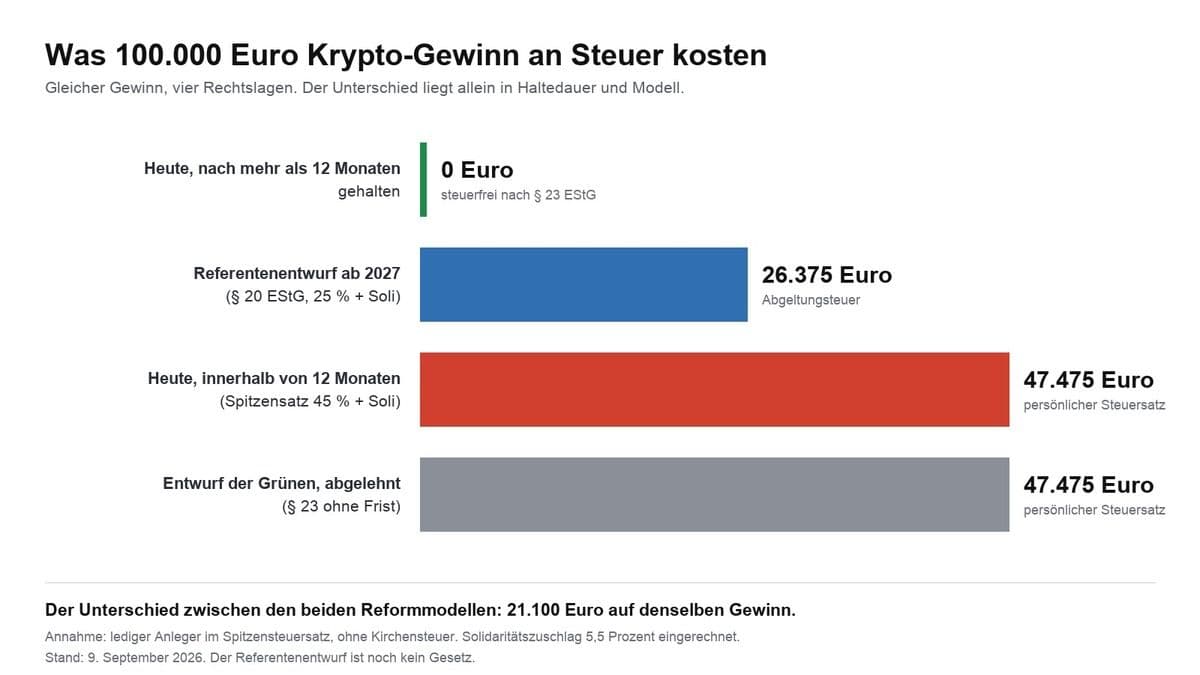
Crypto gains are tax-free after twelve months; before that your personal tax rate of up to 45 percent applies. What triggers tax, how the holding period is calculated, what happens with staking and losses, and what the draft bill would change from 2027.
October 16, 2026 7:25 PM

Crypto holding period for Bitcoin: “That remains to be seen,” says the finance ministry
The federal cabinet did not adopt the draft abolishing the one-year crypto holding period on October 14, 2026; it is still stuck in inter-ministerial consultation. This overview sets out what applies today, which dates follow and why the December 31, 2026 cutoff has no force of law so far.
September 27, 2026 1:17 PM

Dogecoin Price: What to Check on Holding Period and Custody Before the Year End
The Dogecoin price stands at $0.0977 on September 27, 2026 and has barely moved in a day. That calm is exactly the moment to work through the holding period, the reporting duty from 2026 and custody without any time pressure.
September 24, 2026 10:12 AM

XRP Falls 9.7 Percent: What to Check on Holding Period and Buying Route
XRP is down around 9.7 percent on the morning of September 24, twice as much as the typical large crypto asset. Our count of 18 coins shows who the pullback hits and which three things hold true regardless of the price.
September 9, 2026 4:13 PM

Bitcoin 29 Percent Below Last Year: Which Crypto Losses You Can Still Use Before the One-Year Holding Period Expires
Nine out of ten major crypto assets trade lower today than exactly twelve months ago, Bitcoin alone by 29.2 percent. We measured the price series ourselves and show why the purchase date alone decides the tax value of your loss.
September 8, 2026 1:19 AM

Germany's Crypto Holding Period: What Happens Now Signing for Petition 201716 Closed on September 15
Recap as of September 27, 2026: the signature period for German parliamentary petition 201716, which asks for the one-year crypto holding period to be preserved, closed on September 15, 2026. This article explains what ended that day, how the petitions committee proceeds and why no investor has to sell because of it.
September 9, 2026 4:29 PM
Bitcoin and Taxes in Germany: Holding Period, Savings Plan, ETP and Mining
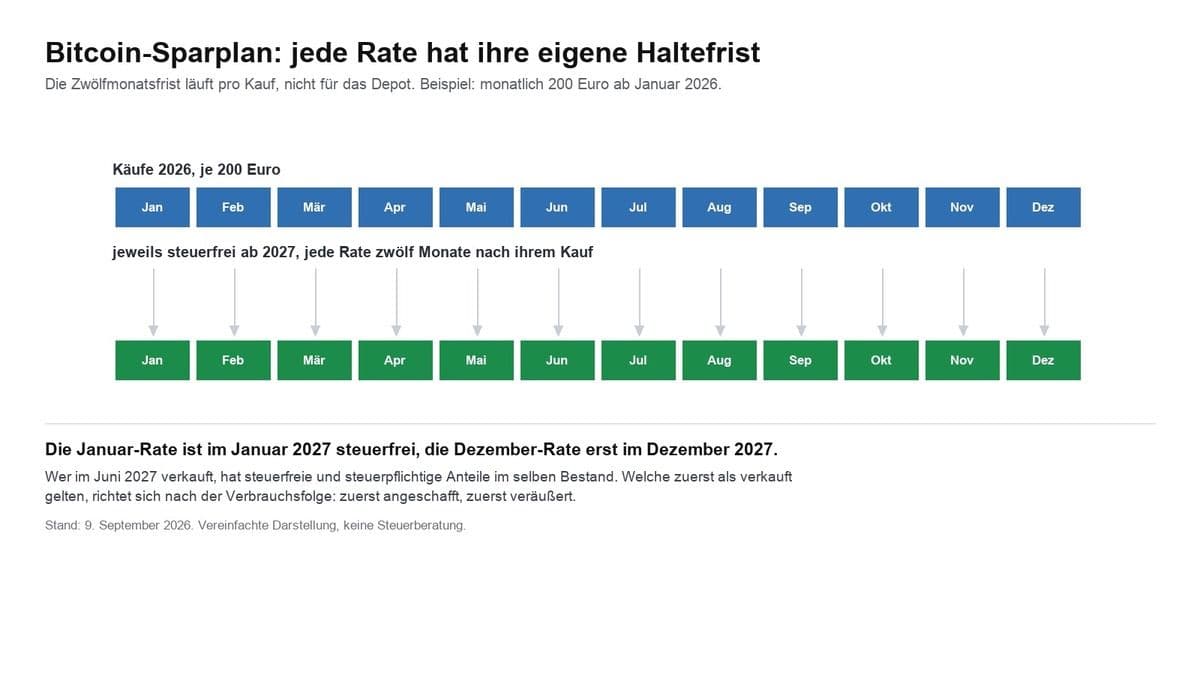
Bitcoin gains are tax-free after twelve months. What that means for a savings plan with twelve deadlines, why ETPs are taxed differently, and what applies to mining, gifts and losses.
September 22, 2026 1:28 PM

Selling Bitcoin and Cashing Out in Euros: How It Works in Germany
Between the sell order and the euros in your current account stand the exchange, your bank and the tax office. Knowing the order of events saves fees, waiting time and, in the best case, the entire tax on the gain.
October 7, 2026 7:18 AM

Certificate, Bitcoin ETN or the coin itself: what each route means for tax and custody
A Bitcoin certificate, an ETN and the coin itself all lead to the same price, but to three different tax treatments and three different risks. The comparison shows which route fits your portfolio and why December 31, 2026 becomes the cut-off date.
October 3, 2026 4:40 PM

Investing in Bitcoin With a Savings Plan or a Lump Sum: What the December 31 Tax Cut-Off Changes
Anyone putting money into Bitcoin now chooses between a lump sum, a monthly instalment and an ETN in a securities account. The German finance ministry’s draft bill would keep the one-year holding period only for holdings bought by December 31, 2026.
September 27, 2026 4:12 AM

Bitcoin ETF Inflows Turn 2026 Positive: How to Tell If the Demand Holds
US spot Bitcoin ETFs took in roughly $2.4 billion in the week to September 25, the strongest week since October 2025, and that turns the 2026 year-to-date balance positive. Why the daily inflow fell 87 percent within the same week, and what to check on buying route, holding period and custody.
August 24, 2026 10:29 AM

Buying More Bitcoin at $77,000: Savings Plan or Lump Sum
Bitcoin stands at $77,256 after gaining 22.78 percent in a week. This guide shows you how to buy more cleanly at this price and which method fits which starting position.
October 14, 2026 4:27 PM

Bitcoin price 25 percent below its level a year ago: what you can do now
A year ago one Bitcoin cost 99,310 euros, today it is 74,239 euros. For the October 2025 vintage the speculative period now expires, and that changes the calculation behind every sale.
October 6, 2026 4:32 AM

Bitcoin for a gift card: what paying with crypto means for your holding period
Paying for a gift card with Bitcoin is a sale for tax purposes. What counts as the disposal proceeds, when the twelve-month holding period bites, and the four records the tax office expects.
October 2, 2026 5:02 PM

Bitcoin or Ethereum in the fourth quarter of 2026: the two largest crypto-assets compared
Bitcoin is scarce by protocol rule, Ethereum only as scarce as its utilisation, and on access and tax in Germany the paths part again. This comparison puts the verifiable figures on supply, usage, staking and purchase route side by side, without making a price call.
September 27, 2026 10:16 PM

Dogecoin Price Prediction: Which Levels Decide the Fourth Quarter
Dogecoin trades at $0.0973 on September 27 and has gained 12.2 percent in seven days. Which three measured levels frame the fourth quarter, how accurate the circulating price targets proved in September, and which four checks are due before the quarter turns.
September 19, 2026 10:35 AM

The Cost Average Effect with Bitcoin: What Twelve Instalments Really Deliver
Twelve monthly instalments of 100 euros produced an average price of 66,472 euros and ran 33.6 percentage points ahead of the lump sum purchase on the same starting day. The calculation also shows when the savings plan is the worse route.
More from CryptoTicker