
Certificate, Bitcoin ETN or the coin itself: what each route means for tax and custody
A Bitcoin certificate, an ETN and the coin itself all lead to the same price, but to three different tax treatments and three different risks. The comparison shows which route fits your portfolio and why December 31, 2026 becomes the cut-off date.





Which topics should we dive deeper into?
Select what genuinely interests you. Your picks feed directly into our editorial planning.
Crypto news that's actually worth your time.
Weekly. 60 seconds. Carefully curated by our editors: no hype, no promo flood, no spam.
Anyone who wants Bitcoin in a securities account has three routes available in Germany: the coin itself through a crypto exchange, an exchange-traded security tracking Bitcoin, that is an ETN, and a certificate issued by a bank. All three move with the same price. What separates them is the question of who owns the Bitcoin, who owes you the money if things go wrong, and which section of the tax code the tax office applies to your gain.
The price is the smallest difference. Bitcoin traded at $85,543 and €76,040 on Wednesday morning, down 0.43 percent on the previous day, according to CoinGecko as of 03:00 on Wednesday. That figure sits inside all three products. The gap opens up afterwards: in the tax treatment, in the costs, and in the question of what happens if the provider becomes insolvent.
What separates a Bitcoin certificate from a Bitcoin ETN
Both are debt securities, both trade on an exchange, and both sit in an ordinary securities account. They are still two different things.
An ETN (exchange traded note) is an exchange-traded debt security that tracks exactly one underlying, here the Bitcoin price, and that is backed by real Bitcoin at the common European providers. The term is usually open-ended, there is no leverage, and the ratio to the underlying stays the same over the years, less the ongoing fee.
A certificate is the umbrella term for structured securities issued by a bank that promise a payout according to a formula fixed in advance. That formula can be simple, but it can also contain leverage, a knock-out barrier or a fixed maturity. Backing with real Bitcoin is not part of it.
In practice this means an ETN is built for holding over the long run, a leveraged certificate for short phases. Lump the two together as a “Bitcoin product” and it is easy to buy the wrong one.
ETN, ETP, ETC: three words for the same product family
All three abbreviations turn up on the providers' product pages. ETP (exchange traded product) is the collective term for every exchange-traded product of this kind. ETN is the sub-form structured as a debt security, ETC (exchange traded commodity) the label that originally emerged for commodities such as gold and that some issuers also use for crypto assets. In legal terms, European crypto ETPs are almost always bearer debt securities, whichever of the three letter codes appears in the product name.
Bitcoin ETN: a bearer debt security with a redemption right
A bearer debt security is a security under which the issuer owes the holder a payment or a delivery. That is the decisive sentence about every Bitcoin ETN: you do not own Bitcoin, you own a claim against the issuer.
The large European providers soften that by backing the notes they issue with real Bitcoin and storing those coins with a separate custodian. Many products also grant the investor a redemption right, meaning the right to demand the deposited coins instead of cash. Both are set out in the key information document and in the terms of issue, and both differ from product to product.
What does not arise here is segregated fund assets. A fund holds investors' money legally separate from the fund company's own assets, and that is precisely the protection a debt security does not provide. In its place comes the collateral, which is promised by contract and not guaranteed by law.
No Bitcoin spot ETF in the EU: the UCITS limit of 20 percent
The United States has Bitcoin spot ETFs, the European Union does not, and the reason is a sober one rooted in fund law. An ETF for retail investors falls under the UCITS rules in the EU, and those rules require diversification: no single component may account for more than 20 percent of net asset value. A fund holding nothing but Bitcoin reaches 100 percent and therefore cannot be authorised.
That is why every European Bitcoin product you can hold with a German broker is not a fund but a debt security. Search engines may suggest a Bitcoin ETF, but in Germany the search inevitably ends at ETNs and ETPs. Which of these products trade on German exchanges and what matters in picking one is covered in the overview of crypto ETFs in Germany.
There is a side effect for savings plans and retirement provision: because it is not a fund, some custodian banks treat crypto ETPs differently from ETFs, for instance in savings plans, in lending against securities or inside managed portfolios. That is not a question of the price but of your provider's house rules.

Bitcoin certificate: knock-out, factor and the risk of total loss
Two designs are particularly common among certificates on Bitcoin, and both behave markedly differently from an ETN.
A knock-out certificate works with a fixed barrier. If the price touches that barrier, the note expires and the amount invested is gone, even if the price climbs again an hour later. The leverage follows from the distance between price and barrier, so it is not constant.
A factor certificate, by contrast, keeps leverage constant by resetting daily against the closing price. In choppy sideways phases that produces a loss in value even if the Bitcoin price is back at its starting point by the end of the week. The effect is called path dependency, and it is regularly underestimated.
For both designs the same holds: the certificate is likewise a debt security of the issuing bank, only without coins deposited behind it. Issuer risk is therefore added to market risk, and with leveraged products comes the possibility that the stake is wiped out entirely while the underlying still exists. Anyone looking to trade leveraged products on crypto assets will find the providers' terms in the crypto broker comparison.
 Find the right crypto broker
The coin itself: self-custody, seed phrase and wallet risk
The third route runs through a crypto exchange and ideally ends in a wallet of your own. Self-custody means you keep the private key to your coins yourself and no company stands between you and the balance. The seed phrase is the sequence of words from which that key can be restored.
Issuer risk disappears entirely at that point. There is nobody who could become insolvent, because nobody owes you anything. Other risks take its place, and they are not smaller: a lost device with no backup, a seed phrase somebody else finds, a contract approved by mistake in a wallet app. None of these risks can be passed on to a third party.
In between sits the case most newcomers actually choose: the coins stay on the exchange. You then do own real Bitcoin, but not the keys, and you depend on a company again, this time on one that needs authorisation as a crypto-asset service provider under the European MiCA regulation. Whether a trading venue holds that authorisation can be looked up in the supervisor's public register, and that is exactly what belongs before the first deposit.
Issuer risk and physical backing: the distance to segregated fund assets
Issuer risk is the danger that the issuer of a security cannot meet its obligation. With a crypto ETN it is the central factor, because in legal terms the note is nothing other than that obligation.
Physical backing is meant to limit the damage. The issuer buys real Bitcoin for every note issued, has it stored with an independent custodian and pledges it in favour of the investors. In an insolvency that holding is meant to go to the noteholders first rather than to the other creditors. In practice the effect hinges on three points you can look up in the key information document: whether the backing is complete, who the custodian is, and whether a trust structure has been inserted in between.
None of the three routes comes with deposit insurance. The statutory protection of €100,000 per customer and bank applies to balances in accounts, not to securities and not to crypto assets. Confuse the two and you will think a note is safer than it is.
Tax on a Bitcoin ETN: 26.375 percent capital gains tax from the first euro
This is where the difference that adds up to the largest amount over the years sits. ETNs and certificates are securities, and their gains count as investment income under Section 20 of the German Income Tax Act (EStG). A separate tax rate applies to that income: under Section 32d (1) sentence 1 EStG, income tax on it is 25 percent. On top comes the solidarity surcharge, which under Section 4 of the Solidarity Surcharge Act amounts to 5.5 percent of the tax. Together that makes 26.375 percent, slightly more for those liable to church tax.
This system knows no holding period. Whether you hold the ETN for three weeks or eleven years makes no difference to the rate. The tax is usually withheld directly by the institution holding the account, and you will find it in the settlement statement.
Relief comes only from the saver's allowance. Under Section 20 (9) EStG, €1,000 a year is deductible, and €2,000 jointly for married couples filing together. That amount covers all investment income together, interest and dividends included, and it is used up quickly.
One advantage of the securities form remains: losses on ETNs can be offset against other investment income, and the bank runs the loss-offset pot automatically. With directly held coins you have to track that yourself in your tax return.

Holding period under Section 23 EStG: one year and the €1,000 threshold
Directly held Bitcoin runs under a different section. Such coins count as other assets within the meaning of a private disposal transaction, and Section 23 (1) sentence 1 no. 2 EStG only captures transactions “in which the period between acquisition and disposal does not exceed one year”. Hold for more than a year and then sell, and no income tax is due on the gain.
Within that year the personal tax rate applies, running from zero to 45 percent depending on income, rather than the flat 26.375 percent. On a high income, selling coins short term is therefore more expensive than the same gain inside an ETN; on a low income it is cheaper.
There is also a threshold that is frequently misquoted. Section 23 (3) sentence 5 EStG states: “Gains remain tax-free if the total gain realised from private disposal transactions in the calendar year was less than 1,000 euros.” That is an exemption threshold, not an allowance. If the total gain is exactly €1,000, the full amount is taxable, not just the euro above the line.
For the order in which coins are deemed sold, the allocation is decisive, in practice usually on the principle that the holdings bought first count as sold first. Anyone who has bought in tranches over several years needs a clean record of every single purchase for that.
 Find the right exchange for your tokens
The December 31, 2026 cut-off in the finance ministry's draft
This coexistence of two tax systems is not meant to last. On September 30, 2026, the Federal Ministry of Finance published its draft bill on reforming the taxation of certain privately held crypto assets. According to the ministry's explanatory memorandum, the current classification under other income no longer does justice to crypto markets that have grown since; the draft is in interdepartmental consultation, and consideration by the cabinet is planned.
In substance, gains on crypto assets are to count as investment income in future. The one-year holding period would fall away, and the same rate that already applies to ETNs would take effect. Several tax firms read a grandfathering provision out of the draft in the same way: the new rules are to cover only crypto assets acquired after December 31, 2026, while the current holding period continues to apply to holdings bought earlier.
Two caveats belong with that. A ministerial draft is not a law, and deadlines and details can still change during the legislative process. And even if it arrives as drafted, it bears on today's purchase decision: purchases made by the end of the year would fall into the protected existing holdings, purchases after that would not.
What that means for the comparison of the three routes
As long as the holding period stands, the directly held coin has the clear tax advantage for long-term holding. If it falls away for new acquisitions, that lead shrinks to the differences in costs, custody and loss offsetting. Anyone making a decision today for the years ahead should run the numbers on both situations, not only on today's.
How to check who stands behind your Bitcoin ETN
The details sit in two documents every issuer has to publish: the key information document and the terms of issue. Both are reachable through the product page and through the exchange page for the security.
- Issuer and domicile: who issues the note, in which country is the company based, and which insolvency law therefore applies if things go wrong?
- Degree of backing: is every note fully backed with Bitcoin, and does that appear as a commitment in the terms or only as an intention in the marketing?
- Custodian: which company holds the coins, is it independent of the issuer, and how is the holding evidenced?
- Redemption right: may you demand delivery of real coins, from what quantity upwards, and at what cost?
- Term and early redemption: is the note open-ended, and under what conditions can the issuer call it early?
With a certificate the formula components come on top: knock-out barrier, leverage, subscription ratio and maturity date. A note whose payout formula you cannot explain in a single sentence does not belong in a portfolio.
Costs per year: management fee, spread and custody charge
The costs of the three routes arise in different places, and that makes the comparison hard at first glance.
With an ETN there is an ongoing management fee that the issuer takes pro rata out of the deposited holding. You will see no statement for it; the effect sits inside the price of the note. On top come your broker's order fee, the spread between bid and ask on the exchange and, depending on the provider, a custody charge.
Buying directly, you pay the exchange's trading fee, a spread again, and a network fee when withdrawing to a wallet of your own. There is no ongoing annual fee; anyone choosing self-custody has the cost of buying a hardware wallet instead.
With a certificate, the order fee and the spread are often joined by a financing component that accrues daily on leveraged products and weighs heavily over longer holding periods. The actual rates change and differ widely; they sit in the key information document for the particular note and are to be looked up there before buying.
As a rule of thumb over long periods: ongoing fees act like a headwind that blows equally hard every year, while one-off costs lose weight the longer you hold.
Bitcoin in your portfolio: the key points for your decision
The three routes lead to the same price and to very different obligations. This order helps with the decision.
- Settle the holding period first, and with it the tax question. Anyone planning in years weighs today's holding period against the planned capital gains tax; anyone trading short term can cut the comparison down to costs and tradability. Which trading venues are authorised for direct purchases under MiCA is covered in the crypto exchange comparison.
- Set up the record before you buy. Purchase date, quantity, price and fees per tranche decide your tax return later, and with directly held coins nobody keeps that record for you. You will find tools for it among the crypto tax software and portfolio trackers.
- Decide custody separately from the purchase decision. With an ETN the issuer's custodian takes on that job; with the coin you choose between an exchange and a device of your own. The differences between the devices are set out in the hardware wallet comparison.
The sentence that holds it all together: with an ETN and a certificate you carry the risk of a company and get convenient settlement in your securities account; with the coin you carry responsibility for the key and keep the holding period for now. Which of these two burdens sits more easily with you is the real question.
(As of October 7, 2026. This article is not investment advice. Prices and fee structures change; check the terms with the provider before you buy.)
Frequently asked questions about Bitcoin ETNs and Bitcoin certificates
Transparency note: This article was produced with the assistance of artificial intelligence and reviewed by our editorial team before publication. All figures and claims were checked against the primary sources linked in the text. The feature image was generated with AI.
More on Bitcoin: All Bitcoin news at a glance
Related articles
- ING and Bitcoin: Around 50 Crypto ETNs in the Portfolio, and What the Delivery Claim Means for Your Holding Period
- Bitcoin ETF Inflows Turn 2026 Positive: How to Tell If the Demand Holds
- Ethereum Rises While ETF Money Leaves: What ETH Holders Should Check Now
- 93.56 million dollars out of the Zcash ETF in one week: what changes for ZEC holders in Europe
- XRP ETF, Solana ETF, Ethereum ETF: What You Can Actually Buy in Germany
Which topics should we dive deeper into?
Select what genuinely interests you. Your picks feed directly into our editorial planning.
Crypto news that's actually worth your time.
Weekly. 60 seconds. Carefully curated by our editors: no hype, no promo flood, no spam.

September 22, 2026 4:12 PM

Nearly $1 Billion Into Bitcoin ETFs: What to Check on ETNs, Portfolio and Holding Period
US spot bitcoin ETFs took in a net $999 million on September 21, the third consecutive day of inflows. German investors cannot reach these funds: what ETNs, the holding period and your buying route mean for you.
October 24, 2026 7:15 AM

635 million dollars flowed out of the Bitcoin ETFs in a day: the level that decides
US spot bitcoin ETFs released a net $635 million on October 22, the largest daily outflow since June 25. Bitcoin trades below the funds' estimated cost basis of $81,500 to $82,000, and for a German portfolio a deadline is running at the same time.

October 14, 2026 1:19 PM

Solana ETF in Hong Kong at 0.6 percent: what changes for European investors
Hong Kong has launched its second spot ETF on Solana at a management fee of 0.6 percent. You cannot buy it from Europe, but the number throws light on European costs: on Xetra, a full percentage point a year separates two Solana wrappers.
October 15, 2026 7:29 AM

17 of 20 top coins down, Ethereum at $2,380: where the sell-off is measured
Ether loses 5.41 percent over 24 hours and falls to a daily low of $2,332.43. Our own count of the 25 largest cryptocurrencies shows how broadly the sell-off really carries.

October 6, 2026 10:14 AM

$3.8 Million Back From the Attacker: Why the NEAR Price Is Up 7.8 Percent
The attacker has sent back the full $3.8 million from the NEAR Intents exploit, and the NEAR price is up 7.8 percent at $5.23. What is behind the recovery, what role the Bitwise NRR ETF plays, and what follows from it for buying route, holding period and custody.
October 16, 2026 7:25 PM

Crypto holding period for Bitcoin: “That remains to be seen,” says the finance ministry
The federal cabinet did not adopt the draft abolishing the one-year crypto holding period on October 14, 2026; it is still stuck in inter-ministerial consultation. This overview sets out what applies today, which dates follow and why the December 31, 2026 cutoff has no force of law so far.
October 8, 2026 1:26 PM

Bitcoin ETFs Lose $487 Million in a Single Day: the Reasons Behind the Outflow
Around $487 million flowed out of the US spot ETFs on Bitcoin on net on October 7, 2026, while the price tests the zone around $82,000. What the figure actually measures, why two data providers give two daily values, and what investors in Germany should check on an ETP.
September 24, 2026 10:12 AM

XRP Falls 9.7 Percent: What to Check on Holding Period and Buying Route
XRP is down around 9.7 percent on the morning of September 24, twice as much as the typical large crypto asset. Our count of 18 coins shows who the pullback hits and which three things hold true regardless of the price.
September 9, 2026 4:13 PM

Bitcoin 29 Percent Below Last Year: Which Crypto Losses You Can Still Use Before the One-Year Holding Period Expires
Nine out of ten major crypto assets trade lower today than exactly twelve months ago, Bitcoin alone by 29.2 percent. We measured the price series ourselves and show why the purchase date alone decides the tax value of your loss.
September 8, 2026 1:19 AM

Germany's Crypto Holding Period: What Happens Now Signing for Petition 201716 Closed on September 15
Recap as of September 27, 2026: the signature period for German parliamentary petition 201716, which asks for the one-year crypto holding period to be preserved, closed on September 15, 2026. This article explains what ended that day, how the petitions committee proceeds and why no investor has to sell because of it.
October 5, 2026 1:40 AM

Crypto at comdirect: 29 certificates with no order fee in a savings plan, but not a single coin
comdirect puts crypto into your securities account as a certificate, not as a coin. Our count of October 4, 2026 shows 29 securities from five issuers on 12 cryptocurrencies. On a one-off purchase the minimum fee of 9.90 euros amounts to 9.90 percent on 100 euros invested; in a savings plan the 1.5 percent is waived until the end of 2027.
October 6, 2026 1:23 AM
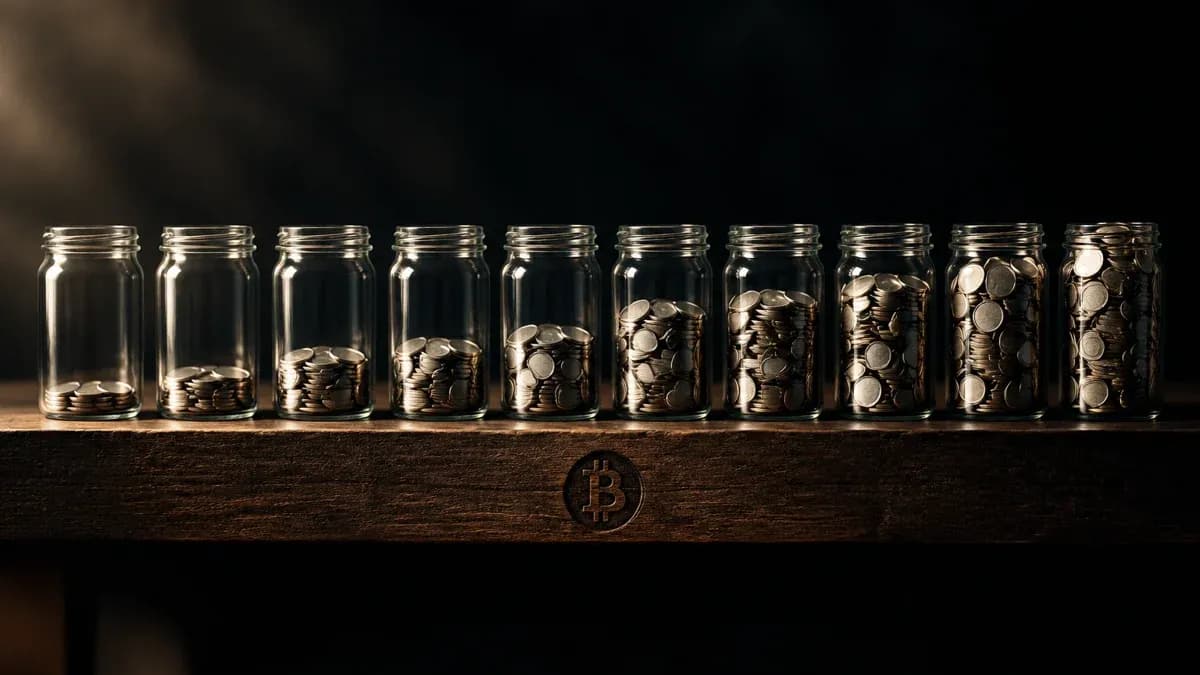
50 euros a month in Bitcoin, 118 instalments since 2017: savings plan vs lump sum
118 monthly instalments of 50 euros since January 2017 add up to €5,900 paid in and around €54,500 today. The same instalment since January 2024 is up only 14.5 percent, and since October 2025 the savings plan beats the lump sum by almost 39 percentage points.
October 16, 2026 7:26 AM
Bitcoin at $81,963 as ETF inflows shrink to $5 million
The US Bitcoin funds took in a net $5.06 million on Thursday, a day after $261.5 million flowed out. The price stands at $81,963 on Friday morning and has hung in a $521 range since midnight.
October 9, 2026 1:18 PM

Bitcoin Tax: One Year Past the $126,080 Peak, Losses No Longer Count
Bitcoin trades at $82,558 on Friday morning, 34.5 percent below an all-time high that is now a good year old. Anyone who bought back then loses more than the prospect of a quick recovery when the one-year period expires: the tax value of the loss goes with it.
October 6, 2026 4:32 AM
Bitcoin for a gift card: what paying with crypto means for your holding period
Paying for a gift card with Bitcoin is a sale for tax purposes. What counts as the disposal proceeds, when the twelve-month holding period bites, and the four records the tax office expects.
September 25, 2026 10:26 PM

Selling bitcoin privately: the tax in Germany and the records you need
A direct sale to a private individual falls under the same one-year rule as an exchange sale, but there is no tax report to go with it. This guide walks through the calculation, the 1,000 euro threshold and the records the tax office wants to see.
September 25, 2026 7:24 PM

Bitcoin Forecast: What to Check on Levels, Holding Period and Buying Route Before the Quarter Ends
Bitcoin stands at $83,877 at 16:40 UTC on September 25, 2026, and the measured volatility of the past 30 days spans a band of $73,600 to $94,200 for the coming month. More important than that band before the quarter ends are three checks: holding period, buying route under MiCA and the reporting duty in force since January 2026.
September 24, 2026 10:19 PM

Bitcoin for Retirement: What Applies from 2027 and What You Decide Now
Bitcoin is not permitted in any state-subsidised retirement product, including the new retirement savings account from 2027. Anyone who still wants to use crypto assets for their own pension goes through private assets, and there a cutoff date at the end of 2026 is shifting the tax rules right now.
September 17, 2026 7:12 PM

Gifting Bitcoin to Children: Allowance, Holding Period and the Tax Office Report
Transferring Bitcoin to your child hands over your holding period and your entry price along with the coins. This guide sets out what really applies in Germany on the allowance, the reporting deadline, representation and custody.

March 26, 2025 4:00 AM
BlackRock NEWS: BUIDL Fund Live on Solana and Bitcoin ETP Launch in Europe
BlackRock's dual crypto push—expanding its BUIDL fund to Solana and launching a Bitcoin ETP in Europe—has ignited market interest. Solana price surged to its best performance this week; so what's next?
September 18, 2026 10:14 PM

Bitcoin Back Above $80,000: Buy More, Hold or Take Profits? What to Check Now
Bitcoin is back above $80,000, for the first time since September 7. Whether you buy more, hold or take profits depends less on the daily price than on three things you can check yourself: your holding period, the way you buy, and where your coins are kept.
September 24, 2026 10:11 PM

Bitcoin Price Prediction: What to Check on Levels, Holding Period and Leverage Before the October 28 Rate Decision
Bitcoin is trading at around $83,800, a third below its October 2025 high, while the sentiment index reads greed. Which dates, levels and deadlines over the coming weeks really decide your net gain, and which of them you steer yourself.
September 20, 2026 1:11 PM

Bitcoin Golden Cross: What Twelve Signals Since 2014 Really Show
Bitcoin's 50-day line has crossed its 200-day line. We evaluated all twelve golden crosses since 2014 ourselves and measured what happened afterwards. The result argues against the common reading of the signal.
September 10, 2026 4:15 PM

BW-Bank Opens Bitcoin Trading Inside the Securities Account: What to Check Before Your First Buy
Since September 9, 2026, BW-Bank customers have been able to trade ten crypto assets through their securities account, executed and held in custody by Bitpanda. The familiar securities-account setting hides three points you should settle before your first order.
October 22, 2026 7:25 PM

Crypto market loses 4.2 percent in a day: why Ethereum is giving up 5.4 percent
Nasdaq down 2.1 percent, Brent crude at a five-month high: the crypto market gives up 4.2 percent, and Ether falls considerably harder than Bitcoin, by 5.4 percent. What set off the sell-off, and what can actually be checked today.
October 11, 2026 4:28 AM

Coinbase Card Without a Transaction Fee: What Investors Need to Know About Conversion and the Holding Period
Coinbase charges no transaction fee for paying with the card. It gets expensive in two places that appear on no receipt: the conversion of the balance and the holding period.
October 2, 2026 10:17 PM
Dogecoin breaks below $0.093: the BWOW fund turns every DOGE into cash on October 14
Dogecoin costs $0.0914 on Friday evening and has lost 3.4 percent in 24 hours. On October 14 the US fund BWOW sells its entire holding, and on the same day the German cabinet takes up the reform of crypto taxation.
More from CryptoTicker