
Solana ETF in Hong Kong at 0.6 percent: what changes for European investors
Hong Kong has launched its second spot ETF on Solana at a management fee of 0.6 percent. You cannot buy it from Europe, but the number throws light on European costs: on Xetra, a full percentage point a year separates two Solana wrappers.





Which topics should we dive deeper into?
Select what genuinely interests you. Your picks feed directly into our editorial planning.
Crypto news that's actually worth your time.
Weekly. 60 seconds. Carefully curated by our editors: no hype, no promo flood, no spam.
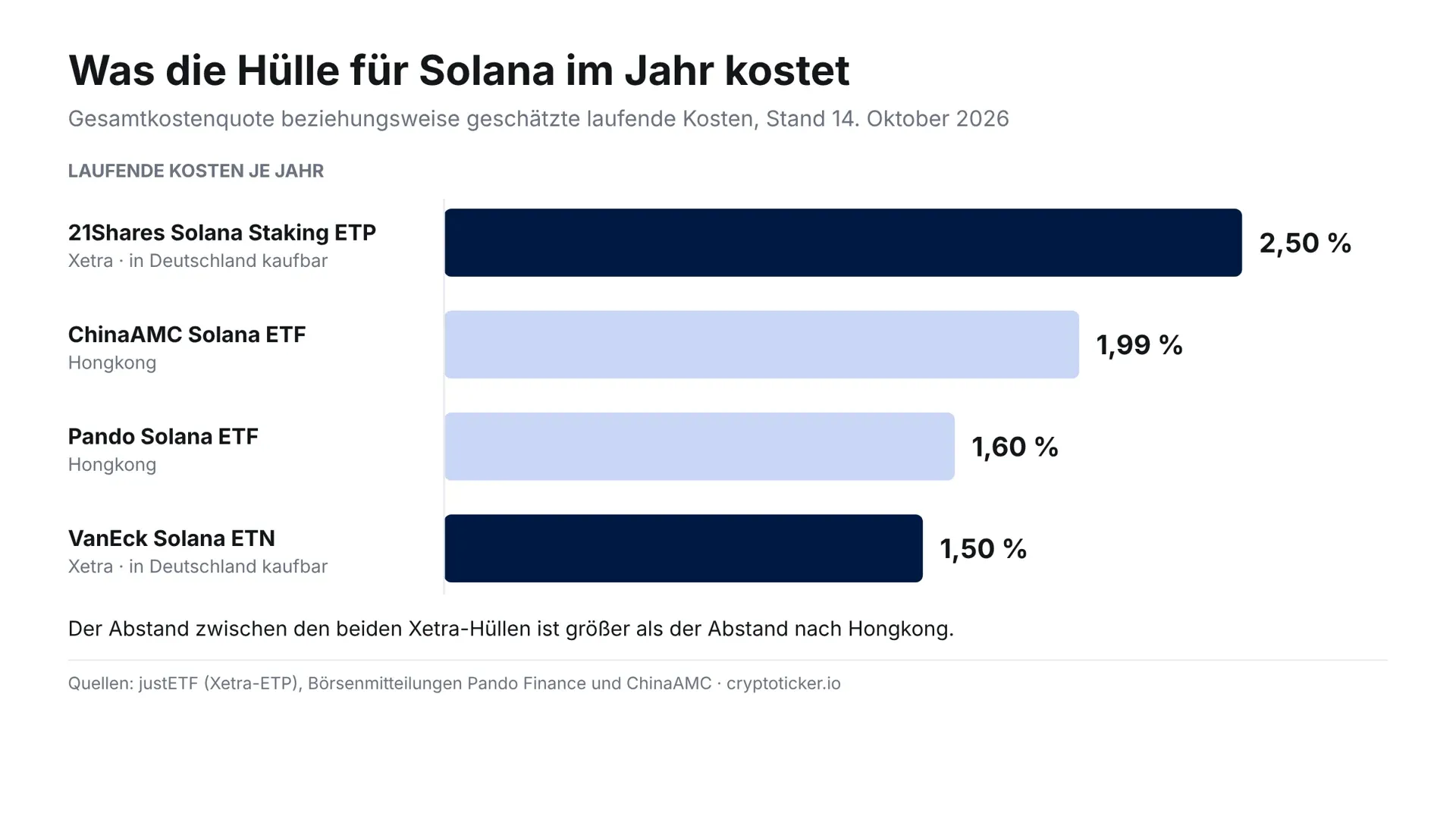
Hong Kong saw the launch of its second spot ETF on Solana on October 13, issued by Pando Finance under the ticker 02831. The management fee is 0.6 percent a year. You cannot buy this product from Europe. The number still matters, because it shows the range in which the cost of a Solana wrapper now sits. On Xetra the spread runs from 1.50 to 2.50 percent a year, and over ten years that gap costs more than any single day's move.
Pando lists Hong Kong's second Solana spot ETF
The fund was introduced on the Hong Kong Stock Exchange after a subscription period running from October 6 to 12. That makes it the city's second spot ETF on Solana after the ChinaAMC product, and Pando Finance's third exchange-traded product on a single cryptocurrency, following Bitcoin and Ethereum.
The construction is deliberately plain. The fund may hold up to 100 percent of its net asset value in SOL, but uses no derivatives and no leverage. It also runs no staking, forgoing the network rewards a Solana position can otherwise earn. The reference is the CME CF Solana Dollar Reference Rate at the Asia-Pacific close. HashKey Exchange handles trading of the coins, HashKey Custody Services the custody, and BOCI-Prudential Trustee acts as trustee.
A spot ETF is an exchange-traded fund that actually buys and holds the cryptocurrency rather than tracking its price through futures. The share price therefore follows the coin price directly, less the running costs.
0.6 percent management and 1.6 percent running costs are two different numbers
The management fee is only part of the bill. Pando puts estimated total running costs at 1.6 percent a year. The gap to the 0.6 percent comes from custody, trusteeship, audit and trading-related costs, which the fund also pays out of its assets. At ChinaAMC, a 0.99 percent management fee sits next to an estimated 1.99 percent in total costs.
Comparing two products therefore means taking the total expense ratio, not the management fee. The first number leads every press release; the second decides the return. In Europe this figure is called the total expense ratio, or TER, and it covers every cost taken from the product on an ongoing basis.
Why the Hong Kong fund is not an option here
An ETF authorised in Hong Kong may not be distributed to retail investors in the European Union. German brokers therefore do not carry such products. The same applies to the US spot ETFs on Solana: those funds do not meet European distribution rules, and a German brokerage account will not even display them.
The European route runs instead through exchange-traded notes, called ETPs or ETNs depending on the issuer. Legally these are not funds but collateralised bearer notes, backed by real coins held at a custodian. In practice you buy them like a share through an ordinary brokerage account. Which products those are, and what matters about the collateral, is set out in the overview of crypto ETFs in Germany.
 Find the right crypto tax tool
Solana ETPs on Xetra: 1.50 percent against 2.50 percent
Two large Solana products sit side by side on Xetra, separated by a full percentage point a year. The 21Shares Solana Staking ETP (ISIN CH1114873776, ticker ASOL) costs 2.50 percent a year and holds around 588 million euros. The VanEck Solana ETN (ISIN DE000A3GSUD3, ticker VS0L) costs 1.50 percent and holds around 76 million euros.
The split is striking: the more expensive product holds roughly eight times the money. Part of that has a sound basis, because the 21Shares product runs staking and passes some of the network rewards to investors, which can offset at least part of the higher fee. What counts is therefore what remains after the fee and after the reward, and that number sits in the factsheet, not in the marketing.
21Shares has also launched a cheaper Solana product, the Core Staking ETP (ISIN CH1385084384). At launch the issuer quoted a total expense ratio of 0.35 percent. Because fee models change and comparison sites have recently carried differing figures, check the current rate in the issuer's factsheet before you buy.
How the fee shrinks a Solana holding
With a physically backed product the fee is not debited from your account. The manager takes it out of the deposited holdings. Each share therefore stands behind slightly fewer coins with every year that passes. The price of the note does not fall as a result, but the claim on SOL shrinks, and it does so quietly.
In numbers: at 2.50 percent a year, 77.6 percent of the original coin quantity remains after ten years; at 1.50 percent it is 86.0 percent. The difference is 8.3 percentage points. On an investment of 10,000 euros with an unchanged price, that comes to around 834 euros, the cost of the wrapper alone. In the first year the gap is still modest at 250 against 150 euros, but in every following year it works on an already smaller holding.
This model calculation assumes an unchanged price and leaves staking rewards aside. It does not show what an investor earns, but what the wrapper consumes regardless of the price direction.

The capital gains holding period under Section 23 EStG applies only outside the wrapper
This is where the cost question turns. Holding SOL directly in your own wallet or at an exchange brings Section 23 of the German Income Tax Act into play. Sell after more than one year and the gain is tax-free, whatever its size. Within the year, an exemption limit of 1,000 euros applies to all private disposals together. The German Federal Ministry of Finance confirmed this line in its circular of March 6, 2025.
An exemption limit means all or nothing. One euro above it and the entire gain becomes taxable, not just the excess. The period is counted to the day: buy on March 15 and the earliest tax-free sale is March 16 of the following year.
With an ETP or ETN this treatment is not assured. Whether the one-year period applies there is widely held to depend on whether the note carries a claim to delivery of the actual coins. Without that claim, taxation as investment income under Section 20 EStG is the likely outcome, meaning 25 percent withholding tax plus the solidarity surcharge, even after ten years. A definitive ruling covering every product variant is still missing. Settle the point before you buy, in the securities prospectus and, if in doubt, with a tax adviser, because it usually weighs more than a percentage point of fees.
 Compare exchanges to buy Solana
Staking income and the 256-euro exemption limit
Holding Solana directly allows the coins to be staked for network rewards. For tax purposes those rewards are other income under Section 22 No. 3 EStG, taxable at the personal rate in the year they arrive. A separate exemption limit of 256 euros applies, independent of the 1,000 euros under Section 23.
Two points are regularly confused. First, staking does not extend the holding period of the coins involved. The ten-year period once discussed is off the table; the 2025 ministry circular expressly keeps to one year. Second, the rewards received start their own one-year clock from the day they arrive, so they are fresh coins with a fresh clock. Anyone collecting rewards regularly needs a clean record of each inflow, and that is what crypto tax software and portfolio trackers are for. How staking offers differ is shown in the overview of staking platforms.
What the outflows from the US funds say about demand
The Hong Kong opening falls in a week when institutional money was pulled elsewhere. The US spot ETFs on Solana saw net outflows of 24.8 million dollars in the week of October 5 to 9, the first negative week after 14 weeks of inflows. Bitwise's BSOL fund accounted for the largest share at around 21 million dollars. We set out those figures in detail on October 11.
The picture has not turned since. October 12 added a further 0.7 million dollars in outflows, taking the run to six consecutive trading days. For context, the US spot ETFs on Bitcoin and Ethereum together saw around 1.22 billion dollars leave over the same period. That points to a broad retreat from crypto funds rather than a Solana-specific problem.
At midday on Wednesday SOL trades at around 106.62 dollars, or 95.24 euros, 0.6 percent below the previous day and 63.6 percent below its record of 293.31 dollars (data from CoinGecko). The price here is the occasion, not the news. The news is that the supply of wrappers is growing while demand for them is easing.
Our assessment: the wrapper is a cost question, not the price question
From the newsroom's perspective, the most interesting number of the week is not the 0.6 from Hong Kong but the split on Xetra. That around 588 million euros sits in the product charging 2.50 percent and around 76 million in the one charging 1.50 percent can only partly be explained by staking rewards. Much suggests that name recognition and first listing weigh more heavily than the cost ratio.
There is a serious objection on the other side: a staking product with a higher fee can end up ahead of a cheaper one without staking once rewards are counted. Whether that holds can only be read from the net result reported in each factsheet, not from the fee alone. The 1.50 to 2.50 percent spread is documented, the difference in fund size is documented, and the ten-year calculation is documented. What is not documented is that the more expensive wrapper earns its premium. We are assessing the situation and making no buy or sell recommendation.
Solana ETP fees: 1.50 versus 2.50 percent adds up over a decade
- Check your product's factsheet for the total expense ratio rather than the management fee. Which wrappers are tradable in Germany is set out in the overview of crypto ETFs in Germany.
- Check the prospectus for whether your ETP carries a claim to delivery of the coins. That determines whether the one-year period is reachable at all. Recording each purchase and each inflow is handled by crypto tax software and portfolio trackers.
- Price up the direct purchase: holding SOL yourself for more than a year means no annual fee and, under Section 23 EStG, no tax on the gain. For a trading venue, see the overview of crypto exchanges.
(As of October 14, 2026. This article is not investment advice. Prices and fee structures change; check the terms with the provider before you buy.)
Frequently asked questions about Solana ETFs and ETPs
Transparency note: This article was produced with the assistance of artificial intelligence and reviewed by our editorial team before publication. All figures and claims were checked against the primary sources linked in the text. The feature image was generated with AI.
Related articles
- Solana DEX Trades Overtake the NYSE: What to Check on Swaps, Tax and Oversight
- Ethereum Rises While ETF Money Leaves: What ETH Holders Should Check Now
- 93.56 million dollars out of the Zcash ETF in one week: what changes for ZEC holders in Europe
- Crypto Tax in Germany: What Applies in 2026 and What Is Set to Change in 2027
- Solana price 108.46 euros: a 2.4 percent gain in euros, a 2.5 percent loss in dollars: what to check now
Which topics should we dive deeper into?
Select what genuinely interests you. Your picks feed directly into our editorial planning.
Crypto news that's actually worth your time.
Weekly. 60 seconds. Carefully curated by our editors: no hype, no promo flood, no spam.

September 26, 2026 10:12 PM
Solana Price Above $120: What to Check on Staking Yield, Holding Period and Spread
Solana is trading at $121.00 on September 26, 2026, 8.6 percent above its level a week earlier. What a self-measured staking yield of 5.27 percent is worth, how the one-year holding period applies to staked SOL, and what an order in euros really costs.

September 8, 2026 10:21 PM

Crypto Holding Period and Grandfathering: Why December 31, 2026 Becomes the Cut-Off in Germany's Draft Bill
A ministerial draft bill from Germany's finance ministry names a cut-off date for the first time: crypto assets acquired after December 31, 2026 are to fall under the flat-rate withholding tax. What that means for legacy holdings, running savings plans and staking income, and why nothing has been decided yet.
October 12, 2026 4:28 PM

XRP price prediction: $160 million behind Solana, 13 weeks of inflows against a 9 percent weekly loss
The XRP funds are only $160 million behind the Solana funds and have been taking in fresh money for 13 weeks. Why the price is falling anyway at $1.38, and what that means for the $2.80 year-end target.
September 27, 2026 4:12 AM
Bitcoin ETF Inflows Turn 2026 Positive: How to Tell If the Demand Holds
US spot Bitcoin ETFs took in roughly $2.4 billion in the week to September 25, the strongest week since October 2025, and that turns the 2026 year-to-date balance positive. Why the daily inflow fell 87 percent within the same week, and what to check on buying route, holding period and custody.
September 26, 2026 1:19 AM
Germany’s Crypto Holding Period Is Wobbling: What to Check Before December 31
A CDU member of the Bundestag makes it plain: the coalition agreement does not guarantee that the one-year holding period for crypto assets will survive. What that means for purchases made before the planned cutoff date of December 31, 2026.
October 7, 2026 7:18 AM

Certificate, Bitcoin ETN or the coin itself: what each route means for tax and custody
A Bitcoin certificate, an ETN and the coin itself all lead to the same price, but to three different tax treatments and three different risks. The comparison shows which route fits your portfolio and why December 31, 2026 becomes the cut-off date.
September 27, 2026 1:17 PM
Dogecoin Price: What to Check on Holding Period and Custody Before the Year End
The Dogecoin price stands at $0.0977 on September 27, 2026 and has barely moved in a day. That calm is exactly the moment to work through the holding period, the reporting duty from 2026 and custody without any time pressure.
September 9, 2026 1:15 AM

Germany's Crypto Tax: 160 Million Euros for a 555-Billion Budget
The German finance ministry's draft bill puts a figure on the crypto tax for the first time: 160 million euros from 2028. What that number means in the 2027 federal budget, how 11.4 billion became 160 million, and what investors can read from it.

September 24, 2026 10:12 AM
XRP Falls 9.7 Percent: What to Check on Holding Period and Buying Route
XRP is down around 9.7 percent on the morning of September 24, twice as much as the typical large crypto asset. Our count of 18 coins shows who the pullback hits and which three things hold true regardless of the price.
September 14, 2026 10:23 AM

Take Ethereum Profits or Wait Out the Holding Period? What the Price Jump Means for Your Tax Bill
Ether reached its highest level since the end of January on September 11, 2026, and many are asking whether to sell now. In Germany the answer hangs on the purchase date first: we work out which tranches are tax free and which of them are showing a gain at all.
September 9, 2026 4:13 PM

Bitcoin 29 Percent Below Last Year: Which Crypto Losses You Can Still Use Before the One-Year Holding Period Expires
Nine out of ten major crypto assets trade lower today than exactly twelve months ago, Bitcoin alone by 29.2 percent. We measured the price series ourselves and show why the purchase date alone decides the tax value of your loss.
September 8, 2026 1:19 AM

Germany's Crypto Holding Period: What Happens Now Signing for Petition 201716 Closed on September 15
Recap as of September 27, 2026: the signature period for German parliamentary petition 201716, which asks for the one-year crypto holding period to be preserved, closed on September 15, 2026. This article explains what ended that day, how the petitions committee proceeds and why no investor has to sell because of it.
October 2, 2026 1:33 PM

Crypto tax before the cabinet on October 14: “Comments are only possible until October 6”
Germany's Federal Ministry of Finance sent the draft bill on crypto taxation to the associations on September 30, 2026, and the cabinet is to decide on October 14. For your holdings one date counts above all: December 31, 2026.
October 9, 2026 1:18 PM

Bitcoin Tax: One Year Past the $126,080 Peak, Losses No Longer Count
Bitcoin trades at $82,558 on Friday morning, 34.5 percent below an all-time high that is now a good year old. Anyone who bought back then loses more than the prospect of a quick recovery when the one-year period expires: the tax value of the loss goes with it.
October 2, 2026 10:17 PM
Dogecoin breaks below $0.093: the BWOW fund turns every DOGE into cash on October 14
Dogecoin costs $0.0914 on Friday evening and has lost 3.4 percent in 24 hours. On October 14 the US fund BWOW sells its entire holding, and on the same day the German cabinet takes up the reform of crypto taxation.
September 25, 2026 10:26 PM
Selling bitcoin privately: the tax in Germany and the records you need
A direct sale to a private individual falls under the same one-year rule as an exchange sale, but there is no tax report to go with it. This guide walks through the calculation, the 1,000 euro threshold and the records the tax office wants to see.
September 17, 2026 10:22 PM
Selling Bitcoin at a Loss and Buying It Straight Back: What That Does to Your Holding Period
Germany has no wash sale rule: the loss stays deductible even if you buy back immediately. The buyback, however, restarts the one-year period for every new unit.
September 16, 2026 7:12 PM

Borrowing Against Bitcoin Instead of Selling: When German Tax Still Applies
Posting Bitcoin as collateral for a loan is not a sale in Germany, because section 39 of the Fiscal Code keeps the coins attributed to you for tax purposes. Tax arises only when the collateral is liquidated, and then the one thing that decides the bill is how long you held the coins beforehand.
September 7, 2026 7:22 AM

German Crypto Holding Period Set to Go After All: A Separate Draft Targets Purchases From 2027
Correction of 8 October 2026: The Income Tax Reform Act 2027, adopted by the German federal cabinet on 2 September, does not cover crypto assets. That did not mean the holding period stays. A separate draft bill from the Federal Ministry of Finance, dated 30 September, would abolish it for anything acquired after 31 December 2026. The cabinet is due to decide on 14 October.
August 21, 2026 4:24 AM

Forced Sale on a Crypto Exchange: Which Moment Counts for the Holding Period and What You Must Document
At Luno, Kraken and Valour the deadlines are running out, after which the provider realises the remaining holding itself. For tax purposes that is a disposal, and what governs it is the exchange's timestamp.
October 10, 2026 7:15 PM

ING and Bitcoin: Around 50 Crypto ETNs in the Portfolio, and What the Delivery Claim Means for Your Holding Period
Bitcoin can be bought at ING, but only as an exchange-traded note: around 50 crypto ETNs from five issuers, as a one-off purchase or a savings plan from one euro. What the offer really costs, and what the one-year holding period hangs on, is not in the advertising but in the key information document.
October 6, 2026 10:14 AM

$3.8 Million Back From the Attacker: Why the NEAR Price Is Up 7.8 Percent
The attacker has sent back the full $3.8 million from the NEAR Intents exploit, and the NEAR price is up 7.8 percent at $5.23. What is behind the recovery, what role the Bitwise NRR ETF plays, and what follows from it for buying route, holding period and custody.
October 6, 2026 4:32 AM
Bitcoin for a gift card: what paying with crypto means for your holding period
Paying for a gift card with Bitcoin is a sale for tax purposes. What counts as the disposal proceeds, when the twelve-month holding period bites, and the four records the tax office expects.
September 27, 2026 7:14 PM
Solana Price at $121.93: What to Check on Staking Yield, Unstaking and Tax
SOL stands at $121.93 on September 27 at 16:42 UTC, after a 12.7 percent gain over seven days. More important than the weekly move is a calculation almost nobody makes: of the staking yield usually quoted, roughly a quarter is left in real terms, and the epoch decides when you can reach your coins again.
September 27, 2026 10:14 AM
Shiba Inu Price Prediction: What to Check on SHIB Before the December 31 Deadline
SHIB trades at $0.00000592 on September 27, 2026, around 93 percent below its all-time high. For German investors one date matters more than the chart right now: December 31, 2026.
September 17, 2026 7:12 PM

Gifting Bitcoin to Children: Allowance, Holding Period and the Tax Office Report
Transferring Bitcoin to your child hands over your holding period and your entry price along with the coins. This guide sets out what really applies in Germany on the allowance, the reporting deadline, representation and custody.
October 7, 2026 4:28 PM

Shiba Inu Price at $0.00000538, Down 8.6 Percent in a Day: Hold or Sell?
Shiba Inu loses 8.6 percent on Wednesday afternoon and trades at $0.00000538. Whether a sale makes sense is decided in Germany less by the chart than by the purchase date of the individual tranche, because the one-year period hangs on it.
More from CryptoTicker