
Bitcoin after the crash: falling knife or buying opportunity? What 13 years of price data show
Bitcoin trades 45 percent below its record high. Buy the dip or a falling knife? Daily prices since 2013 show the first 45 percent drop was almost never the bottom, yet a savings plan started at the record is down only 11.6 percent. What past bear markets say about the bottom.


Which topics should we dive deeper into?
Select what genuinely interests you. Your picks feed directly into our editorial planning.
Crypto news that's actually worth your time.
Weekly. 60 seconds. Carefully curated by our editors: no hype, no promo flood, no spam.
Friday, November 13, 2026, 12:08 p.m. ET: Bitcoin trades at $68,760, 44.9 percent below its highest daily close on October 6, 2025. Is this a buying opportunity or a falling knife you should not try to catch? CoinMarketCap's daily prices since April 2013 give an uncomfortable answer and an encouraging one. The uncomfortable one: in six of seven earlier cases where Bitcoin first closed 45 percent below its record in a cycle, the price was lower one year later. The encouraging one: a $100 weekly savings plan started at the record high is down only 11.6 percent today, while a lump sum invested on the record day is down 44.9 percent.
Why Bitcoin is falling today and what the weekend could bring is covered in our report Bitcoin on Friday the 13th: weekend panic builds as traders eye $60,000. This piece tackles the question many investors are asking tonight: buy Bitcoin now or wait?
Catching a falling knife: what the old market rule means for Bitcoin
"Never catch a falling knife" is an old market rule. If you buy into a sharply falling price, it may keep dropping before a bottom forms. For Bitcoin, that rule has been especially costly. In the three major bear markets since 2013, the price fell by more than three quarters each time, and it took 10 to 13 months from the first 45 percent drawdown to the bottom.
| Phase | Record (daily close) | Lowest close | Drawdown |
|---|---|---|---|
| Bear market 2014/15 | $1,151, Dec 4, 2013 | $178, Jan 14, 2015 | 84.5% |
| Bear market 2018 | $19,497, Dec 16, 2017 | $3,237, Dec 15, 2018 | 83.4% |
| Correction 2021 | $63,503, Apr 13, 2021 | $29,807, Jul 20, 2021 | 53.1% |
| Bear market 2022 | $67,567, Nov 8, 2021 | $15,787, Nov 21, 2022 | 76.6% |
| Since October 2025 | $124,753, Oct 6, 2025 | so far $58,559, Jun 30, 2026 | so far 53.1% |
The table also shows why the outcome is open. The low of this cycle so far, minus 53.1 percent, matches the summer 2021 correction exactly. Back then, no bear market followed, but a new all-time high in November 2021. A drop like 2018 or 2022, by 77 to 85 percent, would put a bottom at roughly $19,300 to $29,200. That is arithmetic, not a forecast: since 2024, exchange-traded funds and companies have been buying Bitcoin on a scale earlier cycles never saw.

 Crypto exchanges compared
Buying Bitcoin after a 45 percent drop: what earlier cycles show
Since 2013, there were seven days on which Bitcoin first closed 45 percent below its record during a downturn. One year later, the price was higher only once: in July 2013, when one Bitcoin cost about $78. In every other case it kept falling, by 16 to 66 percent. Anyone who bought at $10,106 on January 30, 2018, was down 65.5 percent a year later. Anyone who bought at $36,457 on January 21, 2022, was down 37.5 percent twelve months later.
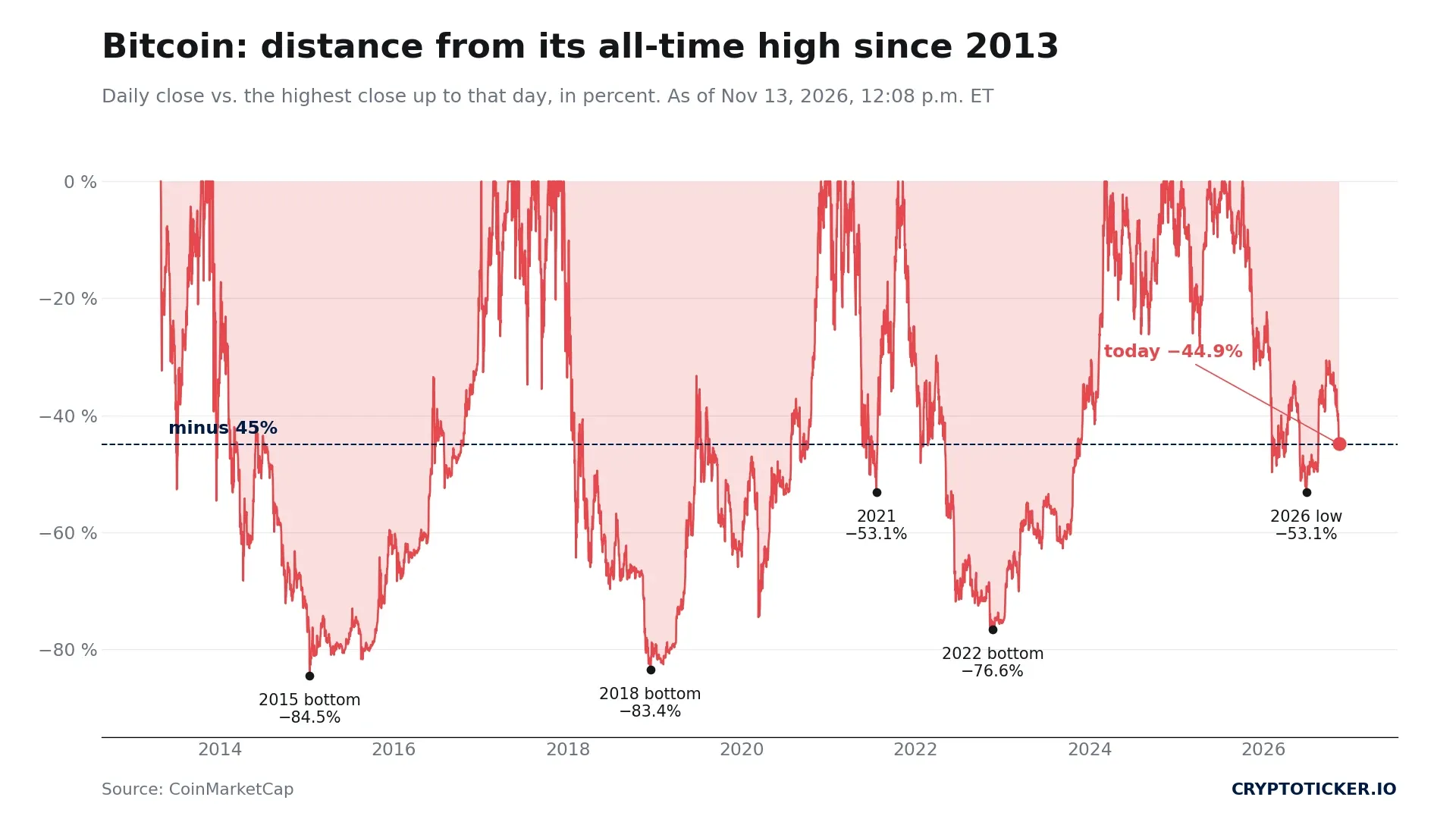
Over a longer view, the picture changes. Looking at every single day since 2013 on which Bitcoin was at least 45 percent below its record, the price was higher one year later in 80 percent of cases, with a median gain of 88.5 percent. The reason: most of those days were deep inside bear markets, shortly before the recovery. Early buyers had to sit through the valley, later buyers were rewarded. Nobody knew the right day in advance.
In this cycle, Bitcoin first fell more than 45 percent below its record on February 5, 2026, to $62,702. Today, a little over nine months later, it trades 9.7 percent higher. Whether this cycle plays out differently will be clearer by February 2027.
Bitcoin dollar-cost averaging in a crash: saving since the record high cuts the loss
If you do not want to guess the bottom, spread your entry. The table shows a plan buying $100 of Bitcoin every Monday at the daily close, valued at tonight's price.
| Savings plan since | Invested | Value today | Result |
|---|---|---|---|
| Oct 6, 2025 (record high) | $5,800 | $5,127 | minus 11.6% |
| Nov 11, 2024 | $10,500 | $8,369 | minus 20.3% |
| Nov 14, 2022 (just before the 2022 bottom) | $20,900 | $29,458 | plus 40.9% |
| Nov 8, 2021 (2021 record high) | $26,200 | $41,875 | plus 59.8% |
For comparison: anyone who bought everything at once on October 6, 2025, is down 44.9 percent today. The savings plan started the same day loses only a quarter of that. And even someone who started saving at the 2021 record high, the worst possible moment, is up almost 60 percent today.
 Regulated crypto exchanges compared
Should you buy Bitcoin now? Three ways to avoid catching the falling knife
- A savings plan instead of a lump sum: a fixed amount every week or month removes the need to pick the right day and automatically buys more Bitcoin when prices are low.
- Staggered buy orders: if you want to invest once, split the amount and place limit orders at levels where buyers stepped in recently, such as the 200-week average at $67,752, the August low at $64,111 and the February low at $60,074.
- Only money that can wait: earlier bear markets took 10 to 13 months from the first 45 percent drawdown to the bottom, and the recovery often took longer. If you need the money sooner, stay out.
Traders who want to play short-term moves can profit from falling prices with short positions, but leverage carries a high risk of loss. What long, short and leverage returned on Friday the 13th is shown in our report on the Friday Bitcoin crash. Which platforms offer recurring buys and what they charge is listed in our crypto exchange comparison, licensed providers in our comparison of regulated crypto exchanges.
Advertisement: Crypto futures trading: Bitget offers leverage of up to 100x. Leverage can lead to high losses. Our exchange comparison shows more platforms.
Bitcoin crash: what investors should keep in mind now
After every major bear market so far, Bitcoin has gone on to new records, but never in a straight line. Anyone buying now should be able to sit through another 20 to 30 percent drop without selling. Taxes depend on where you live: in the US, Bitcoin held for more than one year qualifies for long-term capital gains rates, which are lower than short-term rates.
Not investment advice: cryptocurrencies are highly volatile, so only invest money you can afford to lose.
FAQ: buying Bitcoin in a crash
Partner links: some links on this page are partner links. If you become a customer through one of them, we may earn a commission at no extra cost to you. Selection, ratings and ranking are decided independently by our editorial team. Ethics and Independence · Ownership and Funding
Transparency note: This article was produced with the assistance of artificial intelligence and reviewed by our editorial team before publication. All figures and claims were checked against the primary sources linked in the text. The feature image was generated with AI.
Related articles
- Bitcoin on Friday the 13th: weekend panic builds as traders eye $60,000
- Why Is Crypto Crashing? The 3 Reasons Behind This Brutal Sell-Off
- Will Bitcoin Go Back Up? Three Scenarios to Year-End: $70,000, $80,000 or $100,000
- Crypto Fear and Greed Index at 28: What Happened Every Time the Market Hit Extreme Fear
- Crypto Crash: Why Bitcoin, Ethereum, XRP and Solana Fell This Week and What Comes Next
Which topics should we dive deeper into?
Select what genuinely interests you. Your picks feed directly into our editorial planning.
Crypto news that's actually worth your time.
Weekly. 60 seconds. Carefully curated by our editors: no hype, no promo flood, no spam.

November 6, 2026 3:35 AM

Stock Market Crash 2026: How Close It Is, What Past Crashes Show and What You Can Do Now
The Nasdaq 100 is 14.7 percent below its record, the DAX only 0.9 percent and Bitcoin almost 40 percent. When people speak of a correction, a bear market and a crash, what the big crashes since 1929 show and what you can sensibly do now.
November 5, 2026 7:36 PM

Stellar Price Below the 200-Day Line: What Counts After 29% Down in 30 Days
Stellar lost 8.5% in 24 hours and 29% in 30 days as the Nasdaq rout hit crypto. The levels that count now, what could turn the picture and how to hedge.
November 5, 2026 7:06 PM

Uniswap Price Drops 10.7%: Why UNI Falls Harder Than Bitcoin
Uniswap lost 10.7% in 24 hours and 21% in 30 days as the Nasdaq rout hit crypto. The levels that count now, what could turn the picture and how to hedge.
November 5, 2026 6:48 PM

Sui Price Drops 9.5% in a Day: The Levels SUI Must Hold Now
Sui lost 9.5% in 24 hours and 29% in 30 days as the Nasdaq rout hit crypto. The levels that count now, what could turn the picture and how to hedge.
November 5, 2026 6:36 PM

Litecoin Price: Down 26% in 30 Days, Now the 200-Day Line Decides
Litecoin lost 7.9% in 24 hours and 26% in 30 days as the Nasdaq rout hit crypto. The levels that count now, what could turn the picture and how to hedge.
November 5, 2026 5:36 PM

Bitcoin Crash: Why BTC Fell to $75,568, How Low It Could Go and How to Hedge
Bitcoin (BTC) lost more than $5,000 in under a day as a Nasdaq chip rout wiped out leveraged longs. The reasons, the levels that count now, what 23 earlier 5 percent days show, and how to earn and hedge in this market.

November 5, 2026 5:13 PM

Bitcoin falls below $77,000 as a Nasdaq chip sell-off sets off a liquidation wave
Bitcoin (BTC) dropped from $78,767 to $75,986 within an hour on November 5, and Ether lost more than 6 percent. A sell-off in chip stocks on the Nasdaq set it off, and forced liquidations of more than $560 million deepened the slide.

November 3, 2026 8:28 AM

Why Is Crypto Down Today? The 5 Reasons Behind the November 3 Sell-Off
Why is crypto down today? Bitcoin sits near $76,000 after the Binance hack, a hawkish Fed and a Nasdaq slide. The five drivers, explained.
October 31, 2026 12:48 AM

Crypto Weekly Recap: Binance Hack, Wall Street Crash and Gold Under Pressure
The largest crypto theft in history, Wall Street's worst day since June and a Fed that turns hawkish: week 44 of 2026 in numbers, the five events that mattered, winners and losers among the top coins and what crypto investors should watch next week.
October 29, 2026 9:49 PM

Is This the End? How Low Bitcoin Could Fall After the Binance Hack
About $2.8 billion left a Binance hot wallet and Bitcoin slid below $79,000. Whether this turns into a real crash depends on one question. Three scenarios, the key price levels for Bitcoin, Ethereum and Solana and what to do now.
October 27, 2026 5:23 PM

China AI Bubble Bursts: $480 Billion Gone, So Why Is Bitcoin Not Crashing?
China’s AI stock bubble has burst, erasing $480 billion as the STAR50 drops 40%. Here is why it happened and what it means for Bitcoin and crypto.
October 25, 2026 10:51 AM

Crypto Crash: Why the Top Cryptos Lost Up to 4% in One Week
Crypto crash week: the largest cryptos lost up to 4% in seven days. We break down why crypto prices are falling and what to watch next.
October 22, 2026 10:33 AM

Bitcoin crash history: every fall of more than 50 percent since 2011
Analysis: seven times since 2011 Bitcoin has lost more than half its value, most recently 53 percent to June 2026. Every crash with its high, low, duration and recovery, the triggers from Mt.Gox to the tariff liquidations, and what investors can take from them.
October 20, 2026 10:38 AM
Crypto Crash Today: Why Is Bitcoin Stuck Below $82,000?
Bitcoin can't hold $82K, Ethereum is down 20% in 2026 and ETF money keeps leaving. Here is what is really behind the crypto crash today.
October 14, 2026 7:24 PM

Bitcoin below $82,000, Ether below $2,500: Will the $81,000 level hold?
The crypto market has lost 4.50 percent within 24 hours, with Bitcoin at $81,712 and Ether at $2,420. The US price report on Wednesday came in above forecast and turns rate expectations, while leverage on the futures market has largely been worked off. This piece sorts out both: prices, liquidations and ETF flows are sourced and linked, and the assessment at the end is the newsroom's own view.
October 12, 2026 10:27 AM

Is Bitcoin Still a Good Investment in October 2026?
Spot ETFs have changed who sets the Bitcoin price, and the easy repricing is behind us. What still supports BTC, what could break it, and how much belongs in a portfolio today.
October 8, 2026 5:06 PM

Crypto Crash Reason: Why Bitcoin Fell Below $81,000 and Altcoins Bled Even Harder
Bitcoin slid under $81,000 and Ethereum lost 9% in a week. Here is every crypto crash reason behind the October 2026 selloff explained.
October 8, 2026 4:38 AM

Crypto Market Slides: Bitcoin Loses 4.2 Percent and $651 Million of Long Bets Are Liquidated
Bitcoin has lost 4.2 percent since Tuesday afternoon, and ether and XRP more still. Three reasons can be documented: outflows from the US ETFs, $651 million of forcibly closed long bets and Fed minutes holding out the prospect of another rate rise. A crash it is not, and what to check before buying more is set out here.
October 6, 2026 1:23 AM

50 euros a month in Bitcoin, 118 instalments since 2017: savings plan vs lump sum
118 monthly instalments of 50 euros since January 2017 add up to €5,900 paid in and around €54,500 today. The same instalment since January 2024 is up only 14.5 percent, and since October 2025 the savings plan beats the lump sum by almost 39 percentage points.
September 29, 2026 10:38 AM

Bitcoin Falls Toward $83,000 as Trump Rejects Iran Ceasefire Deal
Bitcoin slipped toward $83,000 after Trump rejected Iran's Hormuz proposal, sending oil above $100 and wiping out $478 million in crypto liquidations.
September 21, 2026 10:24 PM

Four of the Five Largest Coins at a Three-Month High: Only XRP Is Missing
Bitcoin, Ethereum, Solana and BNB trade above every hourly price of the past 90 days, while XRP sits almost ten percent below. Measured against the hourly series rather than sentiment: which highs are real, which exist only in daily closes, and what a $648 million short squeeze has to do with it.
September 21, 2026 4:15 PM

Sui Jumps 26 Percent: The Strongest Coin In The Top 30
Sui gains around 26 percent within 24 hours and beats every other asset in the top 30. Behind the move sit a prominent bet on the AI economy, a new bitcoin protocol and a rotation into layer 1 chains.
September 19, 2026 10:35 AM

The Cost Average Effect with Bitcoin: What Twelve Instalments Really Deliver
Twelve monthly instalments of 100 euros produced an average price of 66,472 euros and ran 33.6 percentage points ahead of the lump sum purchase on the same starting day. The calculation also shows when the savings plan is the worse route.
September 14, 2026 4:19 AM

Fed Rate Decision of September 16: What It Means for Your Bitcoin Savings Plan
Recap as of September 27, 2026: this article appeared before the US Federal Reserve's rate decision on September 16, 2026, when futures markets mostly expected a hike. It describes what a hike means for your monthly instalment, a running crypto loan and your holding periods.


More from CryptoTicker