
Is it Time to Buy the Crypto Dip? Bitcoin at $60k Amid Middle East Escalation
Bitcoin has plunged from $120k to $60k as Middle East geopolitical tensions spike. Explore whether to buy the crypto dip or wait for further downside.





Which topics should we dive deeper into?
Select what genuinely interests you. Your picks feed directly into our editorial planning.
Crypto news that's actually worth your time.
Weekly. 60 seconds. Carefully curated by our editors: no hype, no promo flood, no spam.
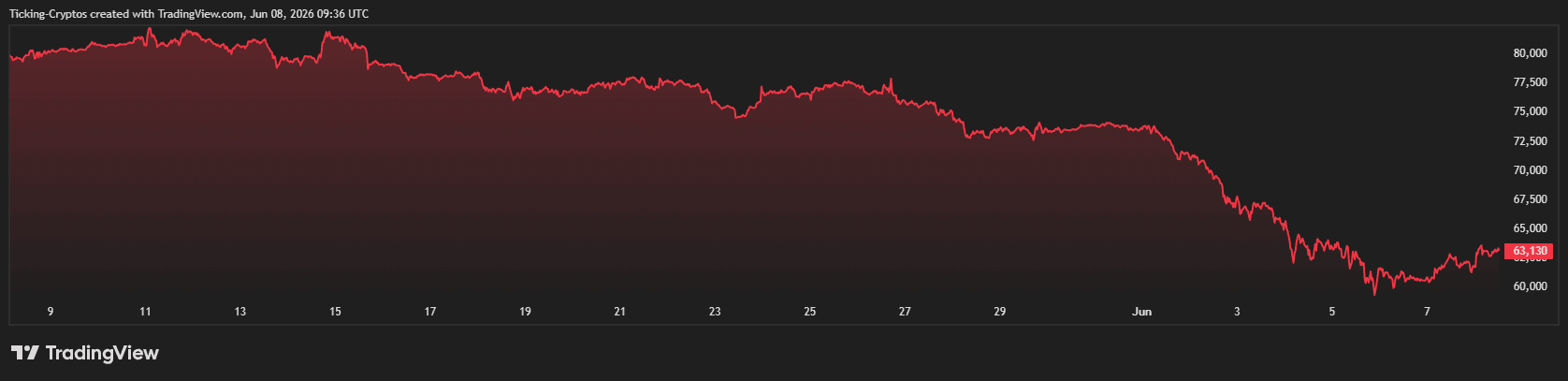
The crypto market is facing its most severe stress test since 2022. Bitcoin ($BTC) has suffered a dramatic 50% retracement, falling from its all-time high near $120,000 down to the psychological support level of $60,000. This massive selloff has wiped out trillions in market value, driven by a brutal cocktail of forced derivatives liquidations, macroeconomic tightening, and severe geopolitical conflict in the Middle East.
With the ongoing 2026 Iran-Israel war threatening regional stability and disrupting global trade routes like the Strait of Hormuz, institutional and retail investors are trapped in a classic market dilemma: Is this the ultimate generational buying opportunity, or is it a falling knife that will drop lower?
Why is the Crypto Market Crashing?
To determine whether Bitcoin at $60,000 is a value buy, we must first understand the structural forces that triggered this unwinding. The crash was not caused by a single isolated failure, but rather by the convergence of three major macro events.
1. Geopolitical Escalation: The Iran-Israel Conflict
The primary driver of the immediate risk-off sentiment is the outbreak of direct military hostilities between Israel and Iran. Following intense military engagements and counter-strikes, recent escalations have shattered temporary regional stability.
When global geopolitical risks spike, capital inherently flees speculative, non-yielding assets in favor of traditional safe havens. According to report frameworks provided by institutions like the House of Commons Library, geopolitical conflicts of this scale disrupt energy facilities and global supply chains, triggering deep market anxieties. In this climate, large hedge funds and institutional desk managers systematically reduce their exposure to volatile assets, treating crypto as a liquidity source rather than a safe haven.
2. The Historic SpaceX IPO Liquidity Drain
An unprecedented catalyst is compounding the drain on global market liquidity: the upcoming initial public offering (IPO) of Elon Musk's SpaceX, trading under the ticker $SPCX. Scheduled for June 12, 2026, the monster offering aims to raise up to $80 billion at a staggering $1.75 trillion valuation, making it the largest public listing in financial history.
Data from brokerage firms shows massive retail and institutional interest, with order books already heavily oversubscribed. To free up capital to participate in this generational equity event, investors are aggressively liquidating profitable positions across traditional stocks and liquid digital assets. This structural capital outflow has stripped the crypto market of vital buy-side liquidity exactly when it needed it most to absorb selling pressure.

3. Cascading Leverage and ETF Outflows
The top of the recent market cycle was highly financialized and heavily leveraged. When the initial shockwaves of the Middle East conflict and the SpaceX capital reallocations hit, they triggered massive liquidation events. Billion-dollar cascades of long positions were forcefully liquidated on derivatives exchanges, creating an artificial, automated downward spiral.
Simultaneously, U.S. spot Bitcoin ETFs saw a violent reversal in sentiment. According to data tracked by institutional analysts at Zacks Investment Research, record-breaking aggregate outflows have drained billions from spot ETFs within a short window. When major institutional capital vehicles shift from accumulation to distribution, spot market demand dries up almost instantly, leaving the order books highly vulnerable to steep drops.
The Case for Buying the Dip: Why $60,000 Could Be the Bottom
Despite the overwhelmingly bearish news cycle, several critical on-chain metrics and historical frameworks suggest that the current price level represents an accumulation zone for long-term investors.
The "Supply at Loss" Capitulation Signal
A key indicator followed by top blockchain analysts is the total volume of Bitcoin supply held at a loss. Historically, major macro bottoms form when more than 10 million coins are underwater. Data from early June 2026 shows that this threshold has officially been crossed, with approximately 10.46 million BTC currently held at unrealized losses.
- Expert Insight: When a vast majority of short-term speculators are thoroughly washed out, selling pressure fundamentally fades. Traders who hold assets deeply underwater become highly reluctant to convert unrealized losses into realized capital losses. This exhaustion of sellers establishes a structural price floor.
Structural vs. Systemic Stress
It is vital to differentiate between an asset crashing due to systemic internal failures (such as the collapse of major crypto protocols or fraudulent exchanges) and an asset falling due to external, macro-driven market stress. The 2026 crash is firmly an external, mid-level market stress event. Bitcoin’s underlying network security, hash rate, and global protocol adoption remain completely intact. For long-term investors, buying an intact technology during an external macro crisis has historically yielded the highest risk-adjusted returns.

The Case for Waiting: Risks of Further Downside
While a 50% discount looks attractive on paper, rushing blindly into the market carries severe tactical risks if the broader macroeconomic environment worsens.
- The Threat of Energy Shocks: If the conflict in the Middle East escalates to the point of long-term global energy rationing, stagflation could become a reality. Severe inflationary pressures caused by supply-chain failures could force central banks to hike interest rates even higher, which would heavily penalize the tech and crypto sectors.
- Altcoin Vulnerability: While Bitcoin has found tentative buyers at the $60k mark, the altcoin market remains in a perilous position. Bitcoin dominance has surged back above 57% during this selloff. Speculative altcoins, including major ecosystems like Ethereum and Solana, have suffered deeper retracements (60% to 70%). If Bitcoin breaks its $60,000 support, altcoins could face another leg down of 30% or more.
- Corporate Liquidations: Market participants must closely monitor large corporate treasuries and institutional holders. If prominent corporate stackers or institutional funds face broader liquidity crises elsewhere in their portfolios, they may be forced to liquidate portions of their Bitcoin holdings to cover liabilities, introducing unexpected blocks of supply to the market.
Tactical Playbook: How to Navigate the Current Market
For market participants deciding between buying the dip and waiting on the sidelines, a binary "all-in" or "all-out" approach is rarely the optimal strategy. A professional capital allocation strategy relies on mitigating volatility through structure.
1. Dollar-Cost Averaging (DCA) in Visual Tiers
Rather than attempting to time the exact dollar bottom, institutional desks scale into positions using tiered limit orders. For retail and professional traders alike, building a position in tranches across key psychological support levels removes the emotional friction of volatile price action.
| Allocation Tier | Price Target (BTC) | Strategic Rationale |
|---|---|---|
| Tier 1 (Current) | $60,000 - $62,000 | Captures the heavy structural on-chain support and historical 50% retracement line. |
| Tier 2 (Downside) | $52,000 - $55,000 | Accumulation zone if localized geopolitical headlines trigger a secondary leverage flushout. |
| Tier 3 (Max Pain) | $45,000 - $48,000 | Ultimate macro support block; highly unlikely unless severe global economic escalation occurs. |
2. Focus Safely on Bitcoin Dominance
During high-regime geopolitical uncertainty, capital rotation dictates that survival takes precedence over outsized gains. Investors looking to deploy capital right now should heavily favor Bitcoin over altcoins. Due to its liquidity, institutional backing via ETFs, and established role as a digital synthetic asset, Bitcoin inherently acts as a defensive anchor for crypto portfolios during macro storms.
Buy the Dip or Wait?
The current market setup is a definitive battle between short-term macro headwinds and long-term structural value.
If your investment horizon is under six months, waiting on the sidelines or maintaining a heavy cash position is entirely justified. The situation in Western Asia remains highly fluid, and sudden headlines can trigger brief, violent liquidations that sweep below the $60,000 level.
However, if your investment thesis extends beyond 12 to 24 months, buying the dip at current prices is supported by historical data. The combination of a 50% structural flushout, the capitulation of over 10 million underwater coins, and the cleansing of excessive derivatives leverage has historically marked the accumulation phases of future bull markets. The most disciplined approach is to scale into the market slowly, keeping ample cash reserves on hand to exploit any further volatility.
Related articles
Which topics should we dive deeper into?
Select what genuinely interests you. Your picks feed directly into our editorial planning.
Crypto news that's actually worth your time.
Weekly. 60 seconds. Carefully curated by our editors: no hype, no promo flood, no spam.

June 6, 2026 12:31 PM

Crypto Crash Reasons as Market Bleeds 20% and $2.5 Trillion Wipes Out
The crypto market crashed over 20% this week as Bitcoin fell to $60k. Discover the macroeconomic and AI sector triggers behind the massive liquidations.

March 21, 2026 9:14 AM

Why is Crypto Crashing Today? 3 Reasons Behind the Bitcoin Crash
Bitcoin and altcoins are facing a sharp sell-off today. From Middle East tensions to hot PPI data, here is why the crypto market is crashing.
March 18, 2026 7:30 AM

Top 5 Cryptos to Buy in March 2026: Best Undervalued Altcoins
Bitcoin is 50% down from its ATH, creating a massive opportunity. Explore the top 5 cryptos to buy in March 2026 as the market prepares for a reversal.
May 18, 2026 8:10 PM

Crypto Crash Reason: Why Geopolitical Tensions Erased Billions in Minutes
Crypto markets and US stocks suffer a brutal flash crash as the US rejects Iran's latest peace proposal ahead of a crucial Situation Room meeting.
February 20, 2026 6:00 AM
Top 3 Reasons Why Cryptos Might Crash Hard Soon: Geopolitics and Macro Risks
Is a crypto crash coming? Explore the top 3 reasons why Bitcoin and altcoins could face a major sell-off, from Middle East tensions to Fed policy.
May 8, 2026 9:32 AM

Crypto Crash Today: Why Is Bitcoin Crashing below 80K?
Bitcoin price has slipped below $80,000 as geopolitical tensions and profit-taking trigger a crypto crash today. Here are the market dynamics behind the BTC drop.
February 28, 2026 10:20 AM

BREAKING NEWS: Crypto Crash as US and Israel Strike Iran
Crypto markets crashed as the US and Israel launched joint strikes on Iran. Bitcoin fell below $64,000 amid mass liquidations and rising geopolitical tension.
February 9, 2026 11:00 AM

Bitcoin Price Today: BTC Coin Reclaims $71,000 After Historic Flash Crash to $60,000
Bitcoin price recovers to $71,000 following a volatile week. Institutional "buy the dip" activity offsets retail panic as BTC stabilizes post-flash crash.
June 3, 2026 11:05 AM

Crypto Price Today: Why is the Crypto Market Crashing? BTC, ETH, SOL and XRP Price Update
Total crypto market cap drops below $2.5 trillion as Bitcoin dips under $70,000. Discover the major macro and institutional reasons driving crypto down today.
December 20, 2024 9:40 PM

Top 3 Reasons Why Cryptos Are Crashing
The crypto market has seen an 8% crash in the past 7 days, with Bitcoin falling below $100K and Ethereum under $4K. Here’s a closer look at the top 3 reasons behind the crypto crash.
February 15, 2026 3:33 PM

Top 10 Cryptos Defying the 2026 Crash: UP Despite the Bitcoin Crash
Bitcoin is down in 2026, but some assets are soaring. Here's why some altcoins are leading the top 10 cryptos up YTD despite the Bitcoin crash.
May 23, 2026 5:28 PM

Crypto Market Crash Deepens as Bitcoin Breaks Below $75K
Crypto market crash deepens as Bitcoin falls below $75K, Ethereum nears $2K, and altcoins slide amid liquidations and macro fears.
May 28, 2026 1:02 PM

Trump Attempts to Salvage Crypto with Bullish Promises, But Crypto Crashes Hard Anyway
Donald Trump made a major push to salvage crypto market sentiment by promising he will "never let crypto down," but Bitcoin and major altcoins crashed anyway.
February 26, 2025 5:36 PM

Crypto News: Will The Crypto Market Crash Further or Recover NEXT?
The crypto market crash has taken its toll on Bitcoin and other major altcoins, with a general market cap decrease of over $0.3T. So, what comes next?
April 12, 2024 8:55 PM

Bitcoin Crashed More Than 5%! Why is Bitcoin Crashing?
After failing to break the $70,000 mark, Bitcoin experienced a sharp decline, plunging below its recent consolidation level. Why is Bitcoin crashing?
February 3, 2025 6:05 AM

Top 3 Reasons Behind the Sudden Crypto Crash
The crypto market is in free fall! Bitcoin crashed below $100K, Ethereum tumbled under $3K, and panic selling is taking over. But why is this happening? Here are the top 3 reasons behind the sudden crash.
May 16, 2026 10:50 AM

Crypto Crash: Bitcoin Slips to 78k as Market Reverses Friday Pump
Crypto prices face a sharp downturn after a brief Friday pump. Bitcoin hovers at 78k, threatening a deeper crash if macro support breaks.
June 24, 2026 6:50 PM

Crypto Crash Reason: Why Bitcoin Just Smashed Below $60,000
Bitcoin has crashed below $60,000 and the entire market is bleeding red. Here's the real reason behind the crypto crash — and what's dragging everything down.
February 24, 2026 7:51 AM
Crypto Crash Reasons: Why Bitcoin Just Plunged Below $63k
Bitcoin has fallen below the $63,000 mark as a massive crypto crash wipes out millions in liquidations. Here is why the crypto market is down today.
June 24, 2024 8:16 PM

Bitcoin News Today: Bitcoin CRASH OVER or MORE Down To Go?
Bitcoin Price Crash below 60k, and the crypto market follows. Why this decline and how low can it go?
October 8, 2026 5:06 PM

Crypto Crash Reason: Why Bitcoin Fell Below $81,000 and Altcoins Bled Even Harder
Bitcoin slid under $81,000 and Ethereum lost 9% in a week. Here is every crypto crash reason behind the October 2026 selloff explained.

February 7, 2026 11:00 AM

Crypto Prices Jump 5% as Bitcoin and Ethereum Hit Key Support Zone
Cryptos are up 5% today, bouncing off major support levels. Analysts eye a medium-term buy zone for Bitcoin and Ethereum despite lingering crash fears.
May 26, 2026 1:16 PM

Bitcoin Proves Unstoppable: Why Bad News Can No Longer Crash the BTC Price
Despite a global stock dump, energy crises, and geopolitical wars, Bitcoin closed March and April in green. Here is why the BTC bottom is officially in.
June 4, 2026 9:52 AM

Why is Crypto Down Today? Market Liquidation Erases Billions
The cryptocurrency market is facing severe downward pressure today. Bitcoin fell over 5% while altcoins like Solana and Ethereum incurred heavier losses.
July 8, 2026 6:22 PM

Why Is Crypto Crashing Today: US Strikes on Iran and a Collapsing Ceasefire
Fresh US airstrikes on Iran and a ceasefire declared "over" sent crypto into the red today. Here's why Bitcoin, Ethereum and altcoins are bleeding.


More from CryptoTicker