
Inactivity Fees at Crypto Exchanges: How to Check Whether Your Dormant Account Loses Money Every Month
Two providers have just raised their rates for dormant accounts, one of them to as much as 52 US dollars a month. Our own survey of 15 fee pages shows why you will almost never find the answer for your account without logging in.




Which topics should we dive deeper into?
Select what genuinely interests you. Your picks feed directly into our editorial planning.
Crypto news that's actually worth your time.
Weekly. 60 seconds. Carefully curated by our editors: no hype, no promo flood, no spam.
An inactivity fee is a fixed amount a provider debits purely because nothing has happened on an account for a defined period. It does not depend on trading, on a withdrawal or on the size of the balance, but on standstill. Anyone who opened a second account at a crypto exchange years ago and then forgot about it may have been paying there for months without noticing.
Two providers have touched their rates in recent weeks, and in both cases the move was upwards. This article explains the mechanics behind it, shows with two documented cases how high the amounts now run, and walks through checking your own dormant account. First, though, the result of our own survey, which is decisive for that check: on publicly accessible fee pages, the answer is very rarely there.
What an inactivity fee is and when a crypto exchange charges it
The term comes from the classic brokerage business. A broker earns on orders; if those dry up, the account still costs money, because account and reporting obligations carry on. The inactivity fee shifts those costs to the customer. Crypto trading venues have adopted the model, partly for trading accounts, partly for the payment cards that go with them.
The trigger is almost always a period without defined activity, twelve months being the usual span. What counts as activity differs considerably, and this is the point where most readers get it wrong: a mere login counts with some providers, not with others. What matters there is a movement of money, that is, a purchase, a sale, a deposit or a withdrawal.
The second peculiarity concerns how it is calculated. Unlike a trading fee, the amount is a flat rate. On an account holding 4,000 euros it is barely noticeable. On a residual balance of 60 euros it eats the account up in less than a year. That is exactly why the fee systematically hits the small, forgotten holdings and not the large ones.
Crypto.com raises its inactivity fee to 5.95 dollars from September 1, 2026
The first documented case concerns the Crypto.com prepaid card. The provider's fee and limit overview states that after twelve months without cardholder-initiated financial activity, a fee of 4.95 US dollars applies for each month of inactivity. It goes on to say that this amount will be raised to 5.95 US dollars with effect from September 1, 2026. As soon as there is activity on the card again, the charge ends and the twelve-month counter starts over.
Two qualifications belong with it, so the figure is placed correctly. The overview quoted applies to the prepaid card in the United States, not automatically to card products from the same provider in the European Union. And it concerns the card, not the trading account. The value of the example therefore lies less in the amount than in the mechanics: a provider states openly from when it charges a dormant product, how high the rate is and what stops it. Those are precisely the three pieces of information you need for your own account.
The increase of one dollar looks small. Over twelve months it is 71.40 US dollars instead of 59.40, and it runs on quietly for as long as nobody touches the card.
Dormancy fee after a withdrawal from the EU: the second case
The second case comes from Luno and shows the harsher variant. The provider has pulled out of several regions, among them the European Economic Area, and has asked customers there to close their accounts. For balances still sitting there after the communicated cut-off date, consistent reports from several trade outlets say a monthly inactivity fee of 2 US dollars applies from September; from December a dormancy fee of 50 US dollars is added, making up to 52 dollars a month in total. The provider's help page on this process does not answer automated requests; in a browser it is reachable.
How this withdrawal played out for the customers affected was described in detail by cryptoticker.io on August 8, 2026. What counts for the context here is the order of magnitude: 52 US dollars a month is no longer an administrative contribution but an amount that consumes a typical residual balance entirely within a few months. The difference between 2 and 52 dollars lies in the word alone. An inactivity fee charges a dormant account; a dormancy fee charges an account the provider regards as definitively abandoned.

Our own survey: 15 fee pages retrieved, 6 were usable
That leaves the question facing every reader with a dormant account: how do you find out whether your provider charges something like this? To answer it, we measured the obvious route a customer takes first, namely a look at the public fee page without logging in.
cryptoticker.io compiled this survey itself on September 11, 2026. Method: for 15 trading venues and brokers relevant to European investors, one publicly linked fee or terms page each was retrieved using an ordinary browser identifier, the visible text was extracted from the source code and searched for the keywords inactivity, dormant, dormancy and the German equivalents.
The result came out more clearly than expected. Eleven of the 15 addresses answered with status code 200; four rejected the automated request with a 403. Of the eleven reachable pages, however, only six delivered enough readable text at all to answer the question; with the remaining five, the content is only assembled in the browser through JavaScript loaded afterwards, so the retrieved document contains practically nothing. On balance, the question could not be answered from the public document on nine of the 15 pages.
Of the six usable pages, exactly one mentioned the keyword at all. At eToro, the fee overview lists, in the section on the money account, the entry inactivity fee with the value free. Third-party sources list a monthly inactivity fee for trading accounts at the same provider; that statement could not be confirmed on the provider's page, and it is therefore not passed on here as fact. At Kraken, Bitpanda, OKX, Bybit and BISON, the keyword did not appear in the retrieved text.
What this survey expressly does not do: it is no proof that the providers named charge no such fee. One page each was checked, not the complete schedule of prices and services, not the terms of use in full and not the logged-in customer area. Four pages were blocked for retrieval, five more were unreadable without a browser. The survey therefore measures how findable the information is, nothing more.
Why the fee is rarely on the public fee page
There is a sober reason for that. Fee pages are sales pages. They set trading fees, spreads and savings plans side by side, because that is exactly what new customers compare. A charge that only bites after a year of standstill plays no part in that decision and therefore sits elsewhere: in the schedule of prices and services, in the general terms and conditions, or in an article in the help section.
On top of that comes the technical hurdle from the survey. Five of the pages checked only assemble their tables in the browser. For a reader that is invisible; for any search across pages it is a wall. Anyone wanting to know what applies at several providers cannot avoid visiting each one. For choosing a new trading venue, an ordered overview of the crypto exchanges relevant to European investors helps, but the question of dormant accounts remains, in every case, one you settle inside your own account.
 Crypto exchanges for European investors compared
Inactivity fee and dormancy fee: the difference that decides the amount
The two terms get mixed up in everyday use, but they describe different stages. An inactivity fee is an ongoing contribution for an account the provider continues to run. A dormancy fee is the rate for an account that, from the provider's point of view, has been given up and is only being administered because money is sitting in it.
The sequence is typical: first a small monthly amount runs, then after a further period the large one is added. The Luno case shows both stages on a timetable, September for one, December for the other. For your own check that means searching the terms for both terms and watching for deadlines that come in stages.
A third variant belongs here too, even though it is not a fee in the narrow sense: the minimum withdrawal. If the balance falls below it, the money can no longer be moved out, and the fee runs regardless. In that case the amount is effectively lost without anyone having withheld it.
What resets the counter: login, trading or payments
This is the most important detail in the terms, and it decides how much work is involved. If a provider requires only a login, a date in the calendar will do. If it requires customer-initiated financial activity, as the quoted Crypto.com overview puts it for the card, logging in is not enough.
What counts in such cases is a real movement: a purchase, a sale, a deposit or a withdrawal. Anyone who only wants to keep a dormant account alive typically triggers a small purchase. That incurs trading fees and possibly a spread, and on a sale in Germany the one-year holding period for a private disposal transaction starts running again for the holdings concerned. A transaction made purely to avoid the fee can therefore end up costing more than the fee.
For most dormant accounts, closing is the cheaper route. If you have not used an account for years, you lose nothing by withdrawing the balance and closing it.

Checking your dormant account: these five steps in this order
First: draw up a list of all your accounts. Search your inbox for confirmation emails from the years of the last market cycles, supplemented by your browser's password store. Anyone who bought Bitcoin on a second or third platform in 2021 typically finds more there than expected.
Second: log in and look at the actual balance, separated into crypto holdings and cash in euros or dollars. The two can be treated differently.
Third: in the logged-in area, open the schedule of prices and services or the fee page and search for inactivity, dormant and dormancy. Judging by the survey above, the public page is enough in only a few cases.
Fourth: go through the account statements or the transaction history for the past twelve months. A charge already running shows up there as a recurring entry with an identical amount each time, usually at the start of the month.
Fifth: decide. Either withdraw the balance and have the account closed, or set a reminder that prompts you to generate activity before the deadline expires. A middle course, in which you simply leave the account lying there, is precisely the case the fee charges for.
Minimum withdrawal and residual balance: when the fee eats the account
The unpleasant situation arises when the fee is larger than what could still be withdrawn. With a minimum withdrawal of ten dollars and a balance of eight, there is no regular way out while the monthly charge keeps running. What applies in that position is set out solely in the terms of the provider in question, and the rules differ: some houses cap the fee at the balance available, others stop charging at a balance of zero and close the account.
No general legal advice can be derived from that, because the applicable law, the provider's place of business and the agreed terms interact. Anyone affected with a meaningful amount at stake should settle it with the provider in writing and ask to be told the legal basis for the charge. The related case of a balance left behind after an exchange closes has been worked through by cryptoticker.io in a separate article on residual balances and cut-off date fees.
What a MiCA licence regulates here and what it does not
Since the transition periods ended, providers serving customers in the European Economic Area need authorisation under the EU regulation on markets in crypto-assets. That authorisation requires, among other things, holding client assets separately from the firm's own, and it obliges providers to state costs clearly. It contains no upper limit for account maintenance, inactivity or dormancy fees.
A practical distinction follows from this. A licence raises the likelihood that the fee is set out cleanly somewhere at all and that a contact inside the EU remains reachable. It says nothing about how high the rate may be. And it no longer bites where a provider leaves the market: that is precisely the situation in which the highest of the amounts documented here have appeared.
Announcing fee changes: how the message reaches you at all
Fee changes are announced, usually by email to the address on file and with a few weeks' notice. This is the point at which the system becomes unreliable for dormant accounts: anyone who has not used an account for years often has an old address on file there, filed the sender into the promotions folder at some point, or simply does not read the message.
Anyone deliberately keeping a dormant account should therefore do two things: bring the address on file up to date and put the provider's sender on an allow list in the inbox. Both take a few minutes and are the only connection through which a change reaches you at all.
For taking stock, the same thinking applies as with a tax return: an account that appears in no overview does not get checked either. If you bring your holdings together in one place anyway, a dormant account shows up at the next reconciliation.
Checking the inactivity fee: what to take away
- List every account before you check anything. Search the inbox and the password store and note down the providers. A tool that brings holdings together across several platforms makes this inventory permanent rather than a one-off; you will find the selection in the overview of crypto tax software and portfolio trackers.
- Search for the terms in the logged-in area, not on the public fee page. According to the survey of September 11, 2026, the question could not be answered at all on nine of 15 public pages. While you are at it, note where the provider is based and whether it is authorised in the EU; which houses those are is shown in the overview of regulated crypto exchanges.
- Decide instead of letting it lie. Either withdraw the balance and close the account, or set a reminder before the deadline and update the email address on file. If you want to consolidate your holdings anyway, move them to a trading venue you use regularly; the candidates are in the comparison of crypto exchanges for European investors.
Sources to read up on: the Crypto.com fee and limit overview for the prepaid card with the rate of 4.95 US dollars and the increase from September 1, 2026, as well as the eToro fee overview, the only one of the six usable pages on which the keyword appeared at all.
(As of September 11, 2026. This article is not investment advice. Prices and fee structures change; check the terms with the provider before you buy.)
Transparency note: This article was produced with the assistance of artificial intelligence and reviewed by our editorial team before publication. All figures and claims were checked against the primary sources linked in the text. The feature image was generated with AI.
Related articles
- Binance fees: 0.1 percent to trade, and one drawback compared with MiCA-licensed exchanges
- Bybit's Counterparty List Runs to Over 50 Names: What to Check on Balances, Withdrawals and Custody
- MEXC Refunds $340,000: The Attacker's API Key Survived the Account Freeze
- Bitget Review 2026: Fees, Safety After the $388M Hack and Who Can Use It
- Crypto Exchanges Head to Head: Which Pairing Is Cheaper Where
Which topics should we dive deeper into?
Select what genuinely interests you. Your picks feed directly into our editorial planning.
Crypto news that's actually worth your time.
Weekly. 60 seconds. Carefully curated by our editors: no hype, no promo flood, no spam.

September 4, 2026 4:39 AM

Source of Funds at a Crypto Exchange: Why a Deposit Can Freeze Your Account for 15 Days
OKX chief Star Xu described on September 2 what an unusual deposit sets off: reviews of 15 days and longer, during which balances and account functions can be restricted. What that means for investors in Germany, and which documents you should keep to hand.
August 20, 2026 1:17 AM

Crypto Withdrawal Fees: What Moving Coins to Your Own Wallet Really Costs
We measured the withdrawal fees for 475 assets on August 17, 2026 and set them against the actual network fee. For Bitcoin, the exchange charged eight to sixteen times what a transaction cost in the same minute.
October 16, 2026 4:34 AM

25 cents to trade, 1.31 euros to withdraw: the Bitvavo fees on 100 euros of Bitcoin
The trading fee is the smallest of four cost items: on 100 euros the purchase costs 25 cents, while moving Bitcoin to your own wallet costs 1.31 euros. We recorded every item separately on 15 October 2026 and measured the spreads of the four largest euro pairs ourselves.
September 27, 2026 4:11 PM
Ripple Cannot Freeze 83 Million Dollars in Stolen XRP: What to Check in Custody and Deposits
The attacker from the Bitget incident has moved around 83 million dollars in XRP, and Ripple has no technical means to stop it. What can be frozen, what cannot, and why an account freeze also hits investors with no connection to the case.
September 15, 2026 10:12 AM
CoinEx Is Shutting Down: The Deadline to Withdraw Your Balance
Crypto exchange CoinEx is winding down and the withdrawal channel closes on December 22, 2026. Our own measurement on the day of the first wind-down stage shows which 37 currencies cannot be withdrawn right now and why the chain you pick decides a double-digit percentage of your residual balance.
September 3, 2026 4:24 AM
Crypto.com Changes Its Card Fees: From October 1 the Paid Tiers Pay a Foreign Transaction Fee Too
From October 1, 2026 the foreign transaction fee on the Crypto.com card also applies to Ruby, Jade and Indigo, and the inactivity fee rises from 5 to 6 euros a month. We checked nine card offers in the European Economic Area to see who discloses such fees at all.

July 2, 2026 8:59 PM
Binance Is Out of the EU: How to Move to a MiCA-Regulated Exchange
Binance has left the EU market. Which exchanges hold a MiCA licence, how to verify an authorisation is real, and how to move your holdings across step by step.
October 11, 2026 10:39 PM
Buying Dogecoin: instant buy at one percent or the order book at 0.8?
Seven cents per €100 separated the best asks of three authorised exchanges on Sunday evening. Between instant buy and order book at the same provider lie 75 cents.
September 20, 2026 10:11 PM
Kraken Review: Fees, MiCA Licence and Withdrawals in Euro
A purchase through Kraken's standard interface costs 1 percent plus spread; on Kraken Pro it is 0.40 to 0.80 percent. What deposits, trading, withdrawals and tax records really cost at the crypto exchange, with the numbers from the official fee schedule.
August 23, 2026 4:25 AM
Crypto Exchange Closure: What Happens to Your Residual Balance and When the Fee Starts
When a crypto exchange stops operating, trading ends on a set date but the account does not. Anyone leaving a residual balance behind now pays a monthly fee at the wind-downs currently under way.
August 19, 2026 7:16 AM

Crypto Exchange Deadlines in August: What Still Applies Now the Seven Cut-Off Dates to August 31 Have Passed
Recap as of September 27, 2026: between August 17 and August 31, 2026, deadlines expired at seven providers that affected investors in Germany. We had recorded the dates ourselves on August 16. Only the withdrawal of the six tokens delisted by Binance remains open, possible until October 17, 2026 at 03:00 UTC.
August 11, 2026 9:18 AM

Your Crypto Exchange Is Telling You to Withdraw: How to Spot Phishing After the MiCA Deadline
Unauthorised crypto providers now have to tell their EU customers to withdraw, which leaves fraudsters an easy run with faked requests. Here is how to check in two minutes whether the message is genuine.
August 6, 2026 3:05 PM
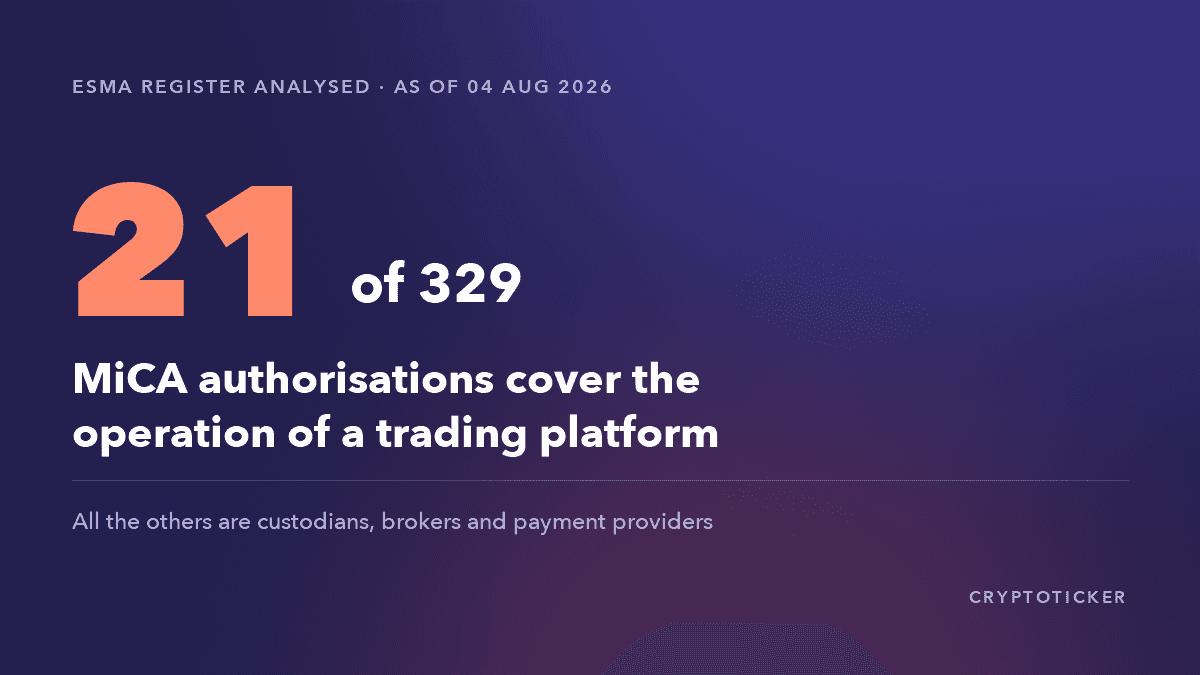
MiCA Register 2026: Only 21 of 329 Licences Are Real Exchanges
ESMA publishes the register of MiCA-authorised providers as an open file. We worked through all of it — and the result is not what the phrase “licensed crypto exchange” suggests.

June 30, 2026 11:20 PM

How to Switch from Binance to a MiCA Regulated Crypto Exchange
Binance is winding down EU services after missing the MiCA deadline. Here's why it's happening and how to move your funds to a regulated platform safely.
October 19, 2026 7:51 AM

Euro balances on a crypto exchange: what to watch after the ESMA answer on MiCA article 70
The European securities regulator ESMA spelled out on October 16, 2026 where a crypto asset service provider may hold your euro balance. A payment service provider without a banking licence is only a staging post of at most one business day.
October 1, 2026 7:15 PM

Bitpanda fees from 0.99 to 2.49 percent: what is behind it
Bitpanda assigns every coin to one of four price tiers, from 0.99 percent for Bitcoin to 2.49 percent for small caps. What 100 euros costs in and out, why the spread is missing from the mandatory document, and where 0.25 percent is enough under the same roof.
September 25, 2026 4:13 PM

Crypto Exchange Protection Funds Recalculated: What Really Covers Your Balance After the Bitget Hack
The $351.6 million attack on Bitget would eat up three quarters of the exchange's in-house protection fund. We retrieved the protection promises of several exchanges ourselves and measured them against deposit insurance and MiCA liability.
September 29, 2026 10:33 AM
ESMA puts reverse solicitation on its 2027 watch list: what investors need to know about exchanges without an EU licence
ESMA presented its work programme for 2027 on September 28, 2026 and made reverse solicitation a supervisory priority. What that means if your coins sit with a provider without EU authorisation, and which three steps make sense now.
September 6, 2026 10:20 PM
Bison App: a 1.25 Percent Spread, 27 Percent of the Staking Rewards and Trading Without an Order Book
The crypto app of Boerse Stuttgart advertises freedom from fees. You pay through the spread instead. What the licences actually cover, why there is no order book, and why the tax report loses its value once you transfer coins out.
August 23, 2026 1:34 PM
BitMart Before the Trading Halt: Which Coins Already Have Withdrawals Blocked
At BitMart, trading ends at 01:00 UTC on August 26, 2026, and the deadline for withdrawal requests at 05:00 UTC. Our own measurement of the public interface shows that for a large share of the listed crypto assets, withdrawal is no longer enabled four days beforehand.
July 10, 2026 10:30 AM
Binance Reveals Where Its EU Users Went After MiCA
Binance just revealed where most departing EU users moved their crypto after MiCA — and the answer is raising hard questions about the new rulebook.
June 26, 2026 5:35 PM
Binance Is Leaving the EU on July 1 — What It Means for Your Funds
Binance will stop serving EU customers from July 1 after failing to secure a MiCA licence. Here's what it means for your funds and your next move.

September 26, 2026 7:40 AM
The RAIN Token After the Enlivex Termination: What to Check on Access, Forced Sale and Holding Period
Enlivex terminated a share placement of 66,666,667 shares payable in RAIN tokens on September 22, 2026. The token sits 46.4 percent below its all-time high, and at Kraken the withdrawal deadline expired long ago.
September 26, 2026 4:21 AM
Operation Herakles disconnects 13,888 phone numbers: what to check on crypto investment calls
Six authorities have disconnected 13,888 phone numbers used by investment fraudsters to call their victims in Operation Herakles, 9,304 of them in the past three months alone. What the Federal Network Agency now requires of telecoms providers and which three checks protect you from the scheme.
August 21, 2026 10:27 AM
Complaining About a Crypto Exchange: the Deadlines Article 71 MiCAR Sets and Why BaFin Will Not Decide Your Case
Authorised crypto providers have to run a formal complaints procedure, and Delegated Regulation (EU) 2025/294 sets a hard limit of two months for it. Our own analysis of the ESMA list shows at the same time that no complaints link is on file for Germany to this day.
August 15, 2026 9:31 PM
Crypto Exchange Shutting Down: What to Do Before the Deadline Passes
Binance, BitMart, Luno and Revolut have ended or cut back their European business within seven weeks. This guide shows which deadline expires first, how a forced sale is treated for tax, and what to secure before the account closes.
October 21, 2026 10:36 AM

LEO Token ranks 18th but moves just $150,000 a day: what that means for your exit
LEO Token is number 18 on the crypto market by market value, yet moves only around $150,000 a day, and 90 percent of that at a single venue. What this means for the route out, your provider's authorisation and the holding period.
More from CryptoTicker