
Polygon Hard Fork: Binance and Polymarket Seek Return of 70 Million POL
Analysis: Binance and Polymarket are asking for a hard fork that would move roughly 70.49 million frozen POL from five attacker addresses back to them. Ordinary holders are unaffected, but on the Polygon forum concern is growing about the precedent it would set.


Which topics should we dive deeper into?
Select what genuinely interests you. Your picks feed directly into our editorial planning.
Crypto news that's actually worth your time.
Weekly. 60 seconds. Carefully curated by our editors: no hype, no promo flood, no spam.
Binance and Polymarket want to recover roughly 70.49 million POL that attackers took on Polygon PoS at the end of October. To do so, the network would use a hard fork to set the balances of five frozen attacker addresses to zero and credit the same amount to recovery addresses controlled by the two companies. What is established: since November 4, 2026 the request has been on the Polygon forum as a PIP proposal, and on November 5 it was presented on the network's governance call. A vote and a date are still pending. Our assessment follows further down: for ordinary holders nothing changes in their balances, but a question of principle about Polygon's immutability is now on the table.
A hard fork is a change to the consensus rules that is not backward compatible. Nodes that do not install the update no longer accept the new blocks and carry on running on a blockchain of their own. That is exactly what makes the step so difficult: it needs the consent and cooperation of validators, exchanges, RPC providers and block explorers.
Polygon hard fork: the Binance and Polymarket proposal of November 4
The proposal is titled "PIP Proposal: Recovery of Funds Held in Blocked Addresses following the Polymarket and Binance Incidents". PIP stands for Polygon Improvement Proposal, the formal route by which protocol changes are requested and debated. Binance and Polymarket submitted it jointly, and both appear in it as proposers.
It stems from two separate incidents. On October 29, 2026, according to the proposal, around 28 million POL were affected at Polymarket; the prediction market says a service provider was the point of entry. Late that same evening Binance was hit: in block 96,406,484 a hot wallet of the exchange sent a total of 46,626,589.6 POL and 6,185,900.1 USDT to an address controlled by the attackers. We put the billion-dollar damage from the Binance hack and its consequences into context in our report Binance hack one week later.
The USDT have already been frozen. Tether can block tokens on its contracts, as the proposers describe. No such function exists for native POL: it is the gas token of Polygon PoS and belongs to no issuer that could halt it centrally. That leaves only the route via the consensus rules.
70.49 million POL on five addresses: where the frozen tokens come from
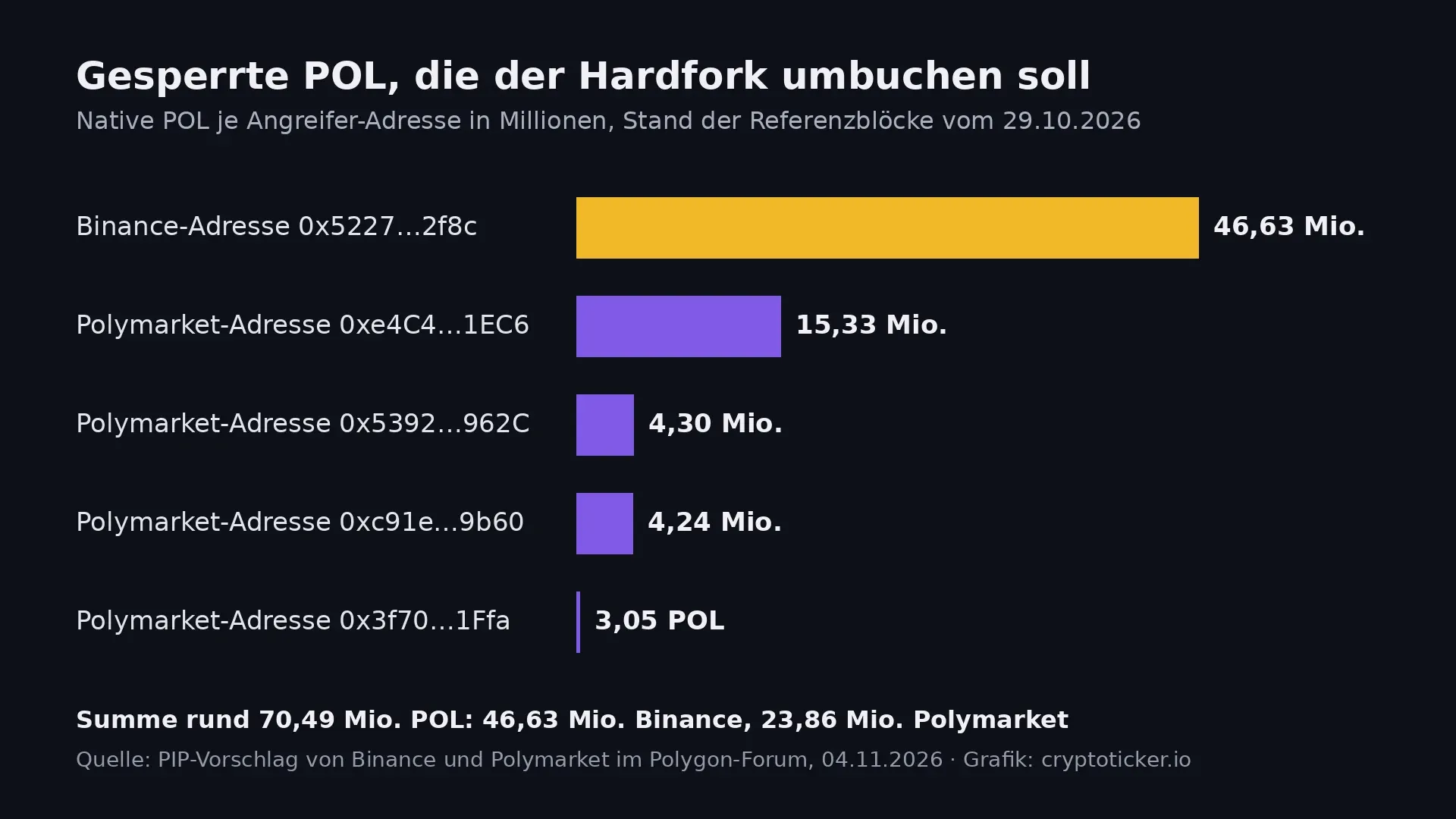
The proposal lists the addresses one by one. Four belong to the Polymarket incident and together hold 23,862,736.07 POL. The largest of them, 0xe4C4…1EC6, carries 15.33 million POL; two further addresses hold 4.30 and 4.24 million POL. The fourth address received 3,282,275.71 POL from the largest in two transfers and, according to the table, now holds only 3.05 POL. A single address belongs to the Binance incident, 0x5227…2f8c, with 46,626,593.27 POL at reference block 96,413,185.
Of the roughly 28 million POL from the Polymarket incident, the freeze covers about 24 million. The rest had already moved on before the block producers reacted. The hard fork would therefore not recover the whole loss, only what still sits on the frozen addresses.
Binance later reported further addresses to the block producers, which the proposal lists as class B. These are expressly left untouched by the hard fork. The reasoning in the text: a wrong attribution would move a legitimate balance, so only addresses whose inflows can be traced on-chain directly from the victims' wallets make the list.
The block producers' blocklist: why the POL are stuck but not coming back
On Polygon PoS a small number of elected block producers create the blocks; the proposal names them anonymous-91 to anonymous-94. At the request of Binance and Polymarket, they added the five addresses to the transaction blocklist of their Bor client. Bor is the software Polygon PoS uses to produce blocks. Since then the producers no longer include transactions from these senders in blocks.
The proposers themselves call this freeze a stopgap. Each producer reads the list only at startup, and every change needs a new deployment and a restart. Entries never expire, and the filter only applies to external senders and to authorisations under EIP-7702, not to every conceivable construction. According to the proposal, the attacker keeps trying: on October 30 a pending transaction with a fee of around 219,450 POL appeared. He is also said to have offered validators cash to let a transaction through. Polymarket has additionally offered him a return channel via SEAL Safe Harbor; according to the proposers, no reply came.
The result is limbo. The 70.49 million POL cannot be moved, yet nothing in the current setup allows them to be returned to their owners. The proposers do not consider it a stable end state to hold around 70 million POL indefinitely in a construction that was meant as a short-term brake.
 Find the right hardware wallet
Hard fork at the activation block: balance zero, credit to the recovery address
Technically, the intervention is narrowly defined. At the start of a set activation block F, before any transaction in it is executed, the client reads the balance of each attacker address from the state after block F-1. It sets that balance to zero and credits the same amount to the recovery address. For the four Polymarket addresses this is 0x3dcE…D952, for the Binance address 0xd9fd…0b80.
The total amount of POL does not change in the process. No new tokens are created and none disappear; balances simply change hands. Heimdall, the consensus layer of Polygon PoS, the StakeManager and the bridge contracts remain unchanged. The proposal is limited to the native POL balance of the listed addresses; it does not touch other tokens held on the same addresses.
Before activation, both companies must prove that they control their recovery address, for example with a signed message or a small test transfer confirmed by Polygon Labs. A list of conditions also applies: the PIP must be accepted in the governance process, the victims' post-mortems must be published and remain consistent with the on-chain data, and the blocklists must be active on all producers until the cut-off date.
Polygon governance call on November 5: Amoy testnet, vote, mainnet
The timetable in the proposal has four stages. On November 5, 2026 at 3:30 p.m. German time, the proposers presented the plan on the Polygon Protocol Governance Call. After approval come the development of the client update and a dress rehearsal on the Amoy testnet. The proposers consider around two weeks after approval feasible for this, and one week tight.
Validators, RPC providers and block explorers are then informed. According to the proposal, Polygon's validator relations team expects 70 to 80 percent of stake to reach the required version quickly after release. Only then does the hard fork activate on mainnet at block F. The fork's name, the activation block and the client version are still open in the proposal. No outcome from the governance call was available at the time of writing.
For exchanges and custodians, this means a date by which they must update their nodes. Anyone who misses it follows a different blockchain from block F. A forum post of November 5 therefore suggests publishing the activation block and the address list in machine-readable form in advance, so that explorers and accounting software record the balance change correctly even though no transaction takes place.
Criticism on the Polygon forum: the precedent for seizures
The forum debate shows both sides. One post expressly supports the proposal: Binance and Polymarket are important to the Polygon ecosystem, and exceptional circumstances justify joint action through transparent governance. Another participant shows sympathy for the victims but warns of the precedent.
His argument: stablecoin issuers such as Tether and Circle can already freeze tokens today. If Polygon now shows that native POL balances can also be frozen, seized or reassigned, authorities around the world would take note. Requests for legal assistance and court orders could follow, and depending on the jurisdiction they would be hard to refuse. Who would then decide what is a legitimate recovery and what is a politically motivated seizure?
The proposers have taken up this concern themselves. They call the step an extreme measure that should not be repeated, and they expressly reject a general mechanism for freezing and recovering funds, because it would create a permanent power over user funds. Future proposals should only be able to cite this case if all conditions are met together: a publicly confirmed theft, a victim as proposer, a freeze on all producers, a material amount, and funds that can be traced on-chain back to the victim.

The 2016 DAO fork and Polygon in 2026: how the two interventions differ
The idea is not new. On July 20, 2016, at block 1,920,000, Ethereum responded with a hard fork to the attack on The DAO, in which more than 3.6 million ETH had been drained from a flawed smart contract. According to the fork history on ethereum.org, the fork moved the funds into a contract from which victims could withdraw one ETH for every 100 DAO tokens. More than 85 percent of the votes were cast in favour of the fork. Some miners rejected it and continued the old blockchain as Ethereum Classic.
The Polygon proposal differs in two respects. First, it concerns thefts from two companies, not a flawed contract. Second, decision-making power lies with a small group: on Polygon PoS a few block producers and the validators, through their stake, determine whether the update runs. The proposal does not provide for a vote of all holders as in 2016.
Our assessment: the proposal is more carefully bounded than many emergency interventions, with a closed address list, a proof requirement and a test run. In its favour, the funds are frozen permanently anyway, and returning them harms no one who lawfully holds a balance. Against it stands the argument from the forum: a network that has once reassigned balances on request will find it harder to turn down future requests from authorities. For investors who hold POL as a neutral infrastructure token, this second point is the more important one.
POL price at $0.093: the sum equals 0.66 percent of circulating supply
The POL price stood at $0.0934 on November 5, 2026 at around 10:50 p.m. CET, roughly 2.95 percent lower than 24 hours earlier. Over seven days it was up 2.2 percent, and market capitalisation was around $994 million, all figures according to CoinGecko. For comparison: Bitcoin lost 5.3 percent in the same 24-hour window, Ether 7.6 percent.
By our calculation, the 70.49 million POL equal roughly 0.66 percent of the circulating supply of 10.64 billion POL and, at the current price, about $6.6 million. The proposers use the October 29 price of $0.0924 and arrive at around $6.5 million. Because the total supply stays the same and the tokens are already frozen today, the hard fork barely changes the tradable supply. If Binance and Polymarket later sold the recovered POL, however, that amount would come back onto the market.
 Compare crypto exchanges licensed in the EU
POL holders in Germany: wallet, exchange and holding period during the hard fork
If you hold POL in your own wallet, the proposal requires nothing of you. The hard fork only touches the five listed addresses; all other balances stay as they are. Nor does a second token emerge, as it would in a chain split, as long as the large majority of validators run the update. All that matters is that your wallet software talks to an updated RPC node after the cut-off date, and for common wallets the providers take care of that.
If your POL sit on an exchange, the provider handles the update. With hard forks, a short pause in deposits and withdrawals around the activation block is common. Whether your provider announces such a pause will be stated in its official notices. For purchases in Germany, exchanges licensed under the EU's MiCA regulation remain the first port of call; our comparison of regulated crypto exchanges gives an overview.
For tax purposes, POL held as private assets is treated like other crypto assets in Germany, with the one-year holding period under Section 23 of the Income Tax Act (EStG): gains from a sale after more than twelve months are tax-free. Since the proposal creates no new tokens, ordinary holders do not acquire any new holding through the hard fork that would need to be reported for tax.
If you trade POL with leverage, keep an eye on the days around the activation block. If individual exchanges briefly suspend trading or transfers, prices can diverge between venues. With leveraged positions, the liquidation price can then draw closer faster than the overall market would suggest.
How to protect yourself from phishing around the Polygon hard fork
What happened: on October 29, 2026, attackers took POL from Polymarket and Binance that now sit on five frozen addresses. Since November 4, Binance and Polymarket have been asking for a hard fork that would move roughly 70.49 million POL back to them; no date has been set yet.
Are you affected? Not as an ordinary POL holder: the hard fork only changes the five addresses in the proposal. You may be affected indirectly, because scammers like to exploit events like this for fake "migrations" and "claims".
- No token migration: the proposal provides for no swap and no migration; any request to send POL anywhere because of the hard fork is a scam.
- Official sources: Polygon publishes the date and client version on its own forum and its own channels; avoid links from direct messages or adverts.
- Read signatures: if a site requests an approval for your POL, cancel when the amount is unlimited or the purpose is unclear.
- Revoke old approvals: use a tool such as Revoke.cash to see which contracts still have access to your tokens, and revoke approvals you no longer use.
- Separate larger holdings: POL you do not trade belong on a hardware wallet; for DeFi, use a separate wallet with a small amount.
Our guide How to store crypto safely explains the basics of secure custody, and our hardware wallet comparison lines up the right devices.
Polygon hard fork: no POL moves without a vote and an Amoy rehearsal
Several hurdles remain before mainnet: approval in the governance process, the dress rehearsal on the Amoy testnet and sufficient adoption of the update among validators. Until then, the 70.49 million POL stay frozen. Three steps help you get through the time until the cut-off date calmly:
- Check whether your exchange is licensed under MiCA and announces hard fork pauses in good time; you can find providers with an EU licence in our comparison of regulated crypto exchanges.
- Move POL you hold for the long term into your own custody; our hardware wallet comparison shows which devices are suitable.
- Before buying, compare providers' fees and trading pairs; our comparison of the best crypto exchanges offers an overview.
(As of November 5, 2026. This article is not investment advice. Prices and fee structures change; check the terms with the provider before you buy.)
Frequently asked questions about the Polygon hard fork
Transparency note: This article was produced with the assistance of artificial intelligence and reviewed by our editorial team before publication. All figures and claims were checked against the primary sources linked in the text. The feature image was generated with AI.
Related articles
- Base Hard Fork on September 30: Binance Freezes Base Transfers an Hour Before Cobalt
- Polygon 2026: Polymarket Takes 84 Percent of the Fees With It to Its Own Chain
- Polymarket attack via a third-party provider: what users should watch now
- Binance Hack On-Chain Analysis: 50 Signatures, 197,460 ETH and $2.83 Billion Frozen
- North Korea Behind the Binance Hack? Everything We Know About the $6.3 Billion Theft
Which topics should we dive deeper into?
Select what genuinely interests you. Your picks feed directly into our editorial planning.
Crypto news that's actually worth your time.
Weekly. 60 seconds. Carefully curated by our editors: no hype, no promo flood, no spam.

March 20, 2020 8:41 PM

Steem Takeover: Community Hard-forks To HIVE Blockchain
Due to the persistent uncertainty, caused by constant struggle between the genuine community witnesses and Tron sock-puppets, resulting in unstable operation on the Steem network, the community has hard-forked and migrated to the newly created clone HIVE on Mar 20 […]
October 31, 2026 12:37 AM

Binance Hack Conspiracy Theories: Fact-Checking CZ, Trump and the Midterms
Inside job, staged hack, money for the Trump family, timing before the midterms: we checked the theories about the Binance hack against the evidence. What is documented about Binance, CZ and World Liberty, and what is not.

August 28, 2024 10:33 PM
How to Migrate from MATIC to POL: Full Guide
How to update and migrate Polygon Tokens from MATIC to POL, when and why? Here is all you need to know...

November 4, 2026 1:12 PM

Binance Hack One Week Later: The Real Cost of the $6 Billion Heist
One week after the biggest crypto theft ever, Binance has spent half its SAFU Bitcoin, lost billions in deposits and faces a second-wave warning. Full recap.
October 30, 2026 9:14 AM

How Much Would It Take to Bankrupt Binance? The $6 Billion Hack Explained
Binance lost $6.3 billion in the biggest crypto hack ever. How much would it take to bankrupt the exchange, and what does it mean for the crypto market?
November 1, 2026 12:31 PM

Binance hack: FBI names North Korea and lists more than 600 addresses
The FBI has attributed the theft of more than six billion dollars at Binance to the North Korean group TraderTraitor and published more than 600 addresses on Ethereum, Bitcoin and Solana alongside it. Why the blocking request is not a sanction, how 2.85 billion dollars came to be frozen, and when flagged coins get stuck at an exchange.
October 30, 2026 3:32 PM

Binance puts the hack at $6.3 billion: what you can do now
Binance names a cause itself for the first time: a compromised laptop belonging to a DevOps engineer is said to have opened access to a service container, while private wallet keys are said not to have leaked. The exchange estimates the total damage at around $6.3 billion, with about $3 billion considered frozen.
October 29, 2026 10:40 PM
Binance Withdrawals After the Hack: Solana and XRP Paused, Bitcoin and Ethereum Open
Binance has confirmed the hack: co-founder Yi He says the exchange will cover all losses, and deposits and withdrawals are temporarily suspended. What it means for users, which networks were already paused and what to watch out for now.
November 1, 2026 5:07 AM
Binance Reopens Withdrawals: 15 Networks First, 95% of Stolen Funds Replaced
Three days after the $6.3 billion hack, Binance is reopening withdrawals in phases. Phase one starts on 1 November between 06:00 and 09:00 UTC with Bitcoin, Ether, USDT, USDC, BNB, Solana, XRP and eight more networks. What customers need to know now.
November 3, 2026 5:15 PM

Binance hack: the attack began with a fake job interview
Binance has released its first incident report on the $6.3 billion hack: a fake hiring process, a tampered Homebrew package and an internal AI tool opened the way to the hot wallets for the attackers. The scheme also targets developers and retail investors, and five habits protect against it.
October 31, 2026 12:36 AM

Binance Hack, Then a Stock Market Crash: Coincidence or Connection?
The largest crypto theft in history on Thursday evening, Wall Street's worst day since June on Friday. Are the Binance hack and the stock market crash connected? Our analysis of timeline, sizes and money flows, and where crypto and stocks really meet.
September 6, 2026 4:34 AM

MultiversX Supernova of September 10: What EGLD Holders Should Know After the Hard Fork
Recap as of September 27, 2026: MultiversX had scheduled the Supernova hard fork for September 10, 2026 to cut block time from six seconds to 600 milliseconds. Our own query of the MultiversX API on September 27 shows 600 milliseconds. This article describes the situation before the hard fork and what exchange and staking users should have checked beforehand.

September 2, 2026 7:38 PM
Core DAO: CORE Transfers Frozen, Emergency Hard Fork Announced. What Our Chain Measurement Shows
Several trading venues have halted deposits and withdrawals on the Core DAO network while the project prepares an emergency hard fork after excessive validator rewards. Our own measurement of the chain dates two addresses that appeared on August 28 and built their last block on August 31 at 5:50 UTC, and shows a block cadence that never paused for longer than five seconds.
June 28, 2026 8:12 PM

Polymarket Hack: $3.1M Stolen as Prediction Market Hype Faces Its Biggest Test
Polymarket hack shocks prediction markets as $3.1M is stolen from 11 wallets. Is the sector ready for mainstream adoption?
November 3, 2026 1:58 AM

Crypto Hack News: Every Attack Since the Binance Hack and How to Stay Safe
Binance, Mercado Bitcoin, BTCPay Server, a WordPress plugin and hijacked WhatsApp accounts: since 29 October hardly a day has passed without a crypto hack. Every case with its status, the loss and the steps that keep you safe now.
October 31, 2026 12:37 AM

Binance Alternatives: 4 MiCA-Licensed Exchanges Compared
After the hack of 29 October 2026, many Binance customers are looking for a new home for their coins. Bitpanda, Kraken, Bitvavo and Coinbase are licensed under MiCA. Here are their fees, supervisors and a five-step guide to moving.
October 29, 2026 9:38 PM
Binance Hack: Around $2.8 Billion Drained From a Hot Wallet
On Thursday evening, roughly $2.8 billion left the Binance wallet “Binance 14” within minutes. The attacker had tied the wallet to their own contract via EIP-7702. Tether and Circle have frozen about $2.4 billion, and Binance says it is investigating.
October 25, 2026 3:28 AM

Hard fork or soft fork: what happens to your coins in a split?
A hard fork can split a blockchain in two, and you then hold the same number of coins on each side. A soft fork changes nothing in your wallet. How to tell the two apart, and what the German finance ministry has settled on the holding period for the new coins.
August 22, 2026 10:29 AM
Bitcoin Fork: What Happens to Your Coins When the Chain Splits
On October 31, 2026 a new chain called ECX splits off from Bitcoin, and every holder is credited automatically. Who actually receives the coins depends on the private keys, on voluntary replay protection and on a tax rule many overlook.
November 3, 2026 3:21 PM

Binance after reopening: $3.64 billion in net outflows, 2.1 percent of reserves
Binance reports net outflows of $3.64 billion in about nine and a half hours after reopening withdrawals. The full proof of reserves due on Tuesday is meant to show whether customer balances are backed one to one.
October 30, 2026 11:28 PM

Is Polygon a Good Buy at Current Prices?
Polygon sits roughly half below its twelve-month high and keeps running into both moving averages. What the chart structure, the RSI and the trading volume say about buying POL at the current price.
October 29, 2026 9:54 PM

Biggest Crypto Hack Ever? Binance Joins the List of Exchange Hacks
At about $2.8 billion the suspected Binance hack would be the largest theft a crypto exchange has ever suffered. The biggest crypto hacks at a glance, why exchanges are hit more often, what Tornado Cash has to do with it and what past cases meant for prices.
September 30, 2026 10:39 AM

The Polygon Network Runs on POL Instead of MATIC: What to Watch in Your Wallet, Fees and Polygonscan
MATIC has become POL, one to one and without any haircut in value. What that means for your holding, how to set Polygon up, what a transfer costs and how to read Polygonscan.
August 22, 2026 4:16 PM
Crypto Stolen or Scammed: What to Do Now and Where to Report It
Wallet drained or fooled by a fake platform? Which steps count in the first hours, where to file a report, when regulators, exchanges and stablecoin issuers can help, and why recovery services that want money upfront are the second trap.
September 15, 2024 5:01 PM
Top 3 Cryptocurrencies Under $1 To Turn A $1000 Crypto Investment Into $100,000 By 2025
Are you looking to turn a small investment into a fortune by 2025? This is your chance to turn a $1000 crypto investment now, to grow up to $100,000 potentially!
November 3, 2026 11:22 PM

Binance hacker sold 499.9 billion SHIB in eight minutes, and the Shiba Inu price barely moved
Analysis: the Binance hacker sold all 499.9 billion SHIB within eight minutes in the early hours of October 30 via ShibaSwap and Uniswap, at a discount of around 14 to 15 percent. The wallet is empty, and the price stands at $0.00000463 on Tuesday evening.
October 31, 2026 3:15 PM

$6.34 Billion Buffer: Binance Promises a Full Proof of Reserves by Monday
Binance says it will present a full proof of reserves by Monday and has set aside more than $6.34 billion for it. What a proof of reserves proves, what it leaves open and how you find your own balance in it.
More from CryptoTicker