
Binance Hack On-Chain Analysis: 50 Signatures, 197,460 ETH and $2.83 Billion Frozen
What really happened in the Binance hack? We analyzed the blockchain ourselves: 50 signatures in one transaction, $2.83 billion frozen, 197,460 ETH with the attacker and an Aave trick. Plus the key voices from X and our conclusion.





Which topics should we dive deeper into?
Select what genuinely interests you. Your picks feed directly into our editorial planning.
Crypto news that's actually worth your time.
Weekly. 60 seconds. Carefully curated by our editors: no hype, no promo flood, no spam.
Update 02:30 UTC: Binance puts the damage at $6.3 billion. In an official announcement Binance estimates the total impact at around $6.3 billion, of which about $3 billion is frozen on-chain. According to the initial investigation, a DevOps engineer's laptop was compromised, which let the attacker access a service container and submit unauthorized withdrawal transactions. Binance says it has found no evidence of a private key leak. The exchange will cover all losses from the SAFU fund and company funds; deposits and withdrawals remain suspended, and an updated proof of reserves will follow.
What really happened in the Binance hack? Our analysis of the blockchain data shows: on October 29, 2026 an attacker took control of the hot wallet "Binance 14" with 50 simultaneously submitted signatures and drained about $2.7 billion within seconds. Binance confirmed the hack overnight and says it will cover all losses. According to our measurements and investigators, more than $2.83 billion is frozen, and the attacker is left mainly with 197,460 ETH. Here is what we verified ourselves, what the key voices on X say and where this is heading.
The minute-by-minute account is in our timeline with live ticker, the news itself in our Binance hack report.
Hack or internal transfer? The first debate of the night
In the first hour it was not clear there had been an attack at all. Analyst Simba considered a planned migration between Binance wallets possible: the destination was freshly created and had not moved the funds at first.
BREAKING: $2.7 BILLION JUST MOVED OUT OF BINANCE IN 24 SECONDS. Everyone is screaming HACK. But the onchain evidence tells a VERY different story.
Simba (@Simba_crpt) October 29, 2026
The theory did not last. The address behind the attack was funded with 0.1 ETH from the mixer Tornado Cash, the wallet was bound to an outside contract, and shortly after the attacker began spreading tokens across dozens of addresses. At 00:04 UTC Binance co-founder Yi He confirmed the hack:
User funds are safe. Binance will cover all hacking losses. Deposits and withdrawals are temporarily suspended while our team conducts security checks, freezes funds, and works with law enforcement.
Yi He (@heyibinance) October 30, 2026
How the attack worked: 50 signatures, one hit
Security firm Blockaid found the decisive technical trick, and we verified it directly on-chain. The attack transaction is of the new type 4, which since the Pectra upgrade lets a wallet hand its control to a smart contract via EIP-7702. It contains exactly 50 such authorizations, all for the Binance 14 wallet, all pointing to the same attacker contract, for nonces 18,914,775 to 18,914,824 (transaction on Etherscan).
The attacker didn't know Binance 14's live nonce. So they sprayed 50 EIP-7702 auths (18914775-18914824) in one type-4 tx. Only 1 of 50 was a hit.
Blockaid (@blockaid_) October 29, 2026
The background: such an authorization is only valid for the nonce the wallet has at the moment of inclusion. Because the hot wallet kept sending withdrawals, the attacker did not know the nonce and fired 50 authorizations at once. One landed. More important is what 50 authorizations require: each must be signed with the wallet's key. The attacker could therefore produce signatures for Binance 14. How he gained that access is for Binance's announced post-mortem to explain. The delegation has since been removed: according to our query at 01:20 UTC the wallet's code is empty again.

 Hold your coins yourself: hardware wallets compared
Where is the money? Our tally at 01:30 UTC
About $2.7 billion left the two Binance wallets on Ethereum, plus smaller amounts on other chains. Most of it is blocked, but not all. Binance itself now puts the total impact across all chains at around $6.3 billion, about $3 billion of it frozen; the breakdown below shows what is visible on Ethereum.
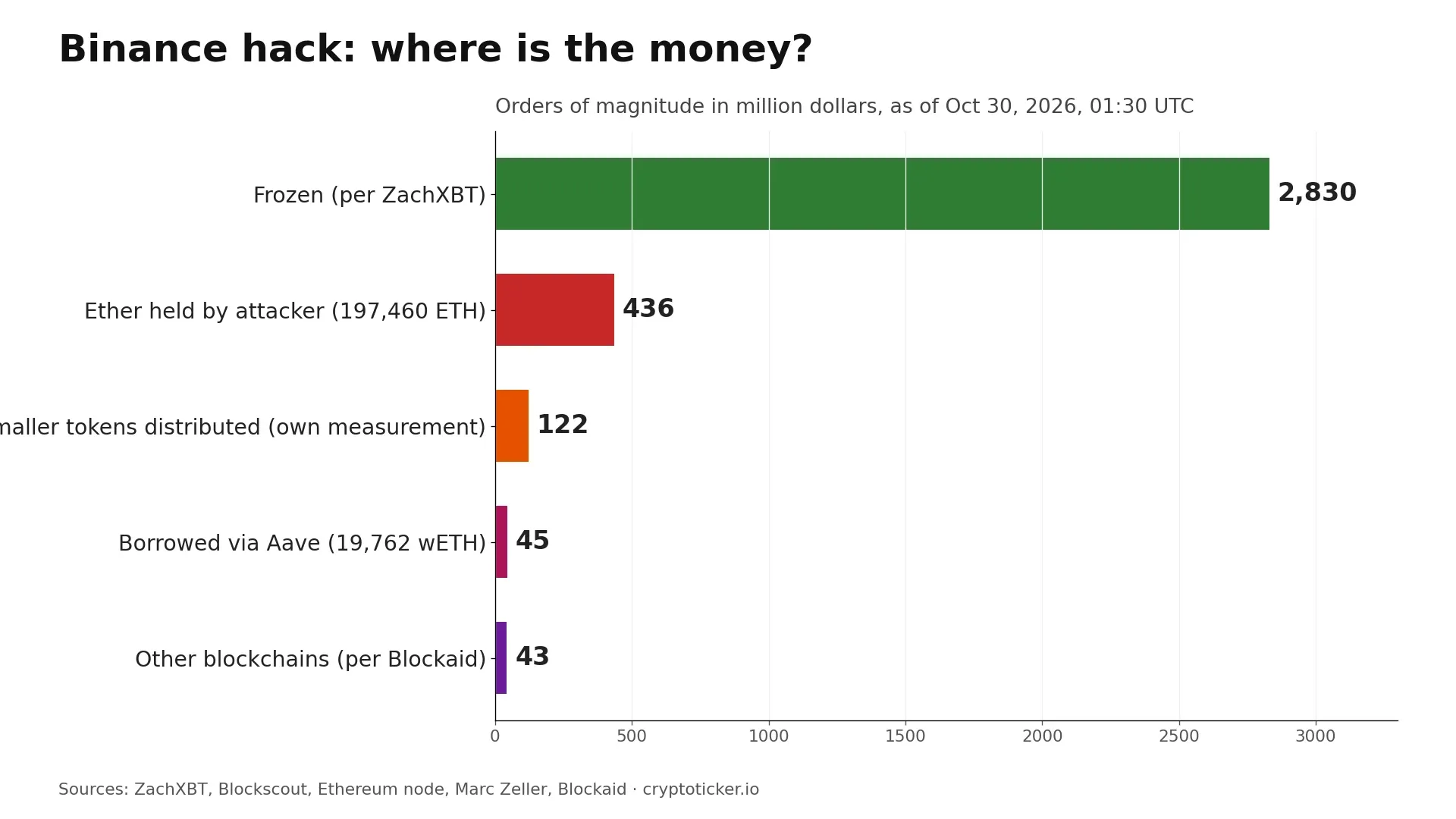
| Item | Amount | Source |
|---|---|---|
| Frozen | more than $2.83B, including 1,767.6M USDT, 823M USDC, 40.5M RLUSD, 27.8M USD1, 29,934 WBETH | ZachXBT |
| of which verified by us | 1,175.5M USDT and 823.0M USDC frozen on 0x5227…2f8c | own contract query |
| Ether held by attacker | 197,460 ETH, about $436M, on 0x8532…43D4, incl. 2,000 ETH added at 01:14 UTC | Ethereum node |
| Borrowed via Aave | 19,762 wETH, about $45M, against 60M USDT | Marc Zeller |
| Smaller tokens distributed | at least $122M in more than 15 tokens such as LINK, AAVE, WBTC, ONDO, WLD | own measurement via Blockscout |
| Other blockchains | about $19.5M on Arbitrum and $24M on Avalanche | Blockaid, preliminary |
Update: This brings the total frozen for the Binance exploit so far to over $2.83B
ZachXBT (@zachxbt) October 30, 2026
The Aave trick: why frozen USDT still yielded Ether
The attacker knew Tether could freeze. Within three minutes he supplied 60 million USDT to the lending protocol Aave and borrowed 19,762 wETH, about $45 million. Shortly after, Tether froze the address, and 46 minutes later Aave froze the affected markets. The frozen USDT now sit as collateral on Aave, the borrowed Ether are with the attacker. He will never repay them.
Aave protocol will be fine. The hacker supplied 60M USDT and borrowed 19,762 wETH (~44.9M$) in 3 minutes, before Tether froze their address and before the Aave Guardian froze the Aave V3 Core reserves (46 min later).
Marc Zeller (@mzeller) October 29, 2026
Aave can absorb it, Marc Zeller of the Aave Chan Initiative explains: the position is overcollateralized and will be liquidated automatically once Ether rises about 4% to roughly $2,365. The debt equals 0.9% of the protocol's wETH reserves. A rising Ether price would, of all things, liquidate the attacker's loan.

 Regulated crypto exchanges compared
More on the Binance hack
- Binance hack: how the hot wallet was drained
- Live ticker and timeline: the crypto crash after the hack
- USDT frozen: what Tether and Circle really blocked
- Binance withdrawals: which networks are paused
- Is this the end? Three scenarios for Bitcoin
- Ethereum: the hacker sits on 195,000 ETH
- Solana below $100: is $80 next?
- BNB crash: another FTT moment?
- The biggest crypto hacks in history
- How to short Bitcoin in the crash
- Why is crypto down today?
What the key voices on X are saying
- Yi He, Binance: user funds safe, Binance covers all losses, deposits and withdrawals temporarily suspended, full post-mortem to follow.
- ZachXBT, investigator: more than $2.83 billion frozen.
- Blockaid, security firm: 50 EIP-7702 authorizations in one transaction, one hit. Verified by us on-chain.
- Marc Zeller, Aave Chan Initiative: the attacker borrowed 19,762 wETH before the freeze, manageable for Aave.
- Simba, analyst: initially considered an internal transfer possible, overtaken by Binance's confirmation.
- Bala, commentator: wrote the attacker "walked away" with the Aave trick. True for $45 million, not for the billions.
Our conclusion: where the Binance hack is heading
- For customers: Binance has pledged to cover all losses, and the frozen share makes that credible. The key question is when deposits and withdrawals resume. Until then: patience, and no links from messages promising refunds. Which exchanges hold a licence is shown in our comparison of regulated exchanges. We track the status in Binance withdrawals after the hack.
- For the loot: of about $2.7 billion, more than $2.8 billion across all chains is blocked. On Ethereum the attacker is left mainly with the 197,460 ETH, the Ether from Aave and distributed smaller tokens, roughly $600 million in total. Going by Binance's figures of $6.3 billion in damage and about $3 billion frozen, however, more than $3 billion across all chains is still unaccounted for; where it sits is the open question of the coming days. He will have to launder it over days and weeks, and every move is public.
- For Ethereum: the 197,460 ETH remain an overhang. At the same time a 4% price rise would liquidate the attacker's Aave position. What it means for the price is in Ethereum crash: the Binance hacker sits on 195,000 ETH.
- For the industry: the attack shows a new pattern. Whoever can produce signatures for a wallet needs, thanks to EIP-7702, a single transaction to sweep everything. Exchanges will have to tighten their signing systems and the approval of such delegations.
We keep monitoring the addresses and will update this analysis as funds move or Binance publishes its post-mortem. This article is not investment advice.
FAQ: on-chain analysis of the Binance hack
Transparency note: This article was produced with the assistance of artificial intelligence and reviewed by our editorial team before publication. All figures and claims were checked against the primary sources linked in the text. The feature image was generated with AI.
Section: All crypto hacks and scams at a glance
More on Ethereum: All Ethereum news at a glance
Related articles
- Binance Hack: Around $2.8 Billion Drained From a Hot Wallet
- Ethereum Crash: The Binance Hacker Sits on 195,000 ETH. Is a Sell-Off Coming?
- Is This the End? How Low Bitcoin Could Fall After the Binance Hack
- “Proven technology that can scale” — what The Clearing House wants from Quant by the second quarter of 2027
- Bitcoin Price Prediction: How Will September Unfold For BTC Price?
Which topics should we dive deeper into?
Select what genuinely interests you. Your picks feed directly into our editorial planning.
Crypto news that's actually worth your time.
Weekly. 60 seconds. Carefully curated by our editors: no hype, no promo flood, no spam.

December 26, 2025 1:50 PM

Breaking: Trust Wallet Chrome Extension Hack Drains $7M, Full Reimbursements Promised
A supply-chain attack hit Trust Wallet’s Chrome extension, draining $7M from users. Binance’s CZ says all victims will be reimbursed.

October 29, 2026 9:59 PM

BNB Crash: Binance Coin Drops 6% After the Hack. Is This Another FTT Moment?
BNB fell 6.3% within 35 minutes after a Binance hot wallet was drained, the worst performer of the top ten cryptocurrencies. Not one BNB was stolen. Why the token falls anyway, how it compares with FTT in 2022 and which price levels matter now.
June 28, 2024 5:22 PM

TON Coin Price Prediction: A New SURGE or DIP Ahead?
Toncoin's on-chain data shows significant activity from large investors, hinting at a potential price rally. But how high can TON go, and at what level will it fall back?
October 29, 2026 9:40 PM

Crypto Crash After Binance Hack: $628 Million Liquidated in One Hour
At 20:24 UTC a Binance hot wallet was drained of about $2.8 billion. Within an hour Bitcoin fell below $79,000 and BNB lost 6.3%. Here is the minute-by-minute timeline, the prices of all major coins and what could come next as Asia wakes up.

May 23, 2026 10:06 PM

ZachXBT Identity Revealed: Analyzing the Viral Allegations Against the Crypto Detective
On-chain sleuth ZachXBT faces intense scrutiny following a viral X thread tracking his identity and alleging conflicts of interest, selective exposure, and legal violations.
October 9, 2026 5:36 PM

Ledger Hack? $86 Million Drained: What Is Behind the Tampered Wallets From Southeast Asia
Since Friday, Ledger users in Southeast Asia have been reporting empty wallets, and analysts count more than $86 million. Ledger has halted the reseller CryptoBilis. An implant inside the device reportedly reads the seed phrase. What is known, what CZ advises and what you should do now.
August 26, 2024 7:44 PM

DOGS Token Major 120% Surge Within Hours Of Its Listing: BUY NOW?
The DOGS token experienced a dramatic surge of over 120% on Binance following its listing. How did the Telegram Open Network (TON) drive this surge?
February 17, 2020 1:31 AM

Crypto Market: Golos +371%, bZx/Chainlink Partner, On-Chain Analysis etc.
Top Gainer Of The Week, Golos (GOLOS) Up By 371% A licensed “forked” version of the Steemit platform – Golos (GOLOS) gained over 371% in the last week. It specially caters to the Russian community. Similar to Steemit, in the […]
October 29, 2026 10:40 PM
Binance Withdrawals After the Hack: Solana and XRP Paused, Bitcoin and Ethereum Open
Binance has confirmed the hack: co-founder Yi He says the exchange will cover all losses, and deposits and withdrawals are temporarily suspended. What it means for users, which networks were already paused and what to watch out for now.
April 20, 2026 9:52 AM

DeFi Hack: Aave and LayerZero Hit by Sophisticated DPRK Attack
DeFi confidence hits a new low as Aave freezes markets following a sophisticated $293M exploit on Kelp DAO’s rsETH, linked to North Korea's Lazarus Group.
August 27, 2026 4:31 AM

Is AAVE a Good Buy at Current Prices?
AAVE has worked its way back above both the 200-day and the 50-day moving average, yet still trades far below its twelve-month high. Using our own price data, we examine what speaks for and against an entry at current prices.
October 29, 2026 9:54 PM

Biggest Crypto Hack Ever? Binance Joins the List of Exchange Hacks
At about $2.8 billion the suspected Binance hack would be the largest theft a crypto exchange has ever suffered. The biggest crypto hacks at a glance, why exchanges are hit more often, what Tornado Cash has to do with it and what past cases meant for prices.
October 29, 2026 10:50 PM

USDT Frozen: We Counted What Tether and Circle Really Blocked in the Binance Hack
Tether and Circle report freezes worth about $2.4 billion. We queried the contracts ourselves: 1.18 billion USDT and 823 million USDC are frozen on the attacker address. About 700 million USDT were already gone. How stablecoin freezes work and whether Tether can freeze your USDT too.
October 2, 2026 4:32 AM

NEAR Intents halts withdrawals after a $3.8 million exploit: here are the reasons
NEAR Intents confirms an exploit of more than $3.8 million and holds deposits and withdrawals on eleven networks. Reimbursement is promised, a date for it is not.
October 7, 2024 10:06 AM

Is Len Sassaman Satoshi Nakamoto? HBO Documentary Might Answer That TOMORROW
Will the mask fall off tomorrow and reveal the identity of Satoshi Nakamoto, or will it fuel more mystery? Here is what to expect...
October 29, 2026 9:55 PM

Solana Crash: SOL Falls Below $100. Is $80 Next?
Solana lost 3.3% within an hour after the Binance hack and slid to $95.64, although not a single SOL was stolen. Why Solana falls anyway, why it was already weak before and which price levels matter now.
October 24, 2026 1:44 PM
Franklin Templeton Puts $150 Million on the XRP Ledger as XRP Price Slides
Franklin Templeton quadrupled its tokenised fund shares on the XRP Ledger in two days while XRP fell toward $1.28. Why usage and price are moving apart.
September 29, 2026 10:14 AM

Bitget discloses the flaw at its supplier and sets out the timetable for withdrawals
Bitget has disclosed how the attackers reached its withdrawal systems on September 24: through a previously unknown flaw in a security product it had bought in. The second stage of the withdrawal schedule opens today at 08:00 UTC, and for the balance you keep on any exchange the case changes the arithmetic.
March 10, 2026 6:00 AM

Why Is Crypto So Volatile? 5 Key Factors That Move the Cryptocurrency Market
Why are cryptocurrencies so volatile? Here are 5 key factors that move crypto prices including liquidity, macro news, whales, and investor sentiment.

February 22, 2026 8:38 AM

Vitalik Buterin ETH Sale: On-Chain Data Debunks $8.2M "Dump" Rumors
Vitalik Buterin sold 428.57 ETH on Feb 22, 2026, totaling $15.51M since Feb 2. Reports of a single $8.2M transaction on Sunday are unconfirmed by on-chain data.
February 26, 2025 5:36 PM

Crypto News: Will The Crypto Market Crash Further or Recover NEXT?
The crypto market crash has taken its toll on Bitcoin and other major altcoins, with a general market cap decrease of over $0.3T. So, what comes next?
June 25, 2024 12:18 PM

After Bitcoin Crash, Will Altcoins Gains Reach 500%?
In the latest Bitcoin News today, and mainly after the Bitcoin Crash, crypto analysts predict a major shift towards altcoins with market corrections near the end and BTC dominance drop. Will the altcoins gain reach 500%?

October 19, 2020 6:51 PM

Top 3 Cryptocurrencies With 100x Potential
Today we take a look at 3 cryptocurrencies that have the potential to increase their value by 100x within the next few years. We are going to look at on-chain metrics as well as technical indicators to find out which […]

May 7, 2019 1:40 PM
Ethereum DApp Transaction Records New All-Time-High
Ethereum DApp transaction has registered a new all-time high, but new DApps developing on-chain are notably low, crypto analytics company Diar reported on May 6. According to the report, 776k Ether was transacted on DApps in the month of April […]

November 17, 2022 12:01 AM

Binance Coin News Ticker – CryptoTicker
Binance Coin is the native coin of the world’s leading cryptocurrency exchange Binance. The coin is native on the Binance Chain, a centralized blockchain. The coin is also supported on the Binance Smart Chain, a new blockchain by Binance that […]
August 30, 2020 8:16 AM

What is Binance Smart Chain?
In April 2020, Binance announced its new Binance Smart Chain. This new blockchain will work in parallel with the exchange’s primary blockchain, the Binance Chain. Both chains are being improved at exceptional speed. This post will take you through a […]
September 14, 2026 4:10 AM

Foreign Code on Your Ethereum Address: How to Check Your EIP-7702 Delegation
Since the Pectra upgrade, a single signature can be enough for your Ethereum address to run the code of someone else's contract. Our own measurement across 200 blocks shows what these delegations mostly point to today, and how to check your own address in a few minutes.
More from CryptoTicker