
North Korea Behind the Binance Hack? Everything We Know About the $6.3 Billion Theft
TRM Labs and Chainalysis see North Korea's TraderTraitor group behind the Binance hack. Everything in one place: how it happened, losses by blockchain, $2.7 billion frozen, withdrawals within 48 hours and what it means for Bitcoin and BNB.


Which topics should we dive deeper into?
Select what genuinely interests you. Your picks feed directly into our editorial planning.
Crypto news that's actually worth your time.
Weekly. 60 seconds. Carefully curated by our editors: no hype, no promo flood, no spam.
Update 14 November, 06:56 UTC: Binance reopens withdrawals on 87 more networks. According to the “Recovery Update” of 14 November, Binance reopened withdrawals on 87 more networks this week, including Cardano (ADA), Litecoin (LTC), Avalanche (AVAX), Cosmos (ATOM), NEAR, Aptos (APT), Stellar (XLM), Bittensor (TAO), Internet Computer (ICP) and Filecoin (FIL), plus the Ethereum networks Linea, Scroll and zkSync Era. Cardano and Litecoin can therefore be withdrawn on their own networks again instead of only as BEP20 tokens on BNB Smart Chain. The exchange aims to reopen all remaining networks and assets by the end of next week. The withdrawal page or the network status page shows whether your token already works on your network; during the rollout a withdrawal may take longer, and if it fails, Binance suggests trying again after a short while. More: Binance withdrawals phase 2.
Update 13 November, 12:54 UTC: Binance has fully covered the losses. According to its announcement of 12 November, the exchange has covered all balances affected by the hack and committed more than $6.34 billion of company funds to do so. Binance bought the missing tokens on the market and over the counter, paid for by part of its user protection fund SAFU, part of its futures insurance fund and its own treasury; it plans to refill SAFU to about $1 billion. A new proof of reserves snapshot taken on 12 November at 00:00 UTC covers 198 tokens. Once the zero-knowledge proof is ready after about 40 to 50 hours, holders of affected tokens can check for themselves that their balance is backed at least 1:1. Binance keeps reopening withdrawals in phases. A very small number of tokens Binance no longer supports were also affected: they go through the usual delisting process, and their holders will be covered too. More: How to check Binance's proof of reserves.
Update 6 November, 06:55 UTC: Binance reopens withdrawals for more tokens. According to “Recovery Update #9”, Binance has been reopening 58 more token and network pairs step by step since 04:00 UTC, including PENDLE, WLFI, SAND and MANA on BNB Smart Chain, VIRTUAL and MORPHO on Base, ETH on Optimism, ETHFI on Arbitrum and FDUSD on Sui, plus pairs on Ethereum, Polygon, Avalanche and Tron. Not all of them are available at once: the exchange enables each pair after a security check and sets the order by user demand over the past week. The withdrawal page for your token and network shows whether it already works; if a withdrawal fails, Binance suggests trying again after a short while. Deposits remain open. More: Binance withdrawals phase 2.
Update 5 November, 21:47 UTC: Binance reopens withdrawals for more tokens. According to “Recovery Update #8”, Binance has been reopening 69 more token and network pairs step by step since 04:00 UTC, including UNI, AAVE, LDO and ENS on Ethereum, AVAX, FIL and INJ on BNB Smart Chain, plus tokens on Base, Tron, Polygon and Sui. Not all of them are available at once: the exchange enables each pair after a security check and sets the order by user demand over the past week. The withdrawal page for your token and network shows whether it already works; if a withdrawal fails, Binance suggests trying again after a short while. Deposits remain open. More: Binance withdrawals phase 2.
Update 4 November, 15:46 UTC: Binance has replaced 98%, new proof of reserves covers 44 tokens. In its “Recovery Update #7” Binance says about 98 percent of the affected amount has been replenished, up from 95 percent. The remaining 2 percent are less liquid tokens the exchange keeps buying on the market and over the counter, which Binance expects to take longer. The new snapshot of 4 November, 00:00 UTC, covers 44 tokens, up from 10. Binance estimates about 50 to 60 hours to generate the proof: after that, anyone holding one of these tokens can check for themselves that their balance is backed at least 1:1. More: Binance's proof of reserves.
Update 3 November, 21:46 UTC: Binance reopens withdrawals for more tokens. In its “Recovery Update #6” Binance sets out the second phase from 04:00 UTC: more tokens on BSC, Ethereum, Solana, XRP Ledger, Sui, Arbitrum, Optimism, Tron and Base. Many well-known coins such as ADA and LTC are listed only under BSC: they come out as BEP20 tokens and need a recipient address on BNB Smart Chain. The rollout is gradual, and the withdrawal page or Binance's network status page shows whether a token is already available on the network you want. Deposits stay open, and Binance says it continues to bear the loss. More: Binance withdrawals phase 2: Cardano and Litecoin only via BEP20 for now.
Update 3 November, 01:03 UTC: Binance's proof of reserves can now be checked by users. In its “Recovery Update #5” of 2 November (12:45 UTC) Binance says the zero-knowledge proof for the 31 October snapshot is complete. Anyone holding BTC, ETH, USDT, BNB, SOL, USDC, XRP, USD1, RLUSD or ZEC on Binance can use the verification tool on the proof of reserves page to check that their balance is backed at least 1:1. The exchange says it has replaced about 95 percent of the stolen amount; the remaining 5 percent are less liquid tokens outside these ten. A new snapshot covering more tokens follows on 4 November, and its proof is expected to take 40 to 50 hours. The next phase of withdrawals for further networks is planned for 3 November. More: How to check Binance's proof of reserves.
Update 1 November, 07:48 UTC: Binance has reopened the first withdrawals. According to Binance's network status, Bitcoin withdrawals on the Bitcoin network have been available again since 07:00 UTC at the latest, and Ether on the Ethereum network, USDT and USDC on Ethereum and BNB Smart Chain, and BNB followed at around 07:48 UTC. Further phase-one networks are following step by step. Which 15 networks open first and what customers should watch out for is in Binance reopens withdrawals.
North Korea is behind the Binance hack of 29 October 2026, according to two leading blockchain investigators. TRM Labs attributes the attack with high confidence to TraderTraitor, a North Korean state-sponsored hacking group, and Chainalysis also sees the same group as the likely perpetrator. Binance itself has not named an attacker. It puts the damage at around $6.3 billion and, according to its announcement on X, expects to reopen withdrawals within 48 hours, by Sunday morning at the latest. Here is everything known so far about the largest crypto theft in history.
Binance hack: the key facts
- Attacker: TRM Labs names North Korea's TraderTraitor and Chainalysis sees the same group; Binance and authorities have not confirmed it.
- Damage: about $6.3 billion according to Binance, $6.36 billion according to TRM Labs, spread across ten blockchains.
- Start: 29 October, 20:05 UTC; most of the funds left within about 20 minutes, a second wave followed around 23:05 UTC.
- Frozen: about $2.7 billion according to TRM Labs, about $3 billion according to Binance, mostly by Tether and Circle.
- Still with the attacker: more than 420,000 ETH and 18,270 BTC, together about $2.4 billion.
- Customers: Binance will cover all losses; deposits work, withdrawals are due to resume by Sunday, 1 November, around 04:36 UTC.
How the evening played out in the market is in our timeline with live ticker, the first report in our Binance hack story.
Who is behind the Binance hack? The North Korea trail
TRM Labs bases the attribution on its own on-chain data and intelligence from outside the blockchain. The pattern matches two earlier attacks: the $1.5 billion hack of the exchange Bybit in February 2025, which the FBI attributed to TraderTraitor, and the attack on KelpDAO in April 2026. In all three cases the attacker's wallet was funded in advance through the mixer Tornado Cash, and the required signatures had been collected before any money moved.
Chainalysis CEO Jonathan Levin also considers TraderTraitor the likely perpetrator. According to SecurityWeek, his investigators found proceeds from last month's Bitget exploit mixed with the Binance loot. Binance says it is working with law enforcement but has not named an attacker, and no authority has made an official attribution yet.
TraderTraitor is a subgroup of the North Korean hacking network widely known as Lazarus. It targets employees of crypto companies, often through rigged job offers or trading apps, to gain access to internal systems. That fits what Binance says about how the attacker got in.
 Compare crypto exchanges and fees
How did the Binance hack happen?
According to Binance's official announcement, a DevOps engineer's laptop was compromised. Through it, the attacker reached a service container and submitted unauthorized withdrawals. Binance found no evidence of a private key leak. TRM Labs goes further: because wallets on ten blockchains were emptied in the same window with ordinary, validly signed transfers, the attacker apparently made the hot wallet signing system itself work for him. A single stolen key or a phishing page does not explain that.
On Ethereum he used the EIP-7702 feature. In our own on-chain analysis we checked the decisive transaction: 50 pre-signed authorizations for the hot wallet “Binance 14”, one for each possible transaction number, so that one would hit. That preparation suggests his access to the signing system was limited in time.
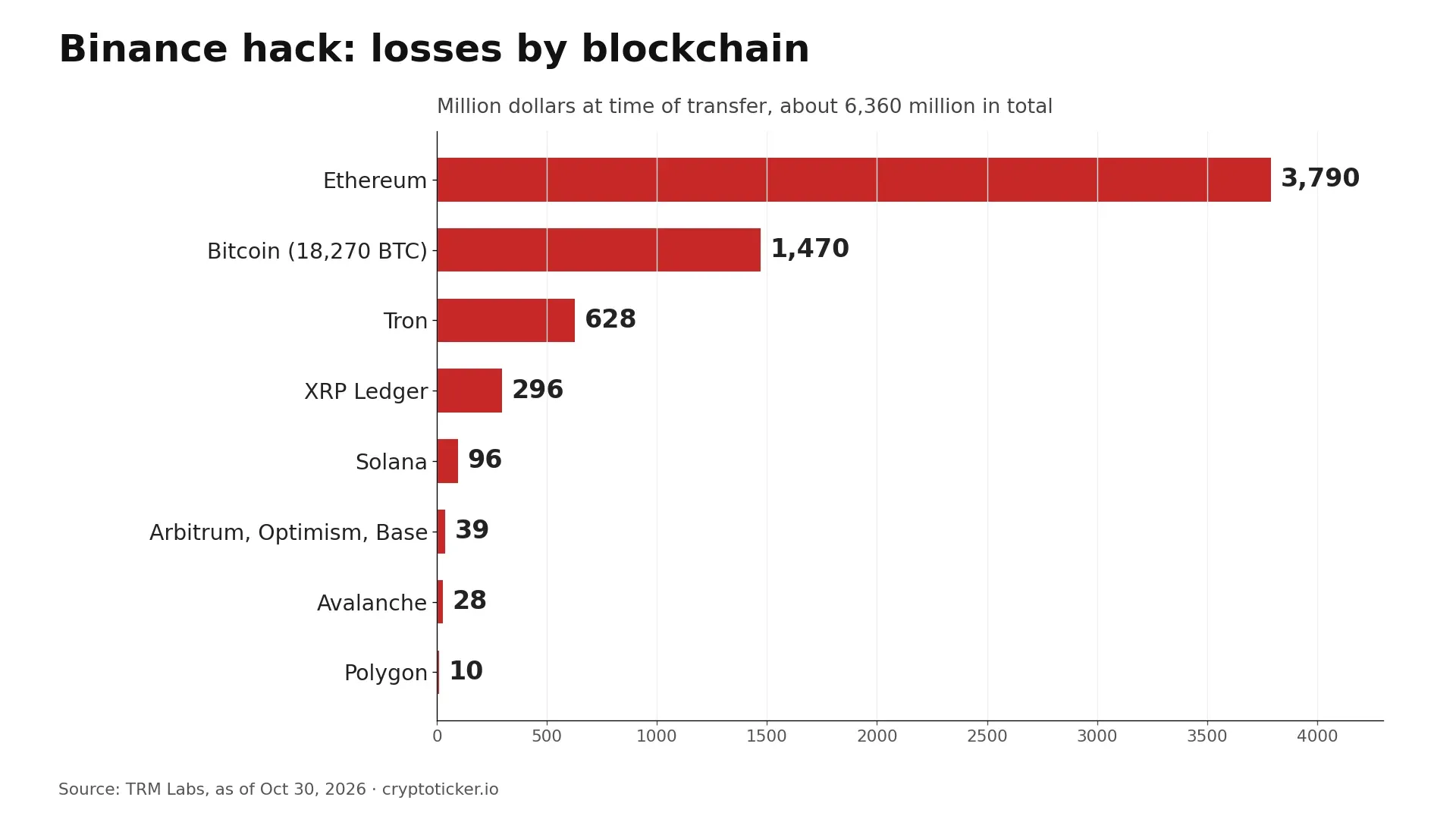
| Blockchain | Drained according to TRM Labs |
|---|---|
| Ethereum | $3.79B (200,630 ETH and 185 other tokens) |
| Bitcoin | $1.47B (18,270 BTC) |
| Tron | $628M (612.7M USDT, 46.4M TRX) |
| XRP Ledger | $296M (233.46M XRP) |
| Solana | $96M (970,500 SOL) |
| Arbitrum, Optimism, Base | $39M |
| Avalanche | $28M |
| Polygon | $10M |
| Total | about $6.36B |
Where is the money from the Binance hack?
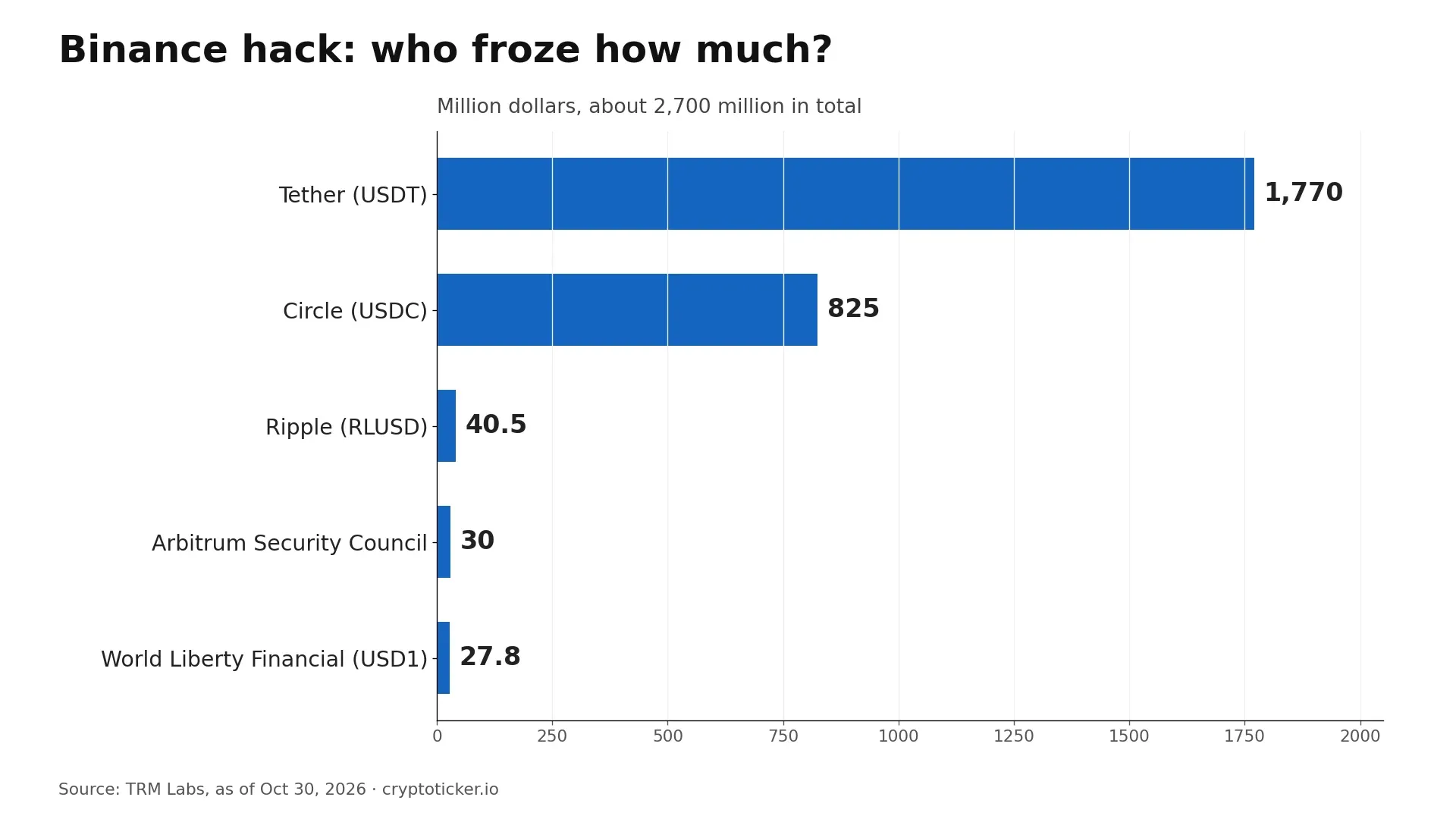
About $2.7 billion is frozen according to TRM Labs; Binance itself speaks of about $3 billion. Most of it was blocked by the stablecoin issuers: Tether froze about 1.77 billion USDT, Circle about 825 million USDC. How we counted the freezes ourselves is in USDT frozen. Ripple added 40.5 million RLUSD, World Liberty Financial 27.8 million USD1, and the Arbitrum Security Council pulled about $30 million in ETH and ARB out of the attacker's wallet at 00:08 UTC.
Beyond the issuers' reach are more than 420,000 ETH and 18,270 BTC, together about $2.4 billion. The attacker used the time before the freezes: he swapped about 325 million USDT into roughly 122,300 ETH through UniswapX and similar services at a discount of more than 10 percent, supplied 60 million USDT to Aave to borrow about 19,760 ETH, and moved 300 million USDT on Tron into the lending protocol JustLend. The bitcoin is being split into chunks of 1,000 and 100 BTC to blur the trail. Unlike after Bybit, the group is relying less on cross-chain bridges this time and more on large swaps and lending protocols. On Tron, according to Elliptic, the attacker also swapped 234 million USDT for 638 million TRX, pushing the TRX price up by just over 9 percent within two hours; how that played out and how much TRX the attacker still holds is in our analysis of the TRX price after the Binance hack.
Regulated crypto exchanges comparedWhen will Binance withdrawals resume?
Deposits are working normally, Binance says. Withdrawals remain paused while the exchange completes a security revamp of the withdrawal service and its related addresses. At 04:36 UTC Binance said it expects to resume them within 48 hours, which would be Sunday, 1 November, around 04:36 UTC at the latest. Binance has not said whether all coins will reopen at once or step by step. Which networks were paused before the full halt is in our story on Binance withdrawals.
Service Update. Deposits remain unaffected and continue to operate as normal. Withdrawals remain paused while our team completes a security revamp of the withdrawal service and its related addresses. We expect to resume within 48 hours, and will update with further details.
Binance (@binance) October 30, 2026
Will Binance cover the losses from the hack?
Yes, according to its own pledge. Binance will cover all losses from its SAFU emergency fund and company funds. Whether the exchange can absorb the damage is what we calculate in How much would it take to bankrupt Binance?. Binance plans to publish an updated proof of reserves once the security work is complete.
If you do not want to keep larger amounts on an exchange, you can hold them yourself, for example in a hardware wallet, or spread your funds across regulated crypto exchanges.
What the Binance hack means for Bitcoin, BNB and the market
On Friday at 10:30 UTC Bitcoin traded at $77,296 according to CoinMarketCap, 3.4 percent lower than 24 hours earlier. BNB lost 5.4 percent to $700.66, Ether 3.9 percent to $2,226 and Solana 3.5 percent to $96.51. Measured against the size of the theft, that is a restrained decline, put into context in Bitcoin price after the Binance hack. The North Korea trail has a sober consequence for the market: state hackers do not hold on to their loot, they convert it in tranches over weeks. The more than 420,000 ETH held by the attacker are therefore what traders are watching most closely.
Our view: for Binance customers the question of who did it changes little. Two dates matter: whether withdrawals really resume by Sunday, and whether the announced proof of reserves shows full coverage. If both happen, pressure on BNB and the market should ease. If either slips, a security incident turns into a question of trust.
All our articles on the Binance hack
- What happened: The Binance hack, On-chain analysis, Timeline of the crash, USDT frozen
- Your money: Binance withdrawals, Could Binance go bankrupt?, Binance review
- Market: Bitcoin price after the hack, How low can Bitcoin fall?, BNB crash, Ethereum crash, Solana crash, How to short Bitcoin
- Background: The biggest crypto hacks in history
FAQ: the Binance hack and North Korea
Partner links: some links on this page are partner links. If you become a customer through one of them, we may earn a commission at no extra cost to you. Selection, ratings and ranking are decided independently by our editorial team. Ethics and Independence · Ownership and Funding
Transparency note: This article was produced with the assistance of artificial intelligence. Figures and claims are based on the primary sources linked in the text. The feature image was generated with AI.
For later? Save this article and find it again in your profile.
Related articles
- Lighter halts withdrawals after a leaked API key drains $10.4 million
- BNB falls below $600, down 23 percent since the Binance hack
- Binance hack: exchange says $6.34 billion in customer losses fully covered
- FaceStealer: FBI warns of fake Zoom calls that drain crypto wallets
- Initia hack: compromised cloud key drains $3.27 million and halts the blockchain
Which topics should we dive deeper into?
Select what genuinely interests you. Your picks feed directly into our editorial planning.
Crypto news that's actually worth your time.
Weekly. 60 seconds. Carefully curated by our editors: no hype, no promo flood, no spam.

November 10, 2026 9:31 AM

Bored Ape Yacht Club: hacks, mishaps and controversies since 2021
Hijacked accounts, $157 million in gas during the Otherdeed sale, UV light at ApeFest and almost four years in court: the major incidents at the Bored Ape Yacht Club (BAYC) with dates, losses, Yuga Labs' response and the outcome.
November 6, 2026 5:19 PM

Binance withdrawals phase 3: HYPE, Aptos and Litecoin due by mid-November
Binance aims to reopen withdrawals for HYPE, INJ, APT, PLASMA, NEAR and LTC by the end of next week, without a fixed date. Which coins already move out via BNB Smart Chain, why HYPE is still waiting despite not being stolen, and what you should secure in the meantime.

November 4, 2026 1:12 PM

Binance Hack One Week Later: The Real Cost of the $6 Billion Heist
One week after the biggest crypto theft ever, Binance has spent half its SAFU Bitcoin, lost billions in deposits and faces a second-wave warning. Full recap.

November 3, 2026 11:22 PM

Binance hacker sold 499.9 billion SHIB in eight minutes, and the Shiba Inu price barely moved
Analysis: the Binance hacker sold all 499.9 billion SHIB within eight minutes in the early hours of October 30 via ShibaSwap and Uniswap, at a discount of around 14 to 15 percent. The wallet is empty, and the price stands at $0.00000463 on Tuesday evening.
November 3, 2026 5:15 PM

Binance hack: the attack began with a fake job interview
Binance has released its first incident report on the $6.3 billion hack: a fake hiring process, a tampered Homebrew package and an internal AI tool opened the way to the hot wallets for the attackers. The scheme also targets developers and retail investors, and five habits protect against it.

November 3, 2026 3:38 PM

Tron below its pre-hack level: the attacker still holds 475 million TRX
Analysis: Tron trades below the level the price showed before the attack on Binance, and according to Elliptic the attacker still holds about 475 million TRX. What the overhang means for holders in Germany, which levels now matter, and why stablecoins can be frozen but TRX cannot.
November 3, 2026 3:21 PM

Binance after reopening: $3.64 billion in net outflows, 2.1 percent of reserves
Binance reports net outflows of $3.64 billion in about nine and a half hours after reopening withdrawals. The full proof of reserves due on Tuesday is meant to show whether customer balances are backed one to one.
November 3, 2026 11:14 AM

Binance reopens Shiba Inu withdrawals five days after the hack
Analysis: since Tuesday morning Binance lets Shiba Inu leave the exchange again, five days after the hack. SHIB trades at $0.00000457, and the $0.0000045 level carries more weight than the reopening itself.
November 3, 2026 1:58 AM

Crypto Hack News: Every Attack Since the Binance Hack and How to Stay Safe
Binance, Mercado Bitcoin, BTCPay Server, a WordPress plugin and hijacked WhatsApp accounts: since 29 October hardly a day has passed without a crypto hack. Every case with its status, the loss and the steps that keep you safe now.
November 2, 2026 11:13 PM

Mercado Bitcoin halts withdrawals after more than $46 million drained in attack
Mercado Bitcoin has confirmed a cyberattack and suspended all deposits and withdrawals; according to Cointelegraph, more than $46 million flowed out. What is known about the attack path and the frozen funds, and how to shield your holdings from the fallout of an exchange hack.
November 2, 2026 4:04 PM

Chainalysis data breach: AI-driven attack exposes names of investigators and compliance teams
Chainalysis confirms an attack using AI-driven methods in which names, email addresses and roles of platform users were taken. Retail investors are not in the dataset, but should expect phishing in the name of real investigators.
November 1, 2026 12:31 PM
Binance hack: FBI names North Korea and lists more than 600 addresses
The FBI has attributed the theft of more than six billion dollars at Binance to the North Korean group TraderTraitor and published more than 600 addresses on Ethereum, Bitcoin and Solana alongside it. Why the blocking request is not a sanction, how 2.85 billion dollars came to be frozen, and when flagged coins get stuck at an exchange.
November 1, 2026 5:07 AM
Binance Reopens Withdrawals: 15 Networks First, 95% of Stolen Funds Replaced
Three days after the $6.3 billion hack, Binance is reopening withdrawals in phases. Phase one starts on 1 November between 06:00 and 09:00 UTC with Bitcoin, Ether, USDT, USDC, BNB, Solana, XRP and eight more networks. What customers need to know now.
October 31, 2026 3:15 PM

$6.34 Billion Buffer: Binance Promises a Full Proof of Reserves by Monday
Binance says it will present a full proof of reserves by Monday and has set aside more than $6.34 billion for it. What a proof of reserves proves, what it leaves open and how you find your own balance in it.
October 31, 2026 12:37 AM

Binance Hack Conspiracy Theories: Fact-Checking CZ, Trump and the Midterms
Inside job, staged hack, money for the Trump family, timing before the midterms: we checked the theories about the Binance hack against the evidence. What is documented about Binance, CZ and World Liberty, and what is not.
October 31, 2026 12:37 AM

Binance Alternatives: 4 MiCA-Licensed Exchanges Compared
After the hack of 29 October 2026, many Binance customers are looking for a new home for their coins. Bitpanda, Kraken, Bitvavo and Coinbase are licensed under MiCA. Here are their fees, supervisors and a five-step guide to moving.
October 31, 2026 12:36 AM

Binance Hack, Then a Stock Market Crash: Coincidence or Connection?
The largest crypto theft in history on Thursday evening, Wall Street's worst day since June on Friday. Are the Binance hack and the stock market crash connected? Our analysis of timeline, sizes and money flows, and where crypto and stocks really meet.
October 30, 2026 3:32 PM

Binance puts the hack at $6.3 billion: what you can do now
Binance names a cause itself for the first time: a compromised laptop belonging to a DevOps engineer is said to have opened access to a service container, while private wallet keys are said not to have leaked. The exchange estimates the total damage at around $6.3 billion, with about $3 billion considered frozen.
October 30, 2026 9:14 AM

How Much Would It Take to Bankrupt Binance? The $6 Billion Hack Explained
Binance lost $6.3 billion in the biggest crypto hack ever. How much would it take to bankrupt the exchange, and what does it mean for the crypto market?
October 30, 2026 1:50 AM

Binance Hack On-Chain Analysis: 50 Signatures, 197,460 ETH and $2.83 Billion Frozen
What really happened in the Binance hack? We analyzed the blockchain ourselves: 50 signatures in one transaction, $2.83 billion frozen, 197,460 ETH with the attacker and an Aave trick. Plus the key voices from X and our conclusion.
October 29, 2026 10:50 PM
USDT Frozen: We Counted What Tether and Circle Really Blocked in the Binance Hack
Tether and Circle report freezes worth about $2.4 billion. We queried the contracts ourselves: 1.18 billion USDT and 823 million USDC are frozen on the attacker address. About 700 million USDT were already gone. How stablecoin freezes work and whether Tether can freeze your USDT too.
October 29, 2026 10:40 PM
Binance Withdrawals After the Hack: Solana and XRP Paused, Bitcoin and Ethereum Open
Binance has confirmed the hack: co-founder Yi He says the exchange will cover all losses, and deposits and withdrawals are temporarily suspended. What it means for users, which networks were already paused and what to watch out for now.
October 29, 2026 9:54 PM
Biggest Crypto Hack Ever? Binance Joins the List of Exchange Hacks
At about $2.8 billion the suspected Binance hack would be the largest theft a crypto exchange has ever suffered. The biggest crypto hacks at a glance, why exchanges are hit more often, what Tornado Cash has to do with it and what past cases meant for prices.
October 29, 2026 9:49 PM

Is This the End? How Low Bitcoin Could Fall After the Binance Hack
About $2.8 billion left a Binance hot wallet and Bitcoin slid below $79,000. Whether this turns into a real crash depends on one question. Three scenarios, the key price levels for Bitcoin, Ethereum and Solana and what to do now.
October 29, 2026 9:38 PM

Binance Hack: Around $2.8 Billion Drained From a Hot Wallet
On Thursday evening, roughly $2.8 billion left the Binance wallet “Binance 14” within minutes. The attacker had tied the wallet to their own contract via EIP-7702. Tether and Circle have frozen about $2.4 billion, and Binance says it is investigating.
October 20, 2026 10:27 PM
Ethereum from the Drift hack: the attacker moves up to $61 million into Tornado Cash
Wallets attributed to the Drift attacker forwarded between 13,400 and 25,700 ether to Tornado Cash on October 20 after two quiet months. Around 81,500 ether still sit with the attacker.
October 5, 2026 1:29 AM

Chainalysis attributes $387 million from the Bitget hack to North Korea: what matters now for investors in Germany
The analytics firm Chainalysis attributes the theft of around $387 million at Bitget to actors with ties to the DPRK and puts the annual total above one billion dollars. What that means for custody, choice of exchange and record-keeping in Germany.
More from CryptoTicker