
BNB falls below $600, down 23 percent since the Binance hack
BNB trades at just $584 on Saturday, below $600 for the first time since August. The token has lost around 23 percent since the Binance hack of October 29, and the wider crypto market is under pressure.


Which topics should we dive deeper into?
Select what genuinely interests you. Your picks feed directly into our editorial planning.
Crypto news that's actually worth your time.
Weekly. 60 seconds. Carefully curated by our editors: no hype, no promo flood, no spam.
BNB fell below $600 on Saturday. According to CoinGecko, the token of the Binance exchange cost $584 at around 5:50 pm Central European Time on November 14, or roughly €530. That is 7.3 percent less than 24 hours earlier and 15.7 percent less over seven days. On CoinGecko's daily data, BNB last traded below $600 on August 11, and it was last this low on August 2.
For holders, a different number matters more. Since October 29, the day of the attack on Binance, BNB has lost around 23 percent. The price stood at $759 back then. Two drivers are overlapping in the decline. The whole crypto market is selling off, and as an exchange token BNB depends more than other large coins on confidence in a single company. What you can check now therefore concerns price and custody alike: your leverage, your exchange and your records.
BNB price on Saturday: $584 and down 7 percent in 24 hours
The slide came in stages on Saturday. Overnight, BNB was still trading at just under $631 on CoinGecko's daily data. In the afternoon the fall accelerated. According to a report by Tokenpost, the price on the Binance spot market dropped to $595 at 4:22 pm Central European Time, a loss of 3.72 percent in just four hours. Four hours earlier it had stood at $618 there. Ninety minutes later, CoinGecko already showed BNB at $584.
Market capitalisation, the price multiplied by the circulating supply, is still around $76.8bn according to CoinGecko. That keeps BNB in fourth place in the crypto market, behind Bitcoin, Ether and Tether. Over 30 days the token is down by just over 20 percent, and it now trades a little more than 57 percent below its record high of $1,369.99 from October 2025.
How the euro price is moving
Holders of BNB in Europe usually think in euros. Here CoinGecko showed around €530 for Saturday afternoon. The €500 mark is therefore still about 6 percent below the current price. For investors who bought at the start of the year, the gap is much larger: in mid-January 2026, BNB still cost almost $948 on CoinGecko's daily data.
BNB below $600: the lowest level since early August
BNB had left the $600 mark behind in mid-August. Between August 9 and August 20 the price oscillated around this zone, followed by the rise to almost $800 in September. The fall back below $600 now wipes out that rally entirely.
Round numbers matter in technical analysis mainly because many traders place buy and sell orders there. A support is a price range where buyers stepped in in the past and slowed a decline. When the price breaks through such a zone, it often turns into resistance, a level where a later recovery tends to stall. Whether that happens at $600 cannot be predicted. The chart does show, however, where BNB turned in the summer.
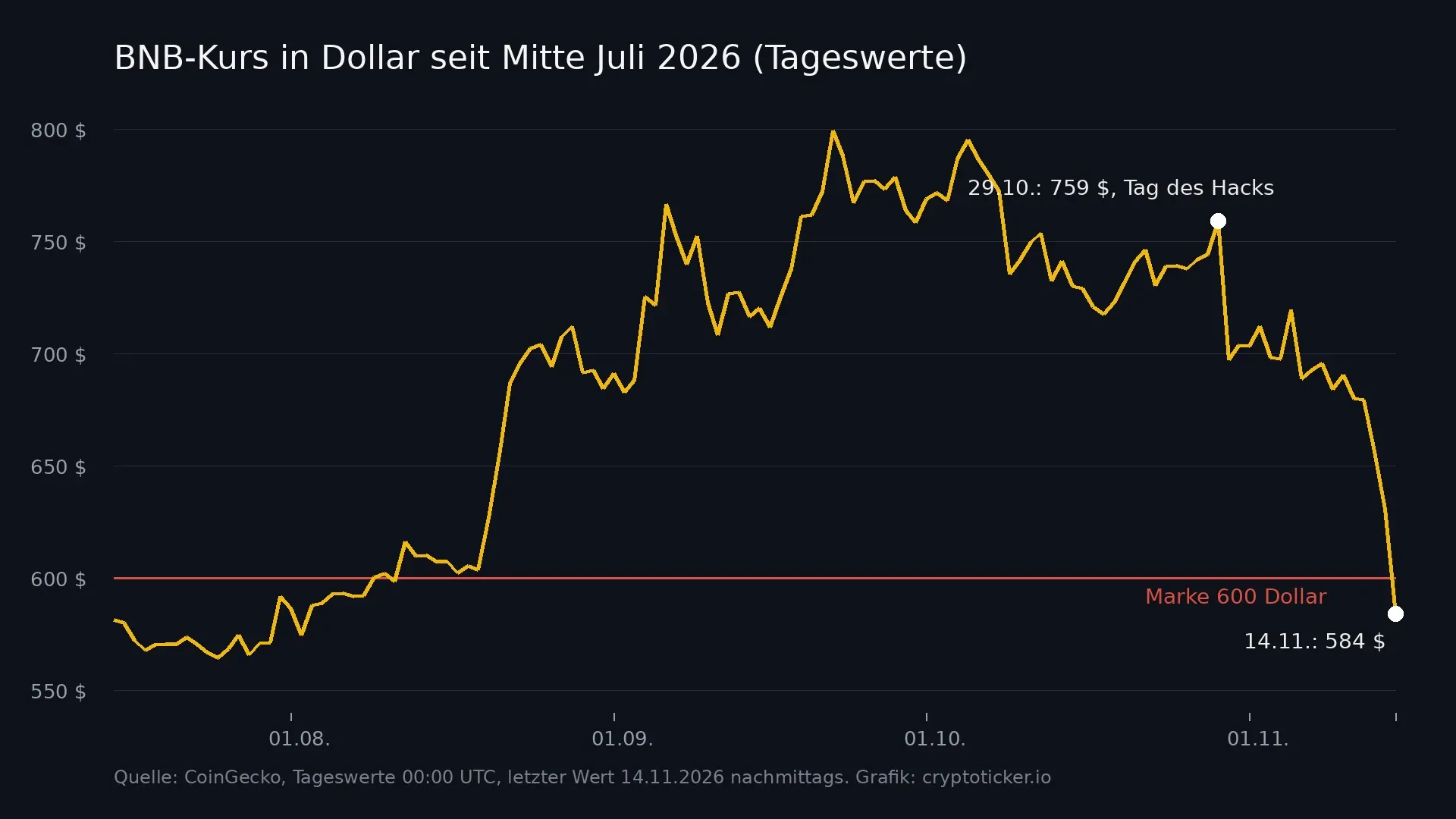
In July, BNB traded almost continuously between $564 and $575, at $564 on July 25. The lowest level of the summer came on July 1 at around $546. These values from CoinGecko's daily data are the next zones where buyers have shown up before.
Since the Binance hack: $759 on October 29, $584 today
At around $6.3bn, the attack on Binance on October 29, 2026 is the largest known theft from a crypto exchange. On November 12, Binance reported that all affected customer balances had been replaced, as set out in our report on the completed Binance reimbursement of November 13. According to that announcement, the more than $6.34bn came from the SAFU emergency fund, from the futures insurance fund and from the company's own treasury.
So far, the reimbursement news has not turned the BNB price around. In the first days after the attack, the token fell from $759 to around $697 and then held between $680 and $720 for almost two weeks. Only with the broad sell-off from November 12 did it slip below that range. The comparison shows that the reimbursement stabilised the situation but did not trigger a recovery.
BNB is more closely tied to a single company than most large coins. The token serves as the fee currency of BNB Chain, brings discounts on trading fees at Binance and gives access to new token listings on the exchange. News about Binance therefore feeds through to the price more directly than with Bitcoin or Ether.
 Compare regulated exchanges with a MiCA licence
Weekend market slide: Bitcoin at $65,100, Ether at $1,814
The drop in BNB is part of a broad sell-off. According to CoinGecko, Bitcoin stood at $65,095 at around 5:50 pm Central European Time on Saturday, 5.1 percent lower than 24 hours earlier. Ether fell 5.7 percent to $1,814 over the same period. Our article on the Bitcoin price below the 200-week line from Saturday afternoon puts Bitcoin's own position in context.
BNB is thus falling harder than the two largest coins, but less than some other large altcoins. Solana lost 9.0 percent according to CoinGecko, Cardano 9.5 percent and NEAR Protocol 11.4 percent. Among the 25 largest crypto assets on CoinGecko, only a single one apart from the stablecoins was in positive territory on Saturday afternoon.
Altcoin Buzz cites several pressures at once on Saturday: outflows from US spot Bitcoin ETFs for the seventh trading day in a row, most recently $185.4m on Friday, a stablecoin supply that has shrunk by $14.2bn in 30 days, and the upcoming Federal Reserve rate decision on December 9. None of the sources reviewed names a single cause for Saturday's move.
Liquidations above $1.2bn: how leveraged long positions accelerate the slide
A liquidation is the forced closure of a leveraged position by the exchange as soon as the posted collateral no longer covers the loss. A long position is a bet on rising prices. When the market falls, exchanges sell such positions automatically, and that selling pushes the price down further.
According to CoinGlass data analysed by Altcoin Buzz, positions worth $1.23bn were forcibly closed across the crypto market in the 24 hours to Saturday, almost twice as much as the day before. Long positions made up 82.7 percent of the total. Depending on the source and time window, other analyses put the figure at up to $1.4bn. For BNB alone, Tokenpost reports long liquidations of $1.97m on Binance, Bybit and OKX in the hour to 4:22 pm Central European Time, against short liquidations of only $10,000.
Anyone trading with leverage should know the distance between entry and liquidation price. With tenfold leverage, a price drop of about ten percent is enough to wipe out the collateral, and slightly less once fees and funding costs are included. BNB has lost almost 16 percent in seven days. Our overview of the best perp DEX compares the margin and liquidation rules of the trading venues.

Fear and Greed Index at 13: extreme fear in the crypto market
The Fear and Greed Index from alternative.me measures sentiment in the crypto market on a scale from 0 to 100. Readings below 25 count as extreme fear. On Saturday the index stands at 13, after 20 on Friday. It is built from price volatility, trading volume and social media sentiment, among other inputs.
A low reading is not a buy signal. It only shows that many market participants are currently selling or waiting. In earlier phases of extreme fear, quick recoveries sometimes followed, and at other times several more weeks of falling prices. Anyone who takes the number as a reason to buy more should do so with an amount they can afford to lose.
 Check margin and liquidation rules at perp DEXs
BNB custody after the hack: proof of reserves and choice of exchange
A proof of reserves is a snapshot in which an exchange shows that it holds at least one unit of a coin for every unit credited to customers. With the reimbursement announcement of November 12, Binance says it published a new snapshot for this proof; the exchange intended to deliver the cryptographic evidence in the following days, as our report of November 13 notes. A snapshot, however, says nothing about the position on a later day.
Anyone who leaves BNB or other coins on an exchange also carries that provider's risk. Whether an exchange is authorised in the EU under the MiCA crypto regulation is shown in the register of the European Securities and Markets Authority, ESMA. Which licensed providers are worth considering is covered in our comparison of regulated crypto exchanges. Holdings you do not actively trade can also be moved to a wallet of your own. BNB runs on BNB Chain, so make sure you pick the right network when withdrawing. How losses and gains from a sale are taxed depends on where you live; tracking tools document every purchase with its date.
BNB levels to the downside and upside: $575, $546 and $656
To the downside, the next documented zones lie in the summer. The first is the daily value of August 2 at around $575, the second the area around $564 from July 25. The summer low of July 1 at around $546 is the third level. All values come from CoinGecko's daily data.
To the upside, the $600 mark itself is the first hurdle. After that comes the daily value of November 13 at around $656, the level before the slide of the past 36 hours. Only above that would the price be back in the $680 to $720 range in which BNB held for two weeks after the hack. This is not a forecast but a classification based on past price data.
BNB price below $600: the recovery depends on the wider market
Whether BNB reclaims $600 depends, in our editorial view, less on Binance itself than on the overall market. The reimbursement after the hack has been reported; the new pressures currently come from ETF outflows, liquidations and the interest rate question. Three steps help you assess the situation for your own portfolio:
- Check your exchange: Confirm whether your provider holds a MiCA licence and compare alternatives among the regulated crypto exchanges.
- Reduce leverage: Recalculate the liquidation price for every open position and compare the margin rules at the best perp DEX.
- Keep records: Note when each of your BNB purchases was made, for example with one of the crypto tax tools.
(As of November 14, 2026. This article is not investment advice. Prices and fee structures change; check the terms with the provider before you buy.)
Frequently asked questions about BNB
Partner links: some links on this page are partner links. If you become a customer through one of them, we may earn a commission at no extra cost to you. Selection, ratings and ranking are decided independently by our editorial team. Ethics and Independence · Ownership and Funding
Transparency note: This article was produced with the assistance of artificial intelligence and reviewed by our editorial team before publication. All figures and claims were checked against the primary sources linked in the text. The feature image was generated with AI.
For later? Save this article and find it again in your profile.
Related articles
- NEAR Protocol and the Binance hack: 11.8 million stolen NEAR are lying dormant
- Bitcoin on Friday the 13th: weekend panic builds as traders eye $60,000
- Why Is Crypto Crashing? The 3 Reasons Behind This Brutal Sell-Off
- BNB falls below $650: Binance Coin at its lowest since August
- Solana price at a three-month low: will the $75 level hold?
Which topics should we dive deeper into?
Select what genuinely interests you. Your picks feed directly into our editorial planning.
Crypto news that's actually worth your time.
Weekly. 60 seconds. Carefully curated by our editors: no hype, no promo flood, no spam.

November 13, 2026 5:15 AM

Bitcoin price falls below $70,000 as $1.3 billion in leveraged bets are wiped out
Bitcoin dropped below $70,000 overnight into Friday for the first time since August, and more than $1.3 billion in leveraged positions were liquidated within 24 hours. The price levels, the triggers and what investors should consider on leverage, custody and record-keeping.
November 12, 2026 5:42 PM

Bitcoin price falls below $72,000: the reasons behind the drop
Bitcoin fell below $72,000 and its 200-day moving average on Thursday, its lowest level since August 20. The Nvidia CEO's resignation, MSCI's removal of Strategy, ETF outflows and rate worries all hit on the same day.
November 10, 2026 11:36 PM

Crypto crash live: Solana and Aave lead the sell-off as markets price a December Fed hike
Hot US inflation data turned a slow slide into a flush: Bitcoin touched its lowest level since August, Solana has lost a quarter of its value in 30 days and Aave fell almost three times as hard as Bitcoin. The live timeline, the reasons and the levels that matter now.
November 7, 2026 9:46 AM

Crypto Crash: Why Bitcoin, Ethereum, XRP and Solana Fell This Week and What Comes Next
Bitcoin lost its post-election gains, ETH hit a 10-week low and XRP led the losses. The four drivers behind this week's crypto crash and the levels to watch.

November 5, 2026 5:13 PM

Bitcoin falls below $77,000 as a Nasdaq chip sell-off sets off a liquidation wave
Bitcoin (BTC) dropped from $78,767 to $75,986 within an hour on November 5, and Ether lost more than 6 percent. A sell-off in chip stocks on the Nasdaq set it off, and forced liquidations of more than $560 million deepened the slide.
November 4, 2026 5:20 PM

Ethereum price jumps above $2,400: why Ether is outpacing Bitcoin after the US midterms
Ether (ETH) has recovered almost 8 percent in twelve hours from its US election-night low and is rising faster than Bitcoin (BTC). What is driving the move, which chart levels matter now and what investors in Germany should consider on buying, tax and custody.
November 4, 2026 1:12 PM

Binance Hack One Week Later: The Real Cost of the $6 Billion Heist
One week after the biggest crypto theft ever, Binance has spent half its SAFU Bitcoin, lost billions in deposits and faces a second-wave warning. Full recap.
November 4, 2026 7:42 AM

Bitcoin ETF Outflows Pass $1 Billion: Why Institutions Are Selling After the Midterms
Spot Bitcoin ETFs bled over $1 billion in three sessions as the Binance hack and the midterms spooked institutions. Where does BTC go next?
November 3, 2026 8:28 AM

Why Is Crypto Down Today? The 5 Reasons Behind the November 3 Sell-Off
Why is crypto down today? Bitcoin sits near $76,000 after the Binance hack, a hawkish Fed and a Nasdaq slide. The five drivers, explained.

November 3, 2026 1:58 AM

Crypto Hack News: Every Attack Since the Binance Hack and How to Stay Safe
Binance, Mercado Bitcoin, BTCPay Server, a WordPress plugin and hijacked WhatsApp accounts: since 29 October hardly a day has passed without a crypto hack. Every case with its status, the loss and the steps that keep you safe now.
November 2, 2026 9:18 AM

THORChain halts Bitcoin and Ether swaps: Binance loot stalls, RUNE down 18 percent
An Ethereum reorg has halted swaps on ten blockchains at THORChain, and Bitcoin, Ether and Solana remain blocked. That also stalls a route used to launder the loot from the Binance hack, and the RUNE price is down more than 18 percent.
October 31, 2026 11:36 PM
Tron Price Falls Below Pre-Hack Level: Binance Attacker Still Holds 475 Million TRX
TRX has erased its post-hack spike and trades at $0.302, below the $0.331 before the Binance attack and the lowest since March. The attacker still holds about 475 million TRX and sells them every 96 seconds. Why the market discounts ten times the stash, and which levels matter now.
October 31, 2026 12:48 AM

Crypto Weekly Recap: Binance Hack, Wall Street Crash and Gold Under Pressure
The largest crypto theft in history, Wall Street's worst day since June and a Fed that turns hawkish: week 44 of 2026 in numbers, the five events that mattered, winners and losers among the top coins and what crypto investors should watch next week.
October 30, 2026 9:14 AM

How Much Would It Take to Bankrupt Binance? The $6 Billion Hack Explained
Binance lost $6.3 billion in the biggest crypto hack ever. How much would it take to bankrupt the exchange, and what does it mean for the crypto market?
October 30, 2026 8:02 AM

Bitcoin Price After Binance Hack: Only 2% Down. What Comes Next?
Bitcoin fell only 2% after the biggest crypto hack ever drained $2.8 billion from Binance. Here are the higher and lower Bitcoin price targets now.
October 30, 2026 6:31 AM

Chainlink drops 11 percent: why LINK falls harder than Bitcoin
Chainlink loses 11.47 percent within 24 hours to 10.42 dollars, falling more than twice as far as Bitcoin. What is behind the drop, the role leverage plays and which levels count for LINK now.
October 30, 2026 6:20 AM

TRX gains 6 percent: TRON outperforms the market as crypto slides
The crypto market slid broadly in the night of 30 October, with Bitcoin falling below 79,000 dollars. TRX is one of four out of twenty large coins that stayed in positive territory.
October 29, 2026 9:59 PM

BNB Crash: Binance Coin Drops 6% After the Hack. Is This Another FTT Moment?
BNB fell 6.3% within 35 minutes after a Binance hot wallet was drained, the worst performer of the top ten cryptocurrencies. Not one BNB was stolen. Why the token falls anyway, how it compares with FTT in 2022 and which price levels matter now.
October 29, 2026 9:55 PM

Solana Crash: SOL Falls Below $100. Is $80 Next?
Solana lost 3.3% within an hour after the Binance hack and slid to $95.64, although not a single SOL was stolen. Why Solana falls anyway, why it was already weak before and which price levels matter now.
October 29, 2026 9:50 PM

Ethereum Crash: The Binance Hacker Sits on 195,000 ETH. Is a Sell-Off Coming?
Ether fell 2.6% within an hour after the Binance hack. The bigger risk: about 195,460 ETH sit with the attacker and, unlike stablecoins, cannot be frozen. How big the selling pressure really is, which price levels matter and why Ethereum itself was not hacked.
October 29, 2026 9:49 PM

Is This the End? How Low Bitcoin Could Fall After the Binance Hack
About $2.8 billion left a Binance hot wallet and Bitcoin slid below $79,000. Whether this turns into a real crash depends on one question. Three scenarios, the key price levels for Bitcoin, Ethereum and Solana and what to do now.
October 29, 2026 9:40 PM

Crypto Crash After Binance Hack: $628 Million Liquidated in One Hour
At 20:24 UTC a Binance hot wallet was drained of about $2.8 billion. Within an hour Bitcoin fell below $79,000 and BNB lost 6.3%. Here is the minute-by-minute timeline, the prices of all major coins and what could come next as Asia wakes up.
October 29, 2026 9:38 PM

Binance Hack: Around $2.8 Billion Drained From a Hot Wallet
On Thursday evening, roughly $2.8 billion left the Binance wallet “Binance 14” within minutes. The attacker had tied the wallet to their own contract via EIP-7702. Tether and Circle have frozen about $2.4 billion, and Binance says it is investigating.
October 25, 2026 10:51 AM

Crypto Crash: Why the Top Cryptos Lost Up to 4% in One Week
Crypto crash week: the largest cryptos lost up to 4% in seven days. We break down why crypto prices are falling and what to watch next.
October 11, 2026 10:20 AM

Crypto Price Today: Bitcoin Slips Under $85,000 as Markets Brace for a Big Week
Bitcoin trades near $83,000 after a red week for crypto. Here is the crypto price today, who is bleeding, who is pumping, and what to watch next.
October 8, 2026 5:06 PM

Crypto Crash Reason: Why Bitcoin Fell Below $81,000 and Altcoins Bled Even Harder
Bitcoin slid under $81,000 and Ethereum lost 9% in a week. Here is every crypto crash reason behind the October 2026 selloff explained.

October 3, 2026 10:38 AM

44 Percent Below the Record: BNB's 37th Burn Follows in Mid-October
A year ago BNB stood at $1,370; today it is around $767. The price has been swinging between $750 and $800 for weeks, and the next quarterly burn is due around the anniversary of the record. Here are the levels that count and what the burn actually does.
More from CryptoTicker