
Tron Price Falls Below Pre-Hack Level: Binance Attacker Still Holds 475 Million TRX
TRX has erased its post-hack spike and trades at $0.302, below the $0.331 before the Binance attack and the lowest since March. The attacker still holds about 475 million TRX and sells them every 96 seconds. Why the market discounts ten times the stash, and which levels matter now.




Which topics should we dive deeper into?
Select what genuinely interests you. Your picks feed directly into our editorial planning.
Crypto news that's actually worth your time.
Weekly. 60 seconds. Carefully curated by our editors: no hype, no promo flood, no spam.
Tron has given back everything the Binance hack added and more. TRX traded at $0.302 late on Saturday, 31 October 2026, down 8.3 percent in 24 hours according to CoinMarketCap at 23:23 UTC. That is below the $0.331 the coin cost before the attack on 29 October and the lowest price since March. Since the hack began, TRX has lost more than any other large coin. The reason sits on the Tron blockchain: the attacker still holds around 475 million TRX that no issuer can freeze, and has been selling them in small slices around the clock.
Tron after the Binance hack: the key facts
- Price: $0.302 on 31 October, 23:23 UTC, minus 8.3 percent in 24 hours and minus 8.2 percent over seven days (CoinMarketCap).
- Since the hack: TRX minus 8.8 percent from 29 October, 20:00 UTC, against minus 4.1 percent for Bitcoin and minus 3.5 percent for Ether (CoinGecko, hourly prices).
- The stash: about 475 million TRX still with the attacker, worth roughly $143 million at today's price (Elliptic, as of 31 October, 05:00 UTC).
- The pattern: 546 transfers out of the main laundering wallet in 27 hours, one every 96 seconds on median.
- The attacker's entry: $0.367 per TRX, so the stash is now 18 percent under water.
- Wall Street: Tron Inc., the Nasdaq-listed company that holds TRX on its balance sheet, fell 6.3 percent on Friday, the first trading session after the hack.
On 29 October TRX was one of the few large coins that rose while the market fell. We explained that move in TRX gains 6 percent: TRON outperforms the market. Two days later the picture has turned around completely, and the chart shows why.
TRX at $0.302: the price after the Binance hack in numbers
Before the attack, TRX traded flat at around $0.331 for days. Within two hours of the first outflows from Binance at 20:05 UTC on 29 October, the price jumped to $0.362, its high for the week. Since then it has fallen almost without pause: $0.337 on Friday morning, $0.321 on Saturday morning, $0.302 on Saturday night. From the post-hack high, TRX has lost 16.5 percent.
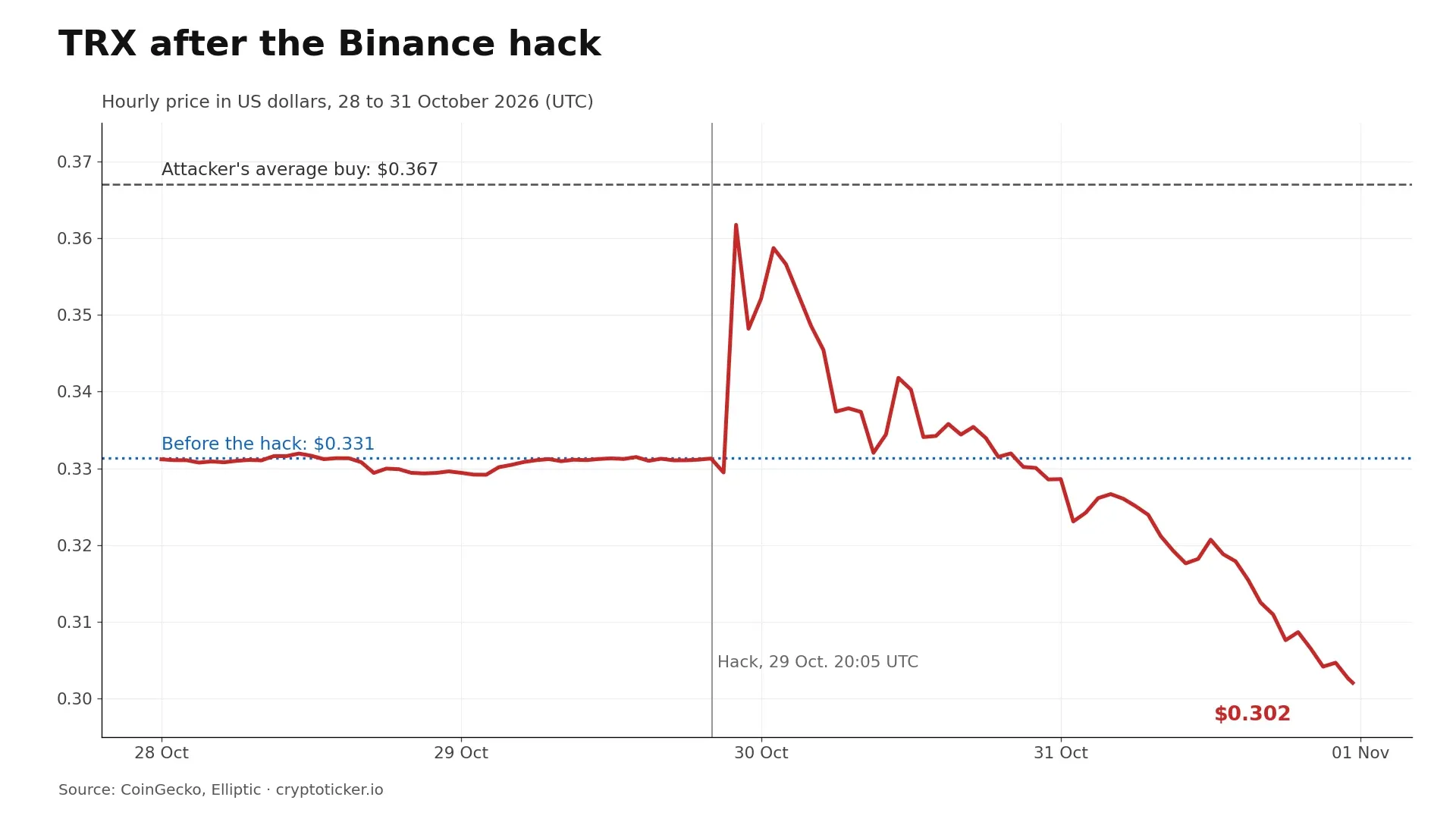
The market value of TRX now stands at $28.7 billion, still rank 8 among all cryptocurrencies. Trading volume over 24 hours was $1.44 billion, down from more than $2 billion on Friday. A falling price on falling volume usually means that there are few buyers left, not that panic selling is growing. The last time TRX closed at this level was on 17 March 2026; the low of the past twelve months was $0.269 on 6 February.
 Keep your TRX yourself: hardware wallets compared
475 million TRX with the attacker: what Elliptic sees on the Tron blockchain
The blockchain analytics firm Elliptic has followed the stolen funds since the night of the hack. In its update from 31 October, 05:00 UTC, it describes the Tron part of the loot in detail. On SunSwap, the largest exchange on Tron, the attacker swapped 234 million USDT for 638 million TRX. The motive is simple: Tether can freeze USDT at a single address, nobody can freeze TRX. A network token like TRX is created by the protocol itself, there is no company behind it with a function to block someone's balance.
On the morning of 30 October the 638 million TRX were split across five fresh addresses. Two of them have since sent their coins to a single wallet, and that wallet does the selling: small amounts of TRX into USDT, then on through swap services and cross-chain bridges, mostly into Ether. Elliptic counts 546 outgoing transfers between 02:00 UTC on 30 October and 04:48 UTC on 31 October, with a median gap of 96 seconds. That is not a panic sale. It is a machine that feeds the market a little at a time, day and night.
According to Elliptic, between $38 million and $67 million worth of TRX has left the traced addresses so far, and around 475 million TRX remain with the attacker. The figures do not fully add up, Elliptic does not reconcile them itself, but they show the direction: most of the stash has not been sold yet. The full picture of the theft, including the attribution to North Korea's TraderTraitor group, is in our analysis of the North Korea trail.
Why the market discounts ten times the stash
Here is the calculation that matters for holders. At $0.302, the 475 million TRX are worth about $143 million. That is roughly one tenth of a single day's trading volume in TRX and about 0.5 percent of all coins in circulation. Large, but not overwhelming.
The price has fallen much further than that. Since 29 October, 20:00 UTC, TRX is down 8.8 percent, Bitcoin 4.1 percent. The difference of 4.7 percentage points is the part of the decline that the general market does not explain. On a market value of $31.5 billion at the time of the hack, that is about $1.5 billion of lost value, ten times the stash itself.
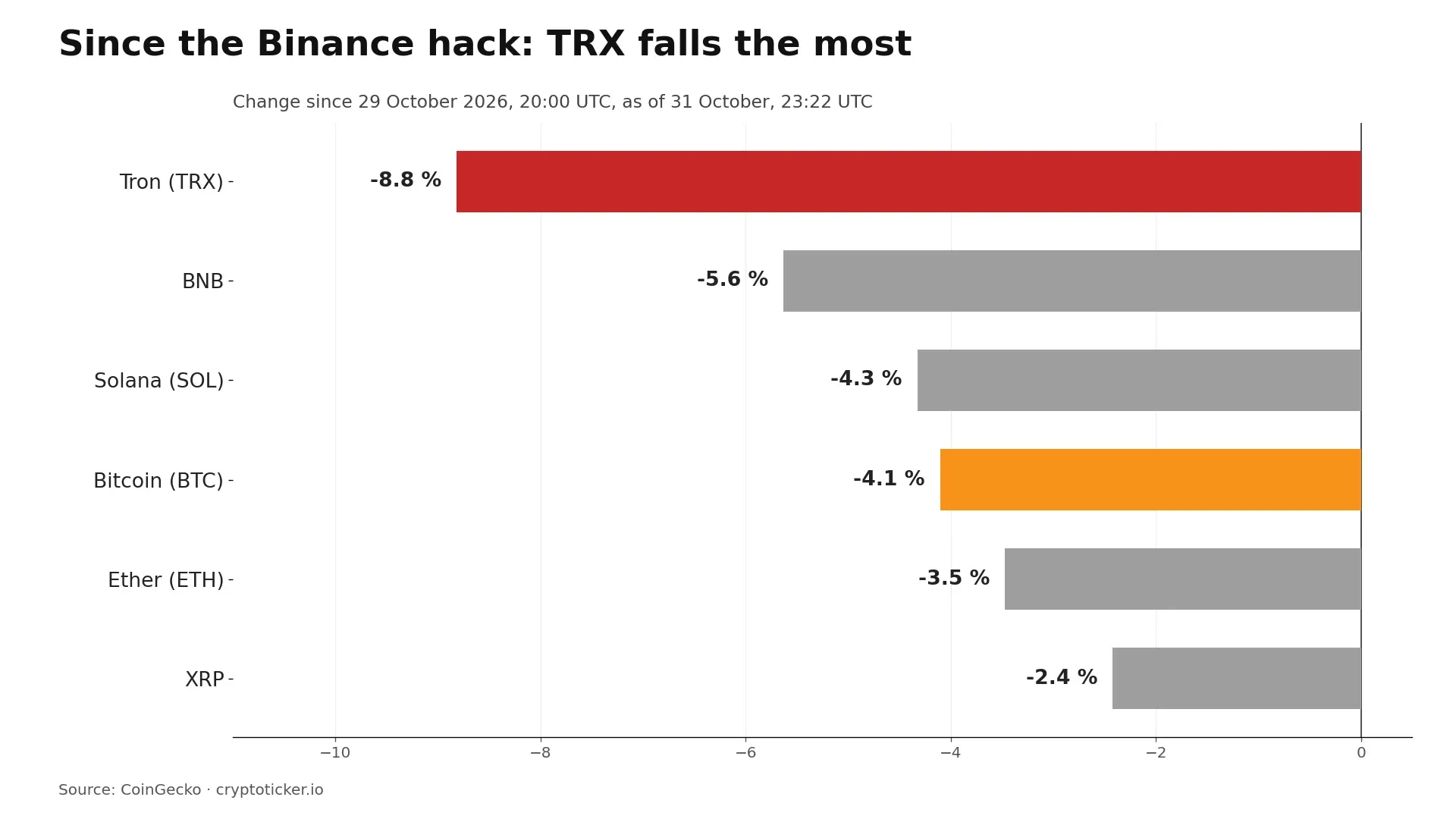
Two things explain the gap. First, the market does not know how fast the remaining 475 million TRX will arrive, and it prices the worst case: a seller that has shown it will sell at any price. It bought at $0.367 and is selling 18 percent lower. Second, the hack has hit the coins around Binance in general. BNB, the exchange's own token, is the second weakest coin of the six with minus 5.6 percent. XRP, where Elliptic also counts 233 million coins beyond any freeze, held up best with minus 2.4 percent. A stash alone does not decide the price, but on Tron it meets a market that had pushed TRX up on the very same flows two days earlier.
 Regulated crypto exchanges compared
Wall Street, Bitcoin and Binance: what the other markets say about TRX
Markets at a glance: Bitcoin $77,406 (plus 0.6 percent in 24 hours), Ether $2,252 (plus 0.7 percent), CoinMarketCap, 31 October, 23:23 UTC. Nasdaq Composite 25,437 (minus 2.86 percent), S&P 500 7,580 (minus 1.82 percent), gold $3,898.90 per ounce (minus 3.3 percent), VIX 19.4, Yahoo Finance closing prices of Friday, 30 October.
The weekend shows how isolated the TRX slide is. Bitcoin and Ether stabilised on Saturday after a week in which US stocks had their worst day since June; how closely the two worlds now move together is explained in our analysis of why US stocks swing like meme tokens. TRX fell on a calm day for the rest of the market. That points to the coin's own seller, not to a new wave of fear.
There is also a direct line to Wall Street. Tron Inc., listed on the Nasdaq under the ticker TRON, holds TRX as its main treasury asset. Its share closed Friday at $1.275, down 6.3 percent in the first session after the hack. When US trading resumes on Monday, 2 November, the share will price in the weekend's TRX decline, and on Tuesday the US midterm elections follow, the next big date for both markets.
The third factor is Binance itself. At 23:21 UTC on Saturday, Binance's public wallet configuration still showed withdrawals for Bitcoin, Ether, TRX and the major stablecoins as "undergoing maintenance". On 30 October at 04:36 UTC Binance had written on X that it expects to resume withdrawals within 48 hours, which points to early Sunday, 1 November. Coins that are stuck on the exchange cannot be sold elsewhere. When withdrawals reopen, some holders may move or sell, and that can add pressure across all large coins for a few hours. How the night of the hack unfolded is documented in our timeline of the crypto crash.
TRX levels to watch: $0.30, $0.295 and $0.331
On the downside, $0.30 is the first mark. It is a round number that many orders cluster around, and the price is sitting right on it. Below that, $0.295 was the closing price of 17 March 2026, the last time TRX traded this low. The twelve-month low of $0.269 from 6 February is a long way off.
On the upside, $0.331 is the level that matters: the price before the hack. As long as TRX trades below it, the market treats the stash as unresolved. A return above $0.331 would mean that buyers absorb the slices faster than the attacker sells them. Our longer view on the coin, with scenarios for the coming years, is in the Tron price prediction.
What TRX holders can do now
Nobody's TRX balance is frozen or at risk because of the hack. Only addresses that forensic firms link to the attacker are watched, and only stablecoins like USDT can be blocked by their issuer. The question for holders is not safety but price: a known seller with a large stash is a burden that can last for weeks.
Three practical points follow from that. First, a decision to sell or hold should not be made in the hours when Binance reopens withdrawals, because that is when the market is thinnest and most nervous. Second, anyone who wants to keep TRX regardless of the price can hold it in their own wallet, outside any exchange; our hardware wallet comparison shows which devices support TRX. Third, anyone who trades should check whether their platform is licensed under the EU's MiCA rules, as listed in our comparison of regulated crypto exchanges: the licence does not protect against price losses, but it decides which rights a customer has if an exchange is attacked.
FAQ: Tron after the Binance hack
Transparency note: This article was produced with the assistance of artificial intelligence and reviewed by our editorial team before publication. All figures and claims were checked against the primary sources linked in the text. The feature image was generated with AI.
Related articles
- Bitcoin Price After Binance Hack: Only 2% Down. What Comes Next?
- Crypto Crash After Binance Hack: $628 Million Liquidated in One Hour
- Bitcoin Falls Toward $83,000 as Trump Rejects Iran Ceasefire Deal
- Crypto Crash: Why the Top Cryptos Lost Up to 4% in One Week
- What Happened to Dogecoin and Cardano Today?
Which topics should we dive deeper into?
Select what genuinely interests you. Your picks feed directly into our editorial planning.
Crypto news that's actually worth your time.
Weekly. 60 seconds. Carefully curated by our editors: no hype, no promo flood, no spam.

March 26, 2026 1:23 PM

Crypto Ignores Bullish News as War Risk Takes Over — Why Bitcoin and Ethereum Are Falling Anyway
Bitcoin and Ethereum fall despite bullish crypto news as war risks, oil spikes, and macro pressure dominate market sentiment.
October 24, 2026 1:44 PM
Franklin Templeton Puts $150 Million on the XRP Ledger as XRP Price Slides
Franklin Templeton quadrupled its tokenised fund shares on the XRP Ledger in two days while XRP fell toward $1.28. Why usage and price are moving apart.
October 29, 2026 7:16 AM
Ripple Is Now a Bank: Why XRP Price Keeps Falling Anyway
Ripple got final OCC approval for a national trust bank, BNY custody and a Moody’s rating in one week. XRP fell anyway. Here is why.
March 29, 2025 8:25 PM

Dogecoin Price Prediction: Will DOGE Price Crash to 1 cent?
Dogecoin tanks over 6% in the last 24 hours as the crypto market faces a bearish wave. Will DOGE bounce back, or is a further drop to $0.15 or lower on the horizon? Here's what to watch out for!
October 20, 2026 10:38 AM
Crypto Crash Today: Why Is Bitcoin Stuck Below $82,000?
Bitcoin can't hold $82K, Ethereum is down 20% in 2026 and ETF money keeps leaving. Here is what is really behind the crypto crash today.
July 25, 2024 12:35 PM

Ethereum Price Analysis: Why is Ethereum Price Down?
Here is the impact of the recent Ethereum ETF launch on the crypto market, leading to a significant sell-off and a $300 million liquidation event. Not what was expected?

August 10, 2026 6:52 PM
Why Is Crypto Down Today? Iran Shuts the Door on US Talks Until 2029
Crypto gave back its morning gains after Iran ruled out talks with Washington until 2029. Bitcoin lost $65,000, oil jumped 5% and altcoins bled again.
October 30, 2026 9:14 AM

How Much Would It Take to Bankrupt Binance? The $6 Billion Hack Explained
Binance lost $6.3 billion in the biggest crypto hack ever. How much would it take to bankrupt the exchange, and what does it mean for the crypto market?
July 28, 2026 11:53 AM

Why Is Crypto Down Today? The Reasons Behind Every Crypto Sell-Off
Why crypto is falling today, updated with every major move: the current trigger, the six forces behind almost every crypto sell-off, a five-minute checklist and a timeline of the 2026 drops.
October 27, 2026 12:31 PM

XRP Price Crashes Below $1.30: What Caused It and What Comes Next
XRP price has dropped below $1.30 after weeks of selling. Here are the factors behind the XRP crash and the next high and low price targets.
October 26, 2026 7:36 AM

Bitcoin Price Crash: Top 3 Reasons Why BTC Price Dropped Below $80,000
Bitcoin price crashed below $80,000 over the weekend. Oil, ETF outflows and a wave of liquidations explain the move, and the Fed decides this week.
June 3, 2026 11:05 AM

Crypto Price Today: Why is the Crypto Market Crashing? BTC, ETH, SOL and XRP Price Update
Total crypto market cap drops below $2.5 trillion as Bitcoin dips under $70,000. Discover the major macro and institutional reasons driving crypto down today.
April 8, 2026 8:53 AM

Bitcoin Price Hits $71,000 as Trump Announces Two-Week Ceasefire
Bitcoin price surged past $71,000 following President Trump’s announcement of a two-week ceasefire with Iran, sparking a major relief rally across global markets.
March 17, 2026 6:00 AM
Why is Ethereum Price UP? Here are 3 Main Reasons...
Ethereum pumped 20% in 8 days. While most watched the charts, two massive regulatory and institutional shifts in March 2026 changed the game for ETH.
July 5, 2024 11:16 AM

Bitcoin News Today: Bitcoin Price Crash BELOW 50K?
Bitcoin's crash has sent shockwaves through the cryptocurrency market. With a significant price drop of over 5% in just 24 hours, is the bottom yet to come for Bitcoin price?
July 21, 2026 4:28 PM

XRP Jumps 4% as MiCA Approval and Bitcoin's Rebound Fuel a Trendline Breakout
XRP is up ~4% today on Ripple's full MiCA approval, wider institutional access, and a resurgent Bitcoin — and the chart just broke a months-long downtrend.
May 23, 2026 5:28 PM

Crypto Market Crash Deepens as Bitcoin Breaks Below $75K
Crypto market crash deepens as Bitcoin falls below $75K, Ethereum nears $2K, and altcoins slide amid liquidations and macro fears.
December 4, 2025 7:45 AM

Ethereum Price Explodes Back Above $3,200: Bigger Moves Coming?
Ethereum jumps back above $3,200 as Bitcoin reclaims $90K. Fresh U.S. liquidity signals and strong risk-asset demand now set the tone for ETH in December.
April 14, 2026 9:02 PM

Why Is Crypto Up Today? Cooling Inflation and Fed Rate Cut Bets Spark Market Rally
Crypto is rising as inflation cools and rate cut bets grow. Here’s why Bitcoin and altcoins are rallying today.
January 28, 2026 2:45 PM

Ethereum Price Reclaims $3,000: Market Gains Momentum Ahead of FOMC
Ethereum price reclaims the $3,000 level as the crypto market turns green. Here is an analysis of the ETH chart and key resistance levels as FOMC volatility looms.
February 25, 2025 12:18 AM

XRP Price Prediction as Cryptos Crash: Will XRP Price Reach $1?
XRP price prediction: Ripple price is in freefall as the crypto market crashes — how low can it go? Will XRP price reach $1?
June 4, 2026 9:52 AM
Why is Crypto Down Today? Market Liquidation Erases Billions
The cryptocurrency market is facing severe downward pressure today. Bitcoin fell over 5% while altcoins like Solana and Ethereum incurred heavier losses.
May 30, 2026 9:44 AM
Why is Stellar Lumens (XLM) Up 20% Today?
Stellar (XLM) has decoupled from a flat crypto market, surging over 20% to retest major multi-month highs following a landmark DTCC tokenization announcement.
April 17, 2026 6:32 PM

Strait of Hormuz Reopens: Bitcoin Hits $78K as Crypto Market Adds $50B in 1 Hour
Bitcoin hits $78K as the Strait of Hormuz reopens, triggering a $50B crypto surge. Is this a real breakout or a short-term relief rally?
April 12, 2026 11:07 AM

Bitcoin Price Drops to $71,500 as US-Iran Peace Talks Collapse in Islamabad
Bitcoin retraces to $71,500 after failed US-Iran peace talks in Pakistan. Geopolitical tensions resurface, impacting the global crypto market sentiment.



More from CryptoTicker