
Hard fork or soft fork: what happens to your coins in a split?
A hard fork can split a blockchain in two, and you then hold the same number of coins on each side. A soft fork changes nothing in your wallet. How to tell the two apart, and what the German finance ministry has settled on the holding period for the new coins.





Which topics should we dive deeper into?
Select what genuinely interests you. Your picks feed directly into our editorial planning.
Crypto news that's actually worth your time.
Weekly. 60 seconds. Carefully curated by our editors: no hype, no promo flood, no spam.
A fork is a change to the rules by which the computers of a blockchain network reach agreement. The practical question behind it is this: do you get new coins out of it, or not? The answer hangs on a single difference. In a hard fork, a blockchain can split in two, with both running on separately afterwards, and you then hold the same number of coins on each side. In a soft fork, one blockchain remains, and nothing new appears in your wallet.
This article explains both forms using two splits that actually happened, and answers the questions that come next: who credits you with the new coins, when the holding period starts and why an announced network upgrade brings you nothing at all in most cases.
Fork means a split: how the German finance ministry defines it
The tersest definition comes from a source you rarely expect here. In its circular on the income tax treatment of crypto assets of March 6, 2025, the German Federal Ministry of Finance writes: "Fork means the forking or splitting of a blockchain and its crypto assets." The paper runs to 34 pages and replaced the older circular of May 10, 2022.
Why a split is possible at all is set out by the same source: the source code of a blockchain is open, anyone may read it, download it and change it. If a dispute arises in the network about how to proceed, it can only be settled by consensus. Where no consensus is found, the software continues in two directions, and the blockchain with it.
Node is the technical term for a computer that stores the complete blockchain and checks every new block against the rules. How many nodes go along with an upgrade and how many do not is what decides whether a fork turns into two blockchains.
Hard fork: why one blockchain becomes two without consensus
A hard fork changes the rules in such a way that the old software rejects the new blocks. A node that does not update considers the new blocks invalid and keeps building on the old blockchain. From that block onwards there are two blockchains with identical history and separate futures.
For you as a holder, what follows is a process the ministry describes as follows: in the course of the split, the holders of the crypto assets of the previously existing blockchain acquire "the same number of crypto assets of the new blockchain without having to provide any consideration for them". So you pay nothing and do nothing, and still there is a balance of your size on the new blockchain.
That sounds like a gift and is worth less in practice than it looks. Whether the new coins get a price at all is only decided afterwards, and that depends on whether exchanges list them and whether anyone wants to buy them. Of the many bitcoin splits of 2017 and 2018, only a handful have a market worth mentioning today.
Soft fork: all nodes keep processing all blocks
With a soft fork, the new rules are narrower than the old ones. Every block that satisfies the new rule also satisfies the old one. A node that has not gone along with the upgrade therefore still accepts the new blocks. The ministry records in paragraph 28 that there is "no splitting of the blockchain or of its crypto assets", because all nodes can continue to process all blocks.
The best-known example is SegWit on Bitcoin, short for Segregated Witness. The change separates the signature of a transaction from the rest of its content and so creates room in the block. It was activated on August 24, 2017 at block 481,824. Nobody received new coins in the process, because there was no second blockchain on which a balance could have arisen.
For you that means: a soft fork is a non-event in terms of tax and custody. There is nothing to check, nothing to claim and nothing to declare.
Bitcoin Cash 2017: what the hard fork at block 478,558 set off
The dispute that led to the first large bitcoin split was about the size of a block. One part of the network wanted to fit more transactions into each block, another part wanted to leave the limit where it was. On August 1, 2017 the two camps parted ways, and Bitcoin Cash came into being.
On the block height the figures differ slightly, and there is a substantive reason for that: block 478,558 was the last block both sides still had in common, while the new software applied its own rules from 478,559 onwards. Some accounts therefore name the one value and some the other. What mattered to holders was the ratio: whoever held one bitcoin had one bitcoin cash in addition afterwards.

Ethereum Classic: how the DAO hard fork at block 1,920,000 left two blockchains behind
The second instructive case has a different cause. In 2016 a smart contract called The DAO was exploited, and a large part of the money locked in it was in the attacker's hands. The majority of the network decided to correct the state of the blockchain once by hand.
The Ethereum Foundation describes the process in its blog post of July 20, 2016: block 1,920,000 contained an irregular state change that moved around twelve million ether out of the DAO contracts into a withdrawal contract. Roughly 85 percent of miners were working on the new blockchain at that point.
The minority that rejected it stayed on the old blockchain. That one has run on since as Ethereum Classic, while the majority blockchain is the Ethereum traded on every exchange today. Both blockchains share every block up to 1,919,999 and none after it.
 Find an exchange that credits fork coins
Planned network upgrades bring you no new coins
This is where the most common misunderstanding sits. When a project announces an upgrade and uses the word fork for it, that usually means everyone goes along. A planned hard fork of that kind changes the rules, but because nobody runs the old software any more, only one blockchain remains. No second balance comes into being.
Ethereum has been working for months on an upgrade named Glamsterdam, which was first meant to run on test networks. As our newsroom reported on October 24, 2026, the date on the Hoodi test network has been cancelled. There was nothing to be had for your balance on that date in any case, because a test network carries no tradeable coins and the upgrade provides for no split.
You can tell the difference by a single question: is there a group that deliberately keeps running the old blockchain? If the answer is no, it is an upgrade. If it is yes, a second balance can come into being. A current case of that second kind is the bitcoin split ECX scheduled for October 30, which we assessed with an eye on custody on October 21, 2026.
Holding period under section 23 of the German Income Tax Act: the acquisition date of fork coins is the old one
This is the point where most people get the sums wrong. You might assume the one-year holding period for the new coins begins on the day of the split. The ministry's circular says the opposite, in paragraph 68: "The acquisition date of the new crypto assets corresponds to the acquisition date of the crypto assets existing before the hard fork."
An example makes the consequence visible. You bought bitcoin in March 2024 and still hold it. If a split happened now, the new coins would count as acquired in March 2024 for tax. The one-year period had therefore long since expired before the new coins even existed, and a sale would no longer be a taxable private disposal under section 23 subsection 1 sentence 1 number 2 of the Income Tax Act.
The reverse applies to your disadvantage in the same way: if you bought the original coins four months ago, the period for the fork coins likewise only expires in eight months. Two further points belong here. The split itself triggers no income under section 22 number 3 of the Income Tax Act, so the inflow is not a taxable event. And the acquisition costs of the old coins are allocated across both sides, in the ratio of the market prices at the time of the split. If the new crypto asset has no price, the acquisition costs stay entirely with the old coins.
The 1,000 euro threshold: when selling fork coins stays tax-free
If you sell within the year, a threshold applies that spares many people the effort. Under section 23 subsection 3 sentence 5 of the Income Tax Act, gains stay tax-free if the sum of all gains from private disposals in a calendar year comes to less than 1,000 euros. Up to the 2023 assessment period that threshold stood at 600 euros.
Two things matter about this figure. It works as a threshold, not as an allowance: if your total gain is 1,000 euros or more, the whole amount is taxable and not just the part above it. And it applies to all private disposals of the year taken together; fork coins sit there alongside every other crypto sale within the one-year period.
You still have to keep records. Without the purchase receipt for the original coins, the acquisition date of the fork coins cannot be evidenced, and it is precisely that date which decides whether tax is due. A portfolio tracker that records every purchase with its date saves you that search later. For NFTs and for so-called liquidity mining, the ministry's circular expressly makes no determinations yet.

Exchange or your own wallet: who decides on crediting the new coins
Technically, the balance on the new blockchain sits under the same key as the old one. Anyone holding their own coins therefore already has the new coins, even if no software displays them. All they need is a wallet that supports the new blockchain.
If your coins sit on an exchange, by contrast, the exchange holds the key. Whether and when it credits you with the coins of the new blockchain is its decision, and it is under no obligation to do so. In practice, exchanges announce their approach ahead of a known split. Some credit the coins and list them, some credit them without offering trading, some do not take part at all. On top of that, deposits and withdrawals are often halted for hours around the time of the split.
If you want to compare how providers handle this ahead of an announced split, our overview of crypto exchanges helps. What to do step by step in a bitcoin split is something we set out on August 20, 2026 in the guide bitcoin fork: what happens to your coins.
 Compare hardware wallets for your own keys
Replay protection and bogus claim offers: the two risks after a split
After a split there are two dangers, and neither has anything to do with the price. The first is technical. Replay protection is the safeguard that prevents a transaction sent on one blockchain from being repeated on the other. Where that protection is missing, a transfer can move both balances unintentionally. Serious splits build it in, and the developers write it into their documentation. If you find no statement about it there, restraint is the better choice.
The second danger is the bigger one. Around every announced split, offers spring up promising to help you "collect" the new coins. If a site or an app asks for your recovery words or your private key to do so, the case is clear: nobody needs that data to credit you with anything, because the balance already sits under your key. Anyone who hands over the words loses both balances at once.
One practical piece of advice: leave a split alone for a few weeks before you touch the new coins at all. Whether there is a market for them and whether the software runs stably shows itself in that time, and the haste costs you nothing but a price that mostly falls anyway.
Total loss possible: what the coins of a new blockchain are worth
The coins of a split are not a bonus with a guaranteed value. They hold a price only as long as enough people buy them and enough computers keep the new blockchain alive. If either of those falls away, the price goes towards zero, and with a fresh split a total loss is the more common outcome than a lasting market.
The tax treatment hangs on that too: if the new crypto asset has no value, the acquisition costs stay with the original coins, according to the ministry. Nothing is lost to you for tax purposes. That changes nothing about the matter itself, and none of the rules described here is a reason to build a position because of an announced split.
Fork: only the split brings new coins, the upgrade brings none
The difference between the two forms decides whether you have anything to do at all. Three steps take you through the next fork you meet in an announcement.
- Settle the type first. If a group deliberately keeps running the old blockchain, a second balance can come into being. If everyone goes along with the upgrade, it is a soft fork or a planned hard fork without a split, and nothing changes for you. What the individual providers announce for a split is gathered in our overview of crypto exchanges.
- Settle who holds your key. If the coins sit with a provider, that provider's announcement applies; you have no claim to the credit. Whoever holds their own coins has the new ones automatically and needs only suitable software. Which devices manage that is set out in the hardware wallet comparison.
- Secure the purchase receipt for the old coins. It determines the acquisition date of the fork coins and with it whether a sale is taxable. A tax tool or portfolio tracker holds that data before it disappears into old exchange statements.
(As of October 24, 2026. This article is not investment advice. Prices and fee structures change; check the terms with the provider before you buy.)
Frequently asked questions about forks
Transparency note: This article was produced with the assistance of artificial intelligence and reviewed by our editorial team before publication. All figures and claims were checked against the primary sources linked in the text. The feature image was generated with AI.
Related articles
- Bitcoin Cash jumps 29 percent in a day: we recalculated 49 jumps like it
- What are Bitcoin Forks? Here’s a Deep Dive into what Forks are
- Selling Bitcoin and Cashing Out in Euros: How It Works in Germany
- Bitcoin Fork: What Happens to Your Coins When the Chain Splits
- Crypto Market Slides: Bitcoin Loses 4.2 Percent and $651 Million of Long Bets Are Liquidated
Which topics should we dive deeper into?
Select what genuinely interests you. Your picks feed directly into our editorial planning.
Crypto news that's actually worth your time.
Weekly. 60 seconds. Carefully curated by our editors: no hype, no promo flood, no spam.

September 17, 2026 10:22 PM
Selling Bitcoin at a Loss and Buying It Straight Back: What That Does to Your Holding Period
Germany has no wash sale rule: the loss stays deductible even if you buy back immediately. The buyback, however, restarts the one-year period for every new unit.

June 30, 2019 4:08 PM
What Is Bitcoin Cash? The Fork, Block Size and What CME Futures Change
Analysis: What Bitcoin Cash is, how BCH differs from Bitcoin and what CME futures and the ETF filing change, with current figures on block size, fees and usage.
October 22, 2026 1:45 PM
Cryptocurrency explained: how digital money works without a bank
A cryptocurrency is an entry in a public ledger that neither a bank nor a central bank controls on its own. This piece explains how that ledger works, what separates Bitcoin from the euro, and which rules apply in Germany to buying, custody and tax.
September 9, 2026 4:29 PM
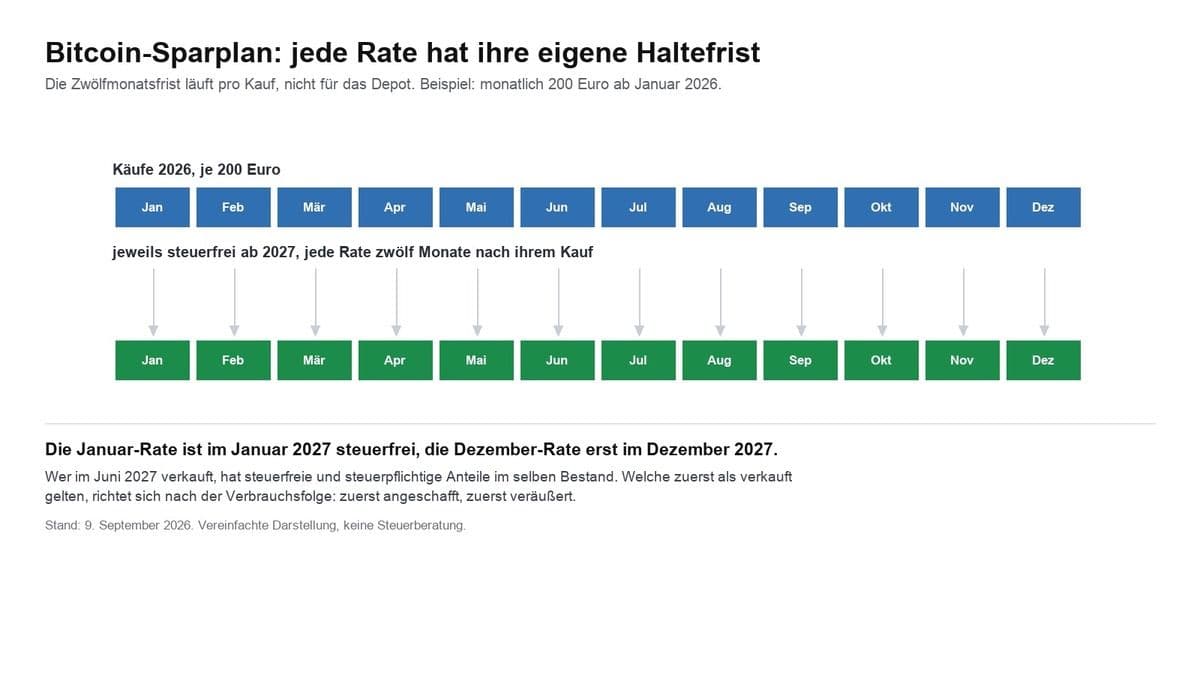
Bitcoin and Taxes in Germany: Holding Period, Savings Plan, ETP and Mining
Bitcoin gains are tax-free after twelve months. What that means for a savings plan with twelve deadlines, why ETPs are taxed differently, and what applies to mining, gifts and losses.
August 28, 2026 10:15 AM

Selling Bitcoin Privately: What Tax Applies in Austria
Selling bitcoin directly to another person? In Austria, private sales can still trigger 27.5 percent tax on the realised gain.
October 16, 2026 7:25 PM

Crypto holding period for Bitcoin: “That remains to be seen,” says the finance ministry
The federal cabinet did not adopt the draft abolishing the one-year crypto holding period on October 14, 2026; it is still stuck in inter-ministerial consultation. This overview sets out what applies today, which dates follow and why the December 31, 2026 cutoff has no force of law so far.

October 8, 2026 10:39 AM

Bitcoin Cash and the CME Futures Launch on October 19: Will the Listing Carry the Price?
The CME Group plans to introduce futures on Bitcoin Cash on October 19, with a standard contract of 250 BCH. The price stands at $294.93 and has given back the jump from the announcement in full.

September 24, 2026 4:11 PM

Bitcoin Cash Falls 5.5 Percent After a 50 Percent Week: Check Your Buy Route, Leverage and Holding Period
Bitcoin Cash fell to $335.19 on September 24, 2026, after gaining almost 50 percent in seven days. The rally was set off by CME's announcement of September 22; what that means for buy route, leverage, holding period and custody is set out here.
October 9, 2026 10:50 AM

Crypto holding period: the Bundestag rejects abolition by 445 votes to 132: what investors need to know
On 8 October the Bundestag rejected the Greens' bill to abolish the crypto holding period in a recorded vote, and the Left's motion fell too. The result by parliamentary group, the official speech from the media centre, and why it was the SPD that gave investors the real signal in the debate.
September 14, 2026 10:23 AM

Take Ethereum Profits or Wait Out the Holding Period? What the Price Jump Means for Your Tax Bill
Ether reached its highest level since the end of January on September 11, 2026, and many are asking whether to sell now. In Germany the answer hangs on the purchase date first: we work out which tranches are tax free and which of them are showing a gain at all.
September 8, 2026 1:19 AM

Germany's Crypto Holding Period: What Happens Now Signing for Petition 201716 Closed on September 15
Recap as of September 27, 2026: the signature period for German parliamentary petition 201716, which asks for the one-year crypto holding period to be preserved, closed on September 15, 2026. This article explains what ended that day, how the petitions committee proceeds and why no investor has to sell because of it.

October 22, 2026 12:31 AM
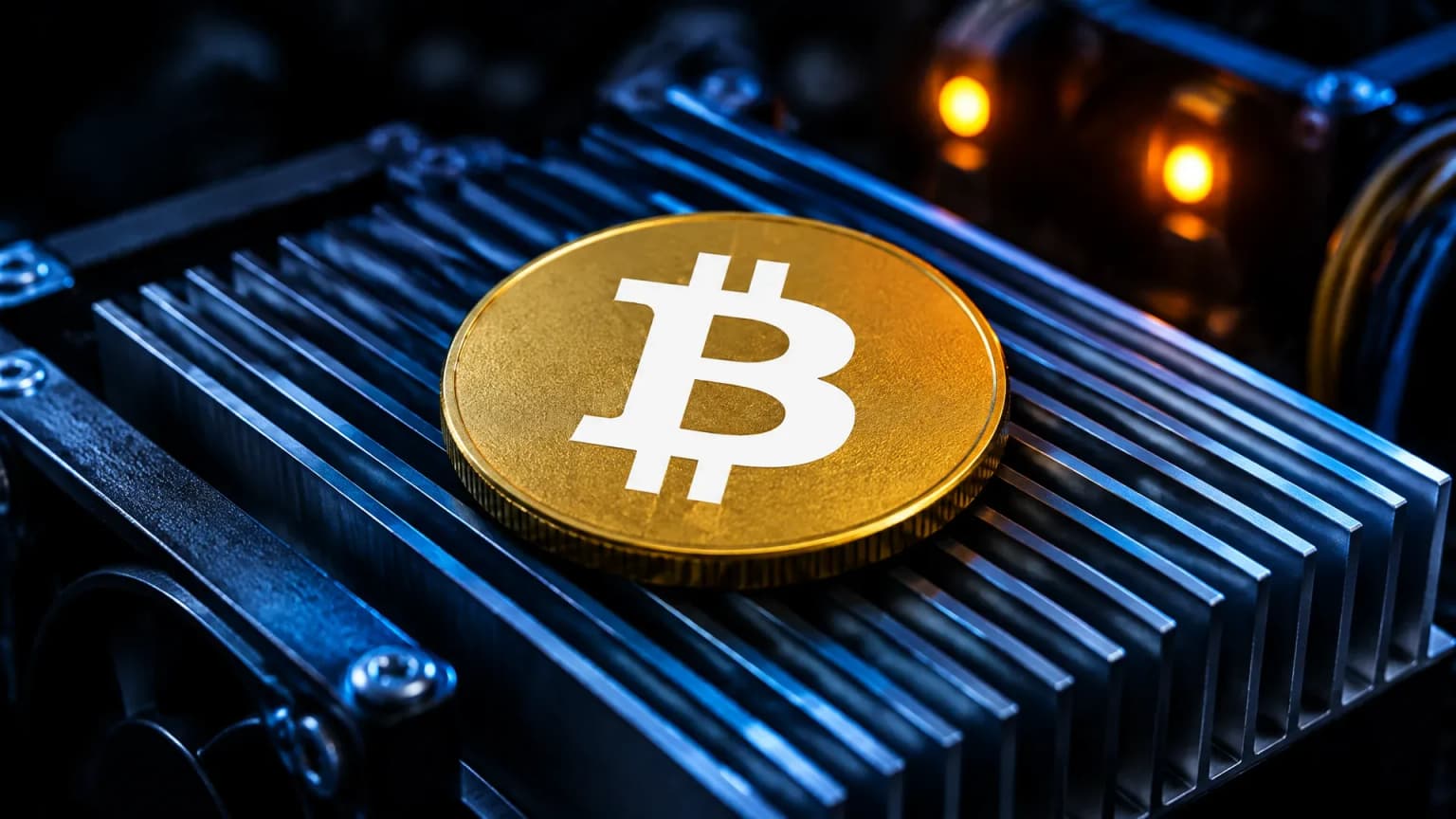
What Is Bitcoin Mining? How It Works and When It Pays Off
Miners secure the Bitcoin network and earn 3.125 BTC per block. How proof of work functions, what an ASIC costs in electricity in Germany and at what power price mining breaks even.

August 12, 2026 5:53 PM

Bitcoin's Quantum Problem: Why 6.7 Million Coins Could Be Frozen Forever
A third of all Bitcoin sits in addresses a future quantum computer could crack. The proposed fix would lock those coins permanently. Here is the plan.
October 2, 2026 5:02 PM

Bitcoin or Ethereum in the fourth quarter of 2026: the two largest crypto-assets compared
Bitcoin is scarce by protocol rule, Ethereum only as scarce as its utilisation, and on access and tax in Germany the paths part again. This comparison puts the verifiable figures on supply, usage, staking and purchase route side by side, without making a price call.
August 24, 2026 12:50 AM
Is Bitcoin Cash a Good Buy at Current Prices?
Bitcoin Cash has held its summer gains but the rally has stalled: the price now sits right on its 50-day line with the RSI back to neutral and turnover halved. We work through what speaks for and against buying BCH at current prices.
October 10, 2026 1:19 PM

Crypto ETF Outflows Pass $1 Billion in October: Is Wall Street Dumping Bitcoin and Ethereum?
Bitcoin and Ethereum ETFs just bled over $1 billion in October. Here is who is selling, who is still buying, and what it means for your coins.
October 9, 2026 1:18 PM

Bitcoin Tax: One Year Past the $126,080 Peak, Losses No Longer Count
Bitcoin trades at $82,558 on Friday morning, 34.5 percent below an all-time high that is now a good year old. Anyone who bought back then loses more than the prospect of a quick recovery when the one-year period expires: the tax value of the loss goes with it.
September 17, 2026 7:12 PM

Gifting Bitcoin to Children: Allowance, Holding Period and the Tax Office Report
Transferring Bitcoin to your child hands over your holding period and your entry price along with the coins. This guide sets out what really applies in Germany on the allowance, the reporting deadline, representation and custody.
October 6, 2026 4:32 AM
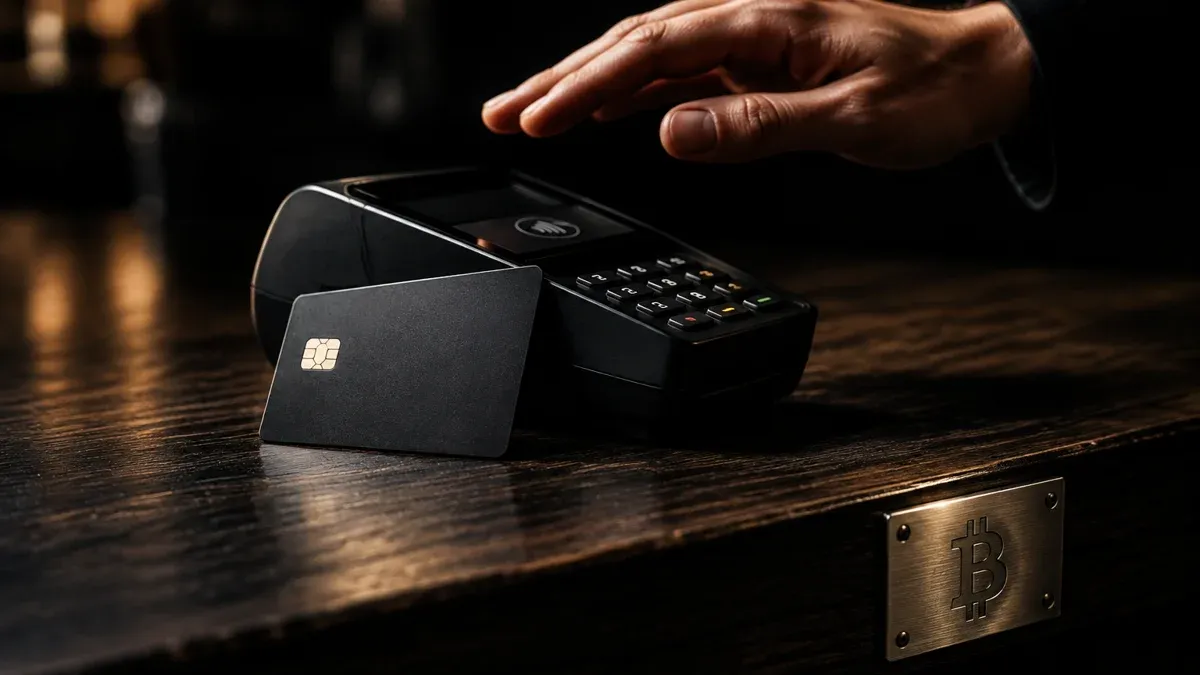
Bitcoin for a gift card: what paying with crypto means for your holding period
Paying for a gift card with Bitcoin is a sale for tax purposes. What counts as the disposal proceeds, when the twelve-month holding period bites, and the four records the tax office expects.
September 27, 2021 2:58 PM
What Is Bitcoin? Bitcoin Explained: Halving, Supply and How to Buy
Analysis: What Bitcoin is and how it works, explained simply with current figures on supply, halving and hash rate, plus how to buy, store and tax bitcoin and our view on the risks.
November 17, 2023 5:56 PM
What Is a Bitcoin ETF? How Spot Bitcoin ETFs Work and What They Cost
US exchanges have traded spot Bitcoin ETFs since January 2024, and net inflows have reached $57.5 billion. How the funds work, what they cost and why investors in the EU usually buy ETPs instead.
October 2, 2026 4:39 AM
Donating bitcoin: when does the full market value count, when only the purchase price?
A bitcoin donation to a charitable organisation is deductible as a donation in kind, and the donation itself produces no taxable gain. The size of the deduction turns solely on whether a sale would have been taxable on the day of the transfer.
September 22, 2026 10:13 AM
Circle Lends Against Bitcoin via cirBTC: Why the Wrapper Can Cost You the German Holding Period
Circle launched loans against deposited bitcoin on September 21, 2026. In Germany, the detour through the cirBTC token is very likely a swap, and a swap restarts your one-year holding period.
September 9, 2026 4:13 PM

Bitcoin 29 Percent Below Last Year: Which Crypto Losses You Can Still Use Before the One-Year Holding Period Expires
Nine out of ten major crypto assets trade lower today than exactly twelve months ago, Bitcoin alone by 29.2 percent. We measured the price series ourselves and show why the purchase date alone decides the tax value of your loss.
August 31, 2026 7:27 PM
Bitcoin Fork with BLAKE2b: What the September 1, 2026 Launch Means for Your Bitcoin
Supporters of the Bitcoin Knots software plan to launch their own chain on September 1 and to swap the hashing algorithm from SHA-256d to BLAKE2b. For holders that means: move nothing, but check four things.
October 5, 2026 7:21 PM

Bitcoin price at $85,662 one year after the all-time high: what to watch now
Bitcoin stands at $85,662, which is 32.1 percent below the all-time high whose anniversary falls on October 6. In euros the gap is smaller, and for anyone who bought in October 2025 the one-year tax period is running out at the same time.
September 9, 2026 4:22 PM
Crypto Tax in Germany: What Applies in 2026 and What Is Set to Change in 2027
In Germany, crypto gains are tax-free after twelve months; before that, your personal rate of up to 45 percent applies. What triggers tax, how the holding period works, what staking and losses mean, and where the 2027 reform stands after the cabinet date of 14 October.
More from CryptoTicker