
Ethereum price at $2,396 and €2,137: next target €2,176
The Ethereum price stands at $2,396 and at €2,137. Over twelve months, 2.2 percentage points lie between the two calculations. For Annex SO and the holding period, only the euro amount counts.





Which topics should we dive deeper into?
Select what genuinely interests you. Your picks feed directly into our editorial planning.
Crypto news that's actually worth your time.
Weekly. 60 seconds. Carefully curated by our editors: no hype, no promo flood, no spam.
Ethereum trades at $2,396 on Monday evening. In euros that is €2,137, and the second figure is the one an investor in Germany works with when buying, selling or sorting paperwork for the tax office. Both numbers describe the same coin, yet they tell two different years: in dollars, Ethereum has lost 39.7 percent since October 20, 2025, in euros 37.5 percent. The gap of 2.2 percentage points comes from the exchange rate.
Ethereum price on Monday evening: $2,396 and €2,137
Against the previous day that is a gain of 1.3 percent in dollars and 1.5 percent in euros (market data from CoinGecko, as of Monday evening, October 19). The daily range ran from $2,329.53 to $2,443.80, a spread of $114 or almost five percent between low and high. Market capitalisation stands at $293 billion, with 122.15 million ETH in circulation.
The distance to the all-time high remains wide. On August 24, 2025, one ETH cost $4,946. From there to today, 51.6 percent is missing. Counted in euros the gap is slightly different, because the euro stood higher back then: €4,230 against €2,137 today, a fall of 49.5 percent.
The ECB reference rate: $1.1225 per euro
You do not have to estimate the conversion rate. The European Central Bank sets a reference rate on every bank working day at around 16:00 and publishes it free of charge. For Monday, October 19, 2026, it shows $1.1225 per euro. A week earlier, on October 13, it was 1.1188, and on October 16 it was 1.1253.
The reference rate is not a trading rate at which you can exchange money. It is a mid-market figure that the central banks of the Eurosystem set jointly, and it serves as a generally accepted yardstick for conversion. That is what makes it usable for records: it comes from a public body, it can be retrieved after the fact, and it is the same for everyone on any given day. The series is published on the ECB page on euro reference rates, and the Deutsche Bundesbank mirrors the same values.
Twelve months in two currencies: 39.7 against 37.5 percent
On October 20, 2025, ETH traded at $3,982 and €3,420. The conversion rate then stood at $1.1643 per euro. Since then the dollar has gained 3.7 percent against the euro, from 1.1643 to 1.1225. A loss in dollars therefore comes out slightly milder once it is converted into euros.
The same effect shows over thirty days, only weaker: in dollars the decline is 8.1 percent, in euros 6.0 percent. Over seven days the relationship even reverses. There ETH lost 5.3 percent in dollars and 5.5 in euros, because the euro firmed again over that single week. The currency effect runs in both directions, and over short periods it is small. Only over months does it grow into a figure you can see on a tax return.
Two annual lows on two different days
The annual low shows how far the two calculations can drift apart. In dollars it was $1,566.01 and fell on June 26, 2026. In euros it was €1,361.52, and that day was June 7, 2026. Nineteen days separate the two troughs.
That is the mechanism behind the whole calculation. A euro investor holds two positions at once, even if only one was bought: Ethereum, and, through the dollar pricing on crypto exchanges, a currency position. The two move independently. In June the euro was strong, so the lowest point reached the euro investor earlier than the one counting in dollars.

What has changed since Friday
On October 16 this space carried an article on the withdrawal of 430,000 ETH from Binance's reserves, at a price of $2,412 at the time. Little has happened since, and that is the real story: $2,440 on Friday, $2,396 on Monday evening, a fall of 1.8 percent over a weekend. In euros it is €2,176 against €2,137, also 1.8 percent, so here both calculations run in step.
The $2,400 level, which had held on Thursday and Friday, broke on Sunday and was won back during Monday's session. Against Bitcoin, ETH stands at 0.02933, with Bitcoin itself at $81,821.
 Find an exchange that takes euro deposits
The daily low met the 90-day average
The low of the day was $2,329.53. The average of the past ninety trading days is $2,330.24. Seventy-one cents separate the two values. A moving average is simply the mean of the most recent closing prices, and it becomes interesting where many market participants see the same line on the chart and place their orders accordingly. Today the line held.
In euros the same ninety-day average sits at €2,033. The current price of €2,137 stands 5.1 percent above it, while in dollars the distance is only 2.8 percent. For an investor who has noted entry prices in euros, the buffer to the line is therefore almost twice as far away as for one watching the dollar chart. If you set alerts, know which currency the threshold refers to. For an overview of which tools keep both currencies cleanly, see our comparison of tax software and portfolio trackers.
How to work out the euro value for Annex SO
Private disposals are governed by section 23 of the German Income Tax Act. The taxable gain is the difference between the sale price and the acquisition cost, less the related expenses. Both amounts belong in Annex SO in euros, even if the exchange settled in dollars or Tether.
Getting there takes three steps. First, note the date and the time of every purchase and sale, not just the month. Second, obtain the reference rate for that date and use it to convert the dollar amount into euros. Third, file the evidence of the rate together with the transaction statement, so the figure stays verifiable if it is ever questioned. If you bought in euros through a German account, you can skip the second step, because the euro amount is already on the statement.
A worked example from the figures in this article: buying one ETH on October 20, 2025 at $3,982 came to exactly €3,420 at a rate of 1.1643. Selling today at $2,396 brings around €2,134 at 1.1225. The loss is €1,286. Taking the dollar amounts at face value and converting only at the end would give €1,413, which is €127 too much.
The holding period runs to the day
Under section 23, a gain from a private disposal stays tax-free if more than a year lies between acquisition and sale. That period counts to the day and not by calendar year. If you bought ETH on October 20, 2025, you have been outside the period since October 21, 2026, which is the day after tomorrow. With a loss that is bad news: hold for longer than a year and the loss can no longer be offset against other disposal gains.
This is where the euro calculation becomes practical. Whether a sale inside the period produces a gain or a loss is decided by the euro amounts, not by the dollar figures on the trading screen. With an exchange-rate move of 3.7 percent over a year, a small dollar gain can turn into a loss in euros, and the other way round. How far the planned reform of the holding period has progressed is set out in our continuously updated status on the crypto holding period.

The levels above and below
Above, the first documented level is Friday's close at €2,176, or $2,440. Beyond it lies the daily high of $2,443.80, which was rejected twice today. Only above that does the way open into the range in which ETH traded in mid-October.
Below, the first level that counts is today's low at $2,329.53, because that is where the ninety-day average runs. In euros that is around €2,075. Should that line break, the next justified level is the average in euros at €2,033. The annual low of $1,566 is far away and plays no part on a daily view.
Our view on the euro calculation
In our editorial view, German investors systematically underestimate the currency effect, because practically every price display runs in dollars. The evidence is above: 2.2 percentage points of difference over twelve months, 2.1 over thirty days, two annual lows nineteen days apart, and a worked example in which €127 of difference appears. Against that, the effect stays small on a weekly view and even reverses, as the past seven days show. For short-term trades it is therefore secondary.
If you hold for months, run savings plans or prepare a tax return, count in euros from the start. That is not a recommendation for or against buying, but a question of bookkeeping. Where things can go on a horizon of months is something we assess regularly in our forecast.
Ethereum in euros: below €2,033 the 90-day average gives way
Three steps that follow from the figures in this article:
- Check which currency your entry prices are recorded in. If they are in dollars, convert them once with the reference rate for the respective purchase date. Then you know whether a position is actually down in euros.
- Compare the fees and the euro deposit options at your exchange. Trading directly in euros saves the conversion and puts the euro amount straight into the statement. Which providers show this cleanly is set out in our comparison of crypto exchanges.
- If you stake, those rewards are a separate item and are valued in euros at the time of receipt, not at the time of sale. The terms and the payout intervals of the providers are in our overview of staking platforms.
(As of October 19, 2026. This article is not investment advice. Prices and fee structures change; check the terms with the provider before you buy.)
 Compare tax tools that track your euro values
Frequently asked questions about the Ethereum price in euros
Transparency note: This article was produced with the assistance of artificial intelligence and reviewed by our editorial team before publication. All figures and claims were checked against the primary sources linked in the text. The feature image was generated with AI.
More on Ethereum: All Ethereum news at a glance
Related articles
- Bitcoin price at $85,662 one year after the all-time high: what to watch now
- Solana price 108.46 euros: a 2.4 percent gain in euros, a 2.5 percent loss in dollars: what to check now
- Take Ethereum Profits or Wait Out the Holding Period? What the Price Jump Means for Your Tax Bill
- ETH Price Prediction: What to Check at the $2,800 Mark Now
- 2,598 dollars and a sixth day of ETF outflows: will Ethereum hold the 2,500 line?
Which topics should we dive deeper into?
Select what genuinely interests you. Your picks feed directly into our editorial planning.
Crypto news that's actually worth your time.
Weekly. 60 seconds. Carefully curated by our editors: no hype, no promo flood, no spam.

September 25, 2026 10:26 PM

Selling bitcoin privately: the tax in Germany and the records you need
A direct sale to a private individual falls under the same one-year rule as an exchange sale, but there is no tax report to go with it. This guide walks through the calculation, the 1,000 euro threshold and the records the tax office wants to see.
September 22, 2026 1:28 PM

Selling Bitcoin and Cashing Out in Euros: How It Works in Germany
Between the sell order and the euros in your current account stand the exchange, your bank and the tax office. Knowing the order of events saves fees, waiting time and, in the best case, the entire tax on the gain.
September 22, 2026 7:23 AM

Gifting Bitcoin to Your Spouse: Allowance, Holding Period and the Report to the Tax Office
Thanks to a 500,000 euro allowance, a gift to a spouse is almost always free of gift tax, and it is not a disposal either. What matters is what travels with it: your purchase date, your purchase price and with them the state of the one-year holding period.

September 24, 2026 10:36 PM

Ethereum Price Prediction: What to Check on Staking, Leverage and Where You Buy After Three Attempts at $2,800
Ether stands at $2,700 and has bounced off the zone around $2,800 three times in thirty days, without a single daily close above it. What our own count shows, and the three things to settle before the next attempt.

August 10, 2024 6:02 PM

Ethereum Price Prediction: Amid Mixed Signals What To Expect For ETH Price?
Ethereum faces volatility and competition, but signs of bullish activity and whale accumulation suggest potential recovery. How does it compare to Solana, and what does the future hold for ETH?
October 17, 2026 10:33 PM

Ethereum forecast: 2,955 new ETH a day, only 13.6 burned, next target: $2,552
Ethereum's supply grew by 2,955 ETH over the past 24 hours, while only 13.6 ETH were burned. What that finding means for the levels between $2,417 and $2,552, and what investors in Germany can take from it.
October 2, 2026 4:40 PM

Ethereum price prediction: Citi raises its twelve-month target to $3,028, and what you can do now
Citi has raised its twelve-month target for Ethereum from $2,240 to $3,028. Anyone following that horizon also decides the tax on the gain with the purchase date.
September 27, 2026 4:25 PM
Ethereum Price Prediction: What to Check on ETH Before the Quarter Turns
Ethereum trades at 2,714.60 dollars on September 27, 2026 and remains pinned to the zone between 2,750 and 2,820 dollars. Which levels decide October, how far apart the analyst targets sit, and which checks to complete before the quarter turns.
September 27, 2026 1:17 PM

Dogecoin Price: What to Check on Holding Period and Custody Before the Year End
The Dogecoin price stands at $0.0977 on September 27, 2026 and has barely moved in a day. That calm is exactly the moment to work through the holding period, the reporting duty from 2026 and custody without any time pressure.
September 22, 2026 1:37 AM

Swapping Bitcoin for Gold: What Happens for Tax in Germany
Moving from coins into gold is a sale in the eyes of the tax office, and the one-year period decides the bill. Where bars, gold ETCs and tokenised gold diverge for tax, and which records you need.
September 17, 2026 7:12 PM

Gifting Bitcoin to Children: Allowance, Holding Period and the Tax Office Report
Transferring Bitcoin to your child hands over your holding period and your entry price along with the coins. This guide sets out what really applies in Germany on the allowance, the reporting deadline, representation and custody.
May 27, 2025 11:59 AM

Ethereum Price Prediction: Will ETH Hit $3,000 in May and a New ATH in 2025?
Ethereum (ETH) is the most trending coin in May 2025. With Bitcoin cooling off, investors are now turning to ETH as their next opportunity. Potential breakout above $3,000 this month and a new all-time high before the year ends?
October 1, 2026 7:38 AM

Buying Ethereum with PayPal: a 72-hour withdrawal lock is the real price of the convenience
PayPal does not trade crypto-assets in Germany, yet it still works as a deposit route at a crypto exchange. What arrives in ether out of 100 euros, why the fee appears only on the final page and what the 72-hour lock means for your ETH.
September 29, 2026 1:20 PM

Ethereum Gas Around 1 Gwei: Why an ETH Transfer Now Costs Six Cents
Ethereum is trading at $2,711 on Tuesday morning and the network fee sits at around 1 Gwei. A simple transfer therefore costs about six cents. What that window means for self-custody, the holding period and the Sepolia date on October 6.
October 17, 2026 10:16 PM

Shiba Inu ten days before its record turns five: what matters now is the holding period
On October 27 the all-time high of Shiba Inu turns five years old, and the price stands 94.2 percent below it. For holders in Germany nothing about that date hinges on the price; it hinges on the one-year deadline in section 23 of the Income Tax Act.
October 7, 2026 4:16 PM

XRP Price Prediction, $1.4445 and a Delayed XRPN Market Debut: What to Watch Now
XRP stands at $1.4445 on October 7, 4.4 percent below the previous day. Three dates shape the week: the XRPN market debut on October 12, the holding-period hearing on the same day and the cabinet session on October 14.
October 6, 2026 4:32 AM

Bitcoin for a gift card: what paying with crypto means for your holding period
Paying for a gift card with Bitcoin is a sale for tax purposes. What counts as the disposal proceeds, when the twelve-month holding period bites, and the four records the tax office expects.
October 3, 2026 10:33 AM

Shiba Inu 93.4 Percent Below Its Record: 31 December 2026 Splits Old and New SHIB
Shiba Inu trades at $0.00000568 on 3 October, 93.4 percent below its record. More important than the day is the German draft bill on crypto tax: it splits your SHIB into grandfathered and new holdings on 31 December 2026.
October 2, 2026 4:39 AM

Donating bitcoin: when does the full market value count, when only the purchase price?
A bitcoin donation to a charitable organisation is deductible as a donation in kind, and the donation itself produces no taxable gain. The size of the deduction turns solely on whether a sale would have been taxable on the day of the transfer.
September 27, 2026 10:14 AM

Shiba Inu Price Prediction: What to Check on SHIB Before the December 31 Deadline
SHIB trades at $0.00000592 on September 27, 2026, around 93 percent below its all-time high. For German investors one date matters more than the chart right now: December 31, 2026.
September 23, 2026 7:22 PM

Solana Price Holds $114: What Holders Check Five Days Before Alpenglow
SOL stands at $114.55 on September 23, after a 17.7 percent gain in seven days and a 2.2 percent loss on the day. Two deadlines matter more than the daily move: Alpenglow opens on September 28, and every purchase made this week starts a holding period of its own.
September 10, 2026 1:13 AM

Staking Taxes in Germany: The Inflow, the 256-Euro Threshold and the Holding Period
Staking is taxed twice: once when the reward arrives and once when you sell it later. This article explains both moments, the threshold of 256 euros, the separate twelve-month period and what applies to liquid staking, restaking and staking ETPs.
September 9, 2026 4:22 PM
Crypto Tax in Germany: What Applies in 2026 and What Is Set to Change in 2027
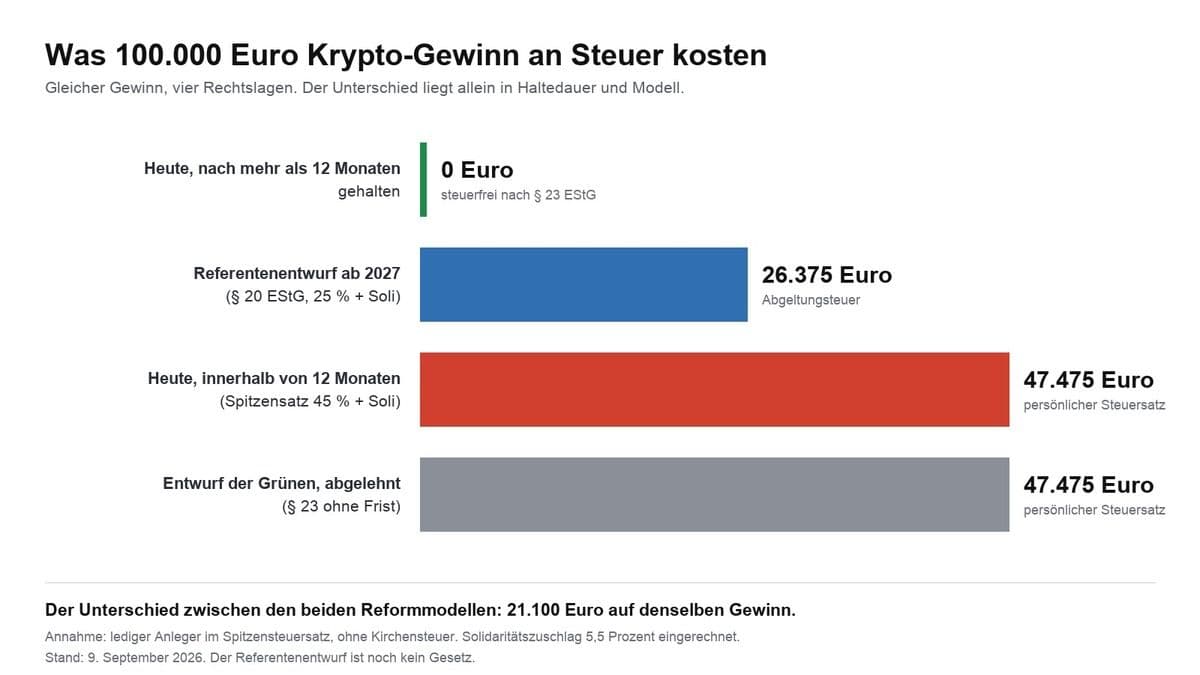
Crypto gains are tax-free after twelve months; before that your personal tax rate of up to 45 percent applies. What triggers tax, how the holding period is calculated, what happens with staking and losses, and what the draft bill would change from 2027.
September 8, 2026 10:21 PM

Crypto Holding Period and Grandfathering: Why December 31, 2026 Becomes the Cut-Off in Germany's Draft Bill
A ministerial draft bill from Germany's finance ministry names a cut-off date for the first time: crypto assets acquired after December 31, 2026 are to fall under the flat-rate withholding tax. What that means for legacy holdings, running savings plans and staking income, and why nothing has been decided yet.
September 26, 2026 1:19 AM

Germany’s Crypto Holding Period Is Wobbling: What to Check Before December 31
A CDU member of the Bundestag makes it plain: the coalition agreement does not guarantee that the one-year holding period for crypto assets will survive. What that means for purchases made before the planned cutoff date of December 31, 2026.


More from CryptoTicker