
70.6 Percent in Three Months: Ethereum Books Its Strongest Third Quarter
Ethereum closed the third quarter of 2026 up around 70.6 percent, its strongest third quarter on record, while Bitcoin managed 42.8 percent. What decides the weeks ahead is the zone around the quarterly high of $2,775.17; what decides your tax year is the purchase date of every position.





Which topics should we dive deeper into?
Select what genuinely interests you. Your picks feed directly into our editorial planning.
Crypto news that's actually worth your time.
Weekly. 60 seconds. Carefully curated by our editors: no hype, no promo flood, no spam.
Ethereum closed the third quarter of 2026 up around 70.6 percent, its strongest third quarter on record. The price rose from $1,569.83 on July 1 to $2,689.39 on the evening of September 30. Bitcoin managed around 42.8 percent over the same period. For you as a holder, the more important question is therefore no longer how good the quarter was, but what the zone just below the quarterly high means for the weeks ahead, and which key dates now belong in your own calendar.
cryptoticker.io compiled this analysis itself on September 30, 2026. The basis is the public price history from CoinGecko for Ethereum and Bitcoin, evaluated across 92 daily values per coin from the start of the quarter to its close.
Ethereum in the third quarter of 2026: the numbers from $1,569.83 to $2,689.39
The course of the quarter falls into two unequal halves. Until the end of July, Ethereum moved within a narrow band; the actual advance began in August and ran into the second half of September. The quarterly high stands at $2,775.17 and was reached on September 22. From there the price gave up around 3.5 percent by the close of the quarter.
The spread between the quarterly low and the quarterly high comes to a factor of 1.77 for Ethereum. For Bitcoin the same figure is 1.48. That is the sober core of the quarterly result: Ethereum swung considerably wider than Bitcoin this quarter, upwards as well as in the pullbacks in between. Anyone who stepped in during August is sitting on a different outcome today than someone who bought at the start of July.
To put the record report in context: specialist media put Ethereum's quarterly gain at 70.6 to 71.0 percent depending on the cut-off moment, and the previous record for a third quarter at 66.55 percent from 2025. Bitcoin, at 42.8 to 44 percent, is on its second-best third quarter since records began. The divergences are explained by the timing of the measurement within the final trading day, not by different data.
Why Ethereum outperformed Bitcoin in the third quarter
Three developments carry the move, and all three are quantified. Spot ETFs on Ethereum in the United States took in between 10 and just under 14 billion dollars over the quarter depending on the survey, with a concentration in August. Companies putting Ethereum on their own balance sheets bought holdings worth more than 15 billion dollars according to industry figures. And the capital locked in DeFi applications on Ethereum and its layer-2 networks grew to around 88 billion dollars.
Total value locked, or TVL for short, denotes the sum of all funds users have paid into an application's contracts. The metric measures usage, not profit, and it also rises when the deposited coins simply become more expensive.
The difference from Bitcoin lies less in the demand itself than in the starting base. Ethereum began the quarter from a level well below its own record of August 2025, while Bitcoin stood closer to its all-time high. An inflow of the same size moves the smaller market value further in that situation. That is an explanation for the quarter just gone and not a promise for the next one.

Spot ETFs and corporate treasuries: where the inflows came from
At this point the origin of the demand is what matters to you, because it says something about how durable it is. Inflows from exchange-traded products are more sluggish than trading on crypto exchanges. Such funds follow investment decisions with a lead time and withdraw in an orderly fashion when sentiment turns. That is exactly what was visible in several weeks of net outflows in the spring of 2026.
Purchases out of corporate treasuries work in the other direction. In the short term they are rare, because a company does not turn its balance sheet position over week by week. In exchange they concentrate on a few addresses, and a single decision can carry more weight there than a thousand retail purchases. If you use the quarterly result for your own planning, you should look at both sources separately rather than adding them into one figure.
A request for caution on the totals: ETF inflows are delimited differently by different providers, depending on whether exchange transactions and staking income are counted in. That is why a range appears here and not a round number. If you work with such values, pay attention to which delimitation the provider states.
 Buy Ethereum at an authorised exchange
The quarterly high at $2,775.17 and the zone below it
At the end of the quarter Ethereum stands some 85 dollars below its own quarterly high. That proximity is the reason the coming trading days deserve more attention than the turn of the calendar itself. A break above $2,775.17 raises the quarterly high into a starting point for the next price band. If the attempt fails repeatedly, the same figure turns into a lid that sellers orient themselves by.
On the downside the first point of orientation lies in the area around $2,500, which served repeatedly as a springboard in September. Below that begins the stretch in which the August advance first took shape. These figures are reference points from the measured course of the quarter and not a forecast. What they state is where a great deal was traded last quarter, not what happens next.
The distinction between a reference point and a price target matters. A reference point describes an area where the behaviour of buyers and sellers has changed in the past. A price target is an expectation. Analyst estimates for the fourth quarter diverge widely, and none of them is presented here as our own assessment.
Bitcoin ends the quarter up 42.8 percent and 3.4 percent below its quarterly high
Bitcoin came from $58,566.09 on July 1 to $83,640.10 at the close of the quarter, with the quarterly high at $86,596.74 on September 22. Both coins therefore reached their high on the same day and give up an almost equally large share of it by the end of the quarter. That argues for a shared driver at the upper end, not for an Ethereum-specific weakness.
On September 30 a macro impulse was added on top. The US price index for personal consumption expenditures came in for August at 3.0 percent year on year, below the expected 3.3 percent, and Bitcoin reacted over the course of the day with a jump into the area around $84,750. If you are interested in how a date like that affects your open positions, the section on leverage and liquidation further down is the relevant one.

Holding period and tax year: which key dates now count for German holders
The turn of the quarter is meaningless for tax. What counts for you in Germany is the purchase date of every single position and December 31 as the end of the tax year. Under the law as it currently stands, a gain from the sale of crypto assets remains tax free if more than one year lies between purchase and sale. Within the year, taxation as a private disposal transaction at your personal tax rate applies, and an exemption limit of 1,000 euros applies to the sum of all private disposal transactions in a year.
In practice that means coins you bought in July or August 2026 only reach their one-year deadline in the summer of 2027. Selling the quarterly gain now would be fully taxable. At the same time the deadline for offsetting losses within the tax year expires on December 31: losses from private disposal transactions can only be offset against gains of the same kind, and for that both have to be realised in the same year.
Which position carries which purchase date can only be answered with a complete record once there have been several purchases over the year. If you bring your transactions together from several sources, you would normally use a tax tool or a portfolio tracker for that, one that keeps the acquisition dates per inflow. The tax treatment of crypto ETFs and ETPs differs from this; if you invest by that route, you will find the classification in the overview of crypto ETFs in Germany. Only tax advice settles your case in a legally binding way.
 Keep purchase dates and holding periods in view
Buying Ethereum in Germany: MiCA authorisation, fees and custody
Since the European crypto regulation MiCA, providers addressing retail clients in the EU need authorisation as a crypto-asset service provider. MiCA is the EU regulation on markets in crypto assets; it governs authorisation, information duties and the handling of client assets. For you that is not a seal of quality for price performance but information about who is supervised and where to turn with a complaint.
When comparing costs it pays to look at three items that are rarely stated together: the trading fee in percent, the markup in the price itself and the cost of withdrawing to your own wallet. A provider with a low fee and a wide price markup can be more expensive than one with a stated percentage. Which houses work with German clients and what their terms look like is set out in the overview of crypto exchanges for German investors, linked at the end of this article.
The custody question arises independently of that. If the coins stay with the provider, you carry its default risk with it. If they sit in your own wallet, responsibility for access lies with you, and lost access is final. Both are defensible as long as the decision is taken deliberately and not out of habit.
Staking yield on Ethereum: lock-up periods and the difference from price movement
Ethereum is secured through staking, and anyone making their coins available for it receives an ongoing payment in the region of a few percent a year. Two things about that are frequently confused. First, the staking yield is not interest. Payment comes from newly issued coins and transaction fees, and counted in euros the amount falls when the price falls. Second, staked coins are not immediately available. The exit queue stood at times above one million waiting ETH in September 2026, with waiting times of several weeks.
For tax purposes staking income has to be treated as other income in Germany and therefore differently from the price gain. Anyone running both through the same address needs a separate record. The providers with their respective lock-up periods and payout models are set side by side in the overview of staking platforms that you will find at the end of this article.
Leverage and liquidation: why the days after a quarter end are vulnerable
A price standing 3.5 percent below its quarterly high sits in an area where many leveraged positions are tightly set. In a leveraged trade you post only part of the position value as collateral. If that collateral no longer suffices after a price move, the position is closed by force, and that is called liquidation. Because such closures sell in themselves, they amplify the move that triggered them.
Around quarter boundaries this coincides more often: position adjustments by institutional houses, expiring futures contracts and, in this case, the reaction to the US price data of September 30. If you are trading with leverage, the distance between your entry price and your liquidation price is the figure you have to know, not the quarterly return. Without leverage this section does not concern you.
What the quarterly result does not say about the fourth quarter
A record quarter is a statement about the past. No claim to a continuation follows from it, and the statistics of earlier fourth quarters are deliberately not cited here as an argument: the sample is small, and the conditions differ too much from year to year to derive an expectation from them.
Three things are documented at this point: the extent of the advance, the reference points from the measured course and the order of magnitude of the inflows that carried it. Everything said beyond that about October to December is an expectation. Analyst estimates for price targets currently diverge widely, and their spread is itself the most usable information in them.
Ethereum quarterly result: what to take away
- Draw up purchase dates, not quarterly returns. Write down for every position when you bought it, and mark which ones reach the one-year deadline before December 31 and which do not. The tax tools and portfolio trackers are suited to bringing several sources together.
- Note the two reference points. $2,775.17 as the quarterly high and the area around $2,500 below it. Decide in advance what you will do in each of the two cases, rather than in the moment of the move. If part of your coins is staked, the exit period belongs in the same note; the providers' periods are in the overview of staking platforms.
- Check the costs and custody of your own access. Trading fee, price markup and withdrawal costs are rarely stated together on a price sheet. The overview of crypto exchanges shows which providers are authorised under MiCA and what a transfer to your own wallet costs.
(As of September 30, 2026. This article is not investment advice. Prices and fee structures change; check the terms with the provider before you buy.)
Sources for further reading: the quarterly result at finanzen.net and the breakdown of ETF inflows at Crypto Briefing.
Frequently asked questions about Ethereum in the third quarter of 2026
Transparency note: This article was produced with the assistance of artificial intelligence and reviewed by our editorial team before publication. All figures and claims were checked against the primary sources linked in the text. The feature image was generated with AI.
More on Ethereum: All Ethereum news at a glance
Related articles
- Crypto Market Slides: Bitcoin Loses 4.2 Percent and $651 Million of Long Bets Are Liquidated
- Top 10 Altcoins to Buy in May 2026 as Bitcoin Recovers
- Bitcoin or Ethereum in the fourth quarter of 2026: the two largest crypto-assets compared
- US Government Reopens After 41 Days – What It Means for Bitcoin, Crypto, and Global Markets
- Bitcoin News Today: Why Is Bitcoin Price Up Starting July?
Which topics should we dive deeper into?
Select what genuinely interests you. Your picks feed directly into our editorial planning.
Crypto news that's actually worth your time.
Weekly. 60 seconds. Carefully curated by our editors: no hype, no promo flood, no spam.

September 24, 2026 10:11 PM

Bitcoin Price Prediction: What to Check on Levels, Holding Period and Leverage Before the October 28 Rate Decision
Bitcoin is trading at around $83,800, a third below its October 2025 high, while the sentiment index reads greed. Which dates, levels and deadlines over the coming weeks really decide your net gain, and which of them you steer yourself.
October 15, 2026 7:29 AM

17 of 20 top coins down, Ethereum at $2,380: where the sell-off is measured
Ether loses 5.41 percent over 24 hours and falls to a daily low of $2,332.43. Our own count of the 25 largest cryptocurrencies shows how broadly the sell-off really carries.
October 13, 2026 4:15 PM

Bitcoin price at $83,200: outperforms the market as Solana sheds 11.9 percent
Bitcoin is trading at around $83,200 at midday on Tuesday, making it the only one of the large coins with a gain over 24 hours. Over the week BTC is down 2.8 percent while Solana loses 11.9 percent, and that very gap is tempting investors into a swap that can turn expensive in Germany.
September 24, 2026 10:36 PM

Ethereum Price Prediction: What to Check on Staking, Leverage and Where You Buy After Three Attempts at $2,800
Ether stands at $2,700 and has bounced off the zone around $2,800 three times in thirty days, without a single daily close above it. What our own count shows, and the three things to settle before the next attempt.

July 30, 2026 11:54 AM

Bitcoin and Ethereum Beat Every Major Market in July as Chip Stocks Crash
Crypto quietly won July. Ethereum gained 20% and Bitcoin 9%, while chip stocks fell 22% and the Nasdaq 100 slid 9%. Here is what actually happened.
May 18, 2026 1:07 PM

Is Solana a Good Buy in 2026? SOL Price Analysis and Potential ROI
Solana (SOL) trades at $104.40 after clearing the $100 resistance. Here's how SOL's potential returns stack up against BTC, ETH, and XRP.
July 25, 2026 11:27 AM
Crypto Price Today: Market Slides Again as Bitcoin Fails at $67,000
Bitcoin slipped back under $64,000 after tapping $66,990. Oil, ETF outflows and Fed nerves are dragging the whole crypto market lower.

September 9, 2026 4:22 PM
Crypto Tax in Germany: What Applies in 2026 and What Is Set to Change in 2027
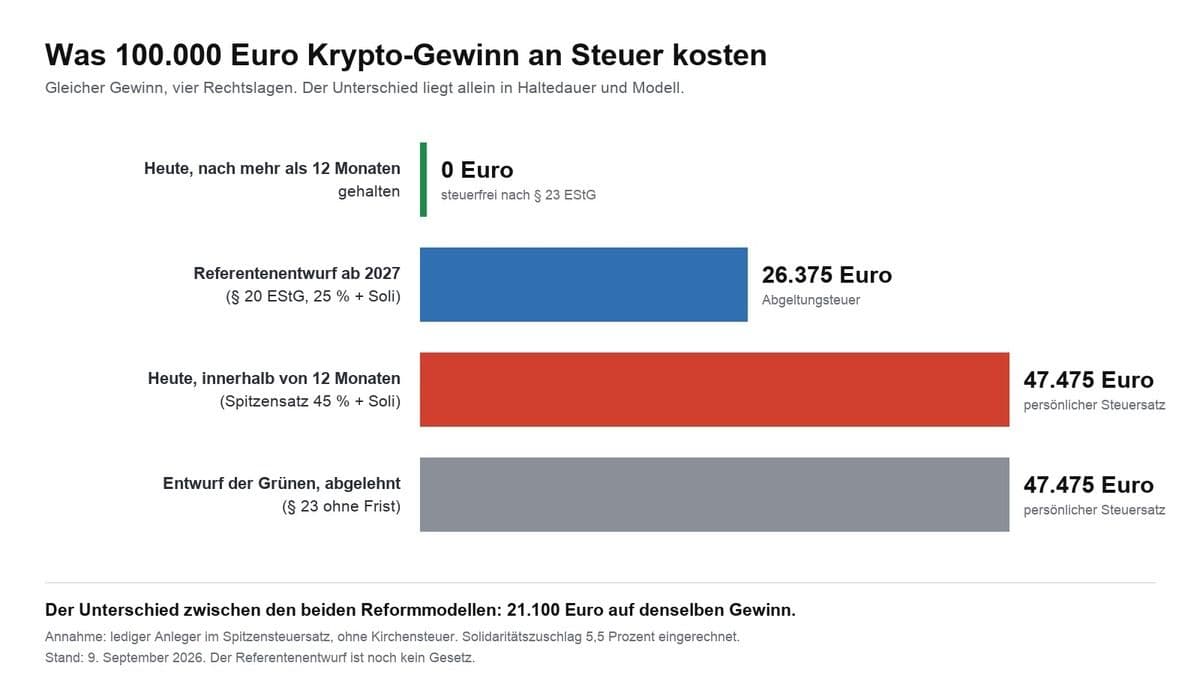
Crypto gains are tax-free after twelve months; before that your personal tax rate of up to 45 percent applies. What triggers tax, how the holding period is calculated, what happens with staking and losses, and what the draft bill would change from 2027.
May 28, 2026 6:42 PM

Crypto Market Crash Deepens While S&P 500 Hits New All-Time High: Why Is Bitcoin Falling?
Crypto prices fall as Bitcoin, Ethereum, and Solana struggle while the S&P 500 hits a record high. Why is crypto not following stocks?
January 12, 2026 12:25 PM

Is This Crypto Cycle Like 2021? The January 2026 Analysis in Hindsight
In January 2026 much spoke against a repeat of 2021. It turned out harsher: Bitcoin lost more than half of its value from the cycle high near $124,700 by July 2026.
July 19, 2026 10:44 AM
Crypto Prices Today: Bitcoin Holds $64K as Ethereum Outperforms
Bitcoin holds $64K as ETF flows turn, Iran tensions cap the rally, and all eyes shift to the July 28–29 Fed meeting. Here's your weekly wrap.
July 17, 2025 10:26 PM

XRP vs Ethereum: Which Altcoin Will Hit Its ATH First After Bitcoin’s Breakout?
As Bitcoin smashes fresh all-time highs, XRP and Ethereum are now in a tight race to reclaim theirs. Who will hit it first — the faster runner or the bigger player?
July 27, 2024 2:34 PM

Why Is The Crypto Market Up TODAY?
With the Bitcoin 2024 Conference taking place now in Nashville, the crypto market is showing bullish signals, intriguing traders around the future of Bitcoin and Altcoins.
September 1, 2026 10:22 AM
Crypto News Today: Bitcoin Stalls While Zcash and Monero Steal the Show
Crypto news today: Bitcoin cools after its best week in three years, Saylor buys again, and privacy coins keep running. Here are the prices and levels.
May 12, 2026 3:51 PM
Bitcoin Holds $80,000 as XRP Outpaces Market Amid ETF Surge
Bitcoin maintains its $80,000 support while XRP breaks key resistance. Discover how institutional ETF inflows and market shifts are driving crypto prices today.
April 3, 2026 3:00 PM
Q1 2026 Crypto Analysis: Why Most Cryptos Crashed YTD
Bitcoin and altcoins faced a brutal Q1 2026 with double-digit losses. Analyze why the market crashed while Tron and UNUS SED LEO remained in the green.
October 16, 2026 7:25 PM

Crypto holding period for Bitcoin: “That remains to be seen,” says the finance ministry
The federal cabinet did not adopt the draft abolishing the one-year crypto holding period on October 14, 2026; it is still stuck in inter-ministerial consultation. This overview sets out what applies today, which dates follow and why the December 31, 2026 cutoff has no force of law so far.
March 13, 2026 10:50 AM

Bitcoin Price Hits $72,500 as Joint SEC-CFTC Regulatory Framework Sparks Bullish Momentum
Bitcoin surges to $72,500 as the SEC and CFTC announce a joint regulatory framework, while BlackRock’s new ETHB ETF records a strong $15.5M debut.
August 12, 2026 4:55 PM
Crypto Prices Today: Only 2 of the Top 10 Coins Are Up in 2026
Bitcoin sits near $63,433 and TRON and Hyperliquid are the only green names on the year. Here are today's prices and the next catalysts.
June 17, 2026 9:41 AM

SpaceX vs Bitcoin: Which Was the Better Investment?
SpaceX stock vs Bitcoin: who actually won? See what investing at SpaceX's launch versus buying Bitcoin a year ago would be worth today.
April 28, 2026 5:01 PM
Ethereum vs. NVIDIA: Which is the Better Investment in 2026?
Ethereum or NVIDIA? We compare the 5-year and 10-year returns of ETH and NVDA to see which asset wins the battle for your portfolio in 2026.
July 8, 2024 7:51 AM

Crypto Market Crash News As BTC Price Crash Back To 56K
With the crypto market crash, and Bitcoin price drop to below 56k with recent dormant BTC whales activity, what comes next: a correction or further crash soon?
June 5, 2024 5:03 PM

Crypto Market Up: Bitcoin Breaches $71K, Altcoins Follow Suit, Eyes on New Highs
Cryptocurrencies are experiencing a surge, with Bitcoin leading the charge by surpassing $71,000. This bullish trend extends to altcoins, igniting optimism across the market. Will Bitcoin reach new highs?
October 8, 2026 5:06 PM
Crypto Crash Reason: Why Bitcoin Fell Below $81,000 and Altcoins Bled Even Harder
Bitcoin slid under $81,000 and Ethereum lost 9% in a week. Here is every crypto crash reason behind the October 2026 selloff explained.
October 6, 2026 1:23 AM

50 euros a month in Bitcoin, 118 instalments since 2017: savings plan vs lump sum
118 monthly instalments of 50 euros since January 2017 add up to €5,900 paid in and around €54,500 today. The same instalment since January 2024 is up only 14.5 percent, and since October 2025 the savings plan beats the lump sum by almost 39 percentage points.
October 3, 2026 4:40 PM

Investing in Bitcoin With a Savings Plan or a Lump Sum: What the December 31 Tax Cut-Off Changes
Anyone putting money into Bitcoin now chooses between a lump sum, a monthly instalment and an ETN in a securities account. The German finance ministry’s draft bill would keep the one-year holding period only for holdings bought by December 31, 2026.

September 24, 2026 4:11 PM

Bitcoin Cash Falls 5.5 Percent After a 50 Percent Week: Check Your Buy Route, Leverage and Holding Period
Bitcoin Cash fell to $335.19 on September 24, 2026, after gaining almost 50 percent in seven days. The rally was set off by CME's announcement of September 22; what that means for buy route, leverage, holding period and custody is set out here.
More from CryptoTicker