
Cryptocurrency explained: how digital money works without a bank
A cryptocurrency is an entry in a public ledger that neither a bank nor a central bank controls on its own. This piece explains how that ledger works, what separates Bitcoin from the euro, and which rules apply in Germany to buying, custody and tax.

Which topics should we dive deeper into?
Select what genuinely interests you. Your picks feed directly into our editorial planning.
Crypto news that's actually worth your time.
Weekly. 60 seconds. Carefully curated by our editors: no hype, no promo flood, no spam.
Updated on November 6, 2026: current market figures, the largest cryptocurrencies compared and how new cryptocurrencies are created.
A cryptocurrency is digital money whose balances sit in a public ledger that thousands of computers keep at the same time and constantly reconcile with one another. For a payment to count, nobody has to trust a bank: it is enough that the majority of those computers recognise the same order of transactions. What you own is therefore neither a coin nor a file on your hard drive, but an entry in that ledger plus the cryptographic key that lets you pass it on.
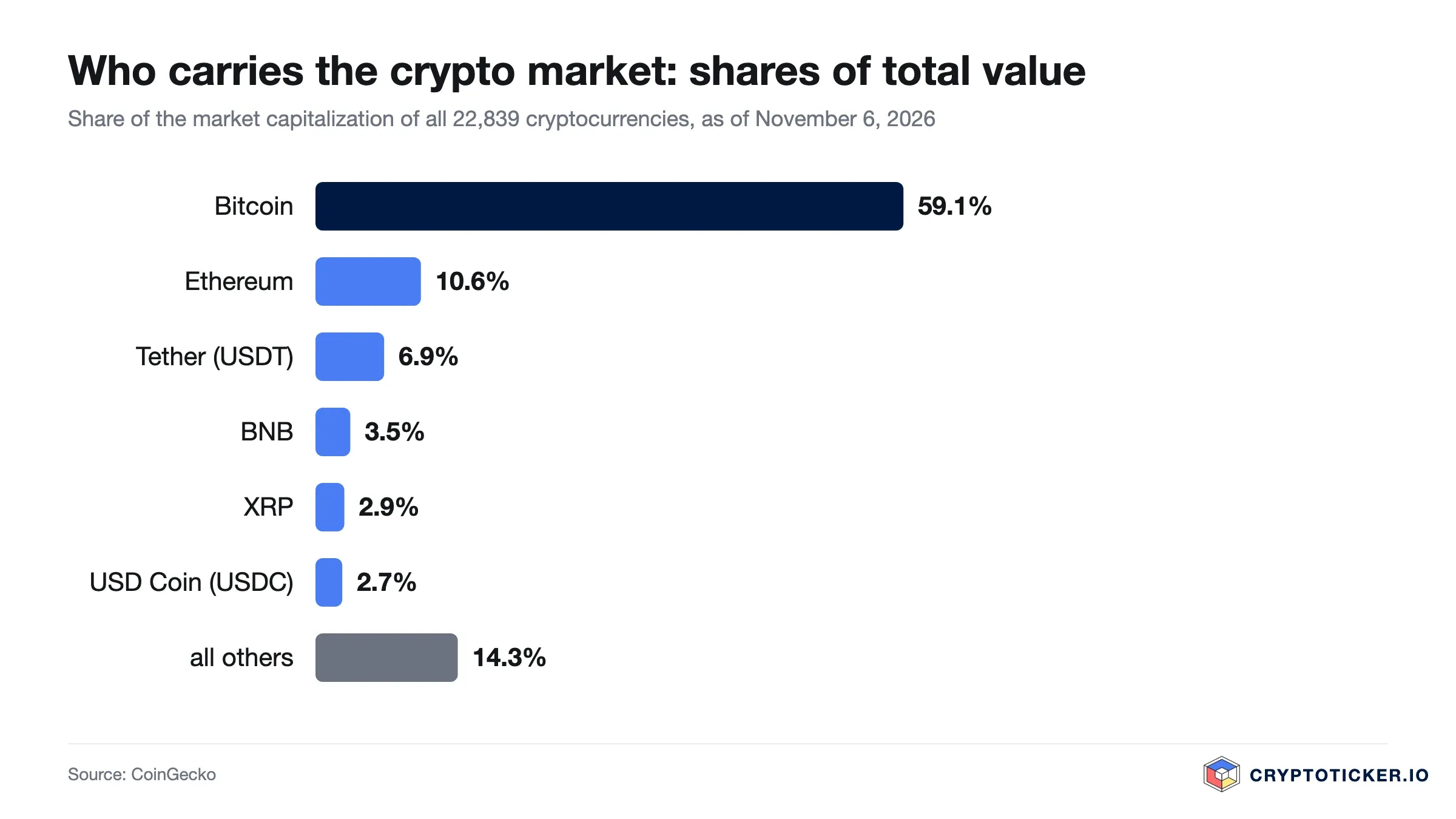
The market behind it has grown large. On October 22, 2026 CoinGecko listed 22,424 cryptocurrencies across 1,511 trading venues, worth around $2.78 trillion in total. Of that, 59.5 percent falls to Bitcoin alone and 10.7 percent to Ethereum. The remaining 22,400-odd entries share less than a third. Two weeks later, on November 6, CoinGecko already counted 22,839 cryptocurrencies across 1,522 trading venues; after the price drop of the past days they were worth $2.57 trillion together, and Bitcoin's share stood at 59.1 percent.
Key points at a glance
- Principle: A cryptocurrency is a digital currency without a bank or any other central authority. Balances sit on a blockchain, a public ledger that thousands of computers keep together. Whoever holds the private key controls the coins.
- Market: 22,839 cryptocurrencies worth $2.57 trillion together, as of November 6, 2026, according to CoinGecko.
- Weights: Bitcoin carries 59.1 percent of the total value, Ethereum 10.6 percent, the remaining 22,800-odd share the rest.
- Creation: New units come from mining or staking, new tokens on existing blockchains from smart contracts; recently around 28 new ones were listed per day.
- Law in Germany: Not legal tender and no deposit guarantee; every cryptocurrency exchange and custodian needs an authorisation under the EU regulation MiCA.
- Tax in Germany: Gains are tax-free after a holding period of one year; before that an annual exemption limit of 1,000 euros applies under section 23 EStG.
What a cryptocurrency is: the answer in two sentences
If you are asking what is cryptocurrency, here is the short definition: a cryptocurrency is a unit of account kept on a blockchain whose transfer is secured by cryptography rather than by an intermediary. The rules under which new units come into being and entries become valid sit openly in the network's program code and can only be changed if the operators of the computers adopt the change.
Blockchain is the technical term for the ledger: a chain of data blocks in which every block carries a checksum of the one before it. Changing an old entry would mean recalculating every checksum after it, and doing so faster than the rest of the network appends new blocks.
The word "currency" is easy to misread here. A currency in the legal sense is issued by a state, and the state obliges everyone to accept it in payment. That does not hold for Bitcoin in Germany. The supervisor and the tax administration treat crypto assets as digital assets, property you dispose of freely and that nobody has to accept.
The blockchain as a ledger that many keep at once
A classic account works like this: the bank keeps a list on which your balance sits. Only the bank may change that list, and if it makes a mistake, it corrects the entry. A cryptocurrency turns that structure around. Anyone who wants to downloads the complete list and keeps it alongside everyone else. A new transaction is distributed to all, everyone verifies it against the rules, and only once it has been taken into a block and that block appended to the chain does it count as confirmed.
A block is a package of transactions with a timestamp and a checksum. With Bitcoin one appears roughly every ten minutes, with other networks within seconds. The more blocks follow your transaction, the more expensive it would be to reverse it. That is exactly why trading venues advise waiting for a few confirmations after a deposit.
Why the order matters more than the encryption
Many people assume the word "crypto" is mostly about secrecy. In fact the transactions on Bitcoin and Ethereum are visible to everyone; what is encrypted is not the content but the proof of entitlement. The real problem these networks solve is called double spending: a file can be copied at will, a balance must not be. The shared, undisputed order of transactions prevents the same unit from being spent twice and protects the ledger against later manipulation.
Why nobody can print more Bitcoin: the cap of 21 million
With state money, a central bank decides how much of it circulates. With Bitcoin the quantity sits in the protocol: there will never be more than 21 million units. New units arise solely as a reward for the computer that finds the next block, and that reward halves roughly every four years. Satoshi Nakamoto described the concept in 2008 in a nine-page paper, the Bitcoin whitepaper; the network has been running since January 2009.
That scarcity, however, is a property of Bitcoin, not a property of cryptocurrencies as such. Ethereum knows no fixed cap, many smaller projects issue new units at will, and with some a team keeps the bulk of the supply locked and releases it over years. Carrying the notion of scarcity across to any cryptocurrency means taking over an assumption that simply does not hold there. The issuance schedule is one of the first points to look up before buying, and it appears on every serious market data site.
Proof of work and proof of stake: who may write the next block
So that not everyone appends blocks at will, a network needs a hurdle. Two such methods, called consensus mechanisms, have prevailed.
Proof of work demands computational effort. Specialised machines search for a number until the block's checksum takes a prescribed form. That costs electricity, and precisely that expense makes an attack expensive. Bitcoin still works this way today.
Proof of stake demands a pledge instead. Whoever wants to propose blocks deposits their own units in the network; whoever plays foul loses part of them. Ethereum switched from computational effort to this pledge method in September 2022 and cut its electricity consumption by more than 99 percent in doing so. Depositing the pledge is called staking in the trade, and the reward for it counts in Germany as taxable income rather than as a tax-free capital gain.
For investors, one thing matters above all: both methods continuously create new units that can come onto the market. How many that is, the code decides, not demand.
How is a new cryptocurrency created?
A new cryptocurrency is created in one of two ways. The laborious way is a blockchain of its own: developers write the software, fix the initial distribution in the first block, the genesis block, and set in the code how many units are added afterwards as a reward for mining or staking, in other words for checking and bundling new transactions. That is how Bitcoin, Ethereum and Solana came about, for example.
The quick way is a token that uses the blockchain technology of an existing network. On Ethereum, Solana or BNB Chain a small program, a so-called smart contract, is enough to set the supply, the name and the rules. Smart contracts like these also run lending platforms, trading venues and stablecoins. Technically this takes a few minutes and, depending on the network, costs anything from a few cents to a few dozen dollars in fees. That is why the number of listed cryptocurrencies grows so fast: between October 22 and November 6, 2026, CoinGecko added 415 entries, around 28 a day.
One simple rule follows from this: the fact that a coin exists says nothing about its value. What matters is who holds the initial supply, when locked units are released and whether users actually use the cryptocurrency.

The difference from the euro: a private asset, not legal tender
The euro is legal tender. A creditor has to accept it in settlement of a debt, and balances in a current account are protected by law up to 100,000 euros per customer and bank. Neither holds for cryptocurrencies. No merchant has to accept Bitcoin, and there is no deposit guarantee for balances held at a trading venue.
A second big difference comes with that: the price. One unit of euro stays one unit of euro, while the value of a cryptocurrency forms daily out of supply and demand. Bitcoin traded at around $82,479 or 73,355 euros on October 22, 2026, Ethereum at about $2,430. Two weeks later, on November 6, one Bitcoin cost $75,674 according to CoinGecko, a drop of just over 8 percent, and Ethereum $2,226. Whether a cryptocurrency serves anyone as a medium of exchange therefore depends less on the technology than on whether both sides want to carry that price risk.
In practice almost none of it is spent, and in everyday payments cryptocurrencies play hardly any role in Germany. By far the greater part of the $2.78 trillion sits as an investment, not as cash. The label "digital gold" that circulates for Bitcoin describes that use more accurately than the word currency.
The main differences between the euro, Bitcoin and a stablecoin at a glance:
| Feature | Euro | Bitcoin | Stablecoin such as USDC |
|---|---|---|---|
| Issuer | European Central Bank, book money via the banks | nobody, the rules sit in the protocol | a company, for USDC Circle |
| Supply | steered by the central bank | at most 21 million | grows and shrinks with demand, backed by reserves |
| Legal tender | yes | no | no |
| Deposit guarantee | up to 100,000 euros per customer and bank on a bank account | none | none |
| Price | fixed in euros | moves every day | pegged to the US dollar |
| Supervision in the EU | banks under BaFin and the ECB | none over the coin, but over exchanges and custodians under MiCA | the issuer needs an authorisation for e-money tokens under MiCA |
| Tax on sale in Germany | none | tax-free after one year, before that a 1,000-euro exemption limit | like other crypto assets |
 Find an exchange for your first purchase
Coin or token: why not every cryptocurrency has its own blockchain
The terms get thrown together, but the difference is simple.
A coin is the native unit of its own blockchain. Bitcoin runs on the Bitcoin blockchain, Ether on Ethereum, SOL on Solana. If the network fails, the coin is affected.
A token, by contrast, is an entry in a program running on someone else's blockchain. The vast majority of the 22,424 listed entries are tokens, mostly on Ethereum, Solana or BNB Chain. A token inherits the security of its blockchain, but it also inherits its transaction fees, and its issuer can give it properties a coin does not have: a freeze on individual addresses, for instance, or the ability to issue new units later on.
In practical terms that means buying a token means buying the issuer's risk on top of the market risk. Who stands behind it and what rights they have reserved in the terms belong to the points to clear up before buying. Which further criteria come before picking an individual coin, we have set out in which cryptocurrency to buy.
Stablecoins such as Tether and USD Coin: crypto assets pegged to a currency
A stablecoin is a token meant to track the value of a state currency, usually that of the US dollar. The issuer promises to hold a corresponding reserve for every unit put out and to redeem it on request. Tether (USDT) traded at $0.9992 on October 22, 2026 and therefore practically at its target.
Stablecoins are the reason crypto trading runs around the clock: as a parking spot between two purchases they hold the value steady without money having to leave the network. At the same time they carry a risk Bitcoin does not know. Behind every stablecoin stands a company that actually has to hold the reserve and that can freeze individual addresses. In the EU, the Regulation on Markets in Crypto-Assets covers these instruments separately as e-money tokens. Where you can trade them and at which fees is shown by our comparison of crypto exchanges.
Wallet, public and private key: who controls the coins
A wallet is not a purse with coins lying in it. Crypto wallets come as apps, browser extensions or hardware devices, and they all do the same job. What it holds are two numbers that belong together. The public key produces the address you pass on so that someone can send you something. The private key is the proof that you are entitled to dispose of the entries at that address. Whoever knows it can move the balance, and nobody can pull the entry back.
That leads to the most important practical rule of this whole subject. If your coins sit at a trading venue, that venue holds the keys and you hold a claim against a company. If they sit in your own wallet, you hold the thing itself, but you also carry sole responsibility for securing it. Which devices are built for that and what they cost is set out in the hardware wallet comparison.
The usual backup is a sequence of twelve or twenty-four words from which the private key can be restored. That word list belongs neither in a cloud nor in a photo on your phone.

How many cryptocurrencies there are, and how few of them count
The figure of 22,424 sounds like an unmanageable choice, but it describes the situation poorly. Bitcoin and Ethereum together carry around 70 percent of the entire market value. Daily trading of around $89 billion is distributed just as unevenly: a large share of the listed entries barely trades on a normal day, and selling larger amounts there moves the price against you.
A day's trading volume is therefore one of the most telling figures of all when an unfamiliar name is in front of you. A market value of a few hundred million against a daily turnover of a few tens of thousands of dollars means the price exists on paper but not for larger quantities.
The largest cryptocurrencies by market value
The ranking shows how unevenly the weights are spread. On November 6, 2026 the top of the list at CoinGecko looked like this:
| Rank | Cryptocurrency | Type | Price | Market capitalization | Maximum supply |
|---|---|---|---|---|---|
| 1 | Bitcoin (BTC) | own blockchain | $75,674 | $1,521 billion | 21 million |
| 2 | Ethereum (ETH) | own blockchain | $2,226 | $272 billion | no fixed cap |
| 3 | Tether (USDT) | stablecoin pegged to the US dollar | $1.00 | $178 billion | no fixed cap |
| 4 | BNB | own blockchain | $695 | $91 billion | 200 million |
| 5 | XRP | own blockchain (XRP Ledger) | $1.19 | $76 billion | 100 billion |
| 6 | USD Coin (USDC) | stablecoin pegged to the US dollar | $1.00 | $70 billion | no fixed cap |
| 7 | Solana (SOL) | own blockchain | $90.36 | $53 billion | no fixed cap |
| 8 | Tron (TRX) | own blockchain | $0.32 | $30 billion | no fixed cap |
| 10 | Zcash (ZEC) | own blockchain | $1,351 | $23 billion | 21 million |
| 11 | Hyperliquid (HYPE) | own blockchain | $78.06 | $19 billion | 1 billion |
Prices, market capitalization and maximum supply according to CoinGecko, November 6, 2026, 4:41 pm UTC. Rank 9 is held by a token for home equity loans (Figure HELOC), a tokenized asset rather than a cryptocurrency in the narrow sense.
 Find a crypto exchange with an EU licence
Buying cryptocurrencies in Germany: what MiCA and BaFin require
Since the end of December 2024 the Regulation on Markets in Crypto-Assets, MiCA for short, has applied across the entire EU. Every provider rendering crypto-asset services needs an authorisation under it, trading venues and custodians included. In Germany the Crypto Markets Supervision Act implements the regulation, and the competent authority is BaFin, which monitors the attendant notification and reporting duties. The transition period for providers already on the market ran out at the end of December 2025 in Germany and on July 1, 2026 across Europe.
That gives you one clear thing to check before a first purchase: a provider addressing customers in the EU needs an authorisation, and reputable houses name it on their site. Where that reference is missing, the basis is missing. An authorisation is no guarantee against price losses, though; it governs who may run the business and which duties apply in doing so.
Outside the EU: how crypto exchanges are regulated in the US and the UK
MiCA only applies in the European Union. In the United States, a crypto exchange registers with the Treasury's Financial Crimes Enforcement Network (FinCEN) as a money services business and needs a money transmitter licence in most states; New York additionally requires its own BitLicense. Stablecoins have had a federal framework since the GENIUS Act was signed on July 18, 2025. A comprehensive market structure law, the CLARITY Act, fell eleven votes short in the Senate on September 15, 2026, and after the midterm elections no new vote has been scheduled. Where it stands and what it would change is set out in our explainer on the CLARITY Act.
In the United Kingdom, crypto firms must be registered with the Financial Conduct Authority (FCA) for anti-money laundering purposes, and since October 8, 2023 every crypto promotion aimed at UK consumers has to follow the FCA's financial promotion rules. Whichever country you live in, the check before a first purchase is the same: find out which authority supervises the provider and whether it is registered or licensed there.
Tax on cryptocurrencies: the one-year period under section 23 EStG and the 1,000-euro threshold
Cryptocurrencies count as "other assets" in German tax law. Gains therefore fall under private disposals pursuant to section 23 of the Income Tax Act (EStG). The provision captures sales in which the period between acquisition and disposal "is not more than one year". If more than a year lies in between, the gain stays tax-free, whatever its size.
Within the year a second rule applies: gains stay tax-free if the total gain from all private disposals in a calendar year comes to less than 1,000 euros. That is a threshold, not an allowance. At 1,000 euros of gain the full amount is taxable; at 999 euros not a cent of it is.
Beginners regularly overlook two points. First, swapping one cryptocurrency for another counts as a sale, and for the newly received coin the one-year period starts afresh. Second, every sale requires proof of when and at what price you bought, otherwise the tax office estimates. Whether the one-year period stays in this form is politically contested; we track the course of the reform debate continuously in our piece on the crypto holding period and the state of the reform.
Outside Germany: how the US and the UK tax crypto gains
The one-year rule in section 23 EStG is a German specialty. Elsewhere a long holding period may lower the tax, but it rarely removes it.
In the United States, digital assets are "considered property, not currency", according to the IRS page on digital assets. Gains on coins held for one year or less are taxed as ordinary income, gains on coins held longer at long-term capital gains rates of 0, 15 or 20 percent, depending on taxable income. Every taxpayer answers a digital asset question on Form 1040, and staking rewards count as income once you control them. Brokers report sales on the new Form 1099-DA: gross proceeds for transactions from January 1, 2025, cost basis for certain transactions from January 1, 2026.
In the United Kingdom, HMRC counts selling, swapping one cryptoasset for another, paying with crypto and giving it away as disposals; gifts to a spouse, civil partner or charity are the exception, as its guidance on cryptoassets explains. Gains above the annual tax-free allowance of £3,000 are taxed at 18 percent within the basic rate band and 24 percent above it, the Capital Gains Tax rates for gains from April 6, 2026.
| Germany | United States | United Kingdom | |
|---|---|---|---|
| How crypto is treated | private disposal under section 23 EStG | property | asset subject to Capital Gains Tax |
| Long holding period | tax-free after more than one year | lower long-term rates after more than one year | no effect |
| Tax-free amount | exemption limit of 1,000 euros a year, a threshold | 0 percent rate on long-term gains up to an income limit | £3,000 a year |
| Rate on gains | personal income tax rate | short term: income tax rates; long term: 0, 15 or 20 percent | 18 or 24 percent |
| Swapping one coin for another | counts as a sale | counts as a disposal | counts as a disposal |
Rules as of November 6, 2026. Tax law differs from country to country and changes often; for larger amounts, a tax adviser in your country of residence is worth the fee.
What a cryptocurrency is not: no account, no deposit guarantee
To close, the distinctions on which most misunderstandings hang.
A cryptocurrency is not an account. There is no body that pulls back a wrongly addressed transfer, no block on suspicion and no customer service that restores a forgotten access. Nor is a cryptocurrency a security in the classic sense: behind Bitcoin stands no company distributing profits and no claim to anything.
And it is not anonymous. The entries lie open, trading venues in the EU have to identify their customers, and specialised firms trace flows of payments across addresses. Pseudonymous fits better than anonymous.
Cryptocurrency: without your own keys the coin stays a claim
If you take one sentence away from this piece, take this one: you own a cryptocurrency in full only once you control the private key. Everything short of that is a claim against a company. Three steps put the start in order:
- Check and choose a trading venue. Look for the authorisation, compare the total costs of fee and spread, and begin with an amount whose loss will not hurt you. Our comparison of crypto exchanges provides the overview.
- Decide on custody before the amount grows. Small sums at the trading venue are defensible, larger ones belong on a device of your own. Which models exist is set out in the hardware wallet comparison.
- Record purchase data from day one. The date, quantity and price of every purchase decide later on the one-year period and on your tax bill. Tools that write that down automatically can be found under crypto tax tools.
(As of October 22, 2026, updated on November 6, 2026. This article is not investment or tax advice. Prices and fee structures change; check the terms with the provider before you buy.)
Frequently asked questions about cryptocurrencies
Transparency note: This article was produced with the assistance of artificial intelligence and reviewed by our editorial team before publication. All figures and claims were checked against the primary sources linked in the text. The feature image was generated with AI.
Related articles
- Crypto market cap explained: Bitcoin vs gold and Apple
- Bear market: what it means, how long it lasts and where stocks and Bitcoin stand in 2026
- Crypto options in Germany: Kraken opens bitcoin and ether options, and the gate is a questionnaire
- How Much Would It Take to Bankrupt Binance? The $6 Billion Hack Explained
- Is This the End? How Low Bitcoin Could Fall After the Binance Hack
Which topics should we dive deeper into?
Select what genuinely interests you. Your picks feed directly into our editorial planning.
Crypto news that's actually worth your time.
Weekly. 60 seconds. Carefully curated by our editors: no hype, no promo flood, no spam.

October 26, 2026 3:21 PM

Swapping Bitcoin for gold: what it means for your holding period and tax
Swapping Bitcoin directly for gold bars is a sale in tax terms. Whether tax is due depends solely on how long you held the coins, and a fresh period starts for the gold on the swap date.
October 23, 2026 1:35 PM

What is Tether (USDT)? The stablecoin explained: 182 billion tokens without EU authorisation
With 182.8 billion tokens in circulation, Tether is the largest stablecoin in the world and settles two out of every three crypto dollars traded. In the EU it lacks authorisation as an e-money token, and from January 8, 2027 authorised providers may no longer offer services around it.

October 22, 2026 12:31 AM

What Is Bitcoin Mining? How It Works and When It Pays Off
Miners secure the Bitcoin network and earn 3.125 BTC per block. How proof of work functions, what an ASIC costs in electricity in Germany and at what power price mining breaks even.
October 20, 2026 4:17 AM

Stablecoin interest: MiCA article 50 bans it, and lending yield is taxable from 256 euros
No issuer in Europe pays interest on the token itself, and article 50 of MiCA expressly forbids it. Where a quoted yield actually comes from and how the tax office treats it.
October 19, 2026 10:42 PM

Crypto GmbH: 25.6 percent tax from the first sale, nothing privately after a year: what matters now
A crypto GmbH pays 25.6 to 33.3 percent on every gain, from day one. Held privately, the same gain stays tax-free after a year. We work through both routes and show where the GmbH wins regardless.
October 17, 2026 4:30 PM

Does swapping Bitcoin for WBTC restart the one-year holding period?
Converting Bitcoin into WBTC triggers a private disposal transaction under one reading and restarts the one-year clock. Under the other the transaction stays tax-neutral: what the statute says, what the Finance Ministry leaves open and which records count either way.
October 16, 2026 7:25 PM

Crypto holding period for Bitcoin: “That remains to be seen,” says the finance ministry
The federal cabinet did not adopt the draft abolishing the one-year crypto holding period on October 14, 2026; it is still stuck in inter-ministerial consultation. This overview sets out what applies today, which dates follow and why the December 31, 2026 cutoff has no force of law so far.

October 11, 2026 4:50 AM
90 Crypto Kidnappings and Robberies in 7 Months: Why France Is the Most Dangerous Country for Bitcoin Holders
France logged 90 crypto kidnappings, extortions and violent thefts this year, one every 2.5 days. Leaked tax data is to blame. Here is how to protect yourself.
October 10, 2026 3:39 PM

Will AI Break Bitcoin? Vitalik Says Prepare for "Bunker Mode", Hoskinson Calls It Numerology
Vitalik Buterin says AI could crack crypto's encryption within 2 years. Charles Hoskinson says that is nonsense. Who is right, and what should you do?
October 9, 2026 1:18 PM

Bitcoin Tax: One Year Past the $126,080 Peak, Losses No Longer Count
Bitcoin trades at $82,558 on Friday morning, 34.5 percent below an all-time high that is now a good year old. Anyone who bought back then loses more than the prospect of a quick recovery when the one-year period expires: the tax value of the loss goes with it.
October 9, 2026 10:50 AM

Crypto holding period: the Bundestag rejects abolition by 445 votes to 132: what investors need to know
On 8 October the Bundestag rejected the Greens' bill to abolish the crypto holding period in a recorded vote, and the Left's motion fell too. The result by parliamentary group, the official speech from the media centre, and why it was the SPD that gave investors the real signal in the debate.
October 8, 2026 1:26 PM

Bitcoin ETFs Lose $487 Million in a Single Day: the Reasons Behind the Outflow
Around $487 million flowed out of the US spot ETFs on Bitcoin on net on October 7, 2026, while the price tests the zone around $82,000. What the figure actually measures, why two data providers give two daily values, and what investors in Germany should check on an ETP.
October 6, 2026 4:32 AM
Bitcoin for a gift card: what paying with crypto means for your holding period
Paying for a gift card with Bitcoin is a sale for tax purposes. What counts as the disposal proceeds, when the twelve-month holding period bites, and the four records the tax office expects.
October 2, 2026 4:39 AM

Donating bitcoin: when does the full market value count, when only the purchase price?
A bitcoin donation to a charitable organisation is deductible as a donation in kind, and the donation itself produces no taxable gain. The size of the deduction turns solely on whether a sale would have been taxable on the day of the transfer.
September 25, 2026 10:26 PM

Selling bitcoin privately: the tax in Germany and the records you need
A direct sale to a private individual falls under the same one-year rule as an exchange sale, but there is no tax report to go with it. This guide walks through the calculation, the 1,000 euro threshold and the records the tax office wants to see.
September 25, 2026 10:14 PM
Sequans sells its last 314 bitcoin: what to check if you hold a treasury stock
Semiconductor maker Sequans has wound down its bitcoin reserve completely, 15 months after setting a target of one hundred thousand coins. What the case reveals about treasury stocks, and which tax rule applies to the share and to the coin.
September 23, 2026 4:26 PM

Paid in Bitcoin: How to Tax Crypto Income as a Self-Employed Freelancer
A fee in Bitcoin is perfectly ordinary business income, valued at the euro price on the day it reaches you. The decisive trap comes afterwards: business assets carry no one-year holding period, so every later price move stays taxable.
September 22, 2026 10:13 AM

Circle Lends Against Bitcoin via cirBTC: Why the Wrapper Can Cost You the German Holding Period
Circle launched loans against deposited bitcoin on September 21, 2026. In Germany, the detour through the cirBTC token is very likely a swap, and a swap restarts your one-year holding period.

September 19, 2026 4:19 AM

Bitcoin Cash Jumps by Double Digits: What the Grayscale ETF Filing Really Means for You in Germany
Bitcoin Cash gained double digits on September 18 because Grayscale wants to convert its BCH trust into an exchange-traded product. The filing itself, however, states that the basis for it has not been approved at all.
September 18, 2026 10:13 AM

Bitcoin and the German Exit Tax: What Applies When You Move Abroad
Anyone emigrating with Bitcoin expects an exit tax on unrealised gains and finds nothing of the sort in the statute. Where the real risks sit is decided at four points: residence, the holding period, the legal form of your investment, and automatic reporting from 2026.
September 17, 2026 10:22 PM

Selling Bitcoin at a Loss and Buying It Straight Back: What That Does to Your Holding Period
Germany has no wash sale rule: the loss stays deductible even if you buy back immediately. The buyback, however, restarts the one-year period for every new unit.
September 17, 2026 7:12 PM

Gifting Bitcoin to Children: Allowance, Holding Period and the Tax Office Report
Transferring Bitcoin to your child hands over your holding period and your entry price along with the coins. This guide sets out what really applies in Germany on the allowance, the reporting deadline, representation and custody.
September 16, 2026 7:12 PM

Borrowing Against Bitcoin Instead of Selling: When German Tax Still Applies
Posting Bitcoin as collateral for a loan is not a sale in Germany, because section 39 of the Fiscal Code keeps the coins attributed to you for tax purposes. Tax arises only when the collateral is liquidated, and then the one thing that decides the bill is how long you held the coins beforehand.
September 9, 2026 7:18 PM
Calculating Crypto Tax in Germany: Formula, Worked Example and 2026 Tax Table
Sale price minus acquisition cost minus fees: the formula is simple, the order of consumption and the tariff are not. With a Bitcoin example at 2026 prices, an exact tax table and the point where the solidarity surcharge hits hardest.
September 9, 2026 4:22 PM
Crypto Tax in Germany: What Applies in 2026 and What Is Set to Change in 2027
In Germany, crypto gains are tax-free after twelve months; before that, your personal rate of up to 45 percent applies. What triggers tax, how the holding period works, what staking and losses mean, and where the 2027 reform stands after the cabinet date of 14 October.

More from CryptoTicker