
What is Tether (USDT)? The stablecoin explained: 182 billion tokens without EU authorisation
With 182.8 billion tokens in circulation, Tether is the largest stablecoin in the world and settles two out of every three crypto dollars traded. In the EU it lacks authorisation as an e-money token, and from January 8, 2027 authorised providers may no longer offer services around it.





Which topics should we dive deeper into?
Select what genuinely interests you. Your picks feed directly into our editorial planning.
Crypto news that's actually worth your time.
Weekly. 60 seconds. Carefully curated by our editors: no hype, no promo flood, no spam.
Tether is the largest stablecoin in the world: a token called USDT that is meant to track the value of one US dollar and is issued by a private company. On October 22, 2026, according to CoinGecko, around 182.8 billion USDT were in circulation, worth $182.7 billion in total. That puts Tether third in the crypto market behind Bitcoin and Ethereum.
For investors in Germany, though, the position shifted in the autumn of 2026. USDT holds no authorisation as an e-money token in the European Union, and the supervisors are drawing conclusions from that. What Tether is, what the dollar peg is supposed to be backed by, and what applies on authorised venues from January 2027 is set out in this article.
What Tether is: a dollar token without dollars in your account
A stablecoin is a cryptocurrency whose price is meant to be pegged to a fixed reference value, usually a state currency. Tether belongs to the most common design: the issuer takes in money, issues tokens against it and promises to redeem every token on demand. The peg therefore does not come from a formula in the program code, but from a company's promise and from traders who exploit every deviation.
The tokens are issued by Tether Operations, S.A. de C.V., which has moved its seat to El Salvador. Holding USDT therefore does not mean holding a dollar in a bank account, but holding a claim against this company, recorded as an entry on a blockchain. That distinction is the core of the whole subject: there is no deposit guarantee for it of the kind a current account has.
The same house issues further tokens, among them a gold-linked instrument and tokens on other currencies. In everyday usage, however, “Tether” almost always means USDT, the dollar token.
182 billion USDT in circulation: why the stablecoin ranks third
Market capitalisation tells only half the story. Turnover is more revealing: USDT accounted for roughly $60.2 billion of trading volume within 24 hours on October 22, 2026, against total crypto market volume of about $89.4 billion. Two out of every three dollars traded therefore run through this single token.
The reason lies in its function. At many venues around the world, trading is not done against the euro or the dollar but against USDT. The token is the unit of account of crypto trading, the place where balances wait between two positions, and often the only route by which money reaches an exchange at all. Anyone looking at prices in dollars is in truth frequently looking at prices in USDT.
That creates a dependency reaching beyond individual investors. Were USDT to lose its peg, it would affect not only its holders but price formation across wide parts of the market. It is precisely for that reason that regulators look at this token more closely than at any other.
The dollar peg: how issuance and redemption work
The process is about as simple as it gets. A vetted business client transfers money to the issuer and is credited with the same number of tokens, which are newly created. In reverse, the client submits tokens, they are destroyed, and the money comes back. Retail customers as a rule do not use this route; they buy and sell USDT on the market.
The price stays stable through the gap to those two prices. If USDT falls below a dollar on the market, it pays for a business client to buy cheaply and redeem at full value with the issuer. That mechanism works for as long as redemption genuinely remains open and is settled promptly.
Why $0.999 is not an error
USDT traded at $0.999256 on October 22, 2026, around 0.89 euros. Deviations of that order, in the per-mille range, are normal and reflect supply and demand at the venue in question. It becomes worth noting only when the price stays markedly below that level for hours: that is when the market doubts redemption.

What lies behind USDT: Tether's own figures on the reserve
On its transparency page the company states that all tokens are “100% backed by Tether's reserves” and that assets exceed liabilities. It publishes the circulating amounts there, along with regular reports on the composition of the reserve, which according to the house consists mainly of short-dated US government bonds and cash equivalents.
Two terms are worth telling apart. An attestation records what the holdings looked like on a given date. An annual audit goes further and assesses the accounting over an entire period. That Tether was able to present an unqualified audit opinion from a large firm for the first time is something we assessed on August 16, 2026 in Tether's KPMG audit.
Independently of that, one limit remains which no report makes disappear: the backing rests on statements and reviews by the issuer and its service providers. There is no state guarantee and no protection fund.
 Find a regulated exchange for your coins
Eleven blockchains, one token: the network choice decides the fee and the arrival
USDT is not a network of its own but a token issued on other blockchains. CoinGecko lists it for at least eleven of them, among them Ethereum, Tron, Solana, Avalanche and The Open Network. The token is everywhere the same claim against the same issuer, but the entries sit in separate networks.
In practice that means this: send USDT over Tron to an address that accepts only Ethereum, and the balance is in all likelihood lost. Before any transfer, therefore, sender and recipient should be matched on the network. Costs also differ considerably; a transfer over Tron costs a fraction of what accrues on Ethereum.
Tether can freeze individual addresses: the clause in the small print
One property distinguishes USDT fundamentally from Bitcoin. The issuer can block individual addresses, so that the tokens sitting there can no longer be moved. This is used at the request of law enforcement, for instance after thefts, and on the basis of sanctions lists. The terms of use expressly reserve that decision to the company at its own discretion, which we broke down on October 8, 2026 in USDT frozen.
It can be judged in both directions. For law enforcement the freeze is an effective tool that does not exist with Bitcoin. For you as a holder it means that a central actor can decide on availability: a risk that lies in the design and cannot be removed by self-custody. How the large stablecoins differ on this point and on authorisation is shown in our stablecoin comparison.
USDT under MiCA: Tether has not applied for e-money token authorisation
Since the end of December 2024 the EU regulation on markets in crypto-assets, MiCA for short, also governs stablecoins. A token that tracks a single currency counts there as an e-money token, and anyone wanting to offer one publicly in the EU needs authorisation as an electronic money institution or a credit institution. That comes with requirements on the reserve, among them a substantial share held as deposits at banks in the EU.
Tether does not have that authorisation. The company has set itself against the requirements and has obtained no permission for USDT in the EU. The consequence showed up first at the trading venues: several European providers removed the token from trading for customers in the European Economic Area as early as 2025 and 2026. In Germany, BaFin oversees compliance with these rules.

The ESMA deadline of January 8, 2027: what happens on German trading venues
On October 8, 2026 the European securities regulator ESMA published a formal opinion that bars authorised crypto service providers in the EU from offering services around stablecoins which do not comply with MiCA. National supervisors are to wind down remaining holdings no later than three months after publication, which means by January 8, 2027. We documented the wording and the document's reference on the same day in ESMA's stablecoin deadline.
A ban on owning USDT does not follow from it. What falls away is the offering of authorised providers: buying more and continuing to trade on an EU platform come to an end, while selling, swapping and withdrawing to a wallet of your own stay open. How early an individual provider switches off is for that provider to decide; in comparable cases several houses did so well before the cut-off date.
So look through your provider's notices for whether and from when it switches USDT off, and plan the swap before the trading pair disappears. The regular alternative in the EU is authorised stablecoins; which provider carries them is set out in each exchange's product overviews.
 Try a tool for your crypto taxes
The difference from USDC and EURC: authorisation rather than market share
USDC is the second-largest dollar stablecoin, EURC the best known on the euro. Both come from the US company Circle, which has obtained authorisation in the EU and offers its tokens accordingly as e-money tokens. In global trading volume they sit far behind USDT; in the EU they are on the safe side of regulation instead.
With the euro token a practical advantage comes on top: anyone who thinks and calculates in euros carries the exchange-rate risk as well with a dollar stablecoin. If the euro rises against the dollar, a balance in USDT loses value even though the dollar peg has worked perfectly.
What all three tokens have in common stays the same: behind each stands a company that has to hold the reserve and service redemption. Which other differences count before buying a cryptocurrency is gathered in which cryptocurrency to buy.
Tax on stablecoins: a swap into USDT is a sale
The tax office treats USDT like any other cryptocurrency, namely as an other asset within the meaning of Section 23 of the German Income Tax Act. From that follows the point that surprises most investors: whoever swaps Bitcoin for USDT has sold Bitcoin. If the purchase was less than a year ago, the gain is taxable, even though no euro has landed in the current account.
For the USDT itself, a swap back at the same price regularly produces no gain worth mentioning, because the value barely moves. What is usually relevant for tax is the exchange-rate result against the euro. You still have to record every step with date, amount and price, because the one-year period starts afresh for every token received. Where the reform debate on that period currently stands is something we track in the crypto holding period and the state of the reform.
What a price of $0.999 does not promise: the low at $0.57
A look at the price history puts the word “stable” in context. The all-time high of USDT is $1.32, the all-time low $0.572521, from the token's early years. There were later phases too in which the price slipped noticeably below a dollar amid doubts about the issuer and returned only after days.
A stablecoin is therefore not an instant-access savings account. It is a corporate promise with a market price, and that price reflects how far the market currently trusts the promise. For parking money briefly between two positions that is bearable; for storing larger amounts over months the question looks different.
USDT in Germany: from January 8, 2027 it is a one-way street
Tether solves a real problem of crypto trading and carries a risk for it that Bitcoin does not know: that of its issuer. In the EU the regulatory problem has been added since October 2026. Three steps put the position in order:
- Establish your own holding and your provider. Look up how much USDT you hold and what your trading venue has announced about the deadline. Which exchanges accept German customers and what authorisation they hold is shown by the comparison of regulated crypto exchanges.
- Reshuffle before the cut-off date, not after. As long as the trading pair runs, swapping into an authorised stablecoin or into euros is cheap; once it is switched off, only detours remain. The overview of providers is delivered by the stablecoin comparison.
- Record every movement for tax. Every swap is a sale, and without a purchase record the tax office estimates. Tools that write this down automatically are found under crypto tax software.
(As of October 22, 2026. This article is not investment advice. Prices and fee structures change; check the terms with the provider before you buy.)
Frequently asked questions about Tether (USDT)
Transparency note: This article was produced with the assistance of artificial intelligence and reviewed by our editorial team before publication. All figures and claims were checked against the primary sources linked in the text. The feature image was generated with AI.
Related articles
- Tether Audit by KPMG: What the Unqualified Opinion Means for USDT in the EU
- What is an issuer? Meaning, examples and issuer risk
- SoFi Settles Card Payments in Stablecoin: What Cardholders Should Check
- USDT or USDC: the key points before the October 30 deadline
- Revolut Launches the EURR Euro Stablecoin: Why Germany Is Not in the First Wave
Which topics should we dive deeper into?
Select what genuinely interests you. Your picks feed directly into our editorial planning.
Crypto news that's actually worth your time.
Weekly. 60 seconds. Carefully curated by our editors: no hype, no promo flood, no spam.

September 22, 2026 10:15 PM
Stablecoin Reserves: Why the ECB Wants the Bank Deposit Rule Scrapped
The European System of Central Banks filed its response to the MiCA review on September 22 and calls in it for an end to the requirement to hold 30 to 60 percent of stablecoin reserves as a bank deposit. What lies behind it, and what you can check on your own token.
August 19, 2026 7:17 PM

MiCA Register of Stablecoin Issuers: 23 Authorised Firms, 43 White Papers and Two Dead Links
The official ESMA register lists 23 authorised issuers of e-money tokens and 43 notified white papers. We called up every document address stored there ourselves and show where the record leads nowhere.
October 9, 2026 7:35 AM

Polkadot launches dotUSD without an issuer: why MiCA demands one
Polkadot launched its own stablecoin dotUSD on the mainnet on October 8, 2026, with no issuer and steered by DOT holders. On the same day ESMA requires regulated service providers to wind down non-MiCA-compliant stablecoins within three months.
October 8, 2026 10:14 PM

ESMA stablecoin deadline of January 8, 2027: what you can do with USDT now
ESMA decided on October 8, 2026 that authorised EU platforms should no longer offer services for stablecoins that do not comply with MiCA. For USDT, only selling, swapping, transferring and withdrawing remain until January 8, 2027.
October 18, 2026 10:27 AM

Stablecoin depeg: will the 1.00 euro peg hold?
A stablecoin depeg is the moment the market price leaves its tie to the euro or the dollar. What the MiCA regulation requires of the reserve and of redemption, how to recognise a token's design, and what a swap into a stablecoin means for your holding period.
October 1, 2026 2:16 PM

Open USD is live but absent from the EU register: what matters now for investors in Europe
The dollar stablecoin Open USD launched on September 30, 2026, backed by Coinbase, Mastercard, Shopify, Stripe and Visa. On October 1, 2026 the token was not notified in the MiCA register, and that decides what you can do with it in Europe.
September 25, 2026 10:22 AM
Fed Rules for Stablecoins: What to Check on Backing and the Redemption Right
The Federal Reserve put forward two proposed rules on backing, capital and redemption of payment stablecoins on September 24, 2026. For your holdings in Germany, however, MiCA is what counts, and different checks follow from it.
September 1, 2026 4:12 AM

USDT cashback and 7 percent on stablecoins: what the MiCA interest ban means for you
A new payment card advertises up to 10 percent cashback in USDT and up to 7 percent a year on the balance. Article 50 MiCAR explains why a provider licensed in the EU is not allowed to pay you exactly that.
August 16, 2026 9:11 PM
Swapping Bitcoin for Stablecoins: Does Austria Charge Tax?
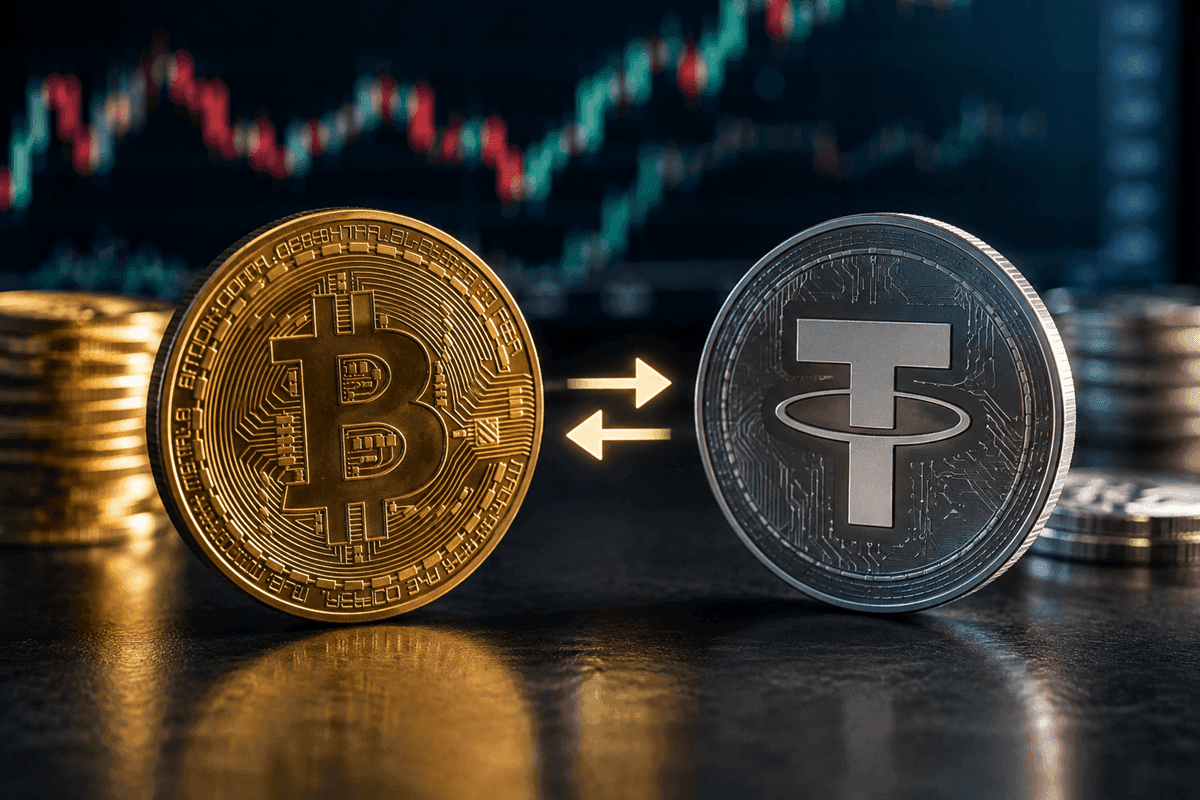
Anyone swapping bitcoin for USDT or another stablecoin usually pays no tax in Austria yet. When the swap does become taxable after all.
October 14, 2026 7:15 AM
$2.41 billion RLUSD: Standard Chartered takes custody as MiCA approval is still missing in the EU
Standard Chartered started institutional custody for Ripple's stablecoin RLUSD on the XRP Ledger on 12 October, supervised by the regulator in Dubai. In the European register of e-money tokens, RLUSD is still absent.

September 26, 2026 7:14 AM
Cardano Before the RealFi Launch on October 1: What ADA Holders Should Check on USDr, MiCA and Tax
On October 1, 2026 the stablecoin platform RealFi goes live on the Cardano mainnet, and ADA has gained 14.67 percent in a week. What is documented about the yield-bearing dollar token USDr, and what investors should settle beforehand.
August 13, 2026 6:18 AM

Revolut Delists USDT: Forced Conversion on August 31, 2026 Counts as a Sale
Revolut is taking USDT off the table on August 31, 2026: purchases have already stopped, deposits are blocked, and anyone who fails to act before the deadline faces an automatic conversion that counts as a sale for tax purposes. This article explains the deadlines, the tax treatment under section 23 of the German Income Tax Act and what you can do now.
October 22, 2026 7:32 AM

US rule on stablecoin interest takes effect January 18, 2027: what changes for investors in Europe
In context: the US banking regulator OCC presented its final rule on payment stablecoins on October 21, 2026, effective January 18, 2027. The surviving interest ban is documented; what the deleted presumption means for reward arrangements is assessed by the editorial desk further down.
October 19, 2026 10:34 PM

JPMorgan brings its JPMD deposit token to Ethereum: retail clients stay shut out
JPMorgan brought its dollar deposit token JPMD to the Ethereum mainnet on October 19, 2026, after almost a year on the layer-2 network Base. The token now sits on an open blockchain, yet nobody can trade it without the bank's approval.
October 19, 2026 7:31 PM

USD1 stablecoin loses $401 million: almost $200 million traces back to a single address
The market capitalisation of the dollar stablecoin USD1 has fallen 9.1 percent in two weeks without the price losing its dollar peg. Just under $200 million of the redemptions came from a single address, according to Onchain Benchmark, and its owner is unknown.
October 14, 2026 10:21 PM

37 banks, one licence: the Qivalis euro stablecoin cannot launch yet
De Nederlandsche Bank authorised Qivalis as an electronic money institution on October 14, 2026; according to the company, 37 European banks from 15 countries stand behind the planned euro stablecoin. Qivalis may not issue the token yet, because the whitepaper required under the MiCA regulation is still missing.
October 23, 2026 1:22 PM
Dogecoin: 96 percent of trading runs on Tether, 0.13 percent on the euro
Of the 100 highest-volume Dogecoin pairs, 96.00 percent run through Tether and 0.13 percent through the euro, measured on October 23, 2026. That exact trading pair loses its basis in the EU by January 8, 2027, and that shifts the question of where you buy DOGE next.
October 16, 2026 1:25 AM
USDC becomes the EU's first significant e-money token: what changes for holders on November 12
The European Banking Authority classified USDC as the EU's first significant e-money token on October 14. From November 12 it will examine the issuer's reserve, own funds and liquidity itself, rather than leaving that to the French supervisor alone.
October 20, 2026 10:18 AM

Coinbase converts USDT and DAI into USDC on October 30: the swap restarts the one-year holding period
On October 30 Coinbase will convert the remaining USDT, DAI and PYUSD balances in the European Economic Area into USDC. The swap counts as a disposal under section 23 of the German Income Tax Act, and the one-year clock starts again for the new balance.
October 10, 2026 4:37 PM

Coinbase delists USDT and DAI on October 30: what to check before the deadline
Coinbase gives customers in the European Economic Area only until October 30, 2026 to move USDT, PYUSD, DAI and further stablecoins off the exchange. After that it converts remaining holdings into USDC itself, and tokens arriving later are no longer credited to the account.
August 19, 2026 4:14 AM

Digital Euro and Stablecoins: Why the Bank of England Is Testing Both Forms of Money in a Single Payment
In the Bank of England's Digital Pound Lab, a consortium around NOBO Finance, Dun & Bradstreet and Polygon has rehearsed how an exporter receives an advance in a stablecoin while the importer settles the final payment in digital central bank money. Why the difference between private and public money also matters for your stablecoin balance in Germany.
September 9, 2026 7:28 PM

Euro Stablecoin From 37 Banks Comes to Ethereum: What to Check on Your Euro Token Now
A consortium of 37 European banks confirmed on 8 September that it will issue its regulated euro stablecoin on the public Ethereum chain. What that means for custody, redemption and deposit insurance, and the six points you can check on your euro token right now.
October 16, 2026 4:25 AM

“Not just for stablecoins, but for every form of money”: Mastercard opens stablecoin payouts to bank accounts
Mastercard and BVNK launched the Global Money Platform on 15 October: fiat and stablecoin accounts, real-time exchange, cards and payouts to local bank accounts through one interface. For German users two questions hang on it that the announcement does not answer: the fees and MiCA authorisation.

July 9, 2026 10:12 AM
MiCA Wiped Out 92% of Europe's Crypto Firms: Here's Who Survived and Who's Cashing In
The July 1 deadline turned 3,000+ EU crypto firms into a few hundred. Binance is out, Tether's gone, and a handful of winners now own the market.
August 30, 2026 10:38 PM

Crypto Cards: Where Your Card Balance Really Sits and What the August 28 Solana Exploit Reveals About It
An attack on a card balance contract on Solana took the loaded balance from 1,685 users while their wallets stayed untouched. The case shows why it matters whether your crypto card holds funds as e-money at a licensed institution or in a smart contract.
October 22, 2026 1:45 PM
Cryptocurrency explained: how digital money works without a bank
A cryptocurrency is an entry in a public ledger that neither a bank nor a central bank controls on its own. This piece explains how that ledger works, what separates Bitcoin from the euro, and which rules apply in Germany to buying, custody and tax.
September 15, 2026 4:12 AM

Using Hyperliquid from Germany: What Applies to Your Funds Without a MiCA Licence
Hyperliquid is not entered in any EU register as an authorised crypto-asset service provider, and for perpetual futures a MiCA licence would be the wrong paperwork anyway. Here is what that means in concrete terms for your funds, your keys and your tax return.
More from CryptoTicker