
Stablecoin depeg: will the 1.00 euro peg hold?
A stablecoin depeg is the moment the market price leaves its tie to the euro or the dollar. What the MiCA regulation requires of the reserve and of redemption, how to recognise a token's design, and what a swap into a stablecoin means for your holding period.





Which topics should we dive deeper into?
Select what genuinely interests you. Your picks feed directly into our editorial planning.
Crypto news that's actually worth your time.
Weekly. 60 seconds. Carefully curated by our editors: no hype, no promo flood, no spam.
A stablecoin is meant to be worth the same thing at all times: one euro, one dollar, no movement. A depeg is the moment when that stops being true: the market price of the token comes loose from the value it refers to. The most important number in all this is not in an exchange's order book, it is in your claim against the issuer. With an e-money token authorised in the EU, the issuer pays back par value, at any time and free of charge. That is set out in Article 49 of Regulation (EU) 2023/1114, which everyone calls MiCA. The exchange price and the redemption price are two different numbers at two different counters, and anyone who confuses them sells at a discount at the wrong moment.
On Sunday morning there is no sign of a depeg. Tether (USDT) stands at $0.9991, USD Coin (USDC) at $0.9998, DAI at $1.00 and Ethena's USDe at $0.9993. Four tokens, four different designs, all four practically on their mark. Quiet phases like this one are exactly when the construction is worth a look, because the differences between those four tokens only become visible once the market puts them to the test.
Depeg: the deviation between market price and reference value
The term is built from peg, for a pin or a tie, and the prefix de-. What is meant is a token's tie to a reference value, usually an official currency. MiCA defines an e-money token as "a crypto-asset that purports to maintain a stable value by referencing the value of one official currency". A depeg exists when the market price leaves that tie, downwards as in the familiar cases, or upwards, which is rarer and has the same cause: a mismatch between supply and demand that the redemption mechanism does not level out quickly enough.
There is no fixed threshold above which a deviation counts as a depeg. In practice, deviations below half a percent disappear into the noise of the trading venues; they arise from spreads, fees and thin order books at individual exchanges. The market speaks of a depeg once the deviation is large enough that arbitrage does not close it within minutes. At that point it is no longer about the price. At that point it is about the backing.
Four designs, four different breaking points
Stablecoin is a collective term, and it hides the fact that the four common designs can tip over in completely different ways.
Fiat-backed: cash and cash-like paper at the issuer
For every token there is money or a cash-like security held at the issuer. USDT and USDC belong here. The breaking point sits wherever the reserve sits: with the bank, with the quality of the securities, with the question of whether the issuer can get at the money fast enough in a crisis.
Overcollateralised: more collateral than tokens issued
Behind DAI sit deposited crypto-assets worth more than the tokens issued. The buffer absorbs price falls until the collateral drops so fast that automatic liquidation can no longer keep up. That is exactly what happened to DAI in March 2020, when realising collateral in a crashing market produced gaps.
Synthetic: hedging through the derivatives market
USDe holds crypto-assets and hedges them at the same time through futures contracts. The construction depends on that hedge working on the derivatives exchanges and staying affordable. If it tears, no bank balance carries the token.
Algorithmic: a mechanism instead of a reserve
Here there is no collateral but a mechanism that steers supply and demand through a second token. With TerraUSD (UST) that sister token was LUNA: anyone redeeming a UST below the target price received a dollar's worth of LUNA, for which new LUNA had to be created. That model delivered the industry's most expensive collapse in May 2022: once confidence tips, the mechanism amplifies the decline instead of braking it, the death spiral everyone has talked about since. MiCA leaves this design practically no room in the EU any more.
The lesson from that sequence is an uncomfortable one: the name tells you nothing about the risk. Only the design tells you something, and you find it in the whitepaper, not in the price chart.
At least 30 percent in bank accounts: what MiCA requires of the reserve
For e-money tokens authorised in the EU the reserve is not a promise but a legal obligation with figures attached. Article 54 of the regulation states: "At least 30 % of the funds received shall always be deposited in separate accounts in credit institutions." The remainder has to go into "secure, low-risk assets" that qualify as highly liquid financial instruments with minimal market, credit and concentration risk and are denominated in the same official currency the token refers to.
Those three requirements are the core of the protection, and they aim precisely at the cases that went wrong in the past. Separate accounts keep client money apart from the issuer's own assets. The currency rule prevents a euro token from being backed with dollar paper and wobbling with every move in the exchange rate. And the liquidity requirement is meant to ensure the issuer can sell the reserve without pushing the price down itself. One detail deserves attention: the 30 percent is a floor for bank balances, not a ceiling on risk. The larger part of the reserve may sit in securities, and how liquid that paper really is in a genuine crisis only shows up in a crisis.
 Find a crypto exchange with an EU licence
Anyone wanting more detail will find the list of firms permitted to issue stablecoins in the EU, together with the relevant whitepapers, in the European register. How that register is built and what is missing from it is something we took apart in our overview of the MiCA register of stablecoin issuers. Which obligations a provider in Germany has to meet on top of that is set out on our page on MiCA licence duties for crypto firms.
Article 49: redemption at any time, at par value, free of charge
The regulation's strongest provision is not the one on the reserve but the one on the claim. Article 49 governs issuance and redeemability in four short sentences every holder should know. Paragraph 2: "Holders of e-money tokens shall have a claim against the issuer of those e-money tokens." Paragraph 4: "Upon request by the holder of an e-money token, the issuer shall redeem the monetary value of that e-money token to the holder, at any moment and at par value." Paragraph 6 closes the back door: "Without prejudice to Article 46, the redemption of e-money tokens shall not be subject to a fee."
A claim is a right to demand a specific performance from a specific debtor, here money to the amount of par value. In practice that means a price discount on an exchange has no bearing on what the issuer owes you in the case of an authorised euro token. In theory that is a guarantee; in practice it is a procedure. You need an account with the issuer, or a service provider that handles the redemption for you, and you need the redemption conditions that the issuer has to state prominently in the whitepaper under paragraph 5. Anyone who only starts looking for that route once the price has already moved is looking for it at the worst possible moment.
Article 50: why an authorised euro token may not pay interest
One provision takes many people by surprise: Article 50 prohibits interest on e-money tokens, and it does so twice over. Neither the issuer nor a crypto-asset service provider may grant it. Interest here means "any remuneration or other benefit related to the length of time during which a holder of an e-money token holds that e-money token". The legislator names the reason in recital 68 itself: the aim is to reduce the risk of e-money tokens being used as a store of value.
For you that is a test with a high recognition value. An offer promising you a running yield on a euro or dollar stablecoin either does not run through an e-money token authorised in the EU, or it runs through a construction in which the return comes from something other than holding the token, from lending, from derivatives positions or from a bonus scheme. What that hangs on in an individual case is something we worked through for card offers in our piece on the MiCA interest ban and the seven percent on stablecoins.

Exchange price against redemption price: two counters, two numbers
The most common error of thought around depegs is the assumption that there is one price. There are at least two. One forms in an exchange's order book out of supply and demand and can differ from venue to venue. The other is the par value an authorised issuer pays on request. In quiet times the two numbers sit so close together that nobody notices the difference. In hectic times they pull apart, and then that difference decides real money.
An incident from October 2025 demonstrated it. During a wave of liquidations the USDe price slid well below a dollar on one single large exchange, while the token stayed near its mark at other venues. Ethena countered that it was not accurate to speak of a depeg when a single venue steps out of line; the exchange itself traced the slump to its own price determination and reimbursed affected customers a sum in the hundreds of millions. How to judge the episode is disputed to this day. The mechanism behind it is not: if a price from a single venue is used as the basis for liquidations, a local spike transfers losses onto positions whose collateral was in fact stable.
That has a consequence with little to do with the legal position and a great deal to do with practice: if you post stablecoins as collateral for a leveraged position, your liquidation price hangs on your exchange's price source, not on the token's backing. Which price source your provider uses is in its trading terms.
 Find the right crypto tax tool
Four triggers that genuinely break a peg
The cases of recent years can be traced back to four causes, and they rarely appear on their own.
The reserve is worse than assumed. If backing is missing, or if it sits in paper that can only be sold at a discount, the issuer cannot meet every redemption at par value. The market prices that in before it is proven.
The bank holding the reserve fails. In March 2023 USD Coin came under pressure because part of the reserve sat at Silicon Valley Bank and the bank's closure left the availability of that part open for a weekend. The token fell below a dollar and recovered once it was clear the deposits would stay accessible. The backing had never disappeared, only become unreachable, and that is precisely the point of separating it into dedicated accounts.
Liquidity tears, not the backing. In thin order books a large market order shifts the price without anything having changed about the reserve. Spikes like that are often over within minutes. They become expensive for whoever sells or is liquidated inside that window.
Confidence tips and sets off a run. Every stablecoin is built on one assumption: that nobody ever wants to redeem all at once. With TerraUSD in May 2022, redemptions met a mechanism that created new supply with every step. The construction makes the difference to the USDC case, not the panic: a fiat-backed token has a floor plate, an algorithmic one has a system of equations.
How a peg comes back: arbitrage, redemption, supply reduction
A depeg heals through three mechanisms, which bite differently well in each design. The first is arbitrage: if the market price falls below the target, somebody buys the token cheaply and redeems it with the issuer at par value. The difference is their profit, and every such purchase lifts the price. That mechanism requires redemption to be open, quick and free of charge, which is exactly why Article 49 is more than consumer protection: it keeps the repair route open.
The second mechanism is supply reduction. Every redemption takes tokens out of circulation and shrinks the supply until supply and demand fit together again. With a fiat-backed token that route ends at a floor plate of bank balances and securities. With an algorithmic token it ends nowhere: there, redemption created new supply in a different token, and the further the price fell, the more had to be created.
The third mechanism is the slowest and the most important: confidence. USD Coin did not stand at a dollar again in March 2023 because somebody burned tokens, but because it had become certain that the deposits at the closed bank would stay accessible. The reserve had never changed, only the expectation of it. That shows what matters when judging a stablecoin. What is decisive is who pays if it comes to it and how quickly they can get at the money, not the price chart of the past hour.
Whitepaper, authorisation, redemption conditions: the three places with answers
To assess a stablecoin you do not need a chart but three documents. First the crypto-asset whitepaper: under MiCA it has to exist for every e-money token, be submitted to the authority and describe the features and risks. Second the issuer's authorisation: in the EU only credit institutions and electronic money institutions may issue e-money tokens, and who may do so is in the European register. Third the redemption conditions, which under Article 49(5) have to appear prominently in the whitepaper: who redeems, by which route, within what period.
Added to that is a point many overlook: Article 55 requires a recovery and redemption plan from every issuer. It has to be notified to the competent authority within six months of the public offering or of admission to trading. Behind it stands the question of what an orderly wind-down looks like if the issuer itself gets into difficulty. For tokens without EU authorisation that plan does not exist, neither as an obligation nor as a document.
Two current examples from our own coverage show how differently that works out in practice: with the launch of Open USD with no entry in the EU register and with Polkadot's dotUSD with no issuer, the same question arises in each case: against whom does your claim run if the price falls? An overview of the tokens tradable in Germany is in our stablecoin comparison.

Tax in Germany: every swap into a stablecoin is a sale
Here sits the trap that has nothing to do with the stability of the price. Anyone swapping Bitcoin into a stablecoin disposes of their Bitcoin under German tax law. What governs it is section 23 of the Income Tax Act: gains from private disposals stay tax free if more than a year lies between acquisition and sale. Inside that period they are taxed at the personal rate as soon as the year's total gain exceeds the threshold. The swap into a stablecoin is not a parking manoeuvre but a disposal, and a holding period of its own begins for the stablecoin received.
More hangs on that than it first appears. Anyone fleeing into a euro token when prices fall and swapping back later has triggered two transactions of tax relevance and lost the holding period on the original position. Anyone using a stablecoin to pay also triggers a disposal; what that looks like with card payments is in our piece on why every payment with a crypto card is a sale. How the holding period for Bitcoin runs in an individual case depends on the purchase date of each separate position. Receipts and dates are easier to manage with a tool from our comparison of crypto tax software than with a spreadsheet.
Our view on stability in the EU
From the newsroom's perspective, MiCA shifts the risk rather than abolishing it. The evidence sits in the regulation itself: the claim under Article 49(2), repayment at par value under paragraph 4, the absence of fees under paragraph 6 and the minimum of 30 percent in separate bank accounts under Article 54 are hard, enforceable obligations that no algorithmic token of 2022 had. At the same time a remainder is left that no law governs: the market can push any token briefly below its mark, and if that price serves as the basis for liquidations at your provider, you carry the damage even though the backing stands. Against that, the deviations measured this morning sit below 0.1 percent for all four tokens checked, so the constructions hold in normal operation. For abnormal operation the rule still applies: a total loss is possible with any crypto-asset, and an issuer's authorisation is not deposit insurance.
Stablecoin depeg: your claim is against the issuer
A stablecoin's peg is not a law of nature but a construction made of reserve, redemption and confidence. In the EU a claim stands behind par value; at a trading venue there is only an order book. Three steps make that difference usable for your portfolio:
- Establish the design and the authorisation. Look in your stablecoin's whitepaper to see which of the four designs sits behind it and who the issuer is. If you trade through a platform with EU authorisation, you will find both details together with the redemption conditions; a selection of authorised houses is in the comparison of regulated crypto exchanges.
- Read up on your exchange's price source. If you post stablecoins as collateral, search the trading terms for which price counts for liquidations. Which tokens are available in Germany at all is shown by the stablecoin comparison.
- Record your holding periods. Note the date for every swap into a stablecoin, because it ends one holding period and begins another. A tool from the tax software comparison takes over the bookkeeping.
(As of October 18, 2026. This article is not investment advice. Prices and fee structures change; check the terms with the provider before you buy.)
Frequently asked questions about stablecoins
Transparency note: This article was produced with the assistance of artificial intelligence and reviewed by our editorial team before publication. All figures and claims were checked against the primary sources linked in the text. The feature image was generated with AI.
Related articles
- Fed Rules for Stablecoins: What to Check on Backing and the Redemption Right
- Stablecoin Reserves: Why the ECB Wants the Bank Deposit Rule Scrapped
- Polkadot launches dotUSD without an issuer: why MiCA demands one
- Revolut Launches the EURR Euro Stablecoin: Why Germany Is Not in the First Wave
- Tether Audit by KPMG: What the Unqualified Opinion Means for USDT in the EU
Which topics should we dive deeper into?
Select what genuinely interests you. Your picks feed directly into our editorial planning.
Crypto news that's actually worth your time.
Weekly. 60 seconds. Carefully curated by our editors: no hype, no promo flood, no spam.

October 16, 2026 1:25 AM

USDC becomes the EU's first significant e-money token: what changes for holders on November 12
The European Banking Authority classified USDC as the EU's first significant e-money token on October 14. From November 12 it will examine the issuer's reserve, own funds and liquidity itself, rather than leaving that to the French supervisor alone.
September 23, 2026 7:15 AM

SoFi Settles Card Payments in Stablecoin: What Cardholders Should Check
Since September 22, 2026, the US bank SoFi has run its entire card business through its own stablecoin, SoFiUSD, on the Mastercard network. What sets the model apart from a crypto credit card, and which rules would apply if a European provider followed suit.
August 19, 2026 7:17 PM

MiCA Register of Stablecoin Issuers: 23 Authorised Firms, 43 White Papers and Two Dead Links
The official ESMA register lists 23 authorised issuers of e-money tokens and 43 notified white papers. We called up every document address stored there ourselves and show where the record leads nowhere.
October 8, 2026 10:14 PM

ESMA stablecoin deadline of January 8, 2027: what you can do with USDT now
ESMA decided on October 8, 2026 that authorised EU platforms should no longer offer services for stablecoins that do not comply with MiCA. For USDT, only selling, swapping, transferring and withdrawing remain until January 8, 2027.
October 1, 2026 2:16 PM

Open USD is live but absent from the EU register: what matters now for investors in Europe
The dollar stablecoin Open USD launched on September 30, 2026, backed by Coinbase, Mastercard, Shopify, Stripe and Visa. On October 1, 2026 the token was not notified in the MiCA register, and that decides what you can do with it in Europe.
October 14, 2026 10:21 PM

37 banks, one licence: the Qivalis euro stablecoin cannot launch yet
De Nederlandsche Bank authorised Qivalis as an electronic money institution on October 14, 2026; according to the company, 37 European banks from 15 countries stand behind the planned euro stablecoin. Qivalis may not issue the token yet, because the whitepaper required under the MiCA regulation is still missing.
September 1, 2026 4:12 AM

USDT cashback and 7 percent on stablecoins: what the MiCA interest ban means for you
A new payment card advertises up to 10 percent cashback in USDT and up to 7 percent a year on the balance. Article 50 MiCAR explains why a provider licensed in the EU is not allowed to pay you exactly that.
October 14, 2026 7:15 AM
$2.41 billion RLUSD: Standard Chartered takes custody as MiCA approval is still missing in the EU
Standard Chartered started institutional custody for Ripple's stablecoin RLUSD on the XRP Ledger on 12 October, supervised by the regulator in Dubai. In the European register of e-money tokens, RLUSD is still absent.

September 26, 2026 7:14 AM

Cardano Before the RealFi Launch on October 1: What ADA Holders Should Check on USDr, MiCA and Tax
On October 1, 2026 the stablecoin platform RealFi goes live on the Cardano mainnet, and ADA has gained 14.67 percent in a week. What is documented about the yield-bearing dollar token USDr, and what investors should settle beforehand.
August 19, 2026 4:14 AM

Digital Euro and Stablecoins: Why the Bank of England Is Testing Both Forms of Money in a Single Payment
In the Bank of England's Digital Pound Lab, a consortium around NOBO Finance, Dun & Bradstreet and Polygon has rehearsed how an exporter receives an advance in a stablecoin while the importer settles the final payment in digital central bank money. Why the difference between private and public money also matters for your stablecoin balance in Germany.
September 9, 2026 7:28 PM

Euro Stablecoin From 37 Banks Comes to Ethereum: What to Check on Your Euro Token Now
A consortium of 37 European banks confirmed on 8 September that it will issue its regulated euro stablecoin on the public Ethereum chain. What that means for custody, redemption and deposit insurance, and the six points you can check on your euro token right now.
October 10, 2026 1:24 PM

TRON (TRX): Polygon Opens Its Payment Stack to $93.44 Billion in USDT: What Matters Now
Polygon opened its Open Money Stack to TRON on October 8: companies can now settle stablecoin payments entirely over the chain. We checked how much USDT really sits there, and show what decides whether it turns into demand for TRX.

June 12, 2025 3:50 PM

GENIUS Act Now in Play: A Turning Point for Crypto Regulation and Stablecoins?
After the U.S. Senate pushed the GENIUS Act closer to becoming law, this groundbreaking crypto legislation could reshape the future of stablecoins, digital assets, and global crypto adoption. But how?
October 10, 2026 4:37 PM

Coinbase delists USDT and DAI on October 30: what to check before the deadline
Coinbase gives customers in the European Economic Area only until October 30, 2026 to move USDT, PYUSD, DAI and further stablecoins off the exchange. After that it converts remaining holdings into USDC itself, and tokens arriving later are no longer credited to the account.
October 13, 2026 7:19 AM

Financial Stability Board on 300 billion dollars in stablecoins: “untested in severe stress and insolvency”
The Financial Stability Board handed the G20 a status report on stablecoins on 12 October: a market worth 300 billion dollars, 99 percent of it pegged to the US dollar, and a supervisory structure that remains untested in severe stress and insolvency. Here is what the gaps it describes mean for holders in Europe, where MiCA already closes them and which ones stay open.
October 11, 2026 7:32 PM

Solana loses 6.4 percent of its stablecoin reserves: what counts for your sell order now
Since September 25, $1.12 billion in stablecoins has left the Solana chain, around $70 million a day. That number says more about your next sell order than the price does.
May 12, 2025 9:05 PM

US-EU Trade Tensions Rise as US-China Conflict Cools Down
Just as the long-standing US-China trade war appears to ease, new tensions are emerging between the United States and the European Union. With Trump calling Europe “nastier than China,” are we about to witness a new transatlantic trade conflict?
August 30, 2026 10:38 PM

Crypto Cards: Where Your Card Balance Really Sits and What the August 28 Solana Exploit Reveals About It
An attack on a card balance contract on Solana took the loaded balance from 1,685 users while their wallets stayed untouched. The case shows why it matters whether your crypto card holds funds as e-money at a licensed institution or in a smart contract.
May 17, 2025 11:04 AM

Best Yield Stablecoins 2025: Where to Earn Safely and Profitably
Stablecoins offer high yields with low risk. How to earn passive income and start growing your crypto portfolio? Here's all you need to know.
August 16, 2026 9:11 PM
Swapping Bitcoin for Stablecoins: Does Austria Charge Tax?
Anyone swapping bitcoin for USDT or another stablecoin usually pays no tax in Austria yet. When the swap does become taxable after all.
September 22, 2026 10:25 PM
Binance Buys Into Circle: What the USDC Deal Means for Your Balance
Binance is taking a $100 million stake in Circle and extending the USDC agreement by five years. For investors in Germany, the sum matters less than the question of who earns money from stablecoins left sitting idle.
June 30, 2026 5:20 PM
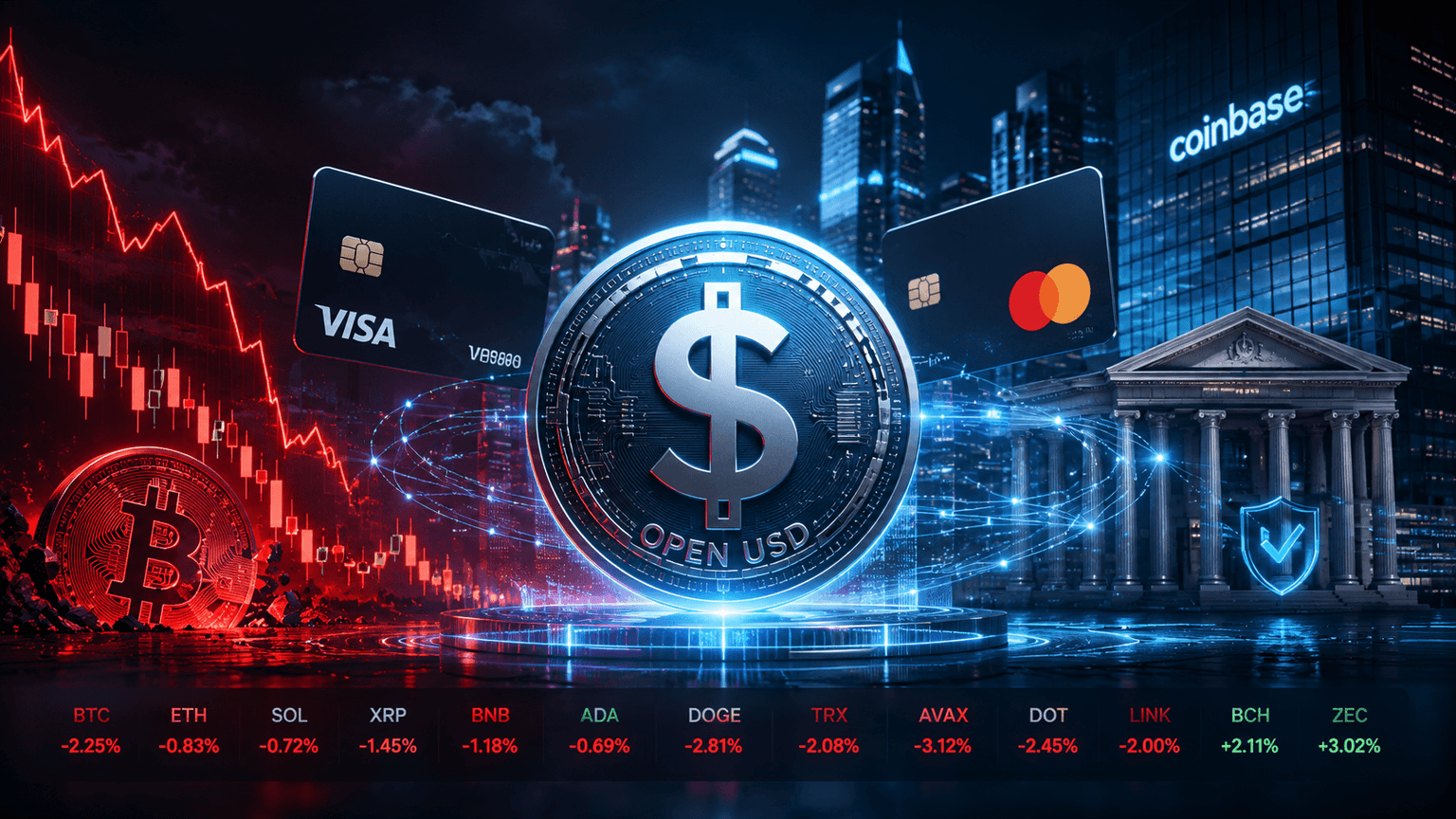
Stablecoin War Begins: Visa, Mastercard and Coinbase Launch Open USD as Bitcoin Crashes
Open USD launches with Visa, Mastercard and Coinbase as Bitcoin falls below $59K. Is this the real crypto story now?
October 16, 2026 4:25 AM

“Not just for stablecoins, but for every form of money”: Mastercard opens stablecoin payouts to bank accounts
Mastercard and BVNK launched the Global Money Platform on 15 October: fiat and stablecoin accounts, real-time exchange, cards and payouts to local bank accounts through one interface. For German users two questions hang on it that the announcement does not answer: the fees and MiCA authorisation.
September 30, 2026 10:40 PM

ESMA Calls for Advertising Rules on Crypto Influencers: Six Changes Now Sitting With the EU Commission
The EU securities watchdog filed its response to the MiCA review on the final day of the consultation. Among the demands are disclosure on staking, a licensable DeFi gateway and the power to freeze crypto assets.
September 29, 2026 10:15 PM

Citi Becomes the Bank Behind Coinbase's Stablecoin Accounts: What Changes for Investors in Europe
Citi and Coinbase announced two products on September 28, 2026 that tie stablecoin payments to a global bank: dedicated payment accounts at Coinbase and stablecoin acceptance for Citi clients. Both launch in the United States. For your balance in Europe, MiCA, the Article 50 interest ban and Section 23 of the German Income Tax Act apply.
April 14, 2026 3:00 PM

Tax-Free Stablecoins? This US Bill Could Trigger the Next Crypto Bull Run
A new US bill could make stablecoin transactions tax-free. Here’s how it could boost crypto adoption and trigger the next bull run.
April 6, 2025 12:47 PM
Big Win for Crypto: SEC Says Dollar-Backed Stablecoins Are Not Securities
The U.S. SEC just made a game-changing move. Stablecoins backed by actual dollars and easily converted to cash are officially not securities. What does that mean for the crypto industry in the USA? Let’s break it down.
More from CryptoTicker