
Bank stablecoin for 3.3 million users: “crypto assets are generally not protected”
HSBC switched on the RedCoin stablecoin in its payment app on October 23, 2026, and the terms make clear that deposit protection does not apply. The same principle holds for e-money tokens in the EU: instead of 100,000 euros in compensation, you hold a redemption right against the issuer.





Which topics should we dive deeper into?
Select what genuinely interests you. Your picks feed directly into our editorial planning.
Crypto news that's actually worth your time.
Weekly. 60 seconds. Carefully curated by our editors: no hype, no promo flood, no spam.
When your bank issues a stablecoin, your money no longer sits in an account. It sits in a token. That changes everything for the statutory deposit guarantee, because the guarantee does not cover that balance. On its consumer page on deposit protection, German regulator BaFin puts it plainly: crypto assets are “generally not protected”. What you get instead is a redemption claim against the issuer.
Since October 23, 2026, that is no longer a theoretical question. On that day a major bank placed its own stablecoin inside a payment app with millions of users. In Germany, banks are working on a euro equivalent. Understand the difference between an account balance and a token now, and you will not have to learn it later in a loss event.
RedCoin: what HSBC switched on in the PayMe app on October 23
HSBC switched on the RedCoin stablecoin, ticker RCHKD, inside its PayMe payment app on October 23, 2026. The token is pegged to the Hong Kong dollar and is meant to be redeemable one for one, subject to the issuer's terms. It is issued by The Hongkong and Shanghai Banking Corporation, which received a licence as a stablecoin issuer from the Hong Kong Monetary Authority in April 2026 under the territory's stablecoin ordinance. Decrypt and other trade outlets reported the launch.
A stablecoin is a token whose value is tied to a fixed reference, usually a state currency. The number quoted in the reports is easy to overstate: the 3.3 million figure refers to existing users of the payment app, not to people who have already activated a token wallet.
Three points from the launch terms matter here. First, the token runs on the bank's own ledger, not on a public blockchain. Second, balances cannot move freely between the payment app and the bank's banking app. Third, according to the bank's documentation the token wallet is not an ordinary deposit account, which is why the Hong Kong deposit protection scheme does not apply to it. The bank also plans to let customers subscribe to units of a tokenised money market fund from 100 Hong Kong dollars using the token.
Hard reserve figures do not exist yet. The numbers published shortly after launch come from the issuer itself and are unaudited; the bank expects a first report after the fourth quarter of 2026. Until then it is assertion against evidence.
E-money tokens under MiCA: only credit institutions and e-money institutions may issue them
In the EU such a token is called an e-money token, EMT for short: a crypto asset that references the value of a single official currency and is treated as electronic money in supervisory law. BaFin states the entry rule briefly: “Only credit institutions or e-money institutions may issue e-money tokens (EMT)” or apply for admission to trading for such tokens. A fintech without a banking licence cannot put a euro token on the market in the EU at all.
That is exactly where the misunderstanding starts. Because a bank stands behind the token, the balance reads like a bank account. In supervisory law it is not one. In its guidance on authorisation requirements, BaFin classifies e-money tokens as electronic money within the meaning of the Second E-Money Directive. Electronic money is its own category with its own safeguards, and deposit protection is not among them.
There is also a procedural part you can look up as an investor. For every e-money token the issuer must file a crypto-asset white paper under Article 51 of the MiCA regulation with BaFin, with a copy going to the competent centre at the Deutsche Bundesbank. No approval of the white paper is foreseen; what counts are the deadlines named in the supervisor's guidance. We have written up what the licence itself requires of companies in our overview of MiCA obligations for crypto firms.

Deposit protection in Germany: 100,000 euros per customer and bank
The deposit guarantee is the statutory compensation that applies when a bank can no longer repay its customers' deposits. As BaFin describes it, the scheme covers account balances, fixed-term deposits and savings deposits, meaning money in current, overnight and term accounts. The statutory claim is capped at 100,000 euros per customer and bank, regardless of how many accounts they hold. On joint accounts each holder has their own claim, and in special cases the protection rises to as much as 500,000 euros for six months.
The supervisor also names what is not a deposit and therefore not covered: bearer and order bonds, profit-participation liabilities and liabilities from the bank's own bills of exchange. The same overview carries the sentence that decides the matter for token balances, namely that crypto assets are generally not protected. Securities such as shares or fund units also fall outside the scheme, but they remain the customer's property and are held in custody.
On process: BaFin determines the compensation event, and for deposits up to 100,000 euros compensation is paid on the basis of the bank's records within seven working days. That machinery runs for deposits. For a token balance it does not run at all.
 Compare MiCA-regulated crypto exchanges
Account balance or token: the difference that decides the protection case
Picture two positions at the same bank. The current account holds 5,000 euros, and the app holds 5,000 euros as a bank token. While everything works, the two behave identically: you can pay, transfer and exchange. The difference shows up only in the one moment when it counts.
If the bank fails, the current account is a case for statutory compensation up to 100,000 euros. The token balance is a claim against the issuer, governed by the token terms and by insolvency law. No guarantee fund pays you out within seven working days here. Whether and when you see your money depends on how the reserve was held and how it is treated in the proceedings.
That is why “does the stablecoin come from a bank?” is the wrong question. The right one is: do I hold a deposit or a token? Both can sit side by side in the same institution, the same app and the same screen. For which stablecoins exist, how they are backed and where you can trade them, see our stablecoin comparison.
Redemption right: the claim against the issuer replaces the guarantee fund
The redemption right is the claim to exchange the token back into the underlying currency at par at any time. It is the heart of e-money token regulation and the actual substitute for deposit protection. For RedCoin the bank names a one-for-one redemption, though subject to the terms in force at the time.
That qualifier deserves a close read, because the quality of the promise is decided there. Check whether redemption happens at par or at the market price, whether a fee applies, how long the payout takes, which channel it runs through, and whether minimum or maximum amounts apply. A redemption right that works through a single app only is weaker than one that keeps several routes open.
A second point comes from European regulation: simply holding a regulated e-money token pays no interest. If you expect a yield, you are looking in the wrong place. The token is a payment instrument, and its value lies in settlement, not in return.

Reserve backing: where the money behind an e-money token sits
The reserve backing is the assets with which the issuer backs the tokens in circulation. For holders, the location matters more than the total: is the reserve held as deposits at credit institutions, in short-dated government paper, or in less liquid assets? That determines how quickly the issuer can serve a wave of redemption requests.
There is an irony in the construction worth knowing. Part of an e-money token's reserve is itself typically held as deposits at banks, and those deposits belong to the issuer, not automatically to you in an insolvency. The protection works at the issuer's level, not at yours.
Publications are what make this checkable. For RedCoin the figures shortly after launch are issuer statements without an audit, and the first report is expected after the fourth quarter of 2026. The same principle applies to every euro token offered to you in Germany: without a regular, audited report, the backing remains an assertion. When a peg to par breaks, the cause almost always sits in the backing, not in trading.
 Compare crypto credit cards
ESMA register and white paper: how to check an issuer's authorisation yourself
You do not have to take the marketing on trust, you can look it up. The European Securities and Markets Authority, ESMA, keeps a register of all authorised issuers of e-money tokens, and BaFin points to it explicitly on its page about token issuance. If a provider is not listed there, authorisation for that token is missing in the EU, however familiar the name on the app may be.
The second step is the white paper. It has to describe the backing, the redemption right and the risks, and it is the document the issuer will be measured against later. If you want to know how to reconcile register and authorisation in practice, our guide to checking MiCA authorisation sets out the route.
Hong Kong and the EU: two supervisory regimes, one identical message on protection
The two legal orders are not comparable, and their licences do not apply to one another. On one point they nevertheless say the same thing. In Hong Kong, the bank's documentation makes clear that the token wallet is not an ordinary deposit account and that the local deposit protection scheme does not apply. In Germany, BaFin lists crypto assets in its overview as generally not protected.
That means the sentence buried in the small print in Hong Kong is not an oddity in the EU but the rule. Anyone handed a euro token from a German bank should not expect the 100,000 euros to travel with it. They will not, because the token is not a deposit.
The takeaway: a bank stablecoin moves your balance out of a category with statutory compensation and into a category with a contractual redemption claim. That can be perfectly fine if you use the token to pay and not to park larger sums. It was not built as a replacement for a savings account.
Bank stablecoin: without deposit protection, only redemption counts
- Settle the category before you move money. Check the terms to see whether your balance is an account balance or a token, and keep larger sums where statutory compensation applies. Our overview of regulated crypto exchanges shows where you can hold euro balances with authorised providers.
- Test the redemption route before your first purchase. Redeem a small amount and measure how long it takes and what it costs, rather than trying it for the first time when it matters. For everyday spending from a crypto balance, it is worth comparing crypto credit cards.
- Read up on issuer and reserve once a quarter. Match the provider against the ESMA register and check whether an audited reserve report exists. Holdings you intend to keep long term belong in your own custody anyway; the devices for that are in the hardware wallet comparison.
(As of October 29, 2026. This article is not investment advice. Prices and fee structures change; check the terms with the provider before you buy.)
Frequently asked questions about bank stablecoins
Transparency note: This article was produced with the assistance of artificial intelligence and reviewed by our editorial team before publication. All figures and claims were checked against the primary sources linked in the text. The feature image was generated with AI.
Related articles
- Open USD is live but absent from the EU register: what matters now for investors in Europe
- MiCA Register of Stablecoin Issuers: 23 Authorised Firms, 43 White Papers and Two Dead Links
- Fed Rules for Stablecoins: What to Check on Backing and the Redemption Right
- $2.41 billion RLUSD: Standard Chartered takes custody as MiCA approval is still missing in the EU
- Polkadot launches dotUSD without an issuer: why MiCA demands one
Which topics should we dive deeper into?
Select what genuinely interests you. Your picks feed directly into our editorial planning.
Crypto news that's actually worth your time.
Weekly. 60 seconds. Carefully curated by our editors: no hype, no promo flood, no spam.

September 9, 2026 7:28 PM

Euro Stablecoin From 37 Banks Comes to Ethereum: What to Check on Your Euro Token Now
A consortium of 37 European banks confirmed on 8 September that it will issue its regulated euro stablecoin on the public Ethereum chain. What that means for custody, redemption and deposit insurance, and the six points you can check on your euro token right now.
October 23, 2026 1:35 PM

What is Tether (USDT)? The stablecoin explained: 182 billion tokens without EU authorisation
With 182.8 billion tokens in circulation, Tether is the largest stablecoin in the world and settles two out of every three crypto dollars traded. In the EU it lacks authorisation as an e-money token, and from January 8, 2027 authorised providers may no longer offer services around it.
October 19, 2026 10:34 PM

JPMorgan brings its JPMD deposit token to Ethereum: retail clients stay shut out
JPMorgan brought its dollar deposit token JPMD to the Ethereum mainnet on October 19, 2026, after almost a year on the layer-2 network Base. The token now sits on an open blockchain, yet nobody can trade it without the bank's approval.
October 19, 2026 7:31 PM

USD1 stablecoin loses $401 million: almost $200 million traces back to a single address
The market capitalisation of the dollar stablecoin USD1 has fallen 9.1 percent in two weeks without the price losing its dollar peg. Just under $200 million of the redemptions came from a single address, according to Onchain Benchmark, and its owner is unknown.
October 14, 2026 10:21 PM

37 banks, one licence: the Qivalis euro stablecoin cannot launch yet
De Nederlandsche Bank authorised Qivalis as an electronic money institution on October 14, 2026; according to the company, 37 European banks from 15 countries stand behind the planned euro stablecoin. Qivalis may not issue the token yet, because the whitepaper required under the MiCA regulation is still missing.
October 27, 2026 9:44 AM

Ripple's banking licence for $2.5 billion RLUSD: what investors need to know
The US banking regulator OCC granted Ripple final approval on October 26, 2026 for a trust bank that manages the reserves of the stablecoin RLUSD. In the European Union the token lacks authorisation as an e-money token, and our own survey shows what that means for your buying route.
October 16, 2026 1:25 AM

USDC becomes the EU's first significant e-money token: what changes for holders on November 12
The European Banking Authority classified USDC as the EU's first significant e-money token on October 14. From November 12 it will examine the issuer's reserve, own funds and liquidity itself, rather than leaving that to the French supervisor alone.
August 19, 2026 4:14 AM

Digital Euro and Stablecoins: Why the Bank of England Is Testing Both Forms of Money in a Single Payment
In the Bank of England's Digital Pound Lab, a consortium around NOBO Finance, Dun & Bradstreet and Polygon has rehearsed how an exporter receives an advance in a stablecoin while the importer settles the final payment in digital central bank money. Why the difference between private and public money also matters for your stablecoin balance in Germany.
September 23, 2026 7:15 AM

SoFi Settles Card Payments in Stablecoin: What Cardholders Should Check
Since September 22, 2026, the US bank SoFi has run its entire card business through its own stablecoin, SoFiUSD, on the Mastercard network. What sets the model apart from a crypto credit card, and which rules would apply if a European provider followed suit.
September 22, 2026 10:15 PM
Stablecoin Reserves: Why the ECB Wants the Bank Deposit Rule Scrapped
The European System of Central Banks filed its response to the MiCA review on September 22 and calls in it for an end to the requirement to hold 30 to 60 percent of stablecoin reserves as a bank deposit. What lies behind it, and what you can check on your own token.
October 18, 2026 10:27 AM

Stablecoin depeg: will the 1.00 euro peg hold?
A stablecoin depeg is the moment the market price leaves its tie to the euro or the dollar. What the MiCA regulation requires of the reserve and of redemption, how to recognise a token's design, and what a swap into a stablecoin means for your holding period.
October 22, 2026 4:42 PM

USDT or USDC: the key points before the October 30 deadline
Analysis: in the European Economic Area, Coinbase converts remaining balances in USDT, DAI and PYUSD into USDC on October 30, 2026, and from November 12 the EBA supervises the USDC issuer directly. This piece sets out what that means for the choice between the two largest dollar stablecoins, and separates the documented deadlines from the newsroom's assessment.
October 8, 2026 10:14 PM

ESMA stablecoin deadline of January 8, 2027: what you can do with USDT now
ESMA decided on October 8, 2026 that authorised EU platforms should no longer offer services for stablecoins that do not comply with MiCA. For USDT, only selling, swapping, transferring and withdrawing remain until January 8, 2027.
August 27, 2026 1:12 AM
Revolut Launches the EURR Euro Stablecoin: Why Germany Is Not in the First Wave
Revolut launched the EURR euro stablecoin on August 26, 2026, starting in Denmark, Poland and Portugal. For German customers a different date matters for now: the USDT deadline ends on August 31.
August 19, 2026 4:15 PM

Tether Audit by KPMG: What the Unqualified Opinion Means for USDT in the EU
Tether reported the first full audit of its financial statements by KPMG on August 13, 2026, with an unqualified audit opinion for the 2025 financial year. That changes nothing about whether USDT can be traded at authorised providers in the EU, because Article 48 MiCA decides that question.
October 29, 2026 12:28 AM
Bitget Wallet opens EUR accounts: incoming euros become USDT or USDC
Since October 27, 2026 Bitget Wallet gives its users their own account number in euros and US dollars, and the app converts incoming money automatically into USDT or USDC. What that means for SEPA transfers, the MiCA status of the two stablecoins and the holding period is set out here.
October 22, 2026 1:36 PM

What is an issuer? Meaning, examples and issuer risk
Context: who the issuer is in the case of a share, an ETF, an ETN, a certificate, a stablecoin and a stock token, what MiCA and prospectus law understand by it, and what an issuer insolvency leaves of 10,000 euros. With tables and a worked example.

September 26, 2026 7:14 AM
Cardano Before the RealFi Launch on October 1: What ADA Holders Should Check on USDr, MiCA and Tax
On October 1, 2026 the stablecoin platform RealFi goes live on the Cardano mainnet, and ADA has gained 14.67 percent in a week. What is documented about the yield-bearing dollar token USDr, and what investors should settle beforehand.
October 24, 2026 4:12 AM

Coinbase Ireland accepts a 3.25 million euro fine and admits the breaches: “We have no tolerance for weaknesses in safeguarding arrangements”
The Central Bank of Ireland has fined Coinbase Ireland Limited 3,252,618 euros because the e-money institution failed to safeguard client funds adequately and did not control the outsourcing to its US parent. European customers are tied to that very entity through the EU passport, and their euro balance is not a bank deposit.
October 22, 2026 7:32 AM

US rule on stablecoin interest takes effect January 18, 2027: what changes for investors in Europe
In context: the US banking regulator OCC presented its final rule on payment stablecoins on October 21, 2026, effective January 18, 2027. The surviving interest ban is documented; what the deleted presumption means for reward arrangements is assessed by the editorial desk further down.
September 1, 2026 4:12 AM

USDT cashback and 7 percent on stablecoins: what the MiCA interest ban means for you
A new payment card advertises up to 10 percent cashback in USDT and up to 7 percent a year on the balance. Article 50 MiCAR explains why a provider licensed in the EU is not allowed to pay you exactly that.
August 21, 2026 10:27 PM

Stablecoin as Cash: The Three Criteria to Check Your Balance Yourself
The US accounting board FASB has for the first time named three conditions under which a stablecoin may count as cash on a balance sheet. Those conditions turn into a checklist that lets you place your own holdings in about twenty minutes.
August 6, 2026 3:05 PM
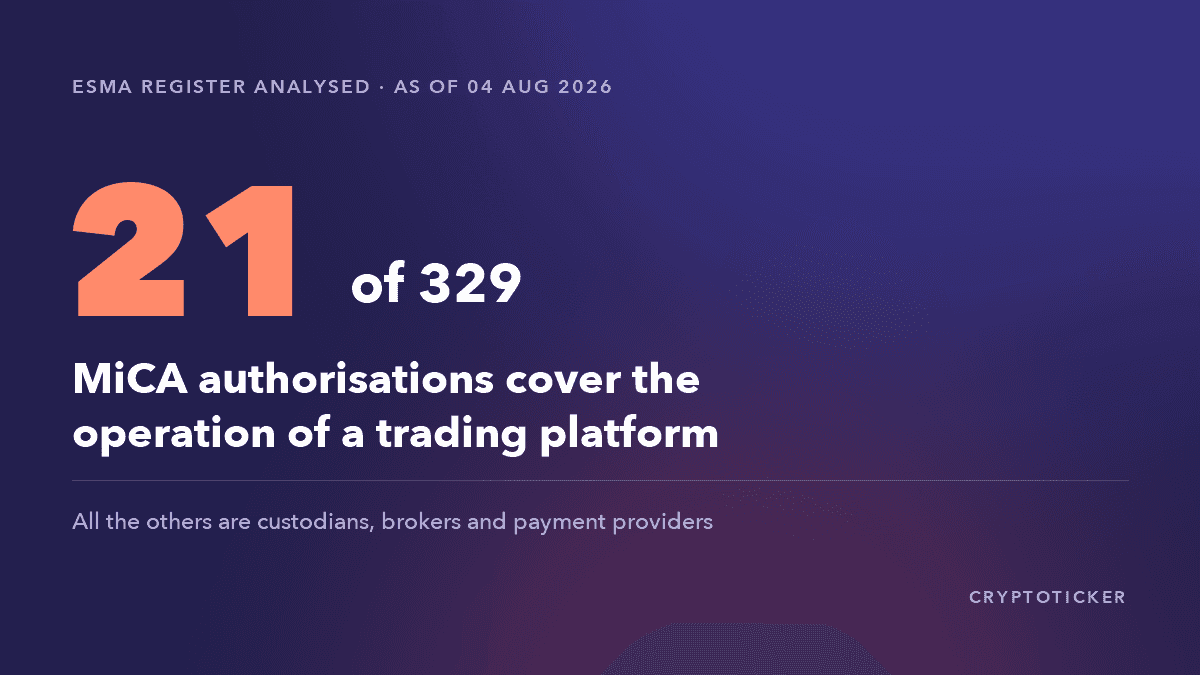
MiCA Register 2026: Only 21 of 329 Licences Are Real Exchanges
ESMA publishes the register of MiCA-authorised providers as an open file. We worked through all of it — and the result is not what the phrase “licensed crypto exchange” suggests.
October 16, 2026 1:35 PM

Kraken parent Payward buys Saldo Bank: the first crypto firm with a bank of its own in the EU
Payward, the parent of Kraken, agreed on October 14 to buy the Lithuanian Saldo Bank and would be the first crypto firm with a bank of its own in the EU. What is established, what stays open until the planned completion in 2027 and what may change for the protection of your euros.

July 21, 2024 6:37 PM

MAJOR Ripple News: How Will These Developments Impact XRP Price?
New developments involving Ripple could have a huge impact on XRP price. What are they and how will XRP price react to this?
October 16, 2026 4:19 PM

NEAR gains 15.9 percent as the confidential SOL vault cites a 5.12 percent yield: what to watch now
NEAR trades at $5.27, 15.87 percent above yesterday's level. The day before, NEAR launched a deposit service for Solana that hides the wallet address and cites an example yield of 5.12 percent. What of it is substantiated, and which EU rules apply to investors in Germany.
August 30, 2026 10:38 PM

Crypto Cards: Where Your Card Balance Really Sits and What the August 28 Solana Exploit Reveals About It
An attack on a card balance contract on Solana took the loaded balance from 1,685 users while their wallets stayed untouched. The case shows why it matters whether your crypto card holds funds as e-money at a licensed institution or in a smart contract.
More from CryptoTicker