
NEAR gains 15.9 percent as the confidential SOL vault cites a 5.12 percent yield: what to watch now
NEAR trades at $5.27, 15.87 percent above yesterday's level. The day before, NEAR launched a deposit service for Solana that hides the wallet address and cites an example yield of 5.12 percent. What of it is substantiated, and which EU rules apply to investors in Germany.




Which topics should we dive deeper into?
Select what genuinely interests you. Your picks feed directly into our editorial planning.
Crypto news that's actually worth your time.
Weekly. 60 seconds. Carefully curated by our editors: no hype, no promo flood, no spam.
NEAR trades at $5.27 on Thursday midday, 15.87 percent above its level of 24 hours ago (CoinGecko). The occasion is a product NEAR presented on October 15, 2026 through its own channel on X: anyone depositing Solana (SOL) via the near.com app should no longer have to disclose their wallet address. The money then works in a vault at Kamino Finance. NEAR itself does not claim a link between the product launch and the price jump, and no such link can be substantiated.
Two details here matter to investors in Germany, and most reports pass over both. The yield on offer comes from lending coins out, not from running the blockchain. And the confidentiality stops at the edge of the NEAR blockchain. Both change how this vault reads for tax and for supervision.
NEAR at $5.27: 15.87 percent in 24 hours, a $4.54 low
The NEAR price has moved through a range of $4.54 to $5.43 over the past 24 hours. On a weekly view it is up 9.02 percent, market capitalisation stands at $6.91 billion and ranks 19th. Coins worth $1.32 billion changed hands in 24 hours.
Measured against its own history, the picture is sober. NEAR reached its all-time high of $20.44 on January 16, 2022. From today's price, that is about 74 percent away. Supply in circulation is 1.309 billion NEAR, practically the entire issued amount, so no unlock on that side is likely to add selling pressure.
Against the broader market, the move stands out. Bitcoin added 1.61 percent over the same period and ether 4.30 percent. NEAR is therefore moving far harder than the two large caps, which points to a trigger of its own rather than a general recovery.
Confidential SOL vault on near.com: Kamino runs it, Gauntlet curates it
NEAR calls the new offering "confidential SOL yield" and runs it inside the near.com app. The sequence: you deposit Solana from a confidential account, the balance moves into a vault at Kamino Finance, a lending platform on the Solana blockchain. That vault is curated by Gauntlet, a firm that sets the risk parameters for vaults of this kind. Gauntlet has run curated Kamino vaults since November 11, 2025 and put their volume at more than $2 billion at launch; Solana Compass has assembled the details of the structure.
A curated vault is not a bank account. The curator decides which collateral is admitted, how far it may be borrowed against and when positions are force-closed. If that judgement lags reality in a violent downturn, depositors carry the loss, not the curator.
There is no minimum holding period, according to the product page. Balances can be swapped or spent while they earn. Sign-in works with a wallet or a passkey. NEAR's product page also notes that deposited SOL is exposed to market and protocol risk and flows into third-party smart contracts. That sentence deserves a second read: it shifts liability from the provider to someone else's code.
What the confidential mode hides and what stays public
The confidentiality is created in a shielded section of the NEAR blockchain, a shard. Activity inside that section cannot be inspected from outside. What stays hidden is the originating wallet and the link between the source of the deposit and its destination.
The other side stays open. On the destination blockchain, the transaction, the asset, the amount and the recipient remain visible to anyone. So if you believe a deposit makes the whole trail disappear, you are mistaken. One link of the trail is covered, namely the attribution to the original address.
NEAR put it this way in its announcement post on X on October 15, 2026: "Your SOL can earn yield in a dozen places. All of them public, until now." Kamino wrote in its own post that users reach the vault "directly on near.com, without exposing their wallet address to the vault". On its home page, NEAR describes the principle as an account whose balances and activity stay confidential, "when you want them to, with control over what you reveal".
Which address the vault does see, who holds the position economically and what fees apply: neither company has published any of it so far. NEAR cites a volume of $1.29 billion over 30 days for its confidential infrastructure. That figure comes from the company itself, is not externally audited and covers every confidential operation on near.com, not this vault alone.

The 5.12 percent is a lending yield, not a staking reward
At launch the product page cited an example rate of 5.12 percent a year on SOL, while making clear that the yield fluctuates and is not guaranteed. Where that number comes from is what counts. The yield arises from borrowing demand: whoever wants to borrow SOL pays interest, and part of it reaches the depositors. It has nothing to do with the reward a validator earns for securing the Solana blockchain.
The distinction matters for the yield itself. A staking reward follows the blockchain's issuance schedule and moves sluggishly. A lending yield falls as soon as demand for borrowed SOL eases, and in quiet weeks it can slip well below the advertised figure. To see the offers side by side, the established providers are in our comparison of staking and yield platforms, which also shows which of them are licensed in the EU.
 Find the best staking rewards for your coins
MPC signing network reaches 17 operators, NEAR token now trades on Solana too
Two further items landed in the same few days. First, NEAR's signing network, which rests on multi-party computation (MPC), now runs with 17 operators on mainnet. It is funded out of the protocol's emissions, and NEAR holders decide how those are used. This network carries the chain signatures with which NEAR Intents triggers operations on other blockchains.
Second, the NEAR token has traded on Solana since October 15 via Sunrise, a route built by the team behind Wormhole, with NEAR Intents serving as the bridge. First-day numbers stay small: on the evening of October 15, Solana Compass counted 18,918 holders, roughly $13.0 million in 24-hour turnover and about $615,000 of on-chain liquidity. For a top-20 asset that is little, and it tempers any expectation that this venue alone carries the price jump.
What has changed since the perpetuals report of October 15
On the evening of October 15, NEAR stood at a gain of 9 percent, and in 74 of 86 perpetual markets examined buyers were paying the funding rate to sellers, as our analysis of NEAR, leverage and open interest showed. The price has risen further since, to $5.27 and $5.43 at the peak.
That leaves the futures market as the largest near-term risk. An imbalance in which leveraged buyers pay continuously tends to resolve either through prices that keep climbing or through a wave of forced closures. The $4.54 low of the past 24 hours marks the spot where that pressure last became visible.
MiCA and the Transfer of Funds Regulation: the legal framework in Germany
Since 2025, crypto service providers in the EU may only operate with authorisation under the Markets in Crypto-Assets Regulation (MiCA). What that authorisation demands of a provider is set out in our overview of MiCA licensing obligations for crypto companies. Whether an EU-authorised provider sits behind near.com is not apparent from the announcement. BaFin keeps a register of providers licensed in Germany, ESMA one for the EU as a whole. A look there costs two minutes and answers the question bindingly.
Alongside it stands the EU Transfer of Funds Regulation (Regulation 2023/1113). It obliges authorised crypto service providers to collect and pass on details of the originator and the beneficiary for every transfer. A product whose purpose is to hide the originating address stands in obvious tension with that duty as soon as an authorised provider is involved. For a deposit from a self-custodied wallet the duty does not apply in that form; for a withdrawal to an account at a regulated exchange it very much does.

Article 79 of the EU Anti-Money Laundering Regulation: what applies from July 10, 2027
The EU Anti-Money Laundering Regulation (Regulation 2024/1624) applies directly in every member state from July 10, 2027; no German implementing act is needed. Its Article 79 prohibits credit institutions, financial institutions and crypto service providers from maintaining anonymous accounts. Accounts that prevent attribution through anonymity-enhancing crypto-assets are named expressly.
Two misunderstandings persist. First, the regulation names not a single coin, and no official list exists. Second, the provision addresses companies, not private holders. A wallet on your own device is not a corporate account and does not fall under it.
In practice the rule still reaches investors, by way of access. If authorised exchanges and custodians turn away confidential transactions as a precaution, a legally permitted position becomes one that is hard to convert back into euros. Roughly 20 months remain until July 2027, and large platforms have a record of acting well before a deadline.
 Compare MiCA-regulated crypto exchanges
Holding period, tax and custody for your portfolio
For tax, the matter splits in two. The deposited SOL itself falls under disposal taxation in Germany pursuant to Section 23 of the Income Tax Act: hold for more than a year, then sell, and the gain is untaxed. The interest from the vault is to be treated separately, because it is current income and must be declared in the year it accrues.
That creates a practical duty, and a tedious one: every inflow needs a date, an amount and the euro rate at the moment of crediting. With interest accruing daily, that quickly adds up to hundreds of individual entries a year, which can hardly be kept straight by hand. The established tools for it are in our comparison of crypto tax tools and portfolio trackers.
An additional problem arises from the confidentiality itself. If the transaction shows no outward link to the originating address, you are the one who has to prove that link to the tax office. So secure the records from the app while you still have access, rather than relying later on a public blockchain explorer that does not carry precisely this trail.
Levels above and below: $4.54, $5.43 and $6.00
On the downside, the daily low at $4.54 is the first level worth anything, because buying actually took place there over the past 24 hours. Below it lies the five-dollar line, which NEAR broke through on October 13 and has since reclaimed.
On the upside, the daily high at $5.43 caps the move for now. The next station above it is the area around $6.00, which NEAR touched briefly on October 10 before the price gave way again. A daily close above that zone would be the first signal that the advance carries more than a counter-move.
Our assessment: the product launch does not explain the price jump on its own. The measurable quantities are too small for that, with $615,000 of liquidity on Solana on day one and an example yield below what lending markets pay in good weeks. What supports the move is the funding situation in the futures market, where leveraged buyers are paying. Against it stands the fact that this very situation can turn against the price just as quickly. None of this is a buy or sell recommendation, and total loss remains possible with any crypto-asset.
NEAR vault: without EU authorisation, the deposit is your risk
- Settle the authorisation question before money moves. Look the provider up in the BaFin register and the ESMA register. If you do not find it there, MiCA's protective provisions do not apply to you. Which venues hold an EU licence is set out in our comparison of regulated crypto exchanges.
- Read the yield for what it is. The 5.12 percent is an example rate from the lending market, not a commitment. Pull the current rate before any deposit and reckon with a markedly lower figure in quiet market phases. What licensed providers currently pay on SOL is shown in our comparison of staking and yield platforms.
- Secure the records and keep holdings apart. With confidential transactions you are the only one who can still evidence the attribution later. File the date, amount and euro rate of every inflow, and keep long-term holdings separate from this in your own custody; the devices for that are in our hardware wallet comparison.
(As of October 16, 2026. This article is not investment advice. Prices and fee structures change; check the terms with the provider before you buy.)
Frequently asked questions about NEAR
Transparency note: This article was produced with the assistance of artificial intelligence and reviewed by our editorial team before publication. All figures and claims were checked against the primary sources linked in the text. The feature image was generated with AI.
Related articles
- Zcash Above $1,500: What ZEC Holders Should Check on Tax and Custody
- Buying Monero in Germany: six major exchanges no longer list XMR
- Zcash today: 2,746 ZEC from the Bitget hack vanish into the Ironwood pool
- Source of Funds at a Crypto Exchange: Why a Deposit Can Freeze Your Account for 15 Days
- Privacy Coins and EU Anti-Money-Laundering Law: An Assessment of the Ban From July 2027
Which topics should we dive deeper into?
Select what genuinely interests you. Your picks feed directly into our editorial planning.
Crypto news that's actually worth your time.
Weekly. 60 seconds. Carefully curated by our editors: no hype, no promo flood, no spam.

August 21, 2026 1:26 PM

Crypto Exchange Account Frozen: Why Nobody Tells You Why, and What Actually Helps
If you get no explanation after a freeze, it feels like arbitrary treatment. In fact the German Money Laundering Act forbids the provider from telling you. What happens in that time, which deadlines apply and which documents shorten the process.

June 17, 2026 7:21 PM

Binance EU Access at Risk: What MiCA Could Mean for BNB and Crypto Users
Binance is facing one of its biggest regulatory tests in Europe as the MiCA deadline approaches. Could this put BNB and EU crypto users under pressure?

September 24, 2026 1:24 PM

NEAR Falls Almost 8 Percent After a 62 Percent Week: What to Check on Perps, Buying Route and Holding Period
NEAR Protocol loses up to 7.9 percent on September 24, 2026 and is still more than 55 percent higher over the week. The rally was carried by a confidential perp offering via Hyperliquid, which raises questions of its own on buying route, leverage and holding period in Germany.
September 18, 2026 10:29 PM

NEAR Jumps 21 Percent: What to Check on the NEAR@3.33 Incentive Programme and the New Perps
NEAR rose to $3.68 on September 18, 2026, after near.com launched confidential perpetuals and set off an incentive programme with a price condition. What is documented, what 40x leverage means and what applies to you in Germany.
July 6, 2026 11:17 AM
XRP Just Got a Massive EU Green Light — But There's a Catch Nobody's Talking About
Ripple scored preliminary MiCA approval to run crypto services across all 30 EEA countries — and $XRP is up ~8% this week. Here's what it really means.
October 1, 2026 2:16 PM

Open USD is live but absent from the EU register: what matters now for investors in Europe
The dollar stablecoin Open USD launched on September 30, 2026, backed by Coinbase, Mastercard, Shopify, Stripe and Visa. On October 1, 2026 the token was not notified in the MiCA register, and that decides what you can do with it in Europe.
September 26, 2026 7:14 AM

Cardano Before the RealFi Launch on October 1: What ADA Holders Should Check on USDr, MiCA and Tax
On October 1, 2026 the stablecoin platform RealFi goes live on the Cardano mainnet, and ADA has gained 14.67 percent in a week. What is documented about the yield-bearing dollar token USDr, and what investors should settle beforehand.
September 24, 2026 10:29 AM

Bank Closed Your Account Over Crypto: Your Rights and the Route to a Replacement Account
After a withdrawal from a crypto exchange, banks repeatedly end the banking relationship, usually without giving a reason. What the German Payment Accounts Act guarantees you anyway, which notice period applies, and in what order you approach the supervisor, arbitration and the courts.
September 19, 2026 7:17 AM

Chainlink Jumps Above $12: What LINK Holders Should Check Now
Chainlink trades at $12.34, 7.4 percent higher than yesterday. What part of the move is the broad market rally, what Chainlink itself contributes, and the three things you should check as a LINK holder.
July 16, 2026 5:34 AM

Trump Just Threw His Weight Behind Stablecoins — And US Banks Are Panicking
Trump backs a UK-US stablecoin pact as the CLARITY Act nears a Senate vote — and banks warn it could drain deposits from smaller lenders. Here's what's at stake.

August 20, 2024 11:07 AM

China Labels Crypto Transactions as Money Laundering in New AML Law
China has just updated its anti-money laundering laws to classify crypto transactions as money laundering. Find out what this means for the crypto world!
November 21, 2023 7:13 PM

BREAKING: Binance CEO Changpeng Zhao to Resign and Plead Guilty
Binance CEO Changpeng Zhao has agreed to step down and plead guilty to criminal charges related to anti-money laundering violations.
August 20, 2026 10:24 PM

MiCA Review: What the European Commission Could Change About the EU Crypto Rules
The European Commission has reopened MiCA for review after barely two years and is asking 86 questions covering the stablecoin interest ban, staking, lending and DeFi. Brussels is taking responses until September 30, 2026.
June 24, 2024 1:29 PM

NEAR Protocol Price SURGE On AI Hype, Is 10$ NEXT?
NEAR Protocol (NEAR) rides the AI hype, showing significant price increases. What factors are driving this trend and what could the future price targets be?
September 19, 2026 4:11 PM

MiCA Consultation Closes September 30: What to Check and Submit Before Then
The European Commission is reviewing the MiCA crypto regulation and will accept submissions until September 30, 2026 at 23:59 CEST. Staking, DeFi, lending, stablecoins and custody are all under examination, and you can take part without a lawyer.

June 30, 2026 11:20 PM
How to Switch from Binance to a MiCA Regulated Crypto Exchange
Binance is winding down EU services after missing the MiCA deadline. Here's why it's happening and how to move your funds to a regulated platform safely.
June 4, 2024 12:42 PM

Solana (SOL) Price Prediction For June 2024
How will Solana (SOL) perform this June? Here are some key technical insights and on-chain activity that could drive its price trajectory.
October 6, 2026 10:14 AM

$3.8 Million Back From the Attacker: Why the NEAR Price Is Up 7.8 Percent
The attacker has sent back the full $3.8 million from the NEAR Intents exploit, and the NEAR price is up 7.8 percent at $5.23. What is behind the recovery, what role the Bitwise NRR ETF plays, and what follows from it for buying route, holding period and custody.
September 25, 2026 1:30 PM

NEAR Staking ETP Passes $100 Million: What to Check on Yield, Brokerage Account and Holding Period
The Bitwise NEAR staking ETP has crossed $100 million in assets under management while NEAR climbs to $4.99. Our own retrieval of the issuer's figures shows the price made the jump, not the inflows.
August 6, 2026 3:05 PM
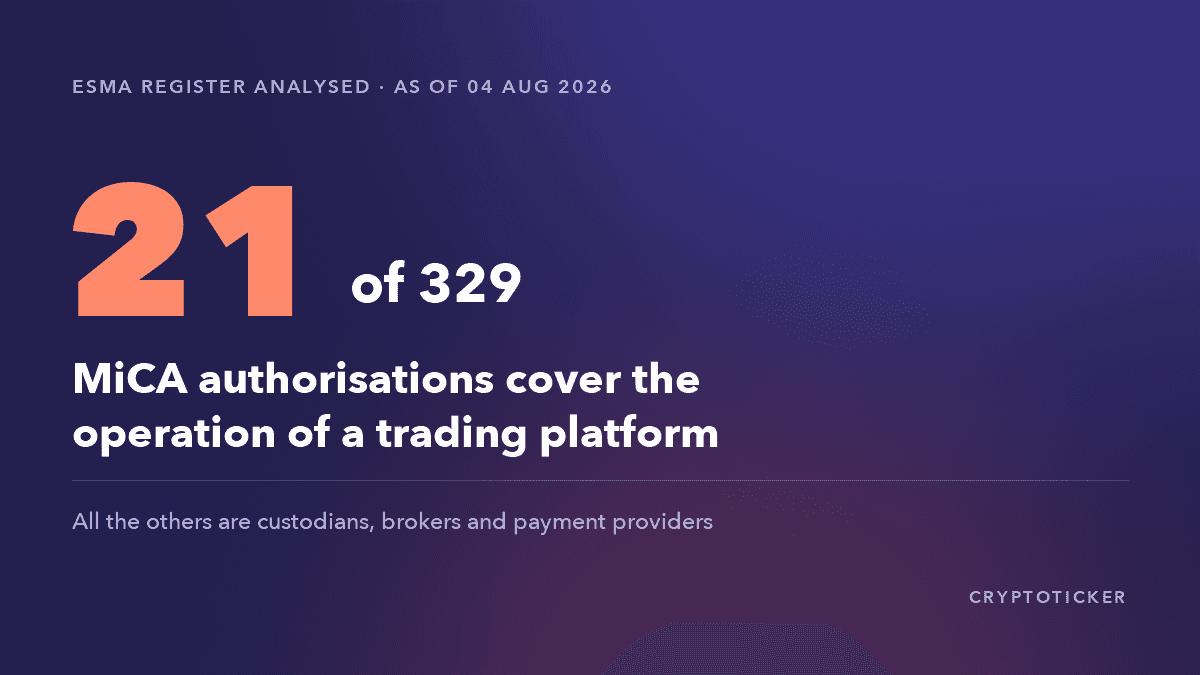
MiCA Register 2026: Only 21 of 329 Licences Are Real Exchanges
ESMA publishes the register of MiCA-authorised providers as an open file. We worked through all of it — and the result is not what the phrase “licensed crypto exchange” suggests.
July 9, 2026 10:12 AM
MiCA Wiped Out 92% of Europe's Crypto Firms: Here's Who Survived and Who's Cashing In
The July 1 deadline turned 3,000+ EU crypto firms into a few hundred. Binance is out, Tether's gone, and a handful of winners now own the market.
July 7, 2025 8:12 PM

BIG Crypto News: EU Approves 14 Stablecoin Issuers Under MiCA
Six months into the MiCA rollout, Europe’s crypto regulatory landscape is taking shape. From authorized stablecoin issuers to licensed crypto service providers, here’s the full July 2025 update.
October 8, 2026 10:14 PM

ESMA stablecoin deadline of January 8, 2027: what you can do with USDT now
ESMA decided on October 8, 2026 that authorised EU platforms should no longer offer services for stablecoins that do not comply with MiCA. For USDT, only selling, swapping, transferring and withdrawing remain until January 8, 2027.
September 20, 2026 7:25 PM

NEAR Intents at $169 Million: What to Check Before a Cross-Chain Swap
NEAR rises by almost 18 percent to $4.23 on September 20, 2026, while the NEAR Intents swap layer holds between $167.6 million and $169.1 million. What an intent is, how it differs from a bridge, and what applies to you in Germany.
July 10, 2026 10:30 AM
Binance Reveals Where Its EU Users Went After MiCA
Binance just revealed where most departing EU users moved their crypto after MiCA — and the answer is raising hard questions about the new rulebook.

More from CryptoTicker