
NEAR cuts issuance to 1.6 percent: gross staking yield shrinks to 3.4 percent
The House of Stake has approved HSP-029: over 24 months, NEAR is to mint at most 1.6 percent new tokens a year instead of 2.5 percent. The change only becomes binding with the validator upgrade and after a 90-day grace period, while the price falls to $3.87.





Which topics should we dive deeper into?
Select what genuinely interests you. Your picks feed directly into our editorial planning.
Crypto news that's actually worth your time.
Weekly. 60 seconds. Carefully curated by our editors: no hype, no promo flood, no spam.
The NEAR blockchain is set to mint significantly fewer new tokens in future. Proposal HSP-029, which lowers maximum annual issuance from 2.5 to 1.6 percent, now carries the status "Succeeded", meaning approved, in the NEAR governance forum. Voting in the House of Stake ran from October 19 to November 2, 2026. For anyone staking NEAR, this means that according to the proposal's model calculations, the gross yield will fall from 5.27 to 3.37 percent over two years once the change takes effect technically. That is at least three months away.
The news has not helped the price so far. NEAR Protocol traded at $3.87, or €3.46, on Tuesday afternoon, November 3, 2026, down 5.1 percent on 24 hours earlier (CoinGecko market data). Over the same period bitcoin slipped just 0.7 percent and ether 0.1 percent. No official link between the vote result and the price decline has been established.
HSP-029 approved: the House of Stake backs the cut to 1.6 percent
The House of Stake is the NEAR community's voting body. Those who lock NEAR and receive voting weight in return decide there on proposals concerning the protocol's economics. HSP-029 ran as a supermajority decision and was submitted on October 7, 2026 by Sal Ternullo, head of the listed company SVRN.
The core of the proposal is a single parameter. Issuance is the quantity of tokens a network mints each year and distributes as rewards. For NEAR, the cap has stood at 2.5 percent of total supply since the halving in 2025. Validators adopted that halving from 5 to 2.5 percent at the time with 68.41 percent approval, as the proposal text notes.
The split remains unchanged: 90 percent of new tokens go to stakers and validators, 10 percent to the protocol treasury. There is no new fund, no redistribution and no mechanism that automatically raises issuance again later. The author explicitly rules out any such way back and requires a new, public decision for it.
In mid-October this was still open. On October 18 we reported that NEAR was staying at 2.5 percent issuance for now, because the draft had not yet been put to a vote. With the result of November 2, the first of two hurdles has been cleared.
A 24-month issuance ramp: 3.75 basis points less per month
The cut will not come all at once. The proposal describes a ramp applied per epoch. On NEAR, an epoch is the period after which the network reassigns validators and books rewards. The cap falls by around 3.75 basis points a month, or 0.0375 percentage points, with no fixed cut-off dates.
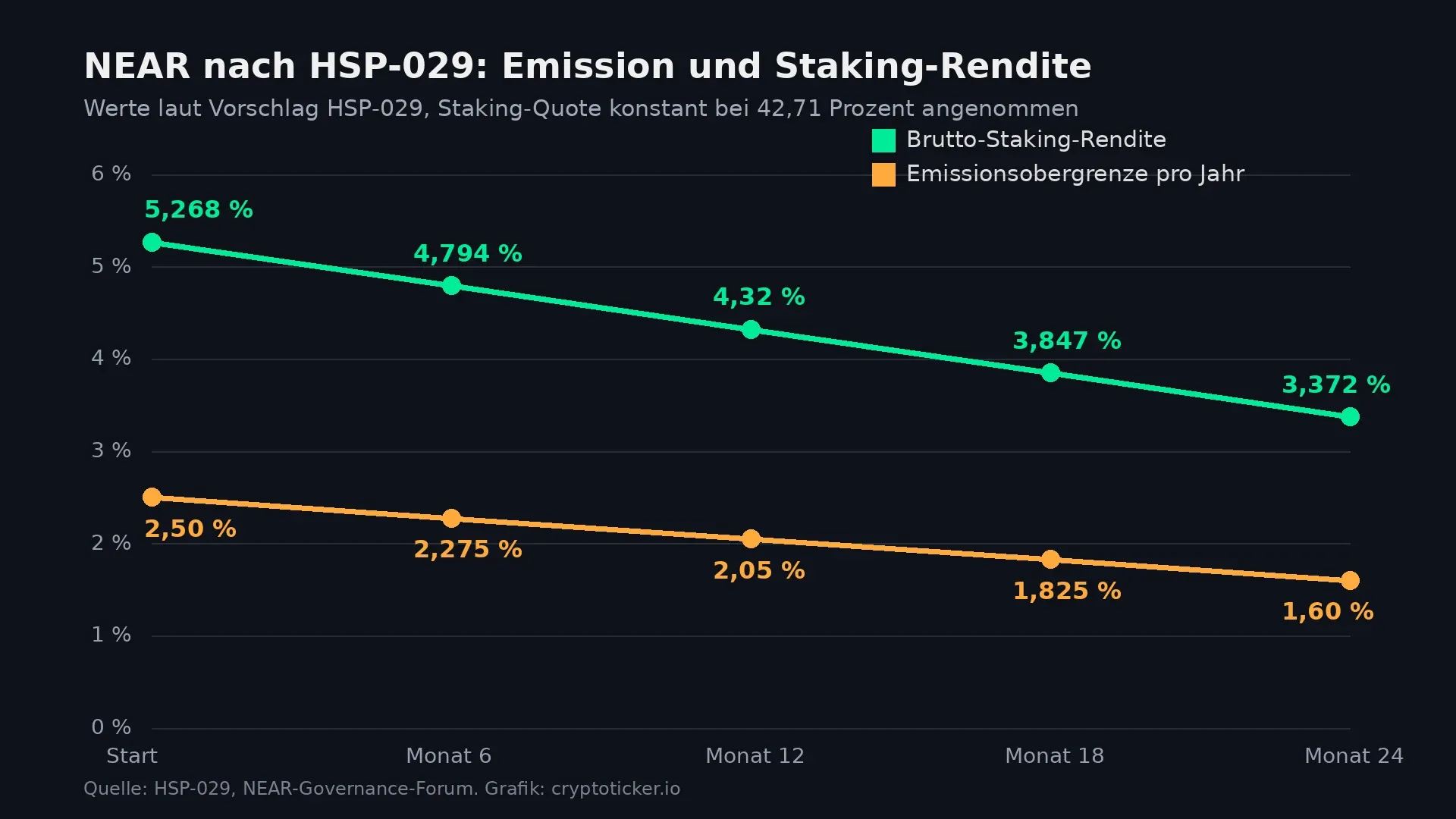
After six months the cap thus stands at 2.275 percent, after twelve months at 2.05 percent, after 18 months at 1.825 percent and after 24 months at the target of 1.6 percent. Around 57,291 new NEAR would then be created each day, compared with about 89,517 today.
Over two years, according to the figures in the proposal, the ramp avoids 11.8 million new NEAR, and 66.1 million over six years. After six years, supply would be 4.36 percent smaller than with unchanged issuance. Nothing is burned in the process; fewer new tokens are simply created.

Validator upgrade and grace period: when the new NEAR issuance applies
A result in the House of Stake does not change the network. The issuance cap is a protocol parameter, and only a software upgrade that validators adopt individually can change it. The proposal text says so itself: ratification by the House of Stake is necessary, but the change only becomes binding once validators adopt it.
On top of that comes a grace period of a full quarter, 90 days after ratification. During this time, wallets, exchanges, custodians and staking providers are meant to update their information. Only then does the first basis point fall. Even if everything runs without delay, the ramp therefore starts in early February 2027 at the earliest.
Under the implementation plan, NEAR One develops and tests the upgrade, with the House of Stake's Security Council involved. After launch, quarterly reports are to show how closely actual issuance follows the schedule.
 Compare staking providers for your NEAR
Staking yield from 5.27 to 3.37 percent: the calculation in the proposal
On NEAR, the staking yield depends on two variables: issuance and the staking ratio, the share of supply that is locked. The formula in the proposal is 0.9 times issuance divided by the staking ratio. If issuance falls, the yield falls. If the ratio falls because holders withdraw tokens, the yield rises for everyone who stays.
At the measured staking ratio of 42.71 percent, that gives a gross yield of 5.268 percent at the start. After twelve months it is 4.320 percent, after 24 months 3.372 percent, a decline of a good third. Gross means before the validator's commission. The proposal assumes an average commission of 5 percent, after which around 3.2 percent of the target value remains.
The proposal also puts a figure on what this costs a staker. Anyone staking 1,000 NEAR will own around 20 NEAR fewer after two years than they would at 2.5 percent issuance. For that holder to break even, NEAR has to rise in value by 1.66 to 1.83 percent; the text gives the two figures in different places. By the author's calculation, the smaller supply alone delivers a little over half of that.
Two sets of figures: why the NEAR issuance yield numbers differ
Two series of figures appear in reports on HSP-029. The proposal's summary cites a decline in the gross yield from 4.80 through 3.93 to 3.07 percent. The table in the same text gives 5.268, 4.320 and 3.372 percent. The difference stems from the staking ratio: the first series comes from a measurement with around 47 percent of supply locked, the second from a later one with 42.71 percent.
Between the two measurements, holders withdrew around 54.5 million NEAR from staking while the price rose from $2.31 to $4.30 in two weeks. The active validator set shrank from 424 to 406 over that period. This gives a range of 3.07 to 3.37 percent for the target yield, depending on how much NEAR is locked in two years.
A forum participant also pointed out a typo: for month six the table gives 4.622 percent, but the proposal's own formula yields 4.794 percent, which is also what the chart in the proposal shows. Our chart below uses the corrected value.
Dilution for holders who do not stake: 57.3 percent of NEAR supply benefits
Dilution means that your share of total supply shrinks because new tokens are constantly being created. Anyone not staking NEAR gets nothing from issuance and so loses share year after year. According to the proposal text, this applies to 57.3 percent of supply.
For these holders, the cut is a clear advantage: their share shrinks more slowly without them having to do anything. The author compares today's issuance with a company that permanently sells new shares on the market. Stakers, by contrast, trade a higher yield for a scarcer supply.
Anyone holding NEAR on an exchange without staking should keep this in mind. The difference between 0 and a good 3 percent annual yield remains noticeable even after the cut. Which providers offer NEAR staking, and at what commission, is shown in our comparison of staking platforms.
Validators under pressure: 24 of 405 pools lose their self-sufficiency
A validator is a computer that verifies and produces blocks and earns rewards for doing so. Delegators assign their NEAR to it and pay a commission in return. Small validators with little stake of their own live off that commission and the return on their own balance.
The proposal sets out the consequences. At a price of $4.30, the number of pools that cover their own operating costs falls from 170 to 146. Of 405 pools examined, 24 thus lose their economic self-sufficiency. The assumed costs are $500 a month for block producers and $200 for simple nodes.
Part of the context is the conflict of interest the author names himself. SVRN holds around 55 million NEAR, more than 90 percent of it staked, accounting for over 8 percent of locked supply. By its own calculation, the cut costs SVRN around 855,000 NEAR a year. Solana adopted a comparable step in August 2026: SGP-0002 passed with 67.001 percent of staked supply, with a yield target of 2.25 percent there.
NEAR price at $3.87: down 14 percent in a week
The price record of recent days is weak. Over seven days NEAR lost 14.2 percent, over 30 days 20.6 percent. Over a year, however, it is still up 92 percent. With a market capitalisation of $5.07 billion, NEAR ranks 21st.
The situation has deteriorated since our last price report. On November 2 the topic was the slide below $4.30. That level now sits around 10 percent above the current price, and the round $4 mark has also fallen. On October 18 NEAR still cost $4.69; it is 17.5 percent lower since then.
The issuance cut affects the price, if at all, only over years. It reduces the ongoing selling pressure from newly distributed tokens, which currently stands at around 89,517 NEAR a day. In the short term, the overall market and sentiment set the price.
NEAR Protocol price levels: $3.74 below, $4.08 above
The daily low on November 3 is $3.74, the daily high $4.08. If the price falls below the daily low, the decline is no longer merely a continuation of previous days. Above lie the round $4 mark and $4.30, where NEAR broke down on November 2.
The proposal itself supplies a more distant level: before the rally in September, NEAR stood at $2.31. A fall to that point would give back the entire autumn rally. Anyone trading NEAR with leverage, for example via perpetual contracts, should set the liquidation threshold of their position against these levels. A perpetual is a futures contract with no expiry date; if the price falls to the liquidation threshold, the exchange forcibly closes the position.
 Find a crypto exchange with MiCA authorisation
NEAR staking in Germany: buying, custody and MiCA authorisation
For investors in Germany, the route to NEAR usually runs through an exchange or a broker. Since the EU's MiCA regulation, providers of crypto services need authorisation as crypto-asset service providers, granted in Germany through BaFin. Whether a provider holds this authorisation can be checked in ESMA's public register. You can find an overview of authorised providers in our comparison of regulated crypto exchanges.
There are two routes to staking. With exchange staking, the provider holds the NEAR and passes on part of the reward, often after its own fee on top of the validator commission. With direct staking from your own wallet, the keys stay with you and you choose the validator yourself. You can then also see where your validator stands on proposals such as HSP-029; delegators explicitly asked about this in the forum.
Important for planning: staked NEAR is not immediately available. After unstaking, several epochs pass on NEAR before the tokens are free again. Anyone wanting to sell quickly in the event of a further slide cannot do so with locked tokens.
Staking income and tax: exemption limit, holding period and the receipt principle
In Germany, staking rewards count as other income under Section 22 No. 3 of the Income Tax Act at the time of receipt, valued at the market price. Such income remains tax-free up to an exemption limit of €256 a year; if it is exceeded, the entire amount becomes taxable. A lower yield therefore also means less taxable income, and smaller holdings stay below the exemption limit for longer.
The one-year holding period applies to a later sale. In the view of the Federal Ministry of Finance, staking does not extend this period to ten years. Each reward does, however, start its own holding period from the day it is received. With daily payouts, this creates many small items, each with its own date. A crypto tax tool keeps these items apart.
NEAR issuance: nothing changes for the yield before February 2027
The decision has been taken; the effect will come slowly. Until validators adopt the upgrade and the grace period ends, issuance stays at 2.5 percent. After that, the gross yield falls gradually to 3.07 to 3.37 percent. Three steps help make use of the time until then:
- Compare staking providers: as the yield falls, commission and extra fees weigh more heavily on the result. The terms are in our comparison of staking platforms.
- Check the exchange's authorisation: if your NEAR sits with a provider, its MiCA authorisation is part of the basic check. Our comparison of regulated crypto exchanges helps.
- Document staking income: every receipt counts, with date and price. A tool from our comparison of tax tools does this automatically.
(As of November 3, 2026. This article is not investment advice. Prices and fee structures change; check the terms with the provider before you buy.)
Frequently asked questions about NEAR issuance and staking
Transparency note: This article was produced with the assistance of artificial intelligence and reviewed by our editorial team before publication. All figures and claims were checked against the primary sources linked in the text. The feature image was generated with AI.
Related articles
- NEAR Ahead of the Vote on Cutting Issuance to 1.6 Percent: Why the Price Is Falling Now
- NEAR keeps 2.5 percent emission instead of 1.6: what you can do about the staking yield
- NEAR Staking ETP Passes $100 Million: What to Check on Yield, Brokerage Account and Holding Period
- NEAR Protocol explained: how sharding and 2.5 percent staking work
- Solana price prediction: the network creates 62,415 new SOL every day
Which topics should we dive deeper into?
Select what genuinely interests you. Your picks feed directly into our editorial planning.
Crypto news that's actually worth your time.
Weekly. 60 seconds. Carefully curated by our editors: no hype, no promo flood, no spam.

October 29, 2019 2:55 PM
Top 4 Cryptocurrency Staking Pools: A-Z Guide
At a high level, staking as a service is basically when a firm (i.e., a cryptocurrency asset custodian) posts the ‘stake’ or ‘bond’ required to validate transactions and receives the requisite return via a PoS-based protocol network. Staking Pools require […]

October 8, 2026 4:52 PM

Dogecoin Price at $0.087: 13.55 Million New DOGE Enter Circulation Every Day
Dogecoin trades at $0.087 and has lost 8.1 percent in seven days. Every day 13.55 million new coins come into existence, and unlike with Ethereum there is no compensation for holders.

October 6, 2026 1:17 PM

Dogecoin price at $0.0948, no native staking in the protocol: what to watch on DOGE yield offers
Dogecoin was quoted at 0.084357 euros on Tuesday morning. Holders looking for a yield on their balance run into offers with the word staking in the name. The Dogecoin chain has no staking at all, and every one of those yields is a lending transaction with its own rules on liability and tax.

March 9, 2025 9:44 PM

Top Crypto Losers of the Week Following the Crypto Summit: Dogecoin, Cardano, and Solana
The recent White House Crypto Summit has affected major altcoins, leading to notable price declines and market shifts. What are the top crypto losers of the week?
October 28, 2026 9:27 PM

Ethereum staking at 2.63 percent: what investors need to know
Analysis: the Fed left the policy rate at 3.75 to 4.00 percent on Wednesday evening, and two members even wanted a hike. For Ether this decision counts for more than it does for Bitcoin, because the staking yield of 2.63 percent competes directly against the money-market rate.
October 23, 2026 10:31 PM
74.12 percent of all SOL is staked: Solana's free float now sets the price
The analysis: 437,116,782 SOL are sitting in staking, 74.12 percent of the circulating supply. Only 152.6 million tokens are free to trade, and daily volume already equals 12.8 percent of that.

October 10, 2026 7:26 AM

NEAR Price at $4.93 After the 16 Percent Day: Is It Still Worth Getting In?
NEAR Protocol gains 8.6 percent to $4.93, a day after a 16.37 percent slump. Over 30 days the price is up 97.5 percent, over 14 days down 0.9 percent: our count shows what that means for an entry today.
March 1, 2025 2:14 PM
Bitcoin March 2025 Price Prediction: After the WORST February for BTC Price in 11 years - How Will March Unfold?
February 2025 saw Bitcoin's sharpest decline in over a decade. Explore the factors behind this downturn and the potential for a market rebound.
October 7, 2026 7:24 PM

2.1 to 2.7 percent a year from Cardano staking: 170 ADA in pool costs sets the range
Cardano staking pays 2.74 percent a year gross and 2.12 percent net on average. Where the reward pot comes from, why 170 ADA in pool costs take almost half the yield at small pools, and when the first credit arrives.
October 25, 2026 3:43 AM
Solana staking at 4.96 percent after commission: how to proceed
The yield follows from 3.59 percent issuance and a staking rate of 68.7 percent: 5.22 percent gross, and after the usual commission of 5 percent still 4.96 percent. Plus 665 validators, 63 of them charging full commission, and an epoch of a good 25 hours.
October 23, 2026 4:14 AM
NEAR drops 7.6 percent as chip stocks drag the Nasdaq: can $4.83 hold?
NEAR Protocol has lost 7.57 percent in 24 hours to $4.91, more than twice as much as Bitcoin. The slide was triggered by the sell-off in technology and chip stocks on Wall Street, not by news out of the NEAR blockchain.
October 18, 2026 10:16 AM
Ethereum staking pays 2.21 percent while the ECB pays 2.50
Ethereum's staking yield of 2.21 percent sits below the European Central Bank's deposit rate of 2.50 percent. What that gap means for the price, for the levels at $2,364 and $2,438 and for your tax return.
October 8, 2026 1:37 AM

MyNearWallet Closes on October 31: What It Means for Your NEAR Coins
MyNearWallet shuts down on October 31, 2026, and its feature set starts shrinking in October. Your NEAR stay onchain, but browser access falls away: what to know about migration, the staking unbonding period, phishing and the holding period.
October 1, 2026 10:20 AM

100 percent of NEAR gas fees will be burned: what to watch now
NEAR is scrapping the 30 percent developer rebate, and from nearcore 2.14 the network burns every gas fee in full. What that means for supply, staking and your holding period.
September 24, 2026 1:24 PM

NEAR Falls Almost 8 Percent After a 62 Percent Week: What to Check on Perps, Buying Route and Holding Period
NEAR Protocol loses up to 7.9 percent on September 24, 2026 and is still more than 55 percent higher over the week. The rally was carried by a confidential perp offering via Hyperliquid, which raises questions of its own on buying route, leverage and holding period in Germany.
March 7, 2021 8:07 PM

Crypto Staking – The DEFINITE Guide on How to MAKE money staking
If you want to know how to make money with cryptos, this is your complete guide to staking on Binance & earn passive income. What is Staking?
October 18, 2026 10:34 PM

Solana price prediction: 22.88 million new SOL a year against $1.56 billion in the ETFs: what you can do now
The Solana blockchain puts out 22.88 million new SOL a year, around $2.31 billion of new supply. All the American Solana ETFs together have gathered $1.56 billion since they launched.
October 17, 2026 7:22 PM
Solana sheds $1.49 billion in stablecoins: what the price prediction hinges on at $100
The Solana blockchain holds $1.49 billion less in stablecoins than on September 25, a drop of 8.6 percent. At the same time the ETF outflows have been running for ten trading days. What that means for the $100 level, the staking yield and your tax return.
October 10, 2026 7:35 AM
Cardano Vote on the 75 ADA Minimum Fee Stands at 34 Percent: What ADA Delegators Need to Know Before October 11
The cut in the stake pool minimum fee from 170 to 75 ADA stands at 34.45 percent approval, against the 67 percent required. The deadline runs out on October 11 at 21:44 UTC, and for small pools the entire distribution hangs on it.
October 4, 2026 10:14 PM

Ethereum price $2,702: next target is $2,775, but 812,887 ETH are queued for the exit
Ethereum trades at $2,702 on Sunday evening, 2.7 percent below the September high of $2,775.17. At the same time 812,887 ETH sit in the staking exit queue, and the way out takes roughly 22 days including the sweep.
October 1, 2026 4:28 PM

Solana loses $11.1 million from the US ETFs: here are the reasons
The US spot ETFs on Solana lost a net $11.1 million on September 30, ending a record week of $188 million. The price stands at $117.66, and the switch to Alpenglow runs over epoch boundaries in October rather than a date.
September 27, 2026 7:14 PM

Solana Price at $121.93: What to Check on Staking Yield, Unstaking and Tax
SOL stands at $121.93 on September 27 at 16:42 UTC, after a 12.7 percent gain over seven days. More important than the weekly move is a calculation almost nobody makes: of the staking yield usually quoted, roughly a quarter is left in real terms, and the epoch decides when you can reach your coins again.
September 26, 2026 10:12 PM

Solana Price Above $120: What to Check on Staking Yield, Holding Period and Spread
Solana is trading at $121.00 on September 26, 2026, 8.6 percent above its level a week earlier. What a self-measured staking yield of 5.27 percent is worth, how the one-year holding period applies to staked SOL, and what an order in euros really costs.
September 2, 2022 12:21 AM

Which is Better: Proof of Work or Proof of Stake (PoW vs PoS)?
Let's take a look at what proof-of-work and proof-of-stake are, and discuss the positives and the negatives. Which is better: PoW vs PoS?

August 17, 2022 2:46 PM

What is Proof of Stake?
The proof of stake method is drawing a lot of recognition these days, with Ethereum shifting over to this method from the proof of work method.
September 28, 2026 10:13 AM

Dogecoin Price Prediction: 5 Billion New DOGE Would Fall to 500 Million, What Matters Now
A proposal in the official Dogecoin repository would lower the block reward from 10,000 to 1,000 DOGE, pushing annual issuance from around 5.3 billion down to around 526 million coins. What that means for the supply side, for the levels between $0.0800 and $0.1004, and for your holding period ending December 31.

More from CryptoTicker