
Cardano Vote on the 75 ADA Minimum Fee Stands at 34 Percent: What ADA Delegators Need to Know Before October 11
The cut in the stake pool minimum fee from 170 to 75 ADA stands at 34.45 percent approval, against the 67 percent required. The deadline runs out on October 11 at 21:44 UTC, and for small pools the entire distribution hangs on it.





Which topics should we dive deeper into?
Select what genuinely interests you. Your picks feed directly into our editorial planning.
Crypto news that's actually worth your time.
Weekly. 60 seconds. Carefully curated by our editors: no hype, no promo flood, no spam.
A vote is running on Cardano that touches every staking payout on the network. At stake is whether the fixed minimum fee of a stake pool drops from 170 to 75 ADA. An analysis of the Cardano chain's voting data from October 10, 2026 puts approval at 34.45 percent among the delegated representatives. The threshold is 67 percent. The last moment at which the proposal can still be accepted is the end of epoch 660 on October 11, 2026 at 21:44 UTC.
Anyone delegating Cardano notices nothing of this at first, because the fee is deducted before distribution and appears in no wallet display. It decides, however, whether a small pool can distribute anything at all. At the price of $0.2526 at which ADA trades on October 10, 170 ADA comes to roughly $43 per epoch and pool.
minPoolCost: the fixed fee every stake pool retains first
The protocol parameter minPoolCost is the minimum amount a stake pool may retain from its block rewards per epoch before anything is distributed at all. A pool can set more, not less. Only after this deduction does the operator's percentage margin apply, and whatever remains then flows to the delegators.
The sequence is the whole point. A pool producing a single block in an epoch has gross rewards in the order of 300 ADA. Of that, 170 ADA goes as a fixed fee, regardless of how many people are attached to the pool. A pool with thirty blocks per epoch spreads the same fixed amount across thirty times the volume.
Why the value was set in 2023
Today's 170 ADA stems from a recommendation by Intersect's parameter committee and took effect in epoch 445 in October 2023, so before the period in which protocol parameters could be changed on chain. The amount was originally calibrated at the Shelley launch against the ADA price of the time, the distribution curve of the time and estimated operating costs of a pool.
All three have shifted since. The rationale of the current proposal cites a decline in block rewards from about 1,800 to roughly 300 ADA, because the reserve from which distributions are made is emptying. The cost of servers and operations has not fallen over the same period.
170 ADA today, 75 ADA in the proposal: the core of PCP-006
The proposal carries the identifier PCP-006 and comes from the pool operator Cerkoryn, published on March 30, 2026 in the Cardano forum. It calls for the reduction to 75 ADA, a cut of roughly 55.9 percent, and by its own wording changes no other protocol parameter. Intersect's Technical Steering Committee backed the reduction on July 9, 2026 according to the proposal.
The proposal expressly sees itself as an interim step. The longer-term idea, not to lower the fixed fee but to work through a minimum margin, is still in development as a separate draft. Until then the lower fixed amount is meant to give small pools room to breathe.
What a block per epoch earns today
The rationale works with the appendix data of the predecessor proposal PCP-001 and gross rewards of about 300 ADA per block, measured in epoch 415. On that basis, the minimum fee amounts to roughly 113 percent of gross rewards at one block per epoch. Nothing remains for the delegators of such a pool in this calculation.

34.45 percent of 67: where the vote stands on October 10
The analysis of the Cardano chain's voting data shows 77 votes in favour and 32 against among the delegated representatives, plus 17 explicit abstentions. Counting, though, goes by the ADA weight behind the votes rather than by heads: 1.28 billion ADA sits on yes, 2.44 billion on no. That produces the 34.45 percent.
The threshold for this proposal is 67 percent. It applies to protocol parameters in the economic group, to which minPoolCost belongs. The gap is therefore not narrow but covers more than half of the approval required. On the constitutional committee, three of seven members voted in favour.
Stake pool operators do not vote on this parameter. Their vote is provided for on protocol changes only in the security-relevant group, and minPoolCost does not fall under it. The voting data accordingly contains not a single operator vote, even though the reduction concerns precisely them.
 Compare staking platforms and yields
Deadline October 11 at 21:44 UTC: the end of epoch 660
A protocol proposal on Cardano lives for six epochs. This one was submitted in epoch 654, so it expires with the end of epoch 660. According to the state of the chain, that transition falls on October 11, 2026 at 21:44 UTC, which is 23:44 German time. Acceptance or rejection always happens at such an epoch boundary, not continuously.
In practice that leaves a good day in which approval could still shift. A jump from 34.45 to 67 percent would have to come from very large delegations, not from a handful of further yes votes. If the proposal fails, the parameter stays at 170 ADA, and the proposal would have to be resubmitted, including the deposit of 100,000 ADA that every protocol proposal requires.
Ten billion ADA on permanent abstention: the real brake
A look at the weights explains why a 67 percent threshold is so hard to reach on Cardano. Yes or no in this vote is decided by 3.72 billion ADA. Sitting on permanent abstention, by contrast, are 10.38 billion ADA, with a further 1.48 billion abstaining explicitly in this case.
Abstentions drop out of the calculation; they count neither as yes nor as no. That sounds harmless but shifts the balance of power: delegating ADA to the preset abstention option leaves the decision to a fraction of the network. Of the good 15.7 billion ADA represented in this vote at all, less than a quarter determines the outcome.
Where your own vote sits
Holding ADA in your own wallet and delegating means two separate delegations: one to a stake pool for the yield and one to a delegated representative for the votes. Many wallets quietly set the second to abstention during setup. If your ADA sits with an exchange, it does not vote in this procedure at all.
One block per epoch: the arithmetic of small stake pools
For choosing a pool, the fee structure produces a clear ranking. A pool with many blocks per epoch spreads the fixed amount across plenty of rewards, and the minimum fee barely registers there. A pool with one or two blocks spreads the same amount across almost nothing, and that is exactly where a cut from 170 to 75 ADA bites.
The second factor is saturation. Cardano caps the rewards per pool through a target of 500 pools, which sets the saturation limit. An overfilled pool spreads the same rewards across more delegation, and the yield per ADA falls. A heavily underfilled pool carries the fixed fee alone. Both ends cost yield, for different reasons.

Delegation and saturation: what the cut means for your ADA yield
Arithmetically the reduction is no great lever if you sit in a well-filled pool. There the lower fixed amount shifts the net yield by fractions of a percentage point. The difference arises at the other end: in a small pool the same step can turn a zero distribution into a distribution.
Indirectly the cut works on the diversity of the network. Small operators for whom running a pool does not pay at a 170 ADA minimum fee give up or consolidate. If it matters to you not to delegate to one of the largest providers, 75 ADA leaves more choice. An overview of providers and their terms is in the comparison of the best staking platforms.
 Buy ADA at regulated providers
Cardano staking in October: 2.1 to 2.7 percent against the new arithmetic
The net yield that actually arrives when delegating ADA in October 2026 lies, according to our analysis of October 7, in a range of 2.1 to 2.7 percent a year. That range rests on today's minimum fee of 170 ADA. Should the parameter fall to 75 ADA, the lower end shifts above all, because that is where the small pools sit.
What has been added since October 7
Compared with that analysis, the price situation has barely changed and the governance situation markedly. ADA is practically unchanged over seven days at plus 0.03 percent, but moved 8.17 percent higher over the past 24 hours, to $0.2526. What is new is that the deadline for the fee cut is now counted in hours rather than weeks.
A second governance event sits in between: on October 8, CIP-0113 took effect as the basis for issuers being able to freeze regulated tokens, which we assessed here. Both events show the same pattern, namely that on Cardano it is now the votes and not the announcements that set the pace.
Three open votes, two of them without prospect
For this article we counted all governance proposals open on Cardano as of October 10, 2026, three in number, and recorded the standing of each. cryptoticker.io compiled this analysis itself on October 10, 2026, based on the Cardano chain's voting data.
| Proposal | Type | Votes in favour | Approval | Threshold |
|---|---|---|---|---|
| Cut minPoolCost to 75 ADA | Protocol parameter | 77 | 34.45 percent | 67 percent |
| 11,787,063 ADA for the OpenZeppelin stack | Treasury withdrawal | 15 | 3.90 percent | 67 percent |
| Target from 500 to 1,000 pools, operator survey | Info action | 29 | 3.77 percent | none |
The fee cut is thus the only one of the three proposals anywhere within reach of a majority. The withdrawal of 11.79 million ADA from the treasury, just under $3 million at the price on October 10, stands at 3.90 percent and expires at the same epoch boundary. In mid-September the same proposal stood at 2.14 percent.
Our assessment: the threshold is the problem, not the amount
From the editorial desk, the evidence suggests the cut will fail on participation rather than on its substance. The proof: 77 in favour against 32 opposed is a clear majority among the votes actually cast, and the Technical Steering Committee backed the reduction according to the proposal. What is missing is weight, because 10.38 billion ADA sit on permanent abstention and therefore outside the calculation.
Against that stands the fact that 2.44 billion ADA voted explicitly against, more than twice as much as in favour. Substantive opposition on that scale cannot be explained by abstention alone. For a delegator both things follow: a cut by October 11 is unlikely on this reading, and the choice of pool remains the lever you hold yourself. None of this is investment advice, and ADA, like any cryptocurrency, can fall to total loss.
Cardano staking: until October 11 the fee stays at 170 ADA
- Look in your wallet to see which stake pool you delegate to, and set its fixed fee and margin against other providers. The terms of the common platforms are in the comparison of the best staking platforms.
- When in doubt, check whether your pool sits close to the saturation limit or well below it. Both situations cost yield, and a cut in the minimum fee changes only the second.
- If you want to add ADA or delegate for the first time, mind the custody: in your own wallet you vote and delegate yourself, with an exchange you do not. Which providers are licensed in Germany under MiCA is in the comparison of the best crypto exchanges, and the running state of the vote can be checked in the official voting tool yourself.
(As of October 10, 2026. This article is not investment advice. Prices and fee structures change; check the terms with the provider before you buy.)
Frequently asked questions about minPoolCost on Cardano
Transparency note: This article was produced with the assistance of artificial intelligence and reviewed by our editorial team before publication. All figures and claims were checked against the primary sources linked in the text. The feature image was generated with AI.
Related articles
- 2.1 to 2.7 percent a year from Cardano staking: 170 ADA in pool costs sets the range
- Cardano Breaks Its 2021 Transaction Record: 1.78 Million in Five Days, Vote Lapsed
- Cardano Jumps 11 Percent: What ADA Holders Should Check Before the Treasury Vote on October 11
- Cardano: 91.5 percent of the spending cap is committed, 42.6 million ADA remain
- NEAR Ahead of the Vote on Cutting Issuance to 1.6 Percent: Why the Price Is Falling Now
Which topics should we dive deeper into?
Select what genuinely interests you. Your picks feed directly into our editorial planning.
Crypto news that's actually worth your time.
Weekly. 60 seconds. Carefully curated by our editors: no hype, no promo flood, no spam.

August 28, 2026 1:21 AM

Cardano Constitutional Committee: What ADA Holders Should Know Now the September 6 Deadline Has Passed
Recap as of September 27, 2026: four of the seven seats on Cardano's constitutional committee were expiring, and their renewal hung on a vote that had not yet cleared on chain at the end of August. This article describes what ran out by September 6, the state of play before the deadline and what ADA holders could do with their voting power.

October 27, 2026 9:46 PM

Cardano treasury: 115,172 ADA flow back, what changes for delegators
For the first time a budget managed by Intersect has returned money to the Cardano treasury, 115,172 ADA from 2025. The amount is tiny, the event is not: it shows for the first time that the contract's clawback really works.
October 25, 2026 1:29 AM

22 million ADA for a copper reserve: Cardano's treasury vote runs to November 15
Toto Finance wants to swap 22 million ADA from Cardano's treasury for physical copper and represent every pound through a token called CuTT. The vote closes around November 15, and it concerns everyone who has delegated their ADA to a representative.
August 30, 2026 10:11 AM

Sushi Staking Yield: What the 3 September Cut to xSUSHI Buybacks Means for You
The Sushi DAO votes until 3 September 2026 on cutting xSUSHI buybacks to 1 percent of protocol fees. A single address holds 26.8 percent of voting power and meets the quorum on its own.

April 3, 2022 3:04 PM

What is Cardano Staking? Here’s a Guide to Earning JUICY INTEREST!
Cardano is a project that gained many loyal followers over time. Cardano staking is an interesting aspect of the project, let's talk about it.
July 11, 2024 5:00 PM
Cardano Price Analysis: Potential 10% Surge and Massive Whale Inflows
Cardano (ADA) shows potential for a 10% price rally and sees a massive 1,218% surge in whale inflows. Here are the technical analysis and whale activity driving ADA's bullish momentum.
October 5, 2026 4:15 AM

Cardano DEX volume halves since October 1, ADA up 6 percent: why the rally is not on-chain
ADA gains 6.29 percent to $0.2597 and is the strongest asset in the top 25. Trading volume on the Cardano venues, however, has fallen from $11.74 million to $5.72 million since October 1.
September 24, 2026 1:34 PM

Cardano Slides Below $0.24: What ADA Holders Should Check on Leverage, Liquidation and Holding Period
Cardano has given back its move above $0.25 and trades around seven percent below the high of the past 24 hours. What that means for leveraged positions, the holding period of your tranches and the buying route under MiCA.
October 20, 2026 7:19 AM

Cardano has $62 million in DeFi against an $8.15 billion market value: what matters now
Cardano's applications hold $62 million while the token is valued at $8.15 billion. That is 0.76 percent, the lowest share among the eleven blockchains we compared.
October 11, 2026 4:22 AM
28 Days Locked for 2.77 Percent a Year: What Polkadot Staking Means for Your DOT
Polkadot pays 2.77 percent a year for staking, and the exit takes 28 days. We weigh the two against each other: what is left after the validator's commission, how many DOT you need to start, and what the lock-up costs at this price.
October 5, 2026 4:36 AM

Ethereum pays 2.66 percent, just over 2.2 arrives: what investors need to know about staking
The Ethereum network pays out around 2.66 percent a year, and just over 2.2 percent arrives through Lido and Rocket Pool. Where the gap comes from, how long the exit takes and what applies for tax in Germany.
October 25, 2026 3:43 AM
Solana staking at 4.96 percent after commission: how to proceed
The yield follows from 3.59 percent issuance and a staking rate of 68.7 percent: 5.22 percent gross, and after the usual commission of 5 percent still 4.96 percent. Plus 665 validators, 63 of them charging full commission, and an epoch of a good 25 hours.
October 15, 2026 7:22 AM

Cardano breaks the $0.2439 level: ADA is falling more than twice as fast as Bitcoin
Cardano has lost 7.13 percent over 24 hours to $0.2207 and now stands at its lowest since September 18. Bitcoin gave up only 2.95 percent in the same period, and our own count shows 15 of the 20 largest coins falling harder than BTC.

October 29, 2026 9:44 AM

Cardano below $0.20: what delegators should watch now
Cardano trades at $0.1979 on Thursday morning, the first reading below the round mark since September 17. The 200-day line stands at $0.2100 and did not hold.
September 26, 2026 7:14 AM

Cardano Before the RealFi Launch on October 1: What ADA Holders Should Check on USDr, MiCA and Tax
On October 1, 2026 the stablecoin platform RealFi goes live on the Cardano mainnet, and ADA has gained 14.67 percent in a week. What is documented about the yield-bearing dollar token USDr, and what investors should settle beforehand.

October 29, 2019 2:55 PM
Top 4 Cryptocurrency Staking Pools: A-Z Guide
At a high level, staking as a service is basically when a firm (i.e., a cryptocurrency asset custodian) posts the ‘stake’ or ‘bond’ required to validate transactions and receives the requisite return via a PoS-based protocol network. Staking Pools require […]
May 6, 2025 4:00 AM

Crypto News Today: Bitcoin, Ethereum, and Top Altcoins in May 2025
The crypto market enters May 2025 with mixed signals: Bitcoin stabilizes, Ethereum gas fees drop, XRP nears a rebound, and Cardano eyes recovery. Here’s what you need to know.
May 31, 2023 11:07 AM

Cardano Price is set to reach 2$ by the End of 2023, in Theory?
Cardano (ADA) is a blockchain platform renowned for its unique proof-of-stake consensus mechanism and multi-layered architecture.
March 23, 2025 1:08 PM
XRP vs ADA in 2025: Which Crypto Will Lead the Next Bull Run?
ADA and XRP are both making headlines in 2025 with big price moves and bullish predictions. Which crypto will lead the next bull run?
March 5, 2025 9:31 PM

Cardano Price Prediction: ADA Eyes Breakout Above $1.50 Resistance for a Major Rally
Cardano (ADA) is showing strong bullish signals, with analysts eyeing a breakout above $1.50. If ADA surpasses this resistance, a surge toward $2.50 could be in play.
September 12, 2024 4:06 PM
Cardano Price Surge: ADA Price Price Sees Explosive Volume and Gains
Cardano (ADA) price has seen huge growth, leading to hopes of a sustained uptrend. Will ADA break through key resistance levels?
July 7, 2024 3:21 PM
XRP, DOGE, and ADA Price Prediction: A Fast Recovery BUT How Long Lasting?
The potential turnaround for XRP, Dogecoin, and Cardano as key metrics indicates a buying opportunity amidst the current market downturn. Here is the latest XRP, DOGE, and ADA price prediction and analysis for a better understanding.
June 4, 2026 3:54 PM
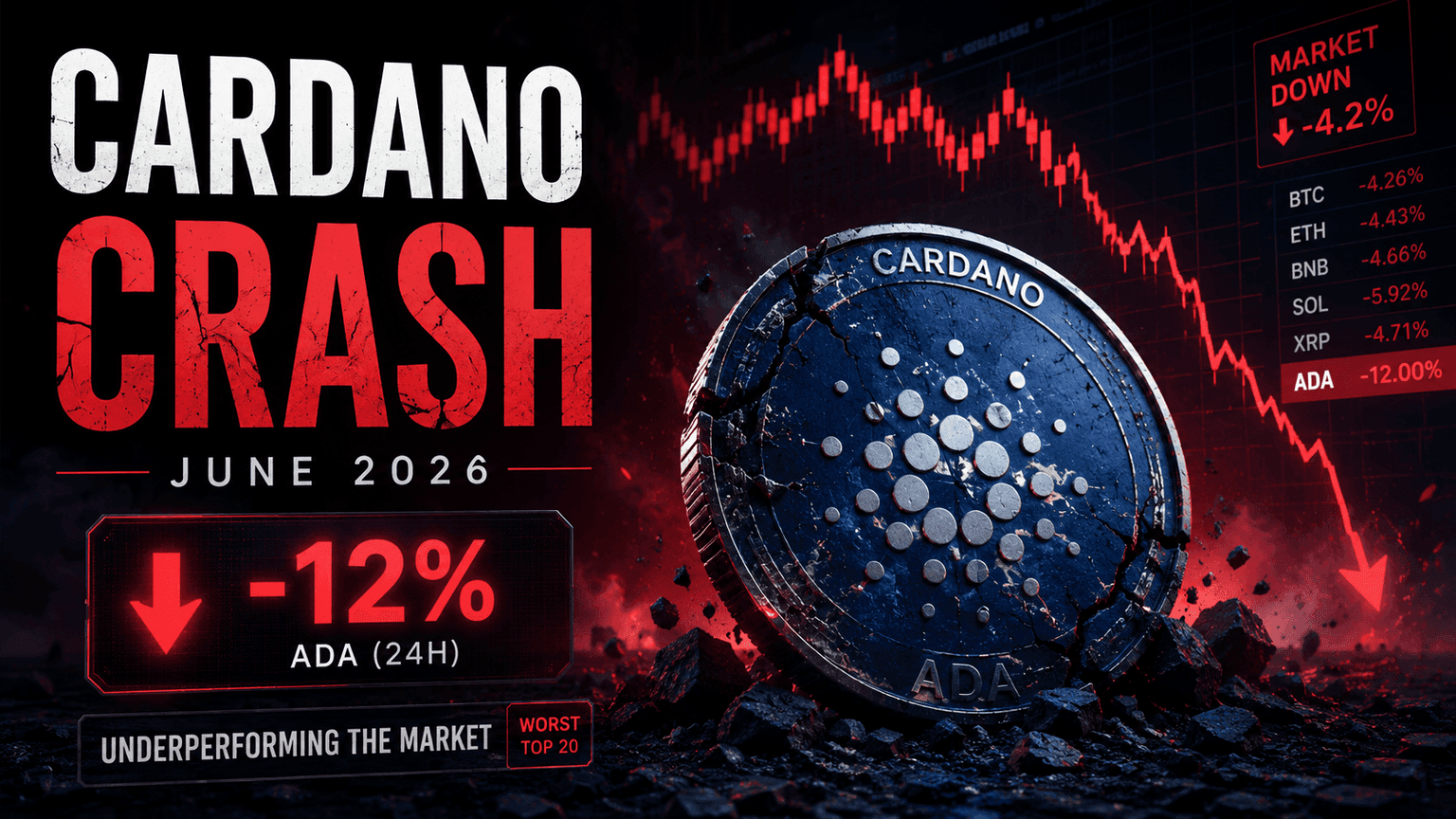
Cardano Crash June 2026: Why Is ADA Falling Harder Than the Crypto Market?
Cardano crash June 2026: ADA drops harder than Bitcoin and Ethereum as ecosystem fears, TapTools shutdown, and weak sentiment hit the market.
July 21, 2025 5:00 AM
Cardano Price Prediction: ADA Finally Wakes Up After Bitcoin ATH
Cardano has been lagging — until now. While Bitcoin topped out weeks ago, ADA is just starting to move. What’s next for the ADA price?
April 5, 2025 3:03 PM
Cardano Price Prediction 2025: Will BTC Integration Push ADA Price to $3 or $5?
Cardano price predictions for 2025 are heating up, with analysts pointing to a possible breakout between $3 and $5. And with the recent announcement by Charles Hoskinson, what to expect for ADA price?

More from CryptoTicker