
Cardano CIP-0113 live: issuers can now freeze and seize regulated tokens, ADA falls 10.3 percent
The Cardano Foundation activated the CIP-0113 standard on the mainnet on October 7, 2026: issuers can write freezing, seizure and KYC rules directly into a token, enforced by the network. ADA itself stays freely transferable and trades at $0.2294, 10.32 percent below the previous day.





Which topics should we dive deeper into?
Select what genuinely interests you. Your picks feed directly into our editorial planning.
Crypto news that's actually worth your time.
Weekly. 60 seconds. Carefully curated by our editors: no hype, no promo flood, no spam.
The Cardano Foundation activated the token standard CIP-0113 on the mainnet on October 7, 2026. It lets issuers write rules directly into a token: who may hold it, how much can be moved per transfer, and whether an authorised third party may freeze or seize it. The network enforces those rules itself on every transfer, every issuance and every burn.
The price of Cardano stands at $0.2294 at the same time, 10.32 percent below its level 24 hours earlier. The two have less to do with each other than the timing suggests. ADA itself does not fall under the new standard, and the daily loss fits into a market slide that has caught Bitcoin and Ether as well.
CIP-0113 on the mainnet: what the Cardano Foundation activated on October 7
What went live is a platform for so-called programmable tokens, together with the open standard CIP-0113. The specification defines programmable tokens as assets that "require the successful execution of a script in order to change owner". Behind that terse wording sits a shift: until now, enforcing rules was the job of whoever issued the token, or of the trading platform it ran through. In future it sits in the chain.
The step came without a hard fork. The specification explicitly describes the aim of modelling transfer logic with building blocks the protocol already has, rather than changing its rules. Programmable tokens remain native assets on Cardano and continue to run in the extended UTXO model. Wallets, explorers and applications therefore treat them technically like existing tokens.
The project is not new. The Cardano Foundation had already presented the platform and the standard on March 9, 2026, then connected to a preview environment on the preview testnet, without real funds. Between the March presentation and the October activation lie several independent security audits; the foundation has not named which auditors were involved. The Swiss Capital Markets and Technology Association has recognised the standard. On the tooling side, the wallets Eternl and GeroWallet, the block explorer CardanoScan and the developer library BloxBean are ready at launch.
Frederik Gregaard, chief executive of the Cardano Foundation, sums up the ambition in a quote carried by CoinCodex: "The rules have to travel with the asset and be enforced every time it moves."
Programmable tokens: how the network clears every change of owner
The mechanics are laid out in the specification. Programmable tokens sit at a shared script address, the programmableLogicBase. Every movement from there requires a call to a global logic, which passes the operation on to a responsible sub-function: one for ordinary transfers, one for third-party interventions, one for restructuring your own holdings.
Whether a transfer is permissible is decided by a token's own script, the transferLogicScript. The specification gives allow lists, per-transfer caps and compliance requirements as examples. Who may issue or burn tokens is governed by a second script, the issuanceLogicScript.
Registry proof: unregistered tokens continue to run like ordinary native assets
One point in the specification matters more to holders than any script name: a registration proof shows whether a token policy is registered at all. Only registered tokens have to execute the logic of their sub-standard. Unregistered tokens behave like ordinary native assets on Cardano, exactly as before. The new powers arise per token and only where an issuer has built them in. They do not apply across the board, nor retroactively.

Freeze and seize: the sub-standard that permits freezing, unfreezing and seizure
The core standard itself defines no freezing. Those functions sit in a sub-standard that the specification calls "Freeze and Seize" and that offers three operations: freeze, unfreeze and seize. The specification describes it as a simplified stablecoin contract with compliance functions. Such a sub-standard requires signatures from a defined circle of keys, called the "Substandard Admin" in the specification. Who sits in that circle is decided not by the standard but by the issuer.
For stablecoins and tokenized securities, that is the real purpose of the exercise. The specification's rationale names both groups explicitly and lists as a shortcoming that issuers using simple native tokens can neither enforce compliance requirements nor block balances.
thirdPartyLogicScript: when a third party moves tokens without the holder's consent
The most far-reaching power carries the name thirdPartyLogicScript in the specification. This power is optional and permits actions without the holder's permission. The specification explicitly lists seizure operations and forced transfers under it.
Partial seizure and wipe: partial confiscation, and seizure followed by burning
Several gradations are described. A partial seizure takes only a share of the holding. An operation designated "wipe" seizes and then burns. A "top-up" goes in the other direction and credits. One side condition in the specification is strikingly matter-of-fact: third-party interventions must actually change the balances concerned, so they may not pass through as an empty transaction.
Anyone who sees a resemblance here to familiar mechanisms on other chains is right. On Solana we described on September 13, 2026 how clawback and freeze functions work for tokenized assets there. The difference lies in the construction, not in the outcome: Cardano anchors the power in an open standard with sub-standards, rather than in extensions to a token program.
The BaFin standard in the specification: a compliance building block from FluidTokens
For German readers, the list of sub-standards contains an entry worth noting. The specification lists a "BaFin Standard" and describes it as a compliant token standard developed by FluidTokens. The name points to the Federal Financial Supervisory Authority as a benchmark, not to any involvement by the authority: the specification names FluidTokens as the developer, not BaFin.
In practice that means an issuer wanting to meet German requirements can take a ready-made rule set instead of writing its own logic. For the holder it means that a token on Cardano may in future sit behind a set of rules modelled on German supervisory law, complete with the blocking powers that go with it.
MiCA and anti-money-laundering rules: blocking functions are compulsory for issuers in the EU
Technical development is converging on the legal position here. Anyone issuing an asset-referenced token or an e-money token in the EU needs authorisation under the Markets in Crypto-Assets Regulation and must maintain procedures for implementing supervisory orders. European anti-money-laundering law additionally requires obliged entities to freeze funds connected with sanctions. A chain that cannot represent blocking powers in the first place turns both into a question of the issuer's goodwill.
The corollary is the more interesting one for holders: a token meant to be sound under supervisory law will as a rule be blockable. Blockability is no design flaw there; it is the condition of admissibility. Which stablecoins in Europe sit under which supervision is shown in our overview of stablecoins.
Portfolio position in Germany: which tokens on Cardano actually fall under CIP-0113
As of this article, the answer is manageable: almost none. The standard has been available on the mainnet for one day, and availability is not adoption. That Eternl, GeroWallet, CardanoScan and BloxBean support it says nothing about how many issuers will actually use it.
Three concrete questions follow for your holdings. First: if you hold ADA, there is nothing to do, because ADA is not a programmable token and remains freely transferable. Second: if you hold a stablecoin or a tokenized asset on Cardano, it pays to look into the issuer's terms to see whether it is switching to the new standard and which sub-standard it picks. Third: if a new tokenized fund or bond arrives on Cardano, the question of freezing and seizure powers belongs in your review before buying.
That your own keys only help so far is the uncomfortable part. Self-custody protects against a trading platform disposing of your holdings. It does not protect against a rule that sits inside the token itself, because the check happens in the protocol and not in the wallet. The limit of that protection is part of understanding the standard.
 Regulated crypto exchanges compared
Loan collateral and lending: what the implementation documents recommend to platforms
One pointer from the foundation's documents should be read by anyone who pledges tokens as loan collateral or accepts them. Lending platforms are advised to check a token's rule sets before accepting it as collateral, because certain configurations allow authorised third parties to move tokens without the holder's consent.
The consequence for a lending business is obvious. Collateral that a third party can seize is not reliable collateral. The specification writes the fitting sentence itself: integrators have to check third-party powers per sub-standard, because compliance with CIP-0113 alone does not answer that question. No provider currently raises the question of whether a pledged token can be seized.

Status "Proposed": the standard is not formally final yet
One detail tempers the assessment, and it comes from the specification itself. CIP-0113 carries the status "Proposed" there, in the Tokens category, filed on January 14, 2023 and submitted in answer to the problem statement CPS-0003. In March the foundation had said it was continuing to work on refining CIP-0113 into a production-ready standard.
A gap therefore exists between a standard with the status "proposed" and a platform running on the mainnet. That is not a contradiction, because a CIP changes its status late in the Cardano process, but it is a reason to wait for issuer announcements rather than infer a wave of regulated tokens from the activation. It also remains open who may change the protocol parameters: the specification does not fix the amendment power and requires every deployment to document it itself.
ADA at $0.2294: a 10.3 percent daily loss in a broad market slide
The price section belongs apart. ADA trades at $0.2294, 10.32 percent below its level 24 hours earlier, 5.54 percent below the previous week and 4.55 percent above its level 30 days ago. Market capitalisation stands at $8.61 billion, trading turnover over the past 24 hours at $597.6 million, and the rank at 17. The daily high was $0.2579. All figures are as of Thursday afternoon and move continuously.
The daily loss is no solo effort. Bitcoin stood at $81,265 on Thursday afternoon, down 2.54 percent, and Ether at $2,428, down 5.36 percent. We described the connection between outflows from Bitcoin index funds, the US Federal Reserve's rate path and the slide separately this morning. That ADA gives up more ground than the two largest crypto assets is the usual pattern in a market with waning risk appetite, where smaller assets swing harder.
Seeing a cause between the activation and the price move would be an assertion without foundation. None of the reports reviewed makes that connection, and one of them explicitly records that the price move provides no evidence of any effect from the switch. An expectation can be argued on the facts, however: if Cardano succeeds in attracting regulated issuers, demand arises for block space and therefore for ADA to pay transaction fees. Whether that happens depends on issuers, not on code.
What comes next: these signals show whether the standard finds users
Three things can be observed without relying on anyone's assessment. The first is the number of registered token policies, because the registration proof is publicly recorded in the chain. The second is announcements from stablecoin issuers and fund providers about a switch. The third is the change of status of CIP-0113 from proposal to adopted standard.
Until then, nothing changes for holders of ADA. For anyone buying tokenized assets on Cardano, one question is added that did not exist before: who besides me may move this token?
CIP-0113: only registered tokens carry the new blocking rules
- Classify your holdings. Check whether, besides ADA, you hold any tokens on Cardano that an issuer administers, meaning stablecoins or tokenized assets. Pure ADA holdings are unaffected.
- Read the issuer's terms. Look through the terms for freezing, seizure and transfer clauses, and for which sub-standard is in use. For self-custody and its limits, the hardware wallet comparison helps.
- Double-check collateral. If you pledge crypto assets or lend them out, establish in advance whether the token can be seized. The providers' terms are in the lending comparison.
The sources for this article are the specification CIP-0113 in the Cardano CIP registry and the Cardano Foundation's account of programmable tokens.
(As of October 8, 2026. This article is not investment advice. Prices and fee structures change; check the terms with the provider before you buy.)
 Hardware wallets compared: which device suits you
Programmable tokens move the enforcement of rules from the trading platform into the chain. For holders of ADA that changes nothing; for buyers of tokenized assets on Cardano one question is added that played no part before October 7, 2026: who besides me may move this token? The answer will from now on sit in the issuer's terms and in the sub-standard it picks.
Frequently asked questions about CIP-0113 on Cardano
Transparency note: This article was produced with the assistance of artificial intelligence and reviewed by our editorial team before publication. All figures and claims were checked against the primary sources linked in the text. The feature image was generated with AI.
Related articles
- Cardano Before the RealFi Launch on October 1: What ADA Holders Should Check on USDr, MiCA and Tax
- Cardano Price Prediction: ADA Eyes Breakout Above $1.50 Resistance for a Major Rally
- Cardano (ADA) Price Analysis: Will ADA Price Continue To Surge?
- Tokenized Assets on Solana: How to Check Whether Your Token Can Be Frozen or Clawed Back
- Cardano Slides Below $0.24: What ADA Holders Should Check on Leverage, Liquidation and Holding Period
Which topics should we dive deeper into?
Select what genuinely interests you. Your picks feed directly into our editorial planning.
Crypto news that's actually worth your time.
Weekly. 60 seconds. Carefully curated by our editors: no hype, no promo flood, no spam.

July 7, 2024 3:21 PM
XRP, DOGE, and ADA Price Prediction: A Fast Recovery BUT How Long Lasting?
The potential turnaround for XRP, Dogecoin, and Cardano as key metrics indicates a buying opportunity amidst the current market downturn. Here is the latest XRP, DOGE, and ADA price prediction and analysis for a better understanding.
September 12, 2024 4:06 PM
Cardano Price Surge: ADA Price Price Sees Explosive Volume and Gains
Cardano (ADA) price has seen huge growth, leading to hopes of a sustained uptrend. Will ADA break through key resistance levels?
July 11, 2024 5:00 PM
Cardano Price Analysis: Potential 10% Surge and Massive Whale Inflows
Cardano (ADA) shows potential for a 10% price rally and sees a massive 1,218% surge in whale inflows. Here are the technical analysis and whale activity driving ADA's bullish momentum.
May 4, 2024 12:21 PM
Cardano Price Prediction: Will Cardano reach $1 in 2024?
Will Cardano reach the $1 milestone by 2024? Let's delve into the factors influencing Cardano's trajectory and assess its potential in this Cardano price prediction.
November 25, 2024 4:31 PM

Cardano Price Prediction: Will ADA Hold the $1 Support Level?
Cardano (ADA) is struggling to maintain the $1 support level. What does the future hold for ADA? Read on for price predictions and resistance levels to watch.
July 21, 2025 5:00 AM
Cardano Price Prediction: ADA Finally Wakes Up After Bitcoin ATH
Cardano has been lagging — until now. While Bitcoin topped out weeks ago, ADA is just starting to move. What’s next for the ADA price?
November 21, 2024 3:34 PM
Cardano Price Soars 42% in a Week: Is the Momentum Shifting?
Cardano's price skyrocketed 42% in the past week, but a 5% dip in the last 24 hours raises concerns about its momentum. Can ADA sustain its growth, or is a correction on the horizon?
April 5, 2025 3:03 PM
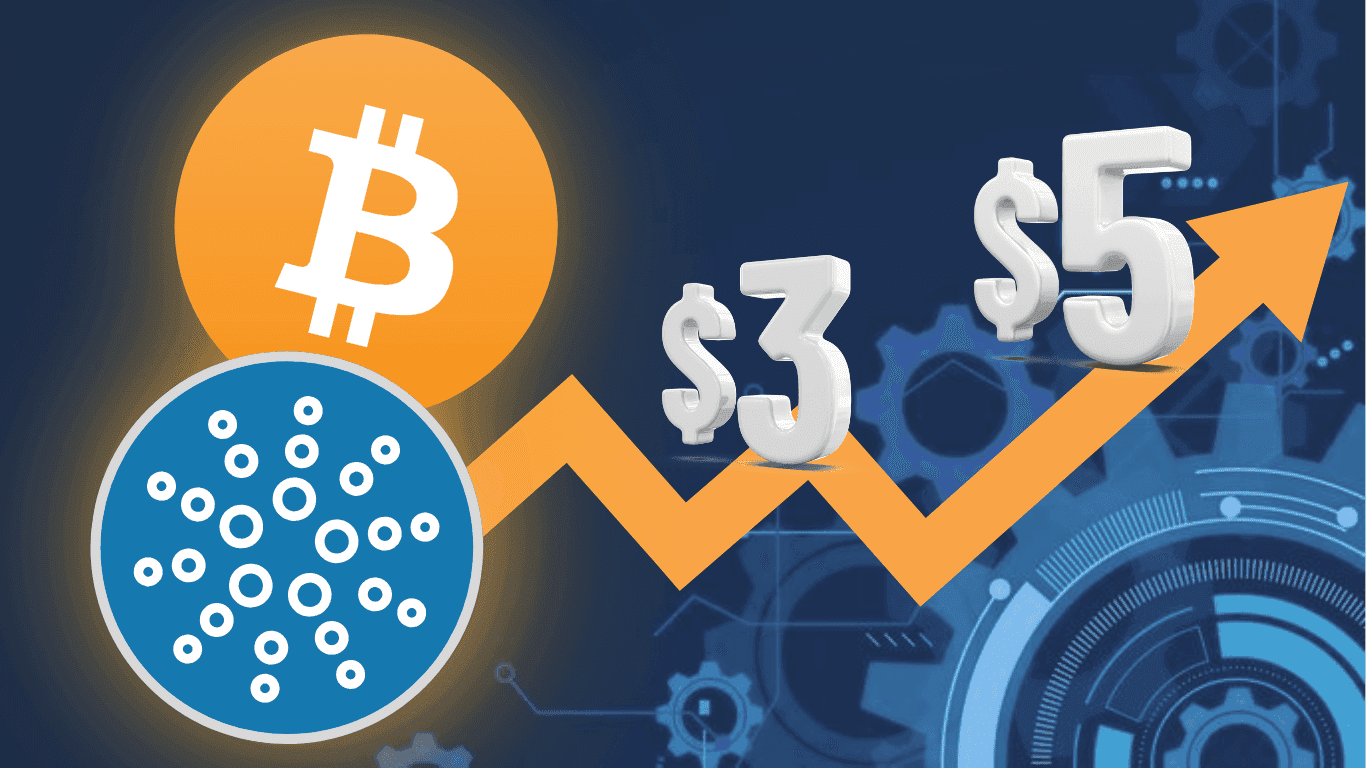
Cardano Price Prediction 2025: Will BTC Integration Push ADA Price to $3 or $5?
Cardano price predictions for 2025 are heating up, with analysts pointing to a possible breakout between $3 and $5. And with the recent announcement by Charles Hoskinson, what to expect for ADA price?
September 23, 2026 7:36 AM

Cardano Price Prediction: ADA Rockets 30% as Bulls Eye the Next Big Target
Cardano price jumped over 30% in a week, reclaiming the 200 EMA. Here's what's driving ADA and the price targets traders are watching next.
February 23, 2025 10:39 AM
Cardano Price Prediction and the Rise of a New Altcoin in 2025
Here is the latest Cardano (ADA) price prediction and how a new altcoin is poised to redefine crypto investments in 2025, blending technical analysis with emerging market trends.
July 24, 2025 6:00 AM
From Resistance to Adoption: Banks Enter a New Crypto Era
The world’s biggest banks are no longer resisting crypto — they’re embracing it. From JPMorgan to BNY Mellon, a new banking era is unfolding with full-scale crypto adoption and tokenized finance.

September 17, 2024 6:38 PM

Breaking News: More than 50 Crypto Tokens including ADA, LUNA, and TRX Now Considered Securities by the US SEC
US SEC has declared over 50 tokens, including ADA, LUNA, and TRX, as securities. Let's take a look at these crypto tokens as securities.
July 21, 2024 6:37 PM

MAJOR Ripple News: How Will These Developments Impact XRP Price?
New developments involving Ripple could have a huge impact on XRP price. What are they and how will XRP price react to this?
February 25, 2025 1:37 PM
Cardano Price Prediction: ADA Crashed hard But This Might be Next!
Cardano crashes below $0.70, currently trading at $0.66 after a 10% drop in 24 hours. Analysts warn ADA could fall further to $0.40 if market conditions worsen.
February 26, 2026 4:18 PM
Cardano Price Analysis: ADA Jumps 8% as Bulls Eye $0.30 Breakout
Cardano (ADA) surges 8% to $0.29. Analysts eye the $0.30 resistance as a make-or-break point for the next major price move toward $0.35.
October 7, 2025 11:36 AM
Cardano Price Prediction: ADA Eyes a Breakout as Bitcoin Hits $126K
Cardano price prediction: ADA bounces from $0.85 support amid Bitcoin’s new $126K ATH. Can ADA retest $0.90 or fall back to $0.80?
June 4, 2026 3:54 PM
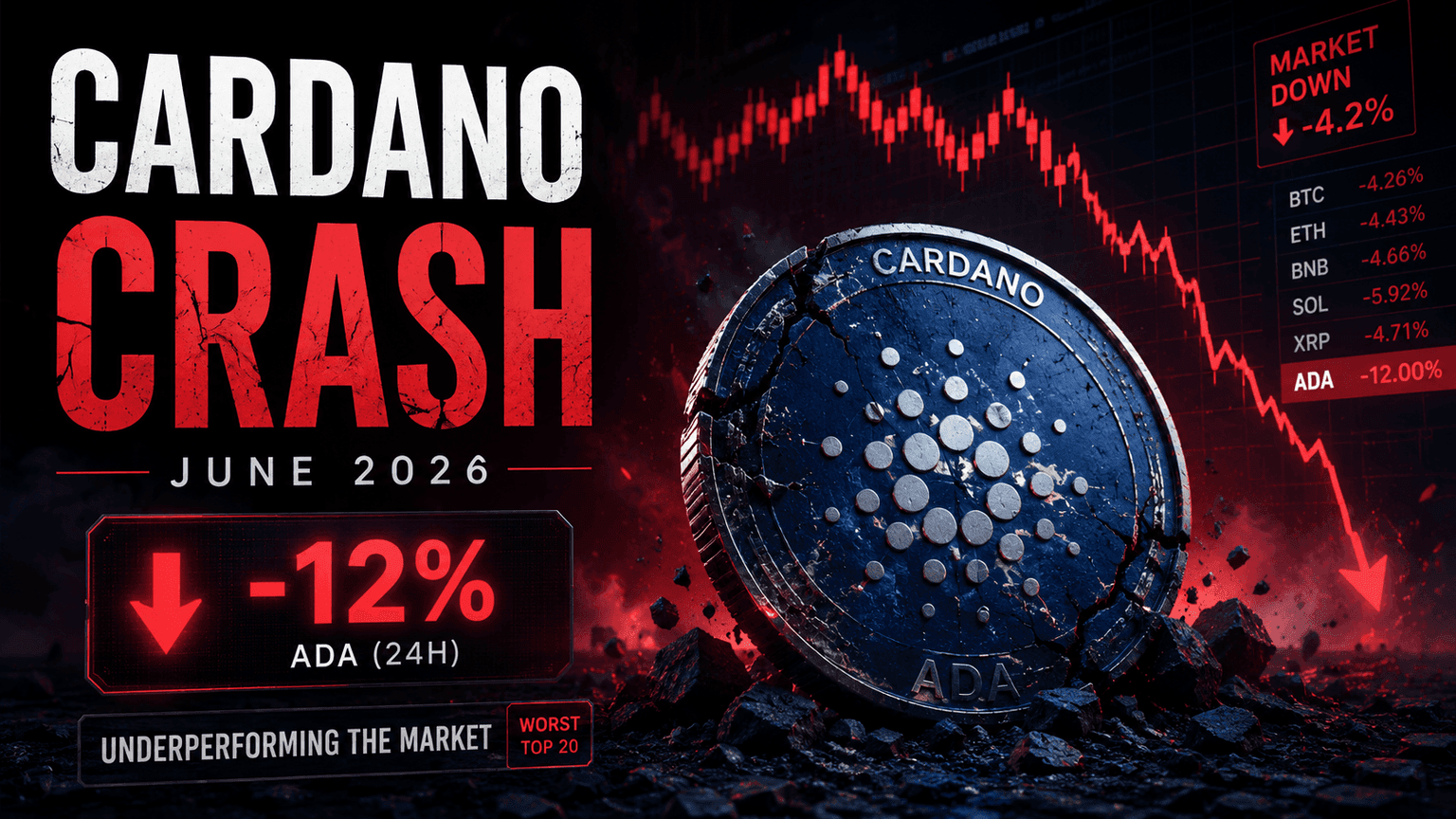
Cardano Crash June 2026: Why Is ADA Falling Harder Than the Crypto Market?
Cardano crash June 2026: ADA drops harder than Bitcoin and Ethereum as ecosystem fears, TapTools shutdown, and weak sentiment hit the market.

May 6, 2026 7:36 AM
Cardano Price Analysis: ADA Breaks $0.25 Resistance as Analysts Predict a Strong Bullrun
Cardano (ADA) surged to $0.263, clearing a major hurdle at $0.25. Technical indicators suggest the beginning of a sustained bullish trend for ADA holders.
March 31, 2026 9:45 AM
Cardano (ADA) Down 60%: Is Cardano Dead or Set for a Comeback in 2026?
Cardano (ADA) is down over 60% yearly. Is ADA dead, or preparing for a rebound? Key levels, Iran war impact, and price targets ahead.
October 22, 2025 12:09 PM
Cardano Price Prediction: ADA Price Drops to CRITICAL Level as Bitcoin Crashes
Cardano price prediction as ADA falls 9% after Bitcoin’s crash to $107K. Will ADA hold $0.62 support or rebound toward $0.71 resistance?
November 23, 2024 10:54 AM
Cardano Price Prediction: ADA Price Breaks $1 Amid Renewed Crypto Optimism
Cardano (ADA) has smashed the $1 milestone, hitting $1.13 after months of consolidation. Renewed crypto optimism in the US and globally fuels the rally.
August 18, 2024 7:30 PM
Cardano Price Prediction: Will ADA Hit $0.40 After Recent Breakout?
With Cardano breaking out of consolidation, can it reach $0.40 soon? Let's analyze in this cardano price prediction article.
March 13, 2026 2:43 PM
Cardano Price Prediction: Can ADA Price Reach $0.40 Amid Bitcoin’s Rally?
Cardano (ADA) eyes a breakout to $0.40 as Bitcoin nears $73,000. Here's an analysis of ADA price chart and market trends in our latest Cardano news update.
September 7, 2025 3:30 PM
Cardano Price Prediction: Can ADA Hold Its Ground Above $0.80?
The crypto market stalls as Bitcoin consolidates above $110K. Cardano trades around $0.82—can ADA break resistance or risk a drop in the short term?
May 30, 2025 2:33 PM
Cardano Price Prediction: Will ADA Crash to $0.35?
Cardano (ADA) is losing momentum as bearish pressure builds and support levels are broken. But could ADA fall as low as $0.35?
March 22, 2025 7:00 PM

Cardano Price Prediction: ADA Price Setting Up for a Strong Comeback at THIS Level
Cardano (ADA) surged 100% earlier this year but has since returned to its $0.70 consolidation zone. Will this support level hold, and what does the future hold for ADA?

October 3, 2026 4:41 AM

Cardano Price Prediction: ADA Stays Below $0.26 Despite Petrobras and the Japan Deal
Petrobras is testing Cardano for tracking aviation fuel, and the Cardano Foundation is bringing in a partner in Japan. The price barely reacts: ADA is clinging to its 200-day moving average. Which levels count now and why the news is not yet carrying the price.
More from CryptoTicker