
Cardano: 91.5 percent of the spending cap is committed, 42.6 million ADA remain
Of the 500 million ADA Cardano may spend in the current budget period, 457.4 million are committed through approved payouts. A single proposal for 22 million ADA is still up for a vote, and it lapses in mid-November.





Which topics should we dive deeper into?
Select what genuinely interests you. Your picks feed directly into our editorial planning.
Crypto news that's actually worth your time.
Weekly. 60 seconds. Carefully curated by our editors: no hype, no promo flood, no spam.
The community treasury of Cardano has almost exhausted its own spending allowance. Of the 500 million ADA the network has permitted itself for the current budget period, 457,395,629 ADA are committed through approved payouts. That is 91.5 percent. What remains is 42,604,371 ADA, around $9.5 million at the current price, and that remainder is meant to last until the period ends in the summer of 2027.
If you hold ADA, this is no administrative footnote. The treasury funds the developers, the infrastructure and the marketing behind the network. When the allowance grows tight, the coming votes decide whether work under way keeps being paid for or stands still for months.
What the Net Change Limit governs at Cardano
The Net Change Limit, NCL for short, is the ceiling on everything that may flow out of the Cardano treasury within a defined span of time. It does not cap the treasury balance itself, but the sum of approved payouts in that period.
The current limit is 500 million ADA and applies to epochs 613 to 713. An epoch at Cardano lasts five days. The period began on 13 February 2026 and ends, on this count, at the end of June 2027. For comparison: the limit for the preceding period was 350 million ADA, so the increase amounts to a good 43 percent.
The figure was settled not through a protocol change but through what is known as an InfoAction. That is a governance proposal with no technical effect, by which the community puts a direction on record. In epoch 647, 62.35 percent of the stake-weighted DRep voting power supported it, CryptoSlate reports. Every individual payout still needs the approval of the DReps and the constitutional committee afterwards.
457 million ADA from 30 approved payouts
cryptoticker.io has analysed the public governance data of the Cardano blockchain, examining all 105 payout proposals submitted since Conway governance began. cryptoticker.io compiled this analysis itself on 17 October 2026.
The result for the current year: 30 proposals were enacted, together 457,395,629 ADA. The largest single item is a payout of 120 million ADA to the AlphaGrowth Cardano PRIME programme, approved in July. Behind it come 62.1 million ADA for the maintenance initiative run by Input Output and Ensurable Systems, 50 million ADA for the joint fund with Draper Dragon and 32.9 million ADA for the Cardano Vision 2026 programme.
Across the whole stretch since 2025, the 70 enacted payouts add up to 804,427,136 ADA. The figures rest on the proposals as submitted; what counts in each case is the amount stated in the proposal.
Treasury and spending cap are two different things
One confusion is worth avoiding, because it crops up regularly in discussion forums. The treasury balance stood at around 1.378 billion ADA in epoch 661 and has in fact risen against epoch 650, from about 1.337 billion ADA.
The treasury fills up continuously from transaction fees and from the protocol's reserves. The spending cap moves independently of that: inflows, donations and returned grants do not free it up again. The network therefore has ample money, but in this period may spend only another 42.6 million ADA of it.

29 failed proposals worth 230 million ADA
The second half of the analysis explains why the allowance has not long since been blown despite the high number of proposals. In the current year, 29 proposals worth 230,725,260 ADA in total expired without securing the necessary approval. Against 30 approved proposals stands almost the same number of failed ones.
The most recent case concerns a payout of 11,787,063 ADA for deploying the security firm OpenZeppelin in the Cardano environment. The proposal expired in epoch 661. Before that, among others, a 20 million ADA envelope for the Cardano Builder DAO, 39.8 million ADA for Tweag's infrastructure work and several attempts to fund the Cardano Summit 2026 all failed.
DReps rejecting proposals is everyday business at Cardano, not an emergency. How the voting weights come about and what role the constitutional committee plays in it, we set out in our piece on the DRep vote about the constitutional committee.
The open proposal: 22 million ADA for tokenised copper
Exactly one payout proposal is currently up for a vote, and it is an unusual one. Under the title Cardano Strategic Copper Reserve, the US company Toto Finance Inc. asks for a one-off payout of 22,000,000 ADA, about $4.9 million at the current price.
With the money, according to the proposal, certified COMEX grade 1 copper cathodes are to be bought, stored in an approved US warehouse and represented as tokens under the ticker CuTT on Cardano. One token is to stand economically for one certified pound of copper. The proposal names a holding period of 18 to 24 months and provides for returning the proceeds of the later sale, together with unspent funds, to the treasury by month 36.
The breakdown is itemised in the proposal: 14,724,409 ADA or 66.93 percent for the copper itself, 2,640,000 ADA for technology and project management by Toto Finance, 3,533,859 ADA for external operations and auditing, 441,732 ADA for execution and 660,000 ADA for independent administration. Independent oversight is to be appointed; the proposal names a US member firm of PwC as preferred, without any engagement being in place.

Were the proposal to pass, 20,604,371 ADA would be left under the cap for the rest of the period. That is why this single vote draws more attention than its sum might at first suggest.
 Compare the best crypto exchanges for ADA
The timetable up to mid-November
The proposal was submitted in epoch 661 and lapses if it finds no majority by the start of epoch 668. On the blockchain's current pace, that transition falls on 15 November 2026. Until then DReps can cast their votes and change them again.
The current epoch 662 ends on 21 October. Every epoch boundary is a possible moment for ratification, because Cardano evaluates votes at the epoch boundary. That means the dates to watch are 21 October, 26 October and the following five-day steps up to mid-November.
You can check the state of every vote yourself, without relying on reports. The official governance interface GovTool lists the proposals with vote tallies and deadlines.
ADA at $0.2233, almost 13 percent below the weekly high
ADA costs $0.2233, according to CoinGecko on Saturday morning. Over seven days it is down 11.96 percent, over 24 hours down 3.38 percent. The weekly high was $0.2557, the weekly low $0.2188. That puts the price 12.7 percent below the high and only 2.0 percent above the low.
Over 30 days the arithmetic looks different: there, a gain of 12.56 percent still stands. Market value is $8.39 billion, which means rank 17. In circulation are 37.56 billion ADA out of a maximum of 45 billion.
No direct connection between the budget position and the week's price action can be drawn from these figures. The setback fell in a week in which Bitcoin and Ether also gave ground.
Levels above and below
On the downside the weekly low at $0.2188 is the next level to watch, behind it the round $0.20 mark. On the upside lies the weekly high at $0.2557, and before it the $0.25 mark, where the price last lingered on 12 October.
These are observation points from the week's course, not price targets. How the levels have developed over recent months is shown by our continuously maintained overview of the ADA price.
Buying route, custody and holding period in Germany
If you want to buy ADA in Germany, the usual route runs through an exchange with MiCA authorisation. Since the regulation took hold, providers addressing customers in the EU need a licence from a European supervisor; in Germany that is BaFin. Which providers are licensed and how their fees differ is set out in our crypto exchange comparison.
One point counts more often at ADA than at other coins: governance runs on delegated stake. Leave your ADA sitting at an exchange and you generally leave it to the exchange whether, and to whom, the voting right is delegated. To vote yourself or appoint a DRep, you need your own wallet. How staking returns differ between providers is shown by the staking platform comparison.
For tax, the one-year period under section 23 of the German Income Tax Act still applies: hold for longer than twelve months and you pay no income tax on the gain. Whether the rule survives is politically open; we have gathered the state of the debate in our piece on the reform of the crypto holding period. Staking can touch the period, so with larger holdings it is worth looking at your own tax documentation before you delegate.
Leveraged products on ADA also exist. There, the distance to the liquidation price decides whether a move of a few percent ends the position. With a coin that loses 12 percent inside a week, that distance is used up quickly.
 Find the right staking platform for your ADA
Cardano budget: 42.6 million ADA of room left until the end of June 2027
The spending allowance is 91.5 percent committed, the treasury itself is well filled, and the last open proposal will be decided by 15 November at the latest. Three things are worth taking from this:
- Keep an eye on the voting dates. Every epoch boundary from 21 October onwards can decide the copper proposal. Anyone holding ADA through an exchange who wants a say should first check whether the provider passes the voting right on at all: a point the exchange comparison lists per provider.
- Settle your own custody. At Cardano, governance and staking hang on the same key. To delegate yourself you need a wallet under your own control; the differences in returns are shown by the staking comparison.
- Count the holding period in. Before a sale it is worth checking the acquisition date, because after twelve months no income tax falls due on the gain in Germany. The state of the political debate is in the overview of the holding period.
What follows in the summer of 2027 is open. Towards the end of the period at the latest, the community will have to vote on a new allowance, and the experience of the past two rounds shows that this is no formality either.
(As of October 17, 2026. This article is not investment advice. Prices and fee structures change; check the terms with the provider before you buy.)
Frequently asked questions about Cardano
Transparency note: This article was produced with the assistance of artificial intelligence and reviewed by our editorial team before publication. All figures and claims were checked against the primary sources linked in the text. The feature image was generated with AI.
Related articles
- Cardano Jumps 11 Percent: What ADA Holders Should Check Before the Treasury Vote on October 11
- Cardano Breaks Its 2021 Transaction Record: 1.78 Million in Five Days, Vote Lapsed
- Cardano Vote on the 75 ADA Minimum Fee Stands at 34 Percent: What ADA Delegators Need to Know Before October 11
- Cardano Price Analysis: Potential 10% Surge and Massive Whale Inflows
- Cardano Price Prediction: ADA Slides as Treasury Proposal and Geopolitics Shake Confidence
Which topics should we dive deeper into?
Select what genuinely interests you. Your picks feed directly into our editorial planning.
Crypto news that's actually worth your time.
Weekly. 60 seconds. Carefully curated by our editors: no hype, no promo flood, no spam.

September 24, 2026 1:34 PM

Cardano Slides Below $0.24: What ADA Holders Should Check on Leverage, Liquidation and Holding Period
Cardano has given back its move above $0.25 and trades around seven percent below the high of the past 24 hours. What that means for leveraged positions, the holding period of your tranches and the buying route under MiCA.
October 15, 2026 7:22 AM

Cardano breaks the $0.2439 level: ADA is falling more than twice as fast as Bitcoin
Cardano has lost 7.13 percent over 24 hours to $0.2207 and now stands at its lowest since September 18. Bitcoin gave up only 2.95 percent in the same period, and our own count shows 15 of the 20 largest coins falling harder than BTC.
October 5, 2026 4:15 AM

Cardano DEX volume halves since October 1, ADA up 6 percent: why the rally is not on-chain
ADA gains 6.29 percent to $0.2597 and is the strongest asset in the top 25. Trading volume on the Cardano venues, however, has fallen from $11.74 million to $5.72 million since October 1.

July 7, 2024 3:21 PM
XRP, DOGE, and ADA Price Prediction: A Fast Recovery BUT How Long Lasting?
The potential turnaround for XRP, Dogecoin, and Cardano as key metrics indicates a buying opportunity amidst the current market downturn. Here is the latest XRP, DOGE, and ADA price prediction and analysis for a better understanding.
March 5, 2025 9:31 PM

Cardano Price Prediction: ADA Eyes Breakout Above $1.50 Resistance for a Major Rally
Cardano (ADA) is showing strong bullish signals, with analysts eyeing a breakout above $1.50. If ADA surpasses this resistance, a surge toward $2.50 could be in play.
September 12, 2024 4:06 PM
Cardano Price Surge: ADA Price Price Sees Explosive Volume and Gains
Cardano (ADA) price has seen huge growth, leading to hopes of a sustained uptrend. Will ADA break through key resistance levels?
February 15, 2025 3:01 PM

Ethereum News: NYSE Proposes Staking Rule and Pectra Launches on Sepolia while ETH Price Defends Key Zone
Ethereum is making headlines with its latest news, the NYSE rule change proposal in Grayscale's Spot Ether ETF, and Pectra launch ready on Sepolia in March 2025. All that while ETH defends a critical price zone amid market volatility...
May 4, 2024 12:21 PM

Cardano Price Prediction: Will Cardano reach $1 in 2024?
Will Cardano reach the $1 milestone by 2024? Let's delve into the factors influencing Cardano's trajectory and assess its potential in this Cardano price prediction.
November 25, 2024 4:31 PM

Cardano Price Prediction: Will ADA Hold the $1 Support Level?
Cardano (ADA) is struggling to maintain the $1 support level. What does the future hold for ADA? Read on for price predictions and resistance levels to watch.
July 21, 2025 5:00 AM
Cardano Price Prediction: ADA Finally Wakes Up After Bitcoin ATH
Cardano has been lagging — until now. While Bitcoin topped out weeks ago, ADA is just starting to move. What’s next for the ADA price?
November 21, 2024 3:34 PM

Cardano Price Soars 42% in a Week: Is the Momentum Shifting?
Cardano's price skyrocketed 42% in the past week, but a 5% dip in the last 24 hours raises concerns about its momentum. Can ADA sustain its growth, or is a correction on the horizon?
April 5, 2025 3:03 PM
Cardano Price Prediction 2025: Will BTC Integration Push ADA Price to $3 or $5?
Cardano price predictions for 2025 are heating up, with analysts pointing to a possible breakout between $3 and $5. And with the recent announcement by Charles Hoskinson, what to expect for ADA price?
September 23, 2026 7:36 AM

Cardano Price Prediction: ADA Rockets 30% as Bulls Eye the Next Big Target
Cardano price jumped over 30% in a week, reclaiming the 200 EMA. Here's what's driving ADA and the price targets traders are watching next.
February 23, 2025 10:39 AM
Cardano Price Prediction and the Rise of a New Altcoin in 2025
Here is the latest Cardano (ADA) price prediction and how a new altcoin is poised to redefine crypto investments in 2025, blending technical analysis with emerging market trends.
February 25, 2025 1:37 PM
Cardano Price Prediction: ADA Crashed hard But This Might be Next!
Cardano crashes below $0.70, currently trading at $0.66 after a 10% drop in 24 hours. Analysts warn ADA could fall further to $0.40 if market conditions worsen.
February 26, 2026 4:18 PM
Cardano Price Analysis: ADA Jumps 8% as Bulls Eye $0.30 Breakout
Cardano (ADA) surges 8% to $0.29. Analysts eye the $0.30 resistance as a make-or-break point for the next major price move toward $0.35.
October 7, 2025 11:36 AM
Cardano Price Prediction: ADA Eyes a Breakout as Bitcoin Hits $126K
Cardano price prediction: ADA bounces from $0.85 support amid Bitcoin’s new $126K ATH. Can ADA retest $0.90 or fall back to $0.80?
June 4, 2026 3:54 PM
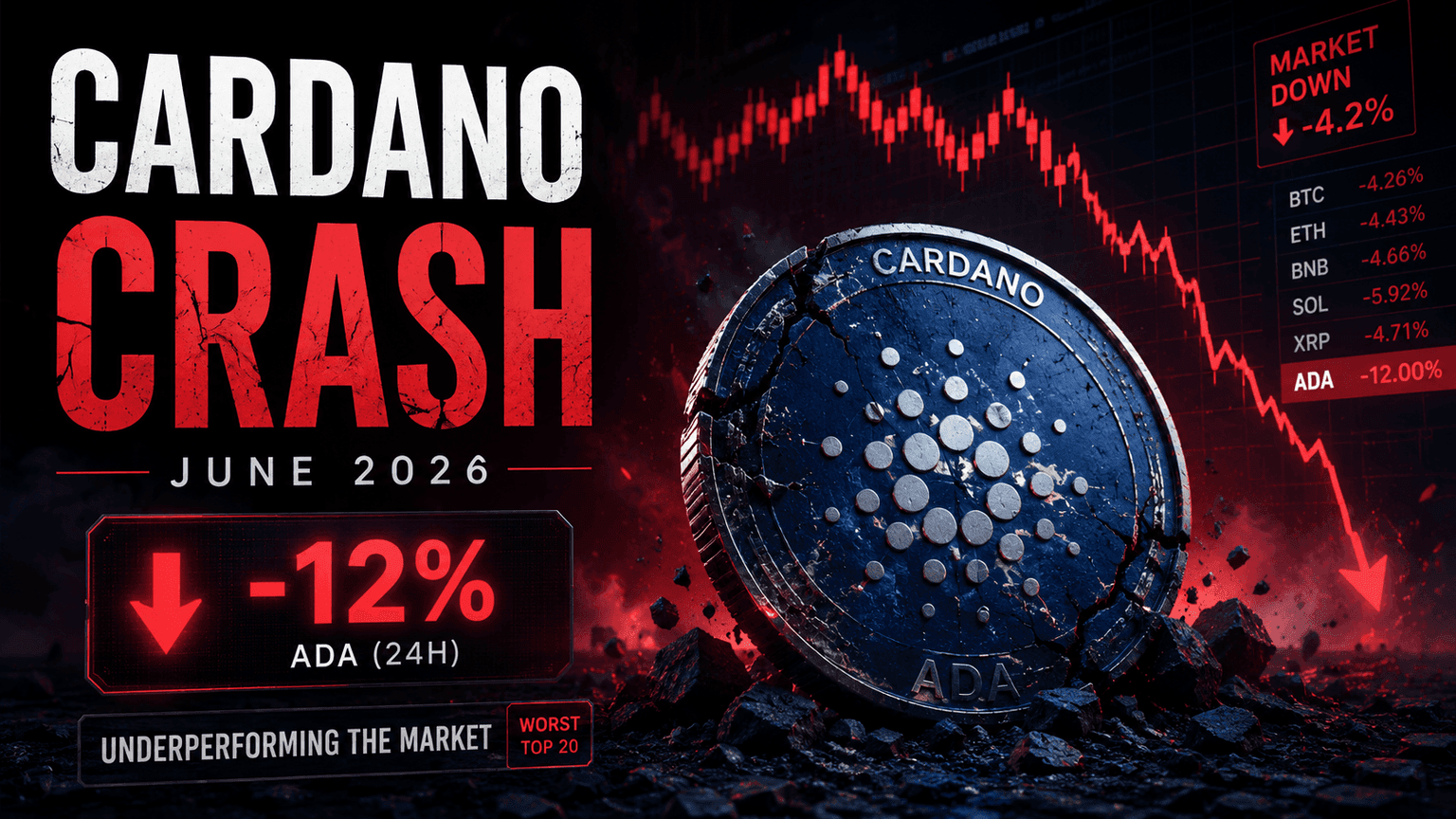
Cardano Crash June 2026: Why Is ADA Falling Harder Than the Crypto Market?
Cardano crash June 2026: ADA drops harder than Bitcoin and Ethereum as ecosystem fears, TapTools shutdown, and weak sentiment hit the market.

May 6, 2026 7:36 AM
Cardano Price Analysis: ADA Breaks $0.25 Resistance as Analysts Predict a Strong Bullrun
Cardano (ADA) surged to $0.263, clearing a major hurdle at $0.25. Technical indicators suggest the beginning of a sustained bullish trend for ADA holders.
September 25, 2024 3:09 PM
Cardano (ADA) Price Analysis: Will ADA Price Continue To Surge?
Cardano (ADA) continues its steady rise. But how can Argentina’s potential CBDC could impact ADA’s future?
March 31, 2026 9:45 AM
Cardano (ADA) Down 60%: Is Cardano Dead or Set for a Comeback in 2026?
Cardano (ADA) is down over 60% yearly. Is ADA dead, or preparing for a rebound? Key levels, Iran war impact, and price targets ahead.
October 22, 2025 12:09 PM
Cardano Price Prediction: ADA Price Drops to CRITICAL Level as Bitcoin Crashes
Cardano price prediction as ADA falls 9% after Bitcoin’s crash to $107K. Will ADA hold $0.62 support or rebound toward $0.71 resistance?
November 23, 2024 10:54 AM

Cardano Price Prediction: ADA Price Breaks $1 Amid Renewed Crypto Optimism
Cardano (ADA) has smashed the $1 milestone, hitting $1.13 after months of consolidation. Renewed crypto optimism in the US and globally fuels the rally.
August 18, 2024 7:30 PM
Cardano Price Prediction: Will ADA Hit $0.40 After Recent Breakout?
With Cardano breaking out of consolidation, can it reach $0.40 soon? Let's analyze in this cardano price prediction article.
March 13, 2026 2:43 PM
Cardano Price Prediction: Can ADA Price Reach $0.40 Amid Bitcoin’s Rally?
Cardano (ADA) eyes a breakout to $0.40 as Bitcoin nears $73,000. Here's an analysis of ADA price chart and market trends in our latest Cardano news update.
More from CryptoTicker