
Cardano treasury: 115,172 ADA flow back, what changes for delegators
For the first time a budget managed by Intersect has returned money to the Cardano treasury, 115,172 ADA from 2025. The amount is tiny, the event is not: it shows for the first time that the contract's clawback really works.





Which topics should we dive deeper into?
Select what genuinely interests you. Your picks feed directly into our editorial planning.
Crypto news that's actually worth your time.
Weekly. 60 seconds. Carefully curated by our editors: no hype, no promo flood, no spam.
A note on how to read this piece. On the record: on October 20 and 21, 2026 the organisation Intersect returned 55,172 and 60,000 ADA to the Cardano treasury in two transfers, 115,172 ADA in total out of the 2025 budget of the Cardano Product Committee. Our own reading follows further down: for the price this amount means nothing; for the question of whether Cardano's budget contract is more than a promise, it means a good deal.
The transaction is documented in the Intersect Weekly Update 134 of October 24, 2026. It was the first time the SweepTreasury function ran on mainnet, and the first time funds managed by Intersect travelled back that way. On Monday afternoon Cardano traded at $0.2056, 0.6 percent above the previous day, with a daily high of $0.2073 and a daily low of $0.2011 (CoinGecko, October 27, 16:44 UTC).
SweepTreasury: how 115,172 ADA came back into the Cardano treasury
Cardano pays for its development out of a treasury the blockchain fills itself. Part of every transaction fee and a yearly shrinking share of the never-issued reserve flow into it. Anyone who wants money out submits a proposal, and the network's voters decide on it. Since 2025 approved funds no longer land directly with the recipient but in a contract.
That contract is called the Treasury Reserve Smart Contract, TRSC for short. A Treasury Reserve Smart Contract is a program on the Cardano blockchain that holds approved budget funds and only passes them on once an agreed condition is met. It knows four functions: Fund fills it, Disburse pays out to projects, Reorganize rearranges the amounts it holds, and SweepTreasury sends back whatever is left at the end.
Three of those four functions were in use. The fourth was not. SweepTreasury had sat in the code since the contract was set up without ever being used on mainnet, simply because no budget had been closed out yet. With the Product Committee's 2025 year-end close, the first pot was empty enough to send the remainder back.
Treasury Reserve Smart Contract: what the contract does technically
The mechanism is the actual news value here, not the amount. With most blockchain treasuries the rule is: once approved and transferred, money is gone. A project that does not spend its funds keeps them on its address anyway, and the community has to trust that someone sends them back voluntarily.
Cardano cast that step into code in 2025. Intersect works with two contract types: the TRSC as a holding pool for the approved total, and the Project-Specific Smart Contract, PSSC for short, for the individual undertaking. A service provider only receives its money once the milestone stored in the contract has been reached. For the 2026 budget year Intersect reports that every budget project has such an on-chain contract, 25 contracts with service providers in total.
That the return path has now run once turns the commitment into a verifiable fact. Whether a contract works is shown in the end by the first transfer that uses it, not by the announcement beforehand. That transfer has been in the blockchain since October 21.
Why $23,700 is nonetheless a small number
At Monday afternoon's price, 115,172 ADA are worth about $23,700. That is the price of a mid-range car, not of a budget line. Anyone selling this as a turning point in Cardano's treasury position is overstretching it.
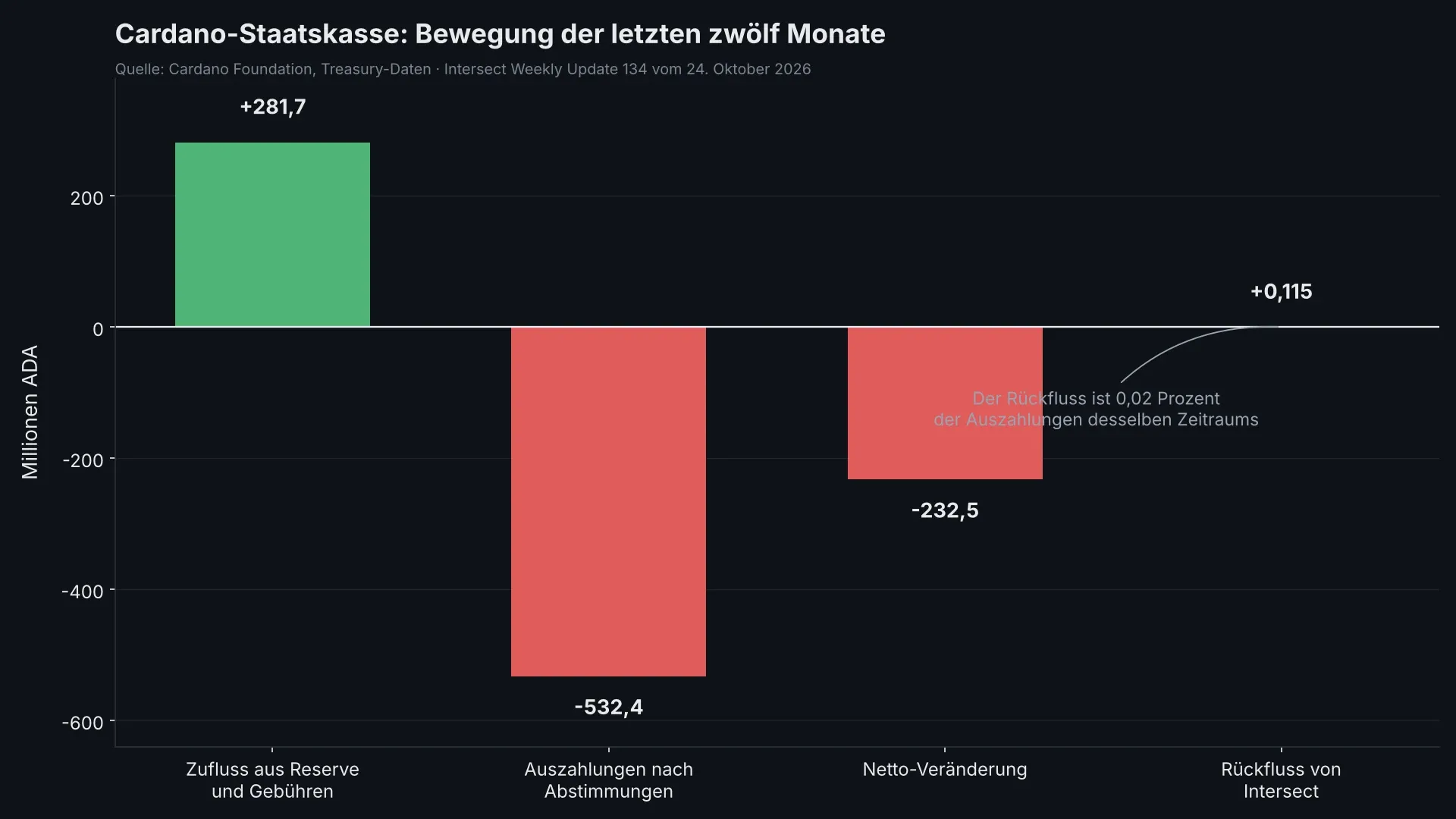
The Cardano treasury is shrinking: 232.5 million ADA less in twelve months
The Cardano Foundation's treasury figures show the order of magnitude. Over the past twelve months roughly 281.7 million ADA flowed in from the reserve and from fees. Over the same period 532.4 million ADA flowed out through approved proposals. The bottom line is a decline of 232.5 million ADA, leaving a balance of around 1.4 billion ADA. On top of that came donations of 21.3 million ADA up to epoch 657.
Against 532.4 million ADA paid out, 115,172 ADA returned amount to 0.02 percent. The proposal for the strategic copper reserve currently up for a vote is, at 22 million ADA, 191 times the size of that first return flow on its own.
 Find a platform for your ADA staking
Three treasury proposals are running, each with its own deadline
For ADA holders the more interesting half of this news concerns the money that is about to go out. As of October 22, Intersect lists three ongoing votes on payouts from the treasury:
- Cardano Strategic Copper Reserve, 22 million ADA, expiring on November 15, 2026 with the end of epoch 668.
- AURORA, a payout from the treasury, expiring on November 20, 2026 with epoch 669.
- PFMS by Trivolve Tech, a payout from the treasury, likewise until November 20, 2026.
We described the copper proposal in detail on October 24: it wants to swap 22 million ADA into tokenised copper, and for holders to see their money again, copper would have to rise well above its all-time high. The particulars are in our piece on the Cardano vote on the copper reserve.
What has changed since our copper article
On October 24, when we wrote about the copper proposal, ADA stood at $0.2107 and the market value at $7.91 billion. On Monday afternoon it is $0.2056 and $7.73 billion, so 2.4 percent less in three days. The proposal itself remains open and unchanged, the deadline has shortened by three days. What has been added since is the return flow from the 2025 budget, and a governance hour on the copper reserve that Intersect scheduled for October 27 at 16:30 UTC.
Looking further back, to our piece of October 20 on DeFi capital and Cardano's market value, the market value then stood at $8.19 billion. Since then 5.6 percent has melted away, without anything fundamental shifting in the treasury itself.

DRep delegation: how ADA holders assign their voting rights
The network votes on these proposals, not the Cardano Foundation and not Intersect. Every ADA carries voting weight, but only if its owner assigns that weight to someone. A DRep, short for Delegated Representative, is an address in the network that votes on behalf of delegated ADA voting weight. Do nothing, and your voting weight lies idle.
This is the point at which an ADA holder can decide something today. Delegation works in wallets with a governance function and moves no coins: the ADA stay on your own address, do not leave the wallet and are not locked either. What is transferred is solely the right to vote with their weight, and it can be moved to another address at any time.
Three routes are open. Either you give your weight to a DRep whose voting record you can look up on the network's governance portals. Or you register as a DRep yourself and vote directly. Or you pick one of the two predefined stances: always abstain, which takes your ADA out of the count, or always no, which blocks every proposal. Anyone who thinks the copper reserve is a bad idea can translate that into a vote until November 15. Anyone who thinks it is right can do the same.
Staking is untouched by this; yield and voting rights are two different things
One confusion is worth avoiding: delegating to a stake pool and delegating to a DRep are two separate processes. The stake pool brings yield, the DRep brings a say. Both run through the same wallet, both without transferring the coins, but one does not replace the other.
How much staking itself returns we measured on October 7 and found 2.1 to 2.7 percent a year, depending on fees and the size of the pool. To compare what terms providers offer for staking rewards, the overview is in our comparison of staking platforms. At that yield range, the difference between a cheap and an expensive pool accounts for a noticeable part of the return.
 Work out your crypto tax with the right tool
Tax in Germany: keep staking income and the holding period apart
For investors in Germany, the distinction between yield and a say also carries a tax consequence. Pure DRep delegation produces no income and therefore triggers nothing. Staking income, by contrast, counts as income and has to be recognised in the year it accrues, at the value it had then.
On a later sale the holding period for private disposal transactions applies. Whether and for how long it stays in place has been politically in motion for months; we track the current state of the process on our page on the crypto holding period. Anyone holding ADA across several years and several pools should document the accrual dates of staking income cleanly, because otherwise they cannot be evidenced in case of doubt. Which tools record that automatically is shown in our comparison of crypto tax software.
ADA at $0.2056: the return flow does not move the price
The transaction left no trace in the market, and that was to be expected. 115,172 ADA correspond to 0.012 percent of daily turnover of roughly $195 million. The price stood at $0.2056 on Monday afternoon, 93.3 percent below the all-time high of $3.09 from 2021. The day's range ran from $0.2011 to $0.2073.
The level that has decided whether a recovery holds in recent days is $0.2107, the reading from October 24. ADA has traded below it for four days. To the downside the daily low of $0.2011 has held twice, most recently on Monday morning. Anyone taking the round $0.20 level as a line should know that it has no technical basis, only a psychological one.
Our reading: the contract counts, the amount does not
From the newsroom's point of view, this return flow is the more important Cardano story of the week, even though the copper proposal carries the bigger number. In favour: a budget rule that has never been applied is an assertion. Since October 21 it is a transfer with a timestamp, and the community can check on the blockchain that unused money really does come back. That all 25 service-provider contracts run on-chain in the 2026 budget year extends that evidence to the entire current budget.
Against it stands the size: 0.02 percent of a year's payouts shows that the function runs, not that it recovers much. Whether the mechanism is worth anything will only show at the close of the 2026 budget, when 25 contracts are settled at once. Until then the treasury remains what the figures show: a pot that for twelve months has had more going out than coming in. That is not a flaw, because the reserve exists to be spent. It is, however, the reason why the decision on each individual proposal carries weight.
Cardano treasury: your delegated vote counts until November 15
- Assign your voting rights. Open the governance section of your Cardano wallet and check whether your ADA weight is assigned to a DRep. If nothing is there, your weight lies idle on the three running proposals. The coins stay where they are.
- Weigh up pool fees. At an annual yield of 2.1 to 2.7 percent, the fee decides a considerable part of the return. What providers charge is in our comparison of staking platforms.
- Record the accruals. Note the date and price of every staking credit while it is fresh. Which tools take that over for you is shown in our comparison of crypto tax software.
(As of October 27, 2026. This article is not investment advice. Prices and fee structures change; check the terms with the provider before you buy.)
Frequently asked questions about the Cardano treasury
Transparency note: This article was produced with the assistance of artificial intelligence and reviewed by our editorial team before publication. All figures and claims were checked against the primary sources linked in the text. The feature image was generated with AI.
Related articles
- Cardano Jumps 11 Percent: What ADA Holders Should Check Before the Treasury Vote on October 11
- Cardano: 91.5 percent of the spending cap is committed, 42.6 million ADA remain
- 22 million ADA for a copper reserve: Cardano's treasury vote runs to November 15
- Cardano Breaks Its 2021 Transaction Record: 1.78 Million in Five Days, Vote Lapsed
- Cardano Vote on the 75 ADA Minimum Fee Stands at 34 Percent: What ADA Delegators Need to Know Before October 11
Which topics should we dive deeper into?
Select what genuinely interests you. Your picks feed directly into our editorial planning.
Crypto news that's actually worth your time.
Weekly. 60 seconds. Carefully curated by our editors: no hype, no promo flood, no spam.

July 11, 2024 5:00 PM
Cardano Price Analysis: Potential 10% Surge and Massive Whale Inflows
Cardano (ADA) shows potential for a 10% price rally and sees a massive 1,218% surge in whale inflows. Here are the technical analysis and whale activity driving ADA's bullish momentum.

October 7, 2026 7:24 PM

2.1 to 2.7 percent a year from Cardano staking: 170 ADA in pool costs sets the range
Cardano staking pays 2.74 percent a year gross and 2.12 percent net on average. Where the reward pot comes from, why 170 ADA in pool costs take almost half the yield at small pools, and when the first credit arrives.
June 14, 2025 9:51 AM
Cardano Price Prediction: ADA Slides as Treasury Proposal and Geopolitics Shake Confidence
ADA is under pressure as Charles Hoskinson proposes converting $100M from Cardano's treasury to stablecoins and BTC. Coupled with rising tensions between Israel and Iran, can ADA recover?

October 5, 2026 4:15 AM

Cardano DEX volume halves since October 1, ADA up 6 percent: why the rally is not on-chain
ADA gains 6.29 percent to $0.2597 and is the strongest asset in the top 25. Trading volume on the Cardano venues, however, has fallen from $11.74 million to $5.72 million since October 1.
September 24, 2026 1:34 PM

Cardano Slides Below $0.24: What ADA Holders Should Check on Leverage, Liquidation and Holding Period
Cardano has given back its move above $0.25 and trades around seven percent below the high of the past 24 hours. What that means for leveraged positions, the holding period of your tranches and the buying route under MiCA.
August 28, 2026 1:21 AM

Cardano Constitutional Committee: What ADA Holders Should Know Now the September 6 Deadline Has Passed
Recap as of September 27, 2026: four of the seven seats on Cardano's constitutional committee were expiring, and their renewal hung on a vote that had not yet cleared on chain at the end of August. This article describes what ran out by September 6, the state of play before the deadline and what ADA holders could do with their voting power.
October 20, 2026 7:19 AM

Cardano has $62 million in DeFi against an $8.15 billion market value: what matters now
Cardano's applications hold $62 million while the token is valued at $8.15 billion. That is 0.76 percent, the lowest share among the eleven blockchains we compared.
October 15, 2026 7:22 AM

Cardano breaks the $0.2439 level: ADA is falling more than twice as fast as Bitcoin
Cardano has lost 7.13 percent over 24 hours to $0.2207 and now stands at its lowest since September 18. Bitcoin gave up only 2.95 percent in the same period, and our own count shows 15 of the 20 largest coins falling harder than BTC.
April 3, 2022 3:04 PM

What is Cardano Staking? Here’s a Guide to Earning JUICY INTEREST!
Cardano is a project that gained many loyal followers over time. Cardano staking is an interesting aspect of the project, let's talk about it.
March 23, 2025 1:08 PM
XRP vs ADA in 2025: Which Crypto Will Lead the Next Bull Run?
ADA and XRP are both making headlines in 2025 with big price moves and bullish predictions. Which crypto will lead the next bull run?
March 5, 2025 9:31 PM

Cardano Price Prediction: ADA Eyes Breakout Above $1.50 Resistance for a Major Rally
Cardano (ADA) is showing strong bullish signals, with analysts eyeing a breakout above $1.50. If ADA surpasses this resistance, a surge toward $2.50 could be in play.
September 12, 2024 4:06 PM
Cardano Price Surge: ADA Price Price Sees Explosive Volume and Gains
Cardano (ADA) price has seen huge growth, leading to hopes of a sustained uptrend. Will ADA break through key resistance levels?
July 7, 2024 3:21 PM
XRP, DOGE, and ADA Price Prediction: A Fast Recovery BUT How Long Lasting?
The potential turnaround for XRP, Dogecoin, and Cardano as key metrics indicates a buying opportunity amidst the current market downturn. Here is the latest XRP, DOGE, and ADA price prediction and analysis for a better understanding.
June 4, 2026 3:54 PM
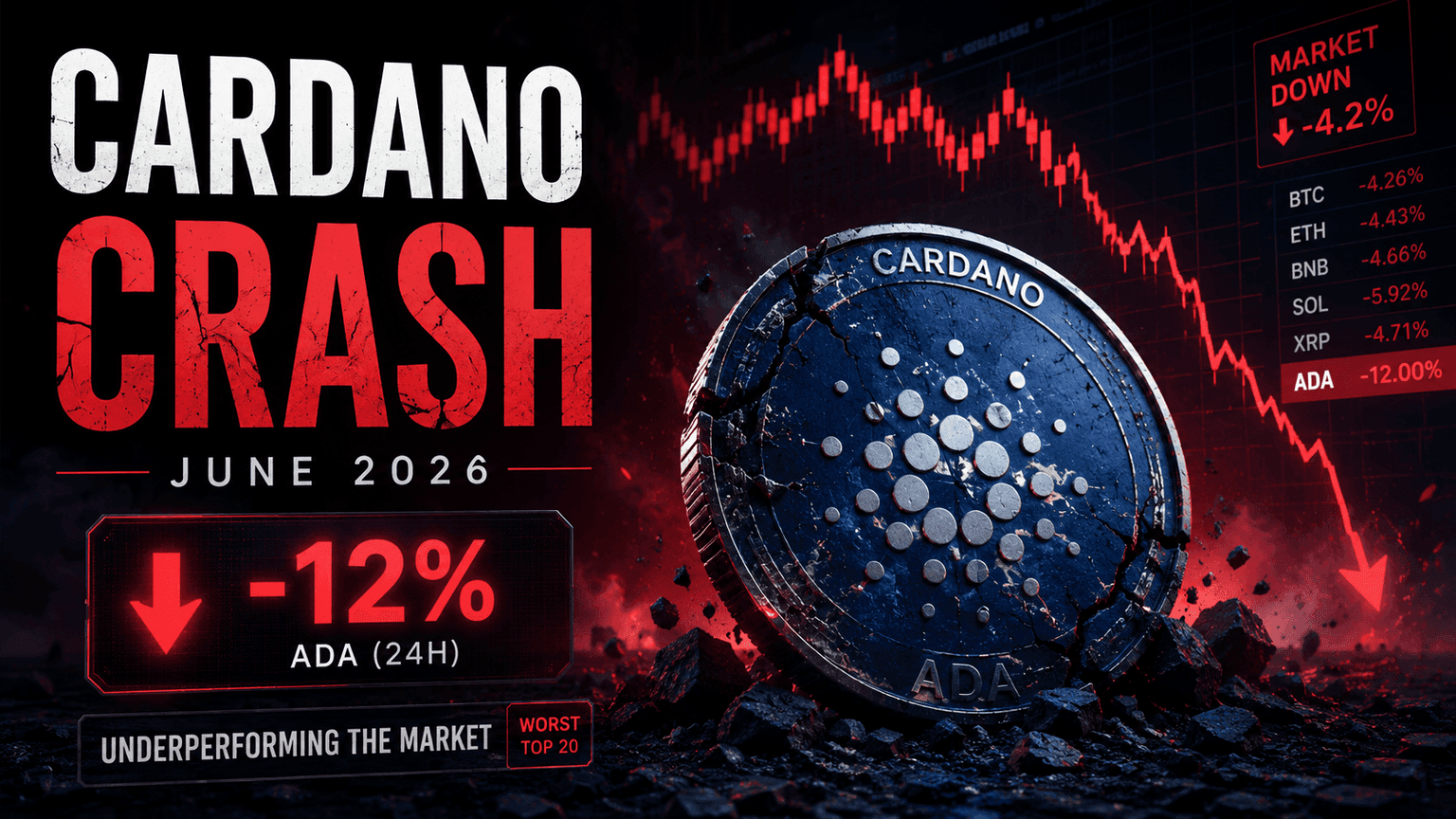
Cardano Crash June 2026: Why Is ADA Falling Harder Than the Crypto Market?
Cardano crash June 2026: ADA drops harder than Bitcoin and Ethereum as ecosystem fears, TapTools shutdown, and weak sentiment hit the market.
July 21, 2025 5:00 AM
Cardano Price Prediction: ADA Finally Wakes Up After Bitcoin ATH
Cardano has been lagging — until now. While Bitcoin topped out weeks ago, ADA is just starting to move. What’s next for the ADA price?
April 5, 2025 3:03 PM
Cardano Price Prediction 2025: Will BTC Integration Push ADA Price to $3 or $5?
Cardano price predictions for 2025 are heating up, with analysts pointing to a possible breakout between $3 and $5. And with the recent announcement by Charles Hoskinson, what to expect for ADA price?
September 25, 2024 3:09 PM
Cardano (ADA) Price Analysis: Will ADA Price Continue To Surge?
Cardano (ADA) continues its steady rise. But how can Argentina’s potential CBDC could impact ADA’s future?
May 16, 2024 1:42 PM

Cardano (ADA) Price Analysis: Bull or Bear in May?
Divided are analysts' opinions on Cardano's (ADA) future as they debate its potential bullish rally versus a bearish downturn. Which will guess it right?
May 30, 2025 2:33 PM
Cardano Price Prediction: Will ADA Crash to $0.35?
Cardano (ADA) is losing momentum as bearish pressure builds and support levels are broken. But could ADA fall as low as $0.35?
November 25, 2024 4:31 PM

Cardano Price Prediction: Will ADA Hold the $1 Support Level?
Cardano (ADA) is struggling to maintain the $1 support level. What does the future hold for ADA? Read on for price predictions and resistance levels to watch.
May 4, 2024 12:21 PM
Cardano Price Prediction: Will Cardano reach $1 in 2024?
Will Cardano reach the $1 milestone by 2024? Let's delve into the factors influencing Cardano's trajectory and assess its potential in this Cardano price prediction.
September 23, 2026 7:36 AM

Cardano Price Prediction: ADA Rockets 30% as Bulls Eye the Next Big Target
Cardano price jumped over 30% in a week, reclaiming the 200 EMA. Here's what's driving ADA and the price targets traders are watching next.
February 23, 2025 10:39 AM
Cardano Price Prediction and the Rise of a New Altcoin in 2025
Here is the latest Cardano (ADA) price prediction and how a new altcoin is poised to redefine crypto investments in 2025, blending technical analysis with emerging market trends.
February 26, 2026 4:18 PM
Cardano Price Analysis: ADA Jumps 8% as Bulls Eye $0.30 Breakout
Cardano (ADA) surges 8% to $0.29. Analysts eye the $0.30 resistance as a make-or-break point for the next major price move toward $0.35.
February 13, 2026 3:12 PM
Cardano (ADA) Price Analysis: Support Holds at $0.25 Amid Market-Wide Pullback
Cardano (ADA) stabilizes at $0.25 support as derivatives sentiment shifts. Explore the technical levels and fundamental updates from Consensus Hong Kong.

More from CryptoTicker