
Ethereum price $2,702: next target is $2,775, but 812,887 ETH are queued for the exit
Ethereum trades at $2,702 on Sunday evening, 2.7 percent below the September high of $2,775.17. At the same time 812,887 ETH sit in the staking exit queue, and the way out takes roughly 22 days including the sweep.


Which topics should we dive deeper into?
Select what genuinely interests you. Your picks feed directly into our editorial planning.
Crypto news that's actually worth your time.
Weekly. 60 seconds. Carefully curated by our editors: no hype, no promo flood, no spam.
The Ethereum price stands at $2,702 on Sunday evening, or 2,399.90 euros, up 0.7 percent over 24 hours. The next target to the upside is no estimate. It is a level taken from Ether's own chart: $2,775, the high of 22 September, and therefore only 2.7 percent away. The question this weekend is not whether ETH clears those $73. What decides matters is who will be able to sell at all over the next three weeks, and who will not.
Because 812,887 ETH are sitting in the staking exit queue, a good $2.2 billion. Anyone joining that queue today gets their money back in roughly 22 days. This is a hard liquidity question for every European investor who holds ETH in staking and wants to remain able to act before the Glamsterdam upgrade on 4 November.
Ethereum price at $2,702: 2.7 percent below the September high, 21.6 percent above the 200-day line
Let us place the price first, so the levels later do not come out of thin air. The following values are taken from CoinGecko's daily price series over the past 365 days, as of 4 October.
- Current price: $2,702, or 2,399.90 euros
- 200-day line: $2,117.74, with the price 27.6 percent above it
- 50-day line: $2,500.34, with the price 8.1 percent above it
- High of the past 30 days: $2,775.17 on 22 September
- Low of the past 30 days: $2,397.50 on 16 September
- January 2026 high: $3,351.82 on 15 January, still 24.0 percent away
- Low for the year: $1,566.01 on 26 June
Two of those numbers carry the picture. First, ETH has closed above its 200-day line for 47 trading days in a row. That line is the average price of the past 200 days and serves as a rough divide between an upward and a downward phase. Second, the price has spent two weeks in a narrow band between $2,397 and $2,775, a corridor of some 16 percent. Together they describe a market that is neither breaking out nor breaking down.
812,887 ETH in the exit queue: $2.2 billion waiting for the way out
Staking your ETH means depositing it with a validator and helping to secure the network. There is a yield for that, but the coins are not freely available. The way back runs through a waiting queue, because the protocol releases only a limited number of validators per unit of time. That queue has become the number of the weekend.
According to validatorqueue.com, which sources its data from beaconcha.in, 812,887 ETH are queued to exit. At a price of $2,702 that is $2.2 billion, or roughly 1.95 billion euros. Measured against the 43.5 million ETH staked in total, it amounts to 1.87 percent. The estimated waiting time until exit is 14 days and 3 hours.
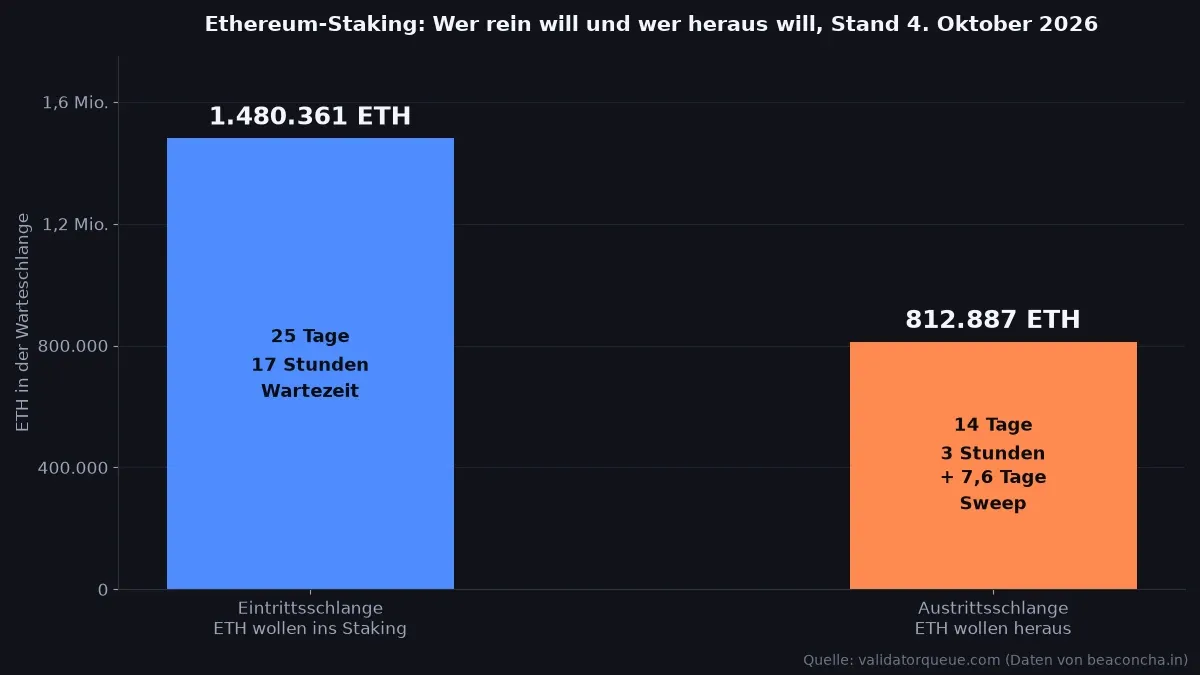
A sweep delay of 7.6 days: 14 days of waiting become about 22
Here lies the point most overviews leave out. Those 14 days and 3 hours are only the first half of the journey. After leaving the validator set, the balance still has to be transferred to the registered withdrawal address, and this so-called sweep works through the addresses in order. That currently adds 7.6 days.
In total, then, 21.7 days pass between the decision and the available balance. Start your exit on 4 October and your ETH lands on the withdrawal address on 25 October. Three weeks is a long time in a market that has moved 16 percent in two weeks. If you want to steer your position size through a possible dip in the price, staked ETH simply does not let you do it at short notice. That is the real cost of the 2.63 percent yield, rather than the yield itself.
In practice: split your holdings between the part that is to stay staked and the part that has to remain tradable. You will find an overview of the providers and their respective exit routes in our comparison of staking platforms, because the protocol deadline is only the floor. Centralised providers add processing times of their own, while decentralised liquid staking tokens can be sold on the market, though often at a discount to the ETH price itself.
The entry queue is larger: 1,480,361 ETH want to go the other way
An exit queue worth $2.2 billion sounds like flight. The counter-figure appears in the same overview and turns out to be considerably bigger: 1,480,361 ETH are waiting to be admitted into staking, with a waiting time of 25 days and 17 hours. That is 1.8 times the exit queue and corresponds to around $4.0 billion.
On balance, 667,474 ETH more want in than out. For the price question that is the more important figure. Every ETH that enters the entry queue is unavailable to the market as sellable supply for at least 25 days. In total, 35.61 percent of all ETH is staked, spread across 870,025 active validators. Read only the exit number and derive selling pressure from it, and you have read half the table.
 Compare crypto exchanges and fees
Glamsterdam on 4 November: the Hoodi fork of 5 October is the last testnet stage
The date on which the queues and the price meet is in the developers' calendar. Glamsterdam is Ethereum's next major upgrade after Fusaka, and according to the overview at EIPs Insight the target date for mainnet is 4 November 2026. One stage comes before it: on 5 October, that is Monday, the Hoodi testnet forks. The Sepolia testnet went through the fork on 21 September.
In substance, Glamsterdam brings two changes worth knowing about, even if you do not run a validator yourself. EIP-7732 writes the separation of block proposal and block building firmly into the protocol, known as enshrined proposer-builder separation. EIP-7928 introduces access lists at block level, allowing a client to know in advance which data a block touches. Both aim to make it possible to raise the gas limit without overwhelming the requirements placed on a single node.
What a testnet fork actually means for you
A testnet fork is a dress rehearsal on a copy of the network without real value. For you as a holder, nothing changes on Monday: your ETH stays where it is, there is no swap, no new address and no action you would have to take. The date only becomes relevant if you run a validator yourself or sit with a provider that fails to update its clients in time. Either way, that is a question for your service provider.

The calendar arithmetic: start on 14 October and you are liquid by the upgrade
A date can be derived from those two numbers, and that date is the real value of this exercise. The upgrade targets 4 November. The way out of staking currently takes 21.7 days. So if you want free use of your ETH on upgrade day, you have to trigger the exit by 14 October at the latest. After that the time runs out.
One caveat belongs here in all honesty: the waiting times are not fixed values. How they develop depends on how many validators want out at the same time, and they can double or halve within days. The 14th of October is therefore not a guaranteed cut-off but the arithmetic based on today's queue. If you want to be safe, build in a buffer of a week and check the figure again before you start.
And there is the counter-question: do you actually need liquidity on 4 November? An upgrade is not an event that forces a sale. Fusaka went over mainnet without incident in December 2025. If you hold for the long term and want to collect the yield, you have no reason to leave staking because of a date. The arithmetic above applies to anyone with a concrete intention to sell.
The levels above: $2,775 from September, then $3,351 from January
Back to the price. The first level to the upside is the September high at $2,775.17. It is the point where the market turned two weeks ago, and it sits 2.7 percent above the current reading. As long as ETH stays below it, the price moves inside the band that has held since mid-September.
Only above it does the view open on the round $3,000 mark, which last held in early February of this year. The next demonstrable target after that is the January high at $3,351.82 from 15 January, currently 24.0 percent away. This is explicitly not a forecast; these are places where trading actually took place in the past.
The levels below: $2,500 as the 50-day line, $2,397 as the September low
To the downside, the first catch line is $2,500.34, the average of the past 50 days, 7.5 percent below the current price. Below that follows the September low at $2,397.50, some 11.3 percent lower. The 200-day line at $2,117.74 is far away at a distance of 21.6 percent and would be the level at which the run of 47 days above that line would end.
For practical purposes: if you work with a stop level, the round number 2,500 has the drawback that almost everyone else can see it too. The average happens to sit just beside it at 2,500.34. Choose a distance of a few percent below and you avoid the densest zone. And if you work with leverage, hold the 16 percent range of the past two weeks against your liquidation distance: at five times leverage, liquidation sits roughly 20 percent away, which is already within what the market has covered in 14 days.
 Compare staking platforms and yields
2.63 percent staking yield: what 870,025 validators pay out over a year
The yield for which one accepts those 22 days of waiting currently stands at 2.63 percent a year. On a single ETH that works out at around $71 a year, and on a stake of 10,000 euros at roughly 263 euros, in each case before tax and before the provider's fee. The rate falls as more ETH is staked, because the protocol's payout is spread across more validators. The entry queue of 1.48 million ETH therefore tends to push this value down further.
The fee decides the net yield. Centralised providers usually keep between 10 and 25 percent of the proceeds, which turns 2.63 percent gross into somewhere between 1.97 and 2.37 percent net depending on the provider. A difference of 0.4 percentage points on 10,000 euros comes to 40 euros a year, and that is more than most people expect when they compare.
Holding period and the tax office: what the German BMF letter of 6 March 2025 sets out for staked ETH
For German private investors, the disposal period under section 23 paragraph 1 sentence 1 number 2 of the Income Tax Act applies to the sale of crypto assets. Once a year has passed since acquisition, a gain on the sale is tax free; before that it counts as a private disposal transaction and is taxed at the personal rate.
The clarification that matters for stakers is in the BMF letter of 6 March 2025: staking and lending do not extend that period. The 2021 draft had provided for an extension to ten years where crypto assets are used as a source of income. That rule never came into force. Hold your ETH for longer than a year and you do not lose the tax exemption on the gain simply because you staked it in the meantime.
The staking rewards themselves are to be looked at separately. These rewards count as other income in the year they accrue, and a holding period of their own begins for them on the day they arrive. Receive rewards in October and sell them in December and you have a taxable event there, even if the ETH originally staked is long outside the period. For documenting these two pots, our overview of tax tools and portfolio trackers is worth a look, because otherwise the inflow dates have to be pulled out of the statements by hand. This account does not replace tax advice; for your individual case, the word of your tax office or your adviser applies.
Holding and buying ETH under MiCA: what to check before your next step
Since the European crypto regulation MiCA has applied in full, providers in Europe need authorisation to offer custody and trading. For you as a buyer, three points are verifiable before you pay money into an exchange or hand ETH over to staking.
- The authorisation: does the provider appear in a public register with a MiCA licence or a licence under banking law, and which country does it cover? That information belongs in the legal notice, not just in the advertising.
- The custody arrangement: is your ETH held separately from the provider's own assets, and do you get proof of it? With a liquid staking token you do not hold ETH itself but a claim on it, and that claim can trade below the ETH price on the market.
- The costs across the whole route: purchase, custody, staking fee and withdrawal. The spread on the purchase is the item fewest people recalculate, because it is not shown as a fee. A side-by-side look at the terms belongs before the purchase rather than after it.
Ethereum price: the key points for your decision
- Measure your staked share against your liquidity needs. An exit currently takes 21.7 days. If you want free use of your ETH on 4 November, 14 October is the last possible starting date by that arithmetic. The deadlines of the individual providers are in the staking comparison.
- Set your levels on the measured points, not on round numbers. Upwards that means $2,775.17, downwards $2,500.34 and $2,397.50. If you are buying or adding, the terms are in the exchange comparison.
- Separate holdings and rewards in your tax file. The one-year period applies to the holding and is not extended by staking; every reward runs a period of its own from the moment it arrives. Tools for this are in the overview of tax software.
(As of October 4, 2026. This article is not investment advice. Prices and fee structures change; check the terms with the provider before you buy.)
Frequently asked questions about the Ethereum price
Partner links: some links on this page are partner links. If you become a customer through one of them, we may earn a commission at no extra cost to you. Selection, ratings and ranking are decided independently by our editorial team. Ethics and Independence · Ownership and Funding
Transparency note: This article was produced with the assistance of artificial intelligence and reviewed by our editorial team before publication. All figures and claims were checked against the primary sources linked in the text. The feature image was generated with AI.
For later? Save this article and find it again in your profile.
More on Ethereum: All Ethereum news at a glance
Related articles
- Ethereum price prediction: Foundation wallet sells for a fourth time, ETF outflows 87 times larger
- Ethereum Price Crashes Below $2,000: How Low Can ETH Go?
- Ethereum price at $1,958: exit queue grows to 269,951 ETH as ETF outflows reach $696 million
- Ethereum price below $2,000: record staking meets ETF outflows
- Ethereum price prediction: Huang's exit pushes ETH below $2,000 as ETF outflows hit day five
Which topics should we dive deeper into?
Select what genuinely interests you. Your picks feed directly into our editorial planning.
Crypto news that's actually worth your time.
Weekly. 60 seconds. Carefully curated by our editors: no hype, no promo flood, no spam.

November 10, 2026 3:21 PM

Ethereum price prediction: Buterin bets on store of value as Bitmine adds 9,587 ETH
Analysis: Vitalik Buterin wants Ether valued as a store of value rather than a fee-burning token, and Bitmine now holds 4.97 percent of all ETH. Why the price still sits below the 200-day moving average at $2,154 and which levels matter until Friday's expiry.

November 8, 2026 11:13 PM

Ethereum price: $343 million in long liquidations push Ether to $2,120
Analysis: Ether loses around 5 percent on Sunday evening and stands at $2,120, its lowest since August. The trigger is a wave of liquidations in which Ether positions made up the largest share, more than Bitcoin.
November 8, 2026 7:15 PM

Ethereum Price Prediction: 2,982 New ETH in a Day, Only 10 Burned
Analysis: Ethereum's fee burn has almost died out, and supply is growing by 0.86 percent a year. What that means for the price, staking yield and tax, and which levels matter now.

November 7, 2026 5:13 PM

Ethereum Upgrade Glamsterdam Halted Before Hoodi Over Eight Gas Traps
Analysis: The Ethereum Foundation is holding Glamsterdam back from the Hoodi testnet because two gas changes could put existing smart contracts at risk. What lies behind EIP-8037 and EIP-8038, how the options market looks through December and which levels around $2,233 matter.
November 6, 2026 7:17 PM

Ethereum price prediction: 986,847 ETH queue to stake while only 4,320 ETH wait to exit
Close to one million ether is waiting to enter staking, while only 4,320 ETH want out. What that ratio says about ether at $2,229, which levels matter until the end of November and what stakers in Germany need to know about tax.
November 4, 2026 5:20 PM

Ethereum price jumps above $2,400: why Ether is outpacing Bitcoin after the US midterms
Ether (ETH) has recovered almost 8 percent in twelve hours from its US election-night low and is rising faster than Bitcoin (BTC). What is driving the move, which chart levels matter now and what investors in Germany should consider on buying, tax and custody.

November 3, 2026 8:59 AM

Ethereum Price Below $2,300: Is $2,000 Next or Is This the Bottom?
Ethereum price slips toward $2,250 as $3 billion leaves DeFi. Whales are buying the dip. Does ETH hold $2,200 or test $2,000 next?
November 2, 2026 12:06 AM

Devcon 8 in Mumbai: What Ethereum's Big Conference Means for ETH
From 3 to 6 November the Ethereum world meets in India for the first time. Glamsterdam has no date, ETH issuance is up for debate, and our analysis of six Devcons shows how little the conference moves the price.
November 1, 2026 3:16 PM

Ethereum price prediction: 1.39 million ETH have left DeFi contracts
Analysis: the contracts of the decentralised finance applications on Ethereum still hold 19.44 million ETH. Since the peak on October 26, 1.39 million ETH have been withdrawn, and for the first time in weeks that is not merely an arithmetic effect but an actual outflow.
October 29, 2026 9:50 PM

Ethereum Crash: The Binance Hacker Sits on 195,000 ETH. Is a Sell-Off Coming?
Ether fell 2.6% within an hour after the Binance hack. The bigger risk: about 195,460 ETH sit with the attacker and, unlike stablecoins, cannot be frozen. How big the selling pressure really is, which price levels matter and why Ethereum itself was not hacked.
October 28, 2026 9:27 PM

Ethereum staking at 2.63 percent: what investors need to know
Analysis: the Fed left the policy rate at 3.75 to 4.00 percent on Wednesday evening, and two members even wanted a hike. For Ether this decision counts for more than it does for Bitcoin, because the staking yield of 2.63 percent competes directly against the money-market rate.
October 22, 2026 10:24 AM

Ethereum price prediction: Glamsterdam forks Hoodi on October 26 with a 200 million gas limit, what to watch
Context: the Ethereum upgrade Glamsterdam forks the Hoodi testnet on October 26 at 17:42:48 UTC, where the gas limit rises to 200 million. A mainnet date is still missing, and that is exactly what decides what the fork is worth for the ETH price at $2,406.
October 20, 2026 7:29 PM

Ethereum price prediction: 1.16 million ETH in the staking queue, the consequences for the price
On October 20, 1,155,535 ETH are waiting for a staking slot and the wait runs to 20 days. In the opposite direction only 174,282 ETH are left. What the asymmetry means for the price at $2,443, and why EIP-8061 changes little about it.
October 18, 2026 10:16 AM
Ethereum staking pays 2.21 percent while the ECB pays 2.50
Ethereum's staking yield of 2.21 percent sits below the European Central Bank's deposit rate of 2.50 percent. What that gap means for the price, for the levels at $2,364 and $2,438 and for your tax return.
October 17, 2026 10:33 PM

Ethereum forecast: 2,955 new ETH a day, only 13.6 burned, next target: $2,552
Ethereum's supply grew by 2,955 ETH over the past 24 hours, while only 13.6 ETH were burned. What that finding means for the levels between $2,417 and $2,552, and what investors in Germany can take from it.
October 16, 2026 10:15 AM

Ether gains 4.22 percent, Glamsterdam clients are due today: Hoodi forks on October 26
Ether trades at $2,451.86 on Friday morning, 4.22 percent above the previous day, while $60.22 million left the US funds on Thursday. The documented date of the day sits with the developers: client releases for Glamsterdam are due today, and on October 26 the last public testnet, Hoodi, forks.
October 10, 2026 7:49 PM

252,402 ETH Gone From the Staking Buffer: Ethereum at $2,507 and 24 Days in Both Queues
Ether trades at $2,507 on Saturday afternoon while something shifts in the queues of the staking system: the lead of the entry queue over the exit queue has shrunk by 252,402 ETH since October 4. What the 24 days of waiting in both directions mean for your stake, and why a full queue still does not support the price.
October 8, 2026 1:16 PM

Ethereum Price Prediction: “We Thought It Would Take Five Years”, and 100,000 Ether Separate BitMine From Its Buying Cap
BitMine holds 6,016,414 Ether and stops buying at five percent of the circulating supply, around 100,000 Ether short of that line. At the same time the spot ETFs pulled $506.3 million over five days, and Glamsterdam has no date for mainnet.
October 6, 2026 4:40 PM

Ethereum price prediction: Glamsterdam live on Sepolia with 64 million gas instead of 200, and why the gap matters
Ethereum's next big upgrade has been running on the Sepolia test network since Tuesday afternoon. The much-quoted gas limit of 200 million is not in place there yet, and the gap says more about the mainnet date than any price target estimate.
September 30, 2026 10:15 AM

Ethereum Price Prediction: 1.6 Million ETH Face a 28-Day Wait for Activation, and What You Can Do Now
1,603,958 ETH are standing in the entry queue for Ethereum staking and waiting almost 28 days for activation. What that tied-up supply means for the price levels, for your yield and for the 256 euro exemption limit at the German tax office.
September 28, 2026 4:15 PM

Ethereum Price Prediction: The Level That Decides ETH Before the October 6 Sepolia Fork
Ethereum trades at $2,675.39 on September 28, just under 3 percent below the supply zone at $2,750 to $2,800. On October 6 the Sepolia test network forks to Glamsterdam, and separately from that, holders in Germany still have to settle before the year end what the holding period and the exemption limit allow.
September 27, 2026 4:25 PM

Ethereum Price Prediction: What to Check on ETH Before the Quarter Turns
Ethereum trades at 2,714.60 dollars on September 27, 2026 and remains pinned to the zone between 2,750 and 2,820 dollars. Which levels decide October, how far apart the analyst targets sit, and which checks to complete before the quarter turns.
September 24, 2026 10:36 PM

Ethereum Price Prediction: What to Check on Staking, Leverage and Where You Buy After Three Attempts at $2,800
Ether stands at $2,700 and has bounced off the zone around $2,800 three times in thirty days, without a single daily close above it. What our own count shows, and the three things to settle before the next attempt.
September 22, 2026 7:20 PM

ETH Price Prediction: What to Check at the $2,800 Mark Now
Ether stands at $2,735.96 on September 22, 2026, right below the zone at which it has failed repeatedly. Instead of a target number, you get four checks that count before your next order: holding period, buying route, the staking line and the distance to liquidation.
September 18, 2026 9:15 PM

Ethereum Breaks Through the $2,600 Mark: What Is Behind the Short Squeeze and What to Check Now
Ethereum rises almost 7 percent to $2,616 and clears the mark it failed at only days ago. Short positions worth $85 million were forcibly closed in the process. What that reveals about the rally and what you should check now.
September 13, 2026 4:23 AM

Staking Lock-Up Period: How Long You Wait for Your Coins After Unstaking
Eight days on Ethereum, exactly 21 on Cosmos, not a single hour on Cardano: the lock-up period decides when you reach your coins again after unstaking. We queried the deadlines directly at the chains on September 13, 2026, and show you how to check them yourself before every decision.

More from CryptoTicker