
Euro Stablecoins: What EURC, EURCV and Other E-Money Tokens Are, How Big the Market Is and Where to Buy Them
Euro stablecoins such as EURC and EURCV are e-money tokens (EMTs) under the EU's MiCA regulation. Using the ESMA register and market data, we show which ones exist, how much the market has grown since 2024, what programmable money means and where you can buy them.

Which topics should we dive deeper into?
Select what genuinely interests you. Your picks feed directly into our editorial planning.
Crypto news that's actually worth your time.
Weekly. 60 seconds. Carefully curated by our editors: no hype, no promo flood, no spam.
A euro stablecoin is a crypto token designed to be worth one euro at all times and redeemable for one euro at face value whenever you want. In the European Union, these tokens have been e-money tokens under the MiCA regulation since June 30, 2024, and only banks and e-money institutions may issue them. On November 21, 2026, euro stablecoins worth €747 million were in circulation according to DefiLlama, 3.4 times as much as when the MiCA rules took effect. Measured against the whole stablecoin market, that is still small: for every euro held in euro stablecoins, there are about 350 dollars in dollar stablecoins. The largest euro stablecoin is Circle's EURC with around 460 million tokens, followed by Société Générale's EURCV.
For you as an investor in the EU, what matters most is whether a stablecoin is licensed here. Tether (USDT), the world's largest stablecoin, has no MiCA authorisation. How much its safety buffer has shrunk in this week's crash is shown in our fact check of the crash warnings, and the figures as of September 30 are in our analysis of Tether's quarterly report. Exchanges with a MiCA licence are expected to end their services involving non-compliant stablecoins by January 8, 2027. If you want to hold euros on a blockchain, the path therefore leads to e-money tokens. The good news: these tokens are tightly regulated, and you can check for yourself in a few minutes whether yours is one of them.
Euro Stablecoins at a Glance: Key Facts
- Legal status: euro stablecoins are e-money tokens under Article 3 of the MiCA regulation and count as electronic money. The rules have applied since June 30, 2024.
- Redemption: the issuer must redeem at face value, at any time and free of charge (Article 49). Interest is prohibited (Article 50).
- Market: €747 million in circulation on November 21, 2026, just under 0.3% of all stablecoins.
- Concentration: EURC and EURCV account for 84% of supply. In July 2024 their share was 14%.
- Register: ESMA lists 51 white paper entries for e-money tokens from 26 issuers in 14 countries (as of November 22, 2026).
- Digital euro: 2029 at the earliest, and according to the ECB never programmable money.
What Is a Euro Stablecoin? E-Money Tokens Under MiCA Explained
Legally, a euro stablecoin is an e-money token, or EMT. You hold a claim against the issuer to redeem it for one euro at any time, and the issuer must invest the money it receives safely. It is still not a bank deposit.
Regulation (EU) 2023/1114 on markets in crypto-assets, known as MiCA or MiCAR, defines an e-money token in Article 3(1)(7) as a crypto-asset that "purports to maintain a stable value by referencing the value of one official currency". If a token references several currencies, gold or a basket, it is an asset-referenced token instead, with separate and stricter rules. The euro stablecoin is therefore the simplest case: one currency, one token.
Four obligations follow for every euro stablecoin in the EU:
- Banks and e-money institutions only: under Article 48, anyone offering an e-money token to the public must be authorised as a credit institution or e-money institution and must first submit a white paper to its supervisor. E-money tokens "shall be deemed to be electronic money", so the E-Money Directive applies as well.
- Redemption at par: under Article 49, you have a claim against the issuer. It issues tokens only at par value, redeems them "at any time and at par value", and redemption is not subject to a fee.
- No interest: Article 50 bans interest, including from exchanges and other crypto-asset service providers. Any remuneration that grows with the holding period counts as interest. What this means for yield offers on stablecoins is covered in our guide to stablecoin interest and the MiCA ban.
- Safe reserve: under Article 54, at least 30% of the funds received must always be held in separate accounts at credit institutions. The rest must go into secure, highly liquid assets in the same currency, such as short-dated government bonds.
The redemption right applies against the issuer, not against the exchange. On a trading platform you pay the market price, which can deviate in a thin market: on Bitstamp, one EURC traded between €0.9895 and €0.9997 in the 24 hours to Sunday, 00:14 UTC, on volume of just over 2,000 EURC. How to spot a real break of the peg is explained in our guide to stablecoin depegs. One point is often overlooked: deposit guarantee schemes covering €100,000 apply to bank deposits, not to electronic money. Our article on the euro stablecoin from 37 banks explains why.
When an e-money token becomes large, the European Banking Authority (EBA) steps in as well. A token is significant if it crosses three of several thresholds, including more than 10 million holders, a value above €5 billion or more than 2.5 million transactions a day (Articles 43 and 56). On October 14, 2026, the EBA classified USD Coin (USDC) as the first significant e-money token, according to its press release, and since November 12 it supervises Circle's reserve, own funds and liquidity directly, as our article on EBA supervision of USDC shows. No euro stablecoin comes close: EURC reaches less than a tenth of the value threshold.
Euro Stablecoins Compared: EURC, EURCV and the Other E-Money Tokens
Ten euro stablecoins listed in the ESMA register, sorted by supply. The table combines two sources: issuer, supervisor and date from ESMA's list of e-money token white papers, supply and number of blockchains from DefiLlama, both as of November 21 and 22, 2026.
| Token | Issuer | Supervisor | White paper in ESMA register | Supply | Blockchains |
|---|---|---|---|---|---|
| EURC | Circle Internet Financial Europe SAS | ACPR, France | July 1, 2024 | €458.3m | 14 |
| EURCV | Société Générale-Forge | ACPR, France | July 1, 2024 | €170.4m | 4 |
| EURI | Banking Circle S.A. (Eurite) | CSSF, Luxembourg | August 28, 2024 | €28.5m | 2 |
| EURe | Monerium ehf | Central Bank of Iceland | January 9, 2026 | €25.2m | 9 |
| EUROP | Salvus (Schuman) | ACPR, France | November 22, 2024 | €13.4m | 6 |
| EURR (StablR) | StablR Ltd | MFSA, Malta | November 14, 2025 | €12.7m | 2 |
| EURQ | Quantoz Payments B.V. | DNB, Netherlands | March 24, 2025 | €5.3m | 4 |
| EURR (Revolut) | Bridge Building S.A. | CSSF, Luxembourg | July 23, 2026 | €1.7m | 2 |
| EURAU | AllUnity GmbH | BaFin, Germany | June 20, 2025 | €0.3m | 5 |
| EURqi | Qivalis B.V. | DNB, Netherlands | October 21, 2026 | no supply recorded yet | none yet |
EURC (formerly Euro Coin) comes from Circle, the issuer of USDC. In the EU it is issued by Circle Internet Financial Europe SAS in Paris and supervised by the French ACPR; its white paper has been in the register since the first day of MiCA. According to Circle, 459.7 million EURC were in circulation on November 22 at 00:13 UTC, and the company publishes its reserves on its transparency page. EURC runs on 14 blockchains, including Ethereum, Base, Solana and Stellar.
EURCV from Société Générale-Forge, the crypto subsidiary of the French bank, is the second-largest euro stablecoin and runs on Ethereum, Solana, Stellar and the XRP Ledger. On July 1, 2024, only 0.8 million EURCV were in circulation; on November 21, 2026, there were 170.4 million. How the bank brought the token to the XRP Ledger is covered in our report on Société Générale's euro stablecoin on the XRPL.
The only German issuer in the register is AllUnity GmbH from Frankfurt, authorised by BaFin. Its euro token EURAU had only €0.3 million in circulation on November 21, though. Revolut has been in the register with EURR since July 2026, via the Luxembourg company Bridge Building S.A.; our article on Revolut's EURR stablecoin explains the details. EURqi is new: the bank consortium Qivalis, backed by 37 banks from 15 countries according to the company, submitted its white paper to the Dutch central bank on October 21, 2026, one week after its authorisation as an e-money institution. DefiLlama does not yet record any supply for the token.
Two earlier euro stablecoins are missing from the register and have shrunk since MiCA: Stasis' EURS from €44.4 million to €6.9 million, and Tether's EURT, last recorded by DefiLlama in May 2026 at €4.2 million. The full list of stablecoins with their MiCA status, including dollar tokens, is in our stablecoin comparison.

How Big Is the Euro Stablecoin Market? More Than Tripled Since MiCA
On November 21, 2026, euro stablecoins worth €747 million were in circulation. On July 1, 2024, the first day of the MiCA rules for e-money tokens, the figure was €221 million. That is 3.4 times as much. Dollar stablecoins grew only 1.8-fold over the same period, from $160.4 billion to $282.5 billion. Even so, the euro's share of the stablecoin market is just 0.29%.
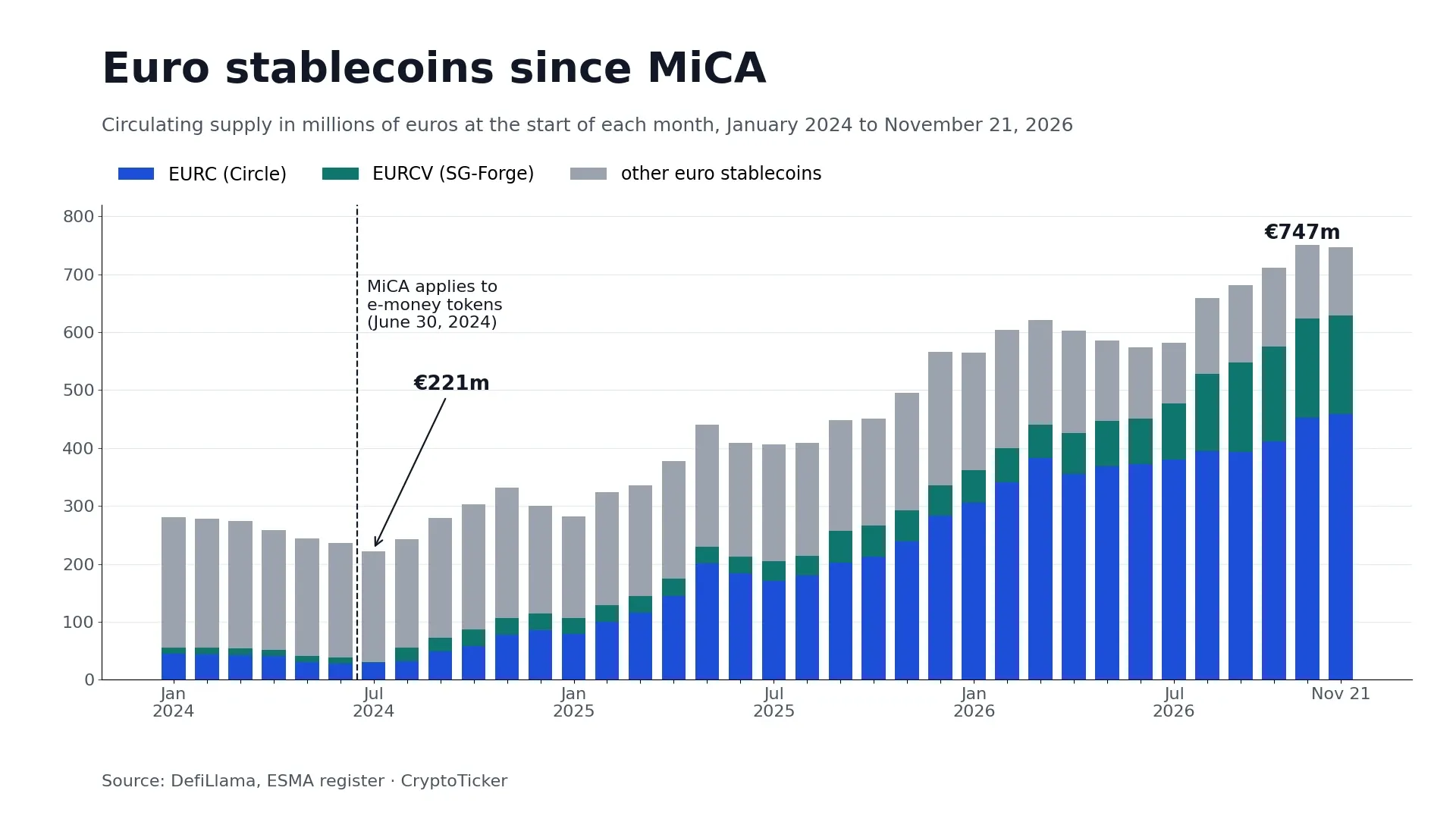
The chart shows what lies behind the growth. Before MiCA, the market consisted mainly of tokens that have no authorisation today, such as Stasis' EURS and Tether's EURT. Back then, EURC and EURCV together made up 14% of supply. On November 21, 2026, they made up 84%, because EURC grew from €29.7 million to €458.3 million and EURCV from €0.8 million to €170.4 million. MiCA did not choke the market, it rebuilt it: away from unsupervised tokens and toward two issuers licensed in France.
During the November crypto crash, the difference also showed in supply. From November 1 to November 21, dollar stablecoin supply shrank by 4.7% to $282.5 billion, while euro stablecoin supply fell by only 0.4% to €747 million. Falling supply means tokens are being redeemed and burned, usually because investors are moving out of the crypto market and into bank money.
A comparison helps with the scale: for every euro in euro stablecoins there are 347 dollars in dollar stablecoins, converted at the rate DefiLlama uses for euro tokens. The ECB reference rate on November 20 was $1.0990 per euro. Even USDC, the dollar token from the same issuer as EURC, has more than a hundred times as much supply. How large the individual dollar stablecoins are and which of them are licensed in the EU is shown in our stablecoin list with MiCA status.
ESMA Register: Which Euro Stablecoins Are Licensed in the EU
Whether a euro stablecoin may be offered in the EU is recorded in the interim MiCA register of the European Securities and Markets Authority (ESMA). On November 22, 2026, its list of e-money tokens contained 51 white paper entries from 26 issuers in 14 countries. At least 18 different euro tokens are among them, alongside tokens in dollars, Swiss francs, pounds, kronor, złoty and lei.
Most entries come from the Netherlands (11) and France (8), followed by Germany with 6 entries, all from AllUnity, Luxembourg (5), and Finland and Malta (4 each). The number of entries is not the number of tokens: some issuers file a separate white paper for each new version. The EBA counted 45 notified e-money tokens in the EU on October 14. In August, our analysis of the MiCA register of stablecoin issuers still counted 23 issuers and 43 white papers.
There is a wide gap between the register and the market. Of the at least 18 euro tokens in the register, only six had more than €10 million in circulation on November 21. Many issuers have their licence but hardly any users, and some tokens, such as Qivalis' EURqi, are not in circulation at all yet.
You can check a euro stablecoin in three steps:
- Issuer in the ESMA register: search ESMA's white paper list for the issuer's name. It shows the competent authority, the country and the link to the white paper with the redemption terms.
- Authorised as a bank or e-money institution: the authorisation column reads "Electronic money institution" or "Credit institution". If the issuer is missing, the token is not a licensed e-money token in the EU.
- Exchange in the register of crypto service providers: the trading platform needs a MiCA licence too. ESMA keeps a separate list of authorised crypto-asset service providers, and our comparison of regulated crypto exchanges shows which exchanges hold one.
Programmable Money: What Euro Stablecoins Can Do That a Bank Account Cannot
For euro stablecoins, programmable means that a program on the blockchain can move them according to fixed rules, without a bank triggering the payment. The money itself remains freely usable. The distinction matters, because the term is used for two different things in the debate.
In its questions and answers on the digital euro, the ECB describes programmable money as digital money that is used for a predefined purpose, like a voucher that is only valid with certain merchants or until a certain date. Programmable payments are something else: you set a condition yourself, for example that a payment is only released on delivery.
Euro stablecoins on public blockchains can do exactly this second kind of payment. Because EURC or EURCV exist as tokens on Ethereum, Solana or the XRP Ledger, a smart contract can manage them. Three examples of what that looks like:
- Delivery versus payment: a tokenised security and the purchase price in euro stablecoins change hands in the same transaction. Neither side has to pay or deliver first.
- Escrow in code: the amount sits in a contract and is released as soon as an agreed condition is met.
- Around the clock: a transfer on a blockchain knows no weekends and no bank holidays, including across borders.
The flip side: the issuer has code in hand as well. The contracts of USDC and EURC include a blocking function that lets Circle freeze individual addresses, for example on the order of an authority. How such freezes work at Tether and how to check your own address is explained in our guide to the USDT blacklist.
For the digital euro, the ECB has already answered the question: it would never be programmable money, but conditional payments should be possible. Our assessment: for investors, the programmability of euro stablecoins is mainly a tool for crypto exchanges and decentralised finance today. Hardly anyone pays with them in everyday life. For banks and companies that settle tokenised bonds and funds, however, it is the real reason behind projects such as EURCV and EURqi.
Digital Euro, Euro Stablecoin, Bank Deposit: Three Kinds of Euro
On a screen, a euro in your current account, an EURC in your wallet and a future digital euro look the same. Legally, they are three different claims against three different debtors, and that decides what happens to your money if something goes wrong.
| Feature | Bank deposit | Euro stablecoin (e-money token) | Digital euro |
|---|---|---|---|
| Debtor | your bank | the issuer, such as Circle or Société Générale-Forge | the Eurosystem, i.e. the ECB and national central banks |
| Protection | deposit guarantee up to €100,000 | reserve, at least 30% in separate bank accounts | central bank money, planned as legal tender |
| Interest | possible | prohibited (Article 50 MiCA) | none planned |
| Where to use | banking network, SEPA | public blockchains, around the clock | checkout, online shops, phone to phone |
| Available | now | now, €747 million in circulation | 2029 at the earliest |
The digital euro is not a stablecoin but digital cash issued by the central bank. The ECB states on its progress page that it could be issued in 2029 if EU lawmakers adopt the regulation in the course of 2026. That looks tight: according to the European Parliament's legislative train, negotiations between Parliament and Council are ongoing, and the negotiating teams had met five times by the end of October. The timeline and how much you would be allowed to hold are covered in our guides to the digital euro and its holding limit. Why central banks are testing both forms of money side by side is explained in our article on the difference between the digital euro and stablecoins.
For you as an investor, this means: a euro stablecoin is the only one of the three forms of euro that you can hold on a blockchain, send to a wallet and trade around the clock on a crypto exchange today. In return, it lacks the protection of the deposit guarantee.

How to Buy a Euro Stablecoin: Where to Get EURC in the EU
The easiest way to buy EURC is on a crypto exchange with a MiCA licence, directly against euros. On November 22, 2026, the public market data of the exchanges showed a EURC/euro trading pair at these three providers, among others, all authorised as crypto-asset service providers in the ESMA register:
- Kraken: EURC/EUR, MiCA licence of Payward Europe Solutions Limited from the Central Bank of Ireland since June 25, 2025. More in our Kraken review.
- Bitvavo: EURC-EUR, MiCA licence of Bitvavo B.V. from the Dutch AFM since June 26, 2025. More in our Bitvavo review.
- Bitstamp: EURC/EUR, MiCA licence of Bitstamp Europe S.A. from Luxembourg's CSSF since May 15, 2025, market page at Bitstamp.
On Coinbase, you trade EURC on the exchange against USDC; the MiCA licence of Coinbase Luxembourg S.A. dates from June 20, 2025, with details in our Coinbase review. Fees, withdrawal options and licences of all major providers are compared side by side in our crypto exchange comparison.
Check three things before you buy:
- Network when withdrawing: EURC exists on 14 blockchains, EURCV on four. Only send via a network that both your wallet and the receiving exchange support, and keep some ether for the network fee on Ethereum.
- Price and spread: on an exchange you pay the market price, not the par value. On small pairs, the gap between buy and sell prices can be much wider than for USDC.
- Taxes: in many countries, swapping one stablecoin for another or for bitcoin is a taxable event. Check the rules in your country before you trade.
Our Assessment: Euro Stablecoins Are Growing, but the Euro Remains a Fringe Currency On-Chain
MiCA has worked, measured against its own goal. The rules did not slow the euro stablecoin market, they brought order to it: 84% of supply now comes from two issuers supervised in France, with a redemption right, a secured reserve and a white paper. Unlicensed tokens have almost disappeared. Anyone who wants to park euros on a blockchain, for example during a crash like this week's, now has a legally sound choice.
That does not mean the euro has won. €747 million against $282.5 billion means the crypto market thinks in dollars, even in Europe. Only a euro stablecoin that customers of European banks use as a matter of course could change that. This is exactly what Qivalis is aiming for with 37 banks; whether its EURqi token takes on that role will only become clear once it is in circulation. Until then, EURC is the standard, and for investors in the EU one simple rule applies: check the ESMA register first, then buy.
Frequently Asked Questions About Euro Stablecoins
Partner links: some links on this page are partner links. If you become a customer through one of them, we may earn a commission at no extra cost to you. Selection, ratings and ranking are decided independently by our editorial team. Ethics and Independence · Ownership and Funding
Researched and compiled with AI. Before an article goes live, automated systems check the source links and hold back quotes and attributions without a verified source. Responsible editor: Dennis Weidner. The feature image was generated with AI. How we use AI
For later? Save this article and find it again in your profile.
Related articles
- CBDCs explained: 146 countries are exploring central bank digital currency, three have issued one
- Moody's rates Ripple's RLUSD A2, yet the stablecoin still lacks MiCA approval in the EU
- Digital Euro: What It Is, When It Is Coming and What It Changes for You
- Bank stablecoin for 3.3 million users: “crypto assets are generally not protected”
- Bitget Wallet opens EUR accounts: incoming euros become USDT or USDC
Which topics should we dive deeper into?
Select what genuinely interests you. Your picks feed directly into our editorial planning.
Crypto news that's actually worth your time.
Weekly. 60 seconds. Carefully curated by our editors: no hype, no promo flood, no spam.

October 27, 2026 9:44 AM

Ripple's banking licence for $2.5 billion RLUSD: what investors need to know
The US banking regulator OCC granted Ripple final approval on October 26, 2026 for a trust bank that manages the reserves of the stablecoin RLUSD. In the European Union the token lacks authorisation as an e-money token, and our own survey shows what that means for your buying route.
October 24, 2026 4:12 AM

Coinbase Ireland accepts a 3.25 million euro fine and admits the breaches: “We have no tolerance for weaknesses in safeguarding arrangements”
The Central Bank of Ireland has fined Coinbase Ireland Limited 3,252,618 euros because the e-money institution failed to safeguard client funds adequately and did not control the outsourcing to its US parent. European customers are tied to that very entity through the EU passport, and their euro balance is not a bank deposit.
October 23, 2026 1:35 PM
What is Tether (USDT)? The stablecoin explained: 182 billion tokens without EU authorisation
With 182.8 billion tokens in circulation, Tether is the largest stablecoin in the world and settles two out of every three crypto dollars traded. In the EU it lacks authorisation as an e-money token, and from January 8, 2027 authorised providers may no longer offer services around it.
October 22, 2026 4:42 PM

USDT or USDC: the key points before the October 30 deadline
Analysis: in the European Economic Area, Coinbase converts remaining balances in USDT, DAI and PYUSD into USDC on October 30, 2026, and from November 12 the EBA supervises the USDC issuer directly. This piece sets out what that means for the choice between the two largest dollar stablecoins, and separates the documented deadlines from the newsroom's assessment.
October 22, 2026 1:36 PM

What is an issuer? Meaning, examples and issuer risk
Context: who the issuer is in the case of a share, an ETF, an ETN, a certificate, a stablecoin and a stock token, what MiCA and prospectus law understand by it, and what an issuer insolvency leaves of 10,000 euros. With tables and a worked example.
October 22, 2026 7:32 AM

US rule on stablecoin interest takes effect January 18, 2027: what changes for investors in Europe
In context: the US banking regulator OCC presented its final rule on payment stablecoins on October 21, 2026, effective January 18, 2027. The surviving interest ban is documented; what the deleted presumption means for reward arrangements is assessed by the editorial desk further down.
October 19, 2026 10:34 PM

JPMorgan brings its JPMD deposit token to Ethereum: retail clients stay shut out
JPMorgan brought its dollar deposit token JPMD to the Ethereum mainnet on October 19, 2026, after almost a year on the layer-2 network Base. The token now sits on an open blockchain, yet nobody can trade it without the bank's approval.
October 19, 2026 7:31 PM

USD1 stablecoin loses $401 million: almost $200 million traces back to a single address
The market capitalisation of the dollar stablecoin USD1 has fallen 9.1 percent in two weeks without the price losing its dollar peg. Just under $200 million of the redemptions came from a single address, according to Onchain Benchmark, and its owner is unknown.
October 18, 2026 10:27 AM

Stablecoin depeg: will the 1.00 euro peg hold?
A stablecoin depeg is the moment the market price leaves its tie to the euro or the dollar. What the MiCA regulation requires of the reserve and of redemption, how to recognise a token's design, and what a swap into a stablecoin means for your holding period.
October 16, 2026 1:25 AM

USDC becomes the EU's first significant e-money token: what changes for holders on November 12
The European Banking Authority classified USDC as the EU's first significant e-money token on October 14. From November 12 it will examine the issuer's reserve, own funds and liquidity itself, rather than leaving that to the French supervisor alone.
October 14, 2026 10:21 PM

37 banks, one licence: the Qivalis euro stablecoin cannot launch yet
De Nederlandsche Bank authorised Qivalis as an electronic money institution on October 14, 2026; according to the company, 37 European banks from 15 countries stand behind the planned euro stablecoin. Qivalis may not issue the token yet, because the whitepaper required under the MiCA regulation is still missing.
October 14, 2026 7:15 AM
$2.41 billion RLUSD: Standard Chartered takes custody as MiCA approval is still missing in the EU
Standard Chartered started institutional custody for Ripple's stablecoin RLUSD on the XRP Ledger on 12 October, supervised by the regulator in Dubai. In the European register of e-money tokens, RLUSD is still absent.
October 9, 2026 7:35 AM

Polkadot launches dotUSD without an issuer: why MiCA demands one
Polkadot launched its own stablecoin dotUSD on the mainnet on October 8, 2026, with no issuer and steered by DOT holders. On the same day ESMA requires regulated service providers to wind down non-MiCA-compliant stablecoins within three months.
October 8, 2026 10:14 PM

ESMA stablecoin deadline of January 8, 2027: what you can do with USDT now
ESMA decided on October 8, 2026 that authorised EU platforms should no longer offer services for stablecoins that do not comply with MiCA. For USDT, only selling, swapping, transferring and withdrawing remain until January 8, 2027.
October 8, 2026 7:59 PM

Cardano CIP-0113 live: issuers can now freeze and seize regulated tokens, ADA falls 10.3 percent
The Cardano Foundation activated the CIP-0113 standard on the mainnet on October 7, 2026: issuers can write freezing, seizure and KYC rules directly into a token, enforced by the network. ADA itself stays freely transferable and trades at $0.2294, 10.32 percent below the previous day.
October 1, 2026 2:16 PM

Open USD is live but absent from the EU register: what matters now for investors in Europe
The dollar stablecoin Open USD launched on September 30, 2026, backed by Coinbase, Mastercard, Shopify, Stripe and Visa. On October 1, 2026 the token was not notified in the MiCA register, and that decides what you can do with it in Europe.

September 26, 2026 7:14 AM
Cardano Before the RealFi Launch on October 1: What ADA Holders Should Check on USDr, MiCA and Tax
On October 1, 2026 the stablecoin platform RealFi goes live on the Cardano mainnet, and ADA has gained 14.67 percent in a week. What is documented about the yield-bearing dollar token USDr, and what investors should settle beforehand.
September 25, 2026 10:22 AM
Fed Rules for Stablecoins: What to Check on Backing and the Redemption Right
The Federal Reserve put forward two proposed rules on backing, capital and redemption of payment stablecoins on September 24, 2026. For your holdings in Germany, however, MiCA is what counts, and different checks follow from it.
September 23, 2026 7:15 AM

SoFi Settles Card Payments in Stablecoin: What Cardholders Should Check
Since September 22, 2026, the US bank SoFi has run its entire card business through its own stablecoin, SoFiUSD, on the Mastercard network. What sets the model apart from a crypto credit card, and which rules would apply if a European provider followed suit.
September 22, 2026 10:15 PM
Stablecoin Reserves: Why the ECB Wants the Bank Deposit Rule Scrapped
The European System of Central Banks filed its response to the MiCA review on September 22 and calls in it for an end to the requirement to hold 30 to 60 percent of stablecoin reserves as a bank deposit. What lies behind it, and what you can check on your own token.
September 15, 2026 4:12 PM

Digital Euro Holding Limit: What the Planned Cap Means for Your Account and Your Crypto
The digital euro is getting a cap, and the trilogue has yet to settle who fixes it and how high it goes. What the draft means for your current account, for euro stablecoins and for your crypto holdings.
September 9, 2026 7:28 PM

Euro Stablecoin From 37 Banks Comes to Ethereum: What to Check on Your Euro Token Now
A consortium of 37 European banks confirmed on 8 September that it will issue its regulated euro stablecoin on the public Ethereum chain. What that means for custody, redemption and deposit insurance, and the six points you can check on your euro token right now.
September 1, 2026 4:12 AM

USDT cashback and 7 percent on stablecoins: what the MiCA interest ban means for you
A new payment card advertises up to 10 percent cashback in USDT and up to 7 percent a year on the balance. Article 50 MiCAR explains why a provider licensed in the EU is not allowed to pay you exactly that.
August 27, 2026 1:12 AM
Revolut Launches the EURR Euro Stablecoin: Why Germany Is Not in the First Wave
Revolut launched the EURR euro stablecoin on August 26, 2026, starting in Denmark, Poland and Portugal. For German customers a different date matters for now: the USDT deadline ends on August 31.
August 19, 2026 7:17 PM

MiCA Register of Stablecoin Issuers: 23 Authorised Firms, 43 White Papers and Two Dead Links
The official ESMA register lists 23 authorised issuers of e-money tokens and 43 notified white papers. We called up every document address stored there ourselves and show where the record leads nowhere.
August 19, 2026 4:15 PM

Tether Audit by KPMG: What the Unqualified Opinion Means for USDT in the EU
Tether reported the first full audit of its financial statements by KPMG on August 13, 2026, with an unqualified audit opinion for the 2025 financial year. That changes nothing about whether USDT can be traded at authorised providers in the EU, because Article 48 MiCA decides that question.
August 19, 2026 4:14 AM

Digital Euro and Stablecoins: Why the Bank of England Is Testing Both Forms of Money in a Single Payment
In the Bank of England's Digital Pound Lab, a consortium around NOBO Finance, Dun & Bradstreet and Polygon has rehearsed how an exporter receives an advance in a stablecoin while the importer settles the final payment in digital central bank money. Why the difference between private and public money also matters for your stablecoin balance in Germany.
More from CryptoTicker