
Digital Euro: What It Is, When It Is Coming and What It Changes for You
The digital euro could complement cash from 2029. We explain the timeline, holding limit, privacy and pilot project as of 2 November 2026 and show what it means for crypto investors.





Which topics should we dive deeper into?
Select what genuinely interests you. Your picks feed directly into our editorial planning.
Crypto news that's actually worth your time.
Weekly. 60 seconds. Carefully curated by our editors: no hype, no promo flood, no spam.
The digital euro is the European Central Bank's planned digital cash: central bank money you could use with your smartphone or a card in shops, online and between friends, free of charge for basic use and as a complement to notes and coins. It is still in preparation: the ECB wants to be ready for a first issuance in 2029, provided the European Parliament and the Council of the EU adopt the regulation by the end of 2026. Both have been negotiating the text since 13 July 2026 in the trilogue, the talks between Parliament, Council and European Commission. From the second half of 2027, the Eurosystem will test a beta version for twelve months with 36 payment service providers and selected merchants. Here you will learn how the digital euro works, how much you can hold, who sees your payments and what it means for cash and crypto.
Key facts at a glance
- What it is: digital central bank money issued by the Eurosystem with legal tender status; the basic functions are free for you.
- Timeline: regulation targeted by the end of 2026, pilot phase from the second half of 2027 for twelve months, possible first issuance in 2029.
- Legislation: Council position on 19 December 2025, Parliament negotiating mandate on 9 July 2026 with 416 votes to 169, trilogue since 13 July 2026.
- Holding limit: no figure has been set yet; the ECB has modelled limits of up to €3,000 per person.
- Privacy: offline, only you and the payee know about a payment; online, the Eurosystem cannot identify you.
- Cash stays: the digital euro is meant to complement notes and coins. For the pilot phase, the Bundesbank is looking for merchants with physical shops until 20 November 2026.
What is the digital euro? Central bank money for your smartphone
The digital euro is a digital form of central bank money, issued and guaranteed by the Eurosystem, meaning the ECB and the national central banks such as the Deutsche Bundesbank. That is how the ECB describes it in its frequently asked questions on the digital euro. It would be legal tender just like cash, only electronic.
The difference from your current account sounds technical, but it is the core of the project. The balance in your account is a claim on your bank, so-called commercial bank money. The only central bank money you hold yourself today is notes and coins. The digital euro would be the second form of it, a claim directly on the Eurosystem.
In everyday life you would see little of the technology. You get access through your bank or another payment service provider, which offers you a wallet in its app or a card. You can pay at the till, in online shops and from smartphone to smartphone among friends. You would not have direct access to an account at the ECB; the payment service providers remain your point of contact.
The ECB explicitly clears up two misconceptions. According to its answers, the digital euro would never be programmable money, so nobody could decide what you spend it on. Conditional payments that you set up yourself would be possible, for example a payment that is only released on delivery. And it is not a cryptocurrency: a central bank stands behind it, while nobody stands behind Bitcoin.
When is the digital euro coming? The timeline to 2029
In 2029 at the earliest, and only if the law is in place on time. On its project progress page, the ECB names exactly this condition: if EU lawmakers adopt the regulation in the course of 2026, the digital euro could be issued in 2029. Whether it actually happens is decided by the ECB Governing Council only after the regulation has been adopted.
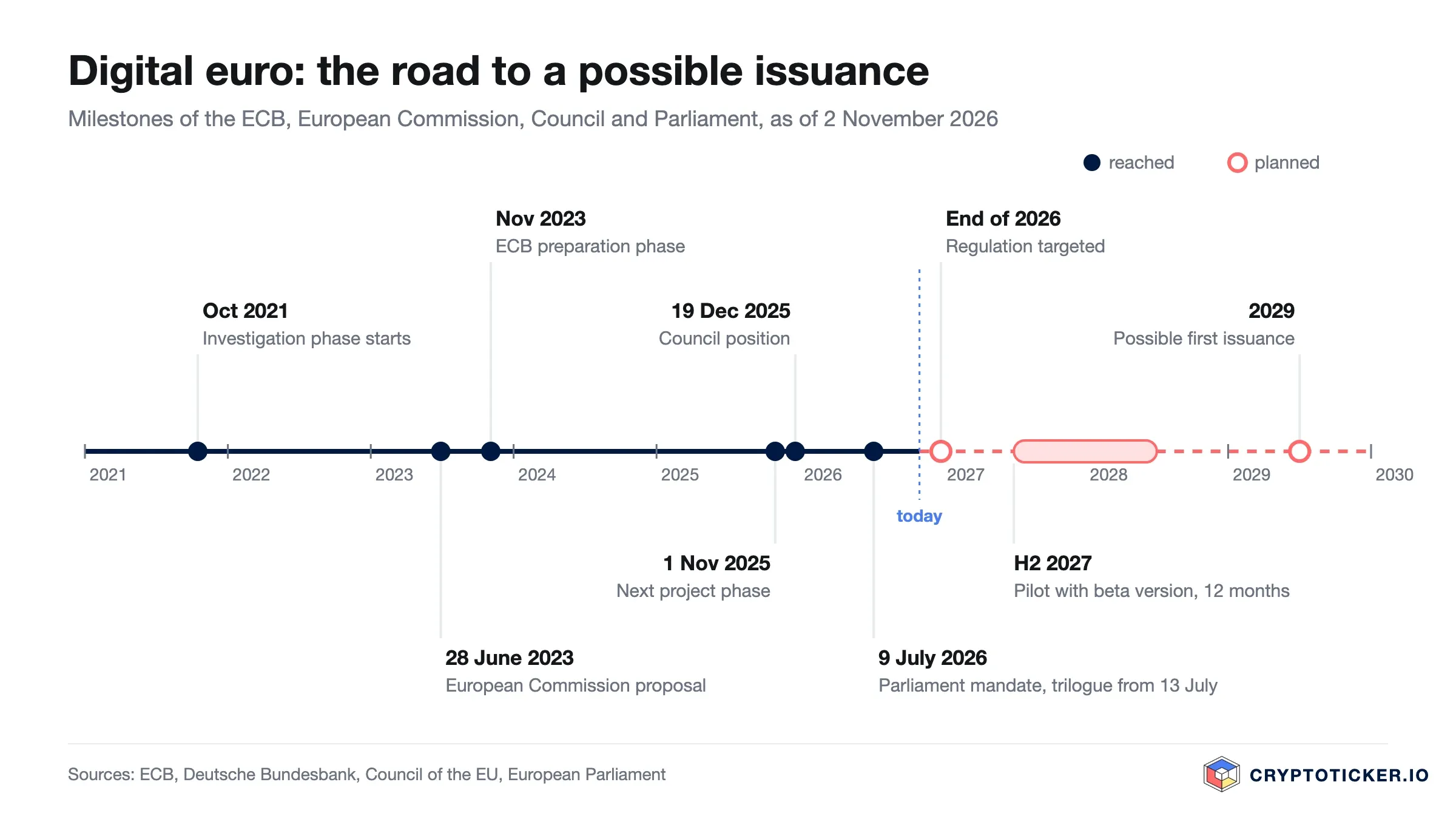
The road there is long. The Eurosystem started a two-year investigation phase in October 2021. On 28 June 2023 the European Commission tabled its legislative proposal, and in November 2023 the ECB's preparation phase began. On 30 October 2025, according to an ECB press release, the Governing Council decided to move to the next phase of the project, which according to the Deutsche Bundesbank began on 1 November 2025.
In the legislative procedure, the Council of the EU set its negotiating position on 19 December 2025, as its press release shows. In the European Parliament, the economic affairs committee adopted its report on 23 June 2026 by 43 votes to 14 with one abstention, and the plenary confirmed the opening of negotiations on 9 July 2026, as the Parliament's procedure overview records. According to the voting record, 416 MEPs voted in favour, 169 against and 22 abstained. The first trilogue round took place on 13 July 2026.
An agreement is still pending at the start of November 2026, and all parties are working towards concluding by the end of the year. Our view: the timeline is tight. If the agreement slips into 2027, 2029 is no longer a given by the ECB's own logic, because the central bank explicitly links its target year to a law adopted in 2026. Anyone who wants to know when the digital euro is coming should therefore watch Brussels more than Frankfurt. How the pilot works and which deadlines applied to merchants is covered in our article on the ECB pilot project.

Digital euro and cash: what changes for notes and coins
Nothing changes for your cash because of the digital euro, and it will not be abolished. In its answers, the ECB states that the digital euro would complement cash, not replace it. Notes and coins remain legal tender.
The Council of the EU even goes a step further. It adopted its position on the digital euro in December 2025 together with a second regulation that strengthens the status of cash. Under it, merchants and service providers should in principle no longer be allowed to refuse cash. The Council foresees exceptions for distance and online purchases and for unattended points of sale such as vending machines.

Why a digital euro at all, then? Because more and more payments are digital, and so far there is no public money there. Anyone paying in an online shop uses cards, wallets or transfers from private providers. The digital euro is meant to close this gap and give you a means of payment online that is backed by a central bank. Cash and the digital euro are thus two routes to the same money, one for your hand and one for your smartphone.
Digital euro holding limit: how much you can hold
There is no fixed figure yet. The only certainty is that there will be a cap, and the ECB says it has modelled hypothetical limits of up to €3,000 per person at the request of lawmakers. In the political process, amounts between €500 and €3,000 have been mentioned, according to a report by the German outlet netzpolitik.org.
The reason for the limit is the stability of banks. If everyone could swap their entire balance into digital euros, banks would suddenly lack deposits in a crisis, which they use to fund loans. The holding limit therefore makes the digital euro a means of payment, not a savings account.
Who sets the limit is one of the points of contention in the trilogue. Under the Council's text, the ECB sets the concrete limit, but within a ceiling that the Council adopts and reviews at least every two years. According to an analysis by the law firm Freshfields, Parliament instead wants the European Commission to set the ceiling via a delegated act on a recommendation from the ECB. For merchants and companies, a very low limit down to zero is under discussion. You can find all positions compared in our analysis of the digital euro holding limit.
Worked example: what happens above the limit?
So that a payment does not fail at the cap, you can link your wallet to your current account. The ECB describes the balancing in both directions: surpluses flow automatically to the account, shortfalls are pulled from it, provided it has sufficient funds. In technical terms this is called the waterfall and the reverse waterfall. Our calculation with an assumed limit of €3,000 shows what this looks like in everyday life.
| Transaction | Balance before | Amount | What happens automatically | Balance after |
|---|---|---|---|---|
| A friend sends you money | €2,800 | +€500 | €200 stay in the wallet, €300 go to your linked current account | €3,000 |
| You buy a bicycle | €150 | −€400 | You pay €150 from the wallet, it pulls €250 from your current account | €0 |
| You pay at a café | €3,000 | −€4.50 | The payment is made entirely from the wallet | €2,995.50 |
For you this means: the limit caps what you hold, not what you pay. A €400 bill goes through even with €150 in the wallet, as long as the current account is funded.
Digital euro privacy: who sees your payments?
That depends on whether you pay online or offline. For an offline payment, the ECB says the personal transaction data would be known only to two people: you and the payee. That largely corresponds to a cash payment.
For online payments, the ECB assures that the Eurosystem cannot identify the payer and payee. Your payment service provider does know you, just as your bank does today with every card payment, because it has to meet anti-money laundering rules, for example. A central register in which the ECB looks up who bought what is therefore not foreseen.
Our view: compared with a card payment, the offline version of the digital euro would be real progress for privacy, while online it is roughly on the level of today's payment system. It only comes close to cash offline. If privacy is your yardstick, watch above all whether the trilogue brings a threshold for anonymous small payments, which was demanded in Parliament.
Digital euro offline: paying without a network
Yes, the digital euro is meant to work without an internet connection too, and Council and Parliament agree on this. The Council states in its position that the digital euro should be usable online and offline.
Offline means: the balance sits on your device, for example your smartphone, and moves directly to the payee's device during the payment. No server needs to be reachable at that moment. That helps in a dead zone, during a disruption in a provider's network or at a weekly market without a stable connection.
It is precisely this function that makes the digital euro more resilient than many of today's payment methods. If a large card network goes down, often only cash remains at the till. With an offline function, Europe would have a second fallback in digital form.

 Hold your crypto yourself: hardware wallets compared
What does the digital euro cost, and who has to accept it?
For you as a consumer, the basic functions are free: opening an account or wallet, paying in and withdrawing money, paying. The ECB justifies this by saying that the digital euro would be a public good. Banks may offer additional services and charge for them.
Merchants are to be required to accept the digital euro if they already accept digital payments. How far exceptions for small businesses, for example, will reach is still being negotiated in the trilogue. On the fees merchants pay, the Council wants a cap at the level of comparable means of payment for a transition period of at least five years. After that, charges are to be based on the actual costs of the digital euro. The cap is meant to ensure that the digital euro does not become more expensive for shops, cafés and online stores than comparable means of payment.
Conversely, there is no obligation for consumers. Nobody has to use the digital euro; it is an option alongside cash, cards and transfers.
Digital euro pilot project: who will test it from 2027
Testing starts in the second half of 2027 and runs for twelve months, with a possible extension of up to six months according to the ECB's pilot FAQ. In the pilot, staff of the ECB and of 19 national central banks pay with a beta version at selected merchants, processed by 36 payment service providers that the ECB, according to its pilot project page, selected from more than 50 applicants. Technically, the beta version largely corresponds to the planned digital euro, but it is not legal tender.
The call for online and mobile merchants ran until 27 October 2026, and the ECB wants to announce the selection by early 2027. The Bundesbank's call for brick-and-mortar retail is still open: until Friday, 20 November 2026, 5 pm CET, experienced retailers can apply to run a temporary point of sale at a Bundesbank site in Frankfurt am Main during the pilot. Participation is voluntary and unpaid. The documents and the contact address are on the Bundesbank's status page.
Digital euro, stablecoins and Bitcoin: the difference
All three are digital, but only the digital euro has a central bank behind it. The ECB draws a clear line in its answers: stablecoins are not guaranteed by a central bank or public authority, and according to the ECB no institution stands behind crypto assets such as Bitcoin. The table shows the differences at a glance.
| Feature | Cash | Digital euro | Current account | Euro stablecoin | Bitcoin |
|---|---|---|---|---|---|
| Issuer | Eurosystem | Eurosystem | your bank | private company | nobody, protocol |
| Who is liable | central bank | central bank | bank, deposit guarantee up to €100,000 | issuer, redemption at par under MiCA | nobody |
| Legal tender | yes | yes, planned | no | no | no |
| Usable offline | yes | yes, planned | no | no | no |
| Cap | none | holding limit planned | none | none | none |
| Price risk | none | none | none | low, pegged to the euro | high |
For stablecoins, the digital euro is a direct competitor, especially for euro stablecoins authorised as e-money tokens under the MiCA regulation. Which platforms already work under MiCA rules is shown in our comparison of regulated crypto exchanges. How central banks test both forms of money side by side is shown by the Bank of England example in our article on the difference between the digital euro and stablecoins.
Our view: what the digital euro means for crypto investors
The digital euro is no signal for the Bitcoin price. It is a payments project with a horizon to 2029, and anyone deriving a price move for the coming weeks from it is stretching the facts. The competition it creates lies elsewhere: with cards, payment apps and euro stablecoins.
For investors who hold their crypto themselves, it is not an alternative either but a different tool. The holding limit makes it a wallet for spending, not a vault. Anyone holding Bitcoin or Ether for the long term is still best off keeping them in their own wallet, and our hardware wallet comparison shows which device suits you.
The digital euro becomes interesting where crypto and everyday life meet. A free euro payment that works offline and carries a central bank guarantee sets the benchmark that private euro stablecoins will have to measure up to. Keep three dates in mind: the trilogue agreement targeted by the end of 2026, the selection of pilot merchants in early 2027 and the start of the pilot in the second half of 2027.
(As of 2 November 2026. This article is not investment advice. Cryptocurrencies are highly volatile, and a total loss is possible.)
Frequently Asked Questions About the Digital Euro
Transparency note: This article was produced with the assistance of artificial intelligence and reviewed by our editorial team before publication. All figures and claims were checked against the primary sources linked in the text. The feature image was generated with AI.
Related articles
- Digital Euro Holding Limit: What the Planned Cap Means for Your Account and Your Crypto
- Digital Euro and Stablecoins: Why the Bank of England Is Testing Both Forms of Money in a Single Payment
- Digital Euro: the ECB Opens Its Pilot Project, Two Dates in October 2026
- ECB Prepares for Potential Digital Euro Launch Amid Trump’s Crypto Revolution
- ECB Develops Settlement System for Distributed Ledger Technology Transactions
Which topics should we dive deeper into?
Select what genuinely interests you. Your picks feed directly into our editorial planning.
Crypto news that's actually worth your time.
Weekly. 60 seconds. Carefully curated by our editors: no hype, no promo flood, no spam.

January 29, 2020 11:59 PM

Only Bitcoin And Digital Currencies Will Survive, Fund Manager
Multicoin Capital’s Managing Partner Tushar Jain tweeted on 27th Jan that FIAT currencies issued from economically challenged smaller countries will be on the verge of extinction soon and we might be left with a few Central Bank Digital Currencies (CBDC) […]

September 5, 2019 3:26 PM

Weekly Tidbits: Crypto News from the German-Speaking Sphere
German Cabinet and Bundesbank tries to resolve CBDC issues The Cabinet of Germany and Deutsche Bundesbank are working together on issues regarding central bank digital currencies (CBDCs). The Cabinet published an official response to a request from the Free Democratic […]
September 22, 2026 7:13 AM
ECB Platform Pontes Goes Live: What to Check on Tokenized Securities Now
The Eurosystem launched its Pontes platform on September 21, 2026, allowing trades in tokenized securities to be settled in central bank money for the first time. Nothing changes in your portfolio today, but the distinction between a crypto-asset and a crypto security will decide tax and liability in future.

August 9, 2022 4:44 PM

US Sanctions Virtual Currency Mixer Tornado Cash: What Will Be The Impact of This Crackdown?
In a major move, the US sanctions Tornado Cash, a virtual currency mixer, after news of money laundering of more than $7 billion.

September 27, 2026 1:17 PM
Dogecoin Price: What to Check on Holding Period and Custody Before the Year End
The Dogecoin price stands at $0.0977 on September 27, 2026 and has barely moved in a day. That calm is exactly the moment to work through the holding period, the reporting duty from 2026 and custody without any time pressure.
September 14, 2026 10:23 AM

Take Ethereum Profits or Wait Out the Holding Period? What the Price Jump Means for Your Tax Bill
Ether reached its highest level since the end of January on September 11, 2026, and many are asking whether to sell now. In Germany the answer hangs on the purchase date first: we work out which tranches are tax free and which of them are showing a gain at all.

November 14, 2020 3:06 PM

Shaping the Blockchain & Crypto Ecosystem at Hong Kong Blockchain Week 2020 November 17-19, With Main Block O2O Virtual Summit on Nov 18th
As Bitcoin price is going up, digital currencies relive their best industry moments while getting closer to a customer than ever in 2020. Experts from business, technology, finance, education hubs will ensure deep thought leadership and share unique analysis of how the crypto currencies world evolved from Satoshi’s whitepaper into a globally important topic of central bank digital currencies.
October 31, 2020 9:40 AM

Deutsche Bundesbank, The German central bank is Partnering with OCEAN
The Central Bank of Germany Deutsche Bundesbank has decided to partner with the OCEAN Protocol to develop a decentralized data autonomy platform. OCEAN Protocol and the Deutsche Bank According to a public notice issued in the Supplement to the Official Journal of the European […]
April 24, 2019 9:50 AM

The IMF accidentally makes a case for Crypto
Is it possible to think that the money in your bank account is different from the cash you hold? Well, one of the fundamental ideas of modern banking is that the balance an individual holds in a bank is the […]
October 13, 2018 9:58 PM

HKMA To Launch Trade Platform via Blockchain
HKMA, Hong Kong’s de facto central bank Hong Kong Monetary Authority is launching a blockchain-based trade finance platform
September 30, 2026 4:14 AM
Bitcoin Price Before the Core PCE at 14:30 CEST: Will the $82,735 Level Hold?
At 14:30 CEST today the Bureau of Economic Analysis publishes the core PCE deflator for August, the inflation gauge the Fed anchors its 28 October rate decision to. Bitcoin stands at $83,329, less than $600 above its daily low, and anyone holding on leverage decides this morning.

September 26, 2026 7:14 AM

Cardano Before the RealFi Launch on October 1: What ADA Holders Should Check on USDr, MiCA and Tax
On October 1, 2026 the stablecoin platform RealFi goes live on the Cardano mainnet, and ADA has gained 14.67 percent in a week. What is documented about the yield-bearing dollar token USDr, and what investors should settle beforehand.
September 24, 2026 4:28 AM

Crypto Trading Bots and Tax: What Applies With Thousands of Trades a Year
A bot turns one investment decision into hundreds of disposals, and the tax office counts every single one. This guide explains the holding period, FIFO, the exemption limit and the record-keeping duties, and what to set up before the bot makes its first trade.
September 22, 2026 1:28 PM
Selling Bitcoin and Cashing Out in Euros: How It Works in Germany
Between the sell order and the euros in your current account stand the exchange, your bank and the tax office. Knowing the order of events saves fees, waiting time and, in the best case, the entire tax on the gain.
September 20, 2026 4:13 AM

Zcash Above $1,500: What ZEC Holders Should Check on Tax and Custody
Zcash rose above $1,500 on September 19 for the first time since 2016 and, after an intraday high of $1,590.80, trades back at around $1,474. For German holders three questions hang on that jump: the one-year holding period, the planned year-end cut-off and the EU anti-money-laundering regulation from July 2027.
September 19, 2026 4:02 PM
Binance MiCA License: Did Lagarde Personally Block Binance From the EU?
The WSJ says ECB chief Christine Lagarde asked Greece not to approve Binance's MiCA license. Here is what happened, and why the ECB had no formal say.
August 24, 2026 4:22 AM

Selling XRP After a 53 Percent Week: What the Holding Period Costs
XRP trades at $1.51 after a weekly gain of a good 50 percent, yet your net proceeds are decided by the purchase date. This article works through the holding period, the exemption limit and FIFO at measured reference-date prices.
March 27, 2025 5:00 AM
Bitcoin or Stablecoins: Which Is the Best to Hold in 2025?
GameStop adds Bitcoin to its treasury while Fidelity explores launching a new stablecoin. But what's in it for investors, and which is the best to hold in 2025?
January 6, 2024 5:46 AM
BIG Bitcoin ETF NEWS: Is the Launch Date for Bitcoin ETF Confirmed?
There is uncertainty whether SEC will announce the ETF approval simultaneously or in separately. Let's take a look at this Bitcoin ETF news

January 20, 2020 7:34 PM

What Is a Bitcoin Mixer and How Does It Work? The Legal Status in 2026
A Bitcoin mixer pools coins from many users to break the visible link between sender and receiver. How the technique works, why people use it, and where courts and lawmakers in the US and the EU stand in 2026.
January 22, 2025 7:31 PM

Tornado Cash OFAC Sanctions Overturned: A Huge Win for Crypto Privacy and a 150% TORN Price Surge
The U.S. court’s reversal of Tornado Cash OFAC sanctions marks a pivotal moment for blockchain privacy, sparking a dramatic surge in the TORN price.
October 23, 2026 10:40 PM

Account terminated over a money laundering suspicion: the three working days cover only the transfer
On October 20, BaFin warned about job offers under which other people's money is to be exchanged for crypto assets through your own account. Those who go along with it often lose their bank account: this guide separates an account block, a termination and the three-working-day deadline in Germany's Money Laundering Act.
October 8, 2026 10:39 AM

Bitcoin Cash and the CME Futures Launch on October 19: Will the Listing Carry the Price?
The CME Group plans to introduce futures on Bitcoin Cash on October 19, with a standard contract of 250 BCH. The price stands at $294.93 and has given back the jump from the announcement in full.
September 24, 2026 4:11 PM

Bitcoin Cash Falls 5.5 Percent After a 50 Percent Week: Check Your Buy Route, Leverage and Holding Period
Bitcoin Cash fell to $335.19 on September 24, 2026, after gaining almost 50 percent in seven days. The rally was set off by CME's announcement of September 22; what that means for buy route, leverage, holding period and custody is set out here.
September 10, 2026 4:15 PM

BW-Bank Opens Bitcoin Trading Inside the Securities Account: What to Check Before Your First Buy
Since September 9, 2026, BW-Bank customers have been able to trade ten crypto assets through their securities account, executed and held in custody by Bitpanda. The familiar securities-account setting hides three points you should settle before your first order.
October 29, 2026 9:42 PM

ECB holds rates at 2.50 percent as Lagarde announces her exit
The ECB Governing Council leaves its key rates unchanged: the deposit facility stays at 2.50 percent, even though inflation in the euro area stands at 3.8 percent. On the same day Christine Lagarde announces her departure for February 7, 2027.
October 14, 2026 10:21 PM

37 banks, one licence: the Qivalis euro stablecoin cannot launch yet
De Nederlandsche Bank authorised Qivalis as an electronic money institution on October 14, 2026; according to the company, 37 European banks from 15 countries stand behind the planned euro stablecoin. Qivalis may not issue the token yet, because the whitepaper required under the MiCA regulation is still missing.
More from CryptoTicker