
Calculating Crypto Tax: Formula, Worked Example and Tax Table
Disposal proceeds minus acquisition cost minus fees: the formula is simple, the consumption order is not. With a worked example, a tax table for the usual income brackets and the points at which every calculator loses precision.




Which topics should we dive deeper into?
Select what genuinely interests you. Your picks feed directly into our editorial planning.
Crypto news that's actually worth your time.
Weekly. 60 seconds. Carefully curated by our editors: no hype, no promo flood, no spam.
The formula is simple: disposal proceeds minus acquisition cost minus fees gives you the gain. If it is above the 1,000-euro exemption threshold and less than a year passed between purchase and sale, you pay tax on it at your personal rate. It only gets difficult once you have bought the same currency several times, because then the order decides.
This article walks through the calculation on a concrete example, gives a table for the usual income brackets and names the points at which every calculator reaches its limits.
Run the numbers with your own data: our free crypto tax calculator with FIFO and CSV import reads the export from Coinbase, Bitpanda, Binance or Kraken, matches every sale to the purchases it uses up and shows the holding time, the taxable gain and the year’s exemption threshold. It needs no account, your data stays in your browser, and like this article it applies German tax law. It is our own tool and not tax advice.
The formula
The taxable gain under section 23 of the German Income Tax Act works out like this:
Disposal proceeds minus acquisition cost minus deductible expenses = gain or loss
The acquisition cost includes the purchase price together with the buying fee. The deductible expenses cover the fees on the sale and the transaction costs that can be attributed directly to the transaction. General costs such as a hardware wallet or a custody charge cannot be deducted.
A worked example
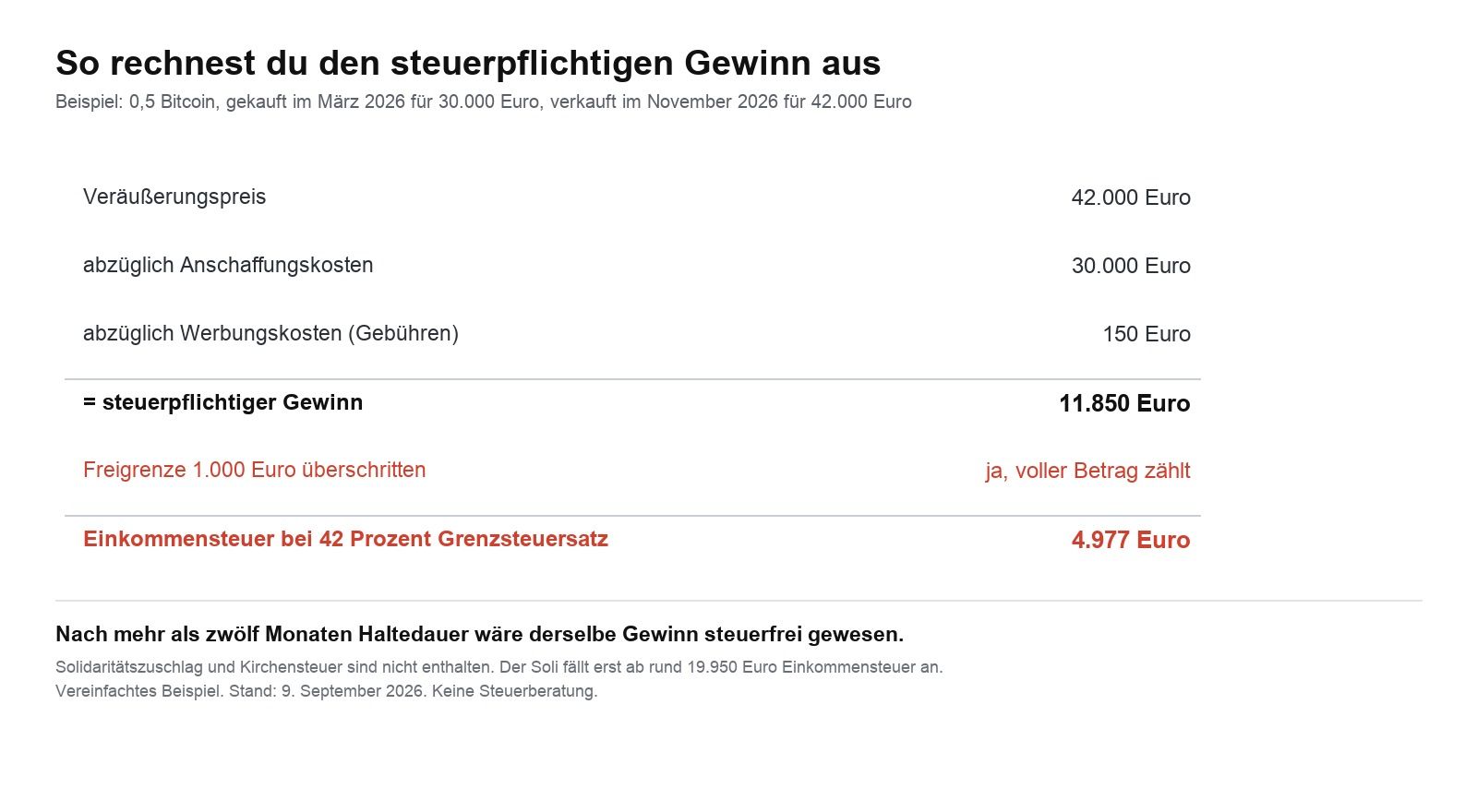
The decisive point is in the last line: had more than twelve months passed between purchase and sale, the same gain would have stayed tax free. The holding period is the only lever that brings the amount down to zero.
Watch the exemption threshold as well. It stands at 1,000 euros and applies to all private disposal transactions of a year taken together. It is an exemption threshold and not an allowance: on a gain of 1,001 euros you pay tax on the full amount, not just on the one euro above the line.
What is left of a 10,000-euro gain
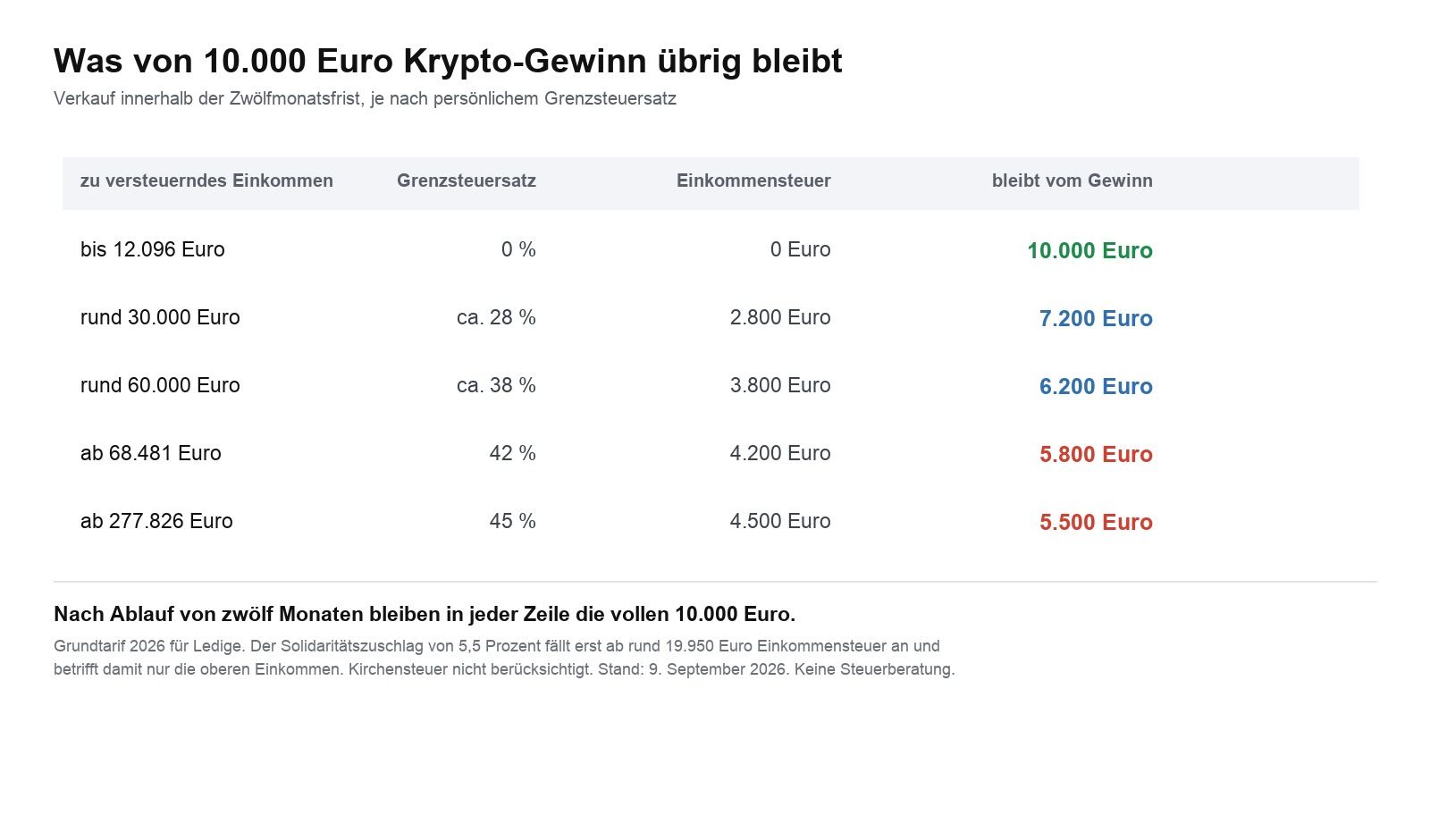
The table shows the 2026 basic tariff for single filers. Two points belong with it, because they are often presented wrongly.
First, the solidarity surcharge. It amounts to 5.5 percent of the income tax, but only kicks in from an income tax of around 19,950 euros. For most investors in the lower rows of the table it does not arise at all. Calculators that add it across the board come out too high.
Second, the marginal rate. It applies to the additional euro, not to your entire income. A crypto gain can also lift you into a higher bracket, so that the average rate rises. Anyone close to a threshold should calculate more precisely than with a table.
What you need for the calculation
For every position sold you need four details. If one of them is missing, the calculation turns into an estimate:
- The acquisition date with the time, because the period runs to the day.
- The acquisition cost in euros, including the buying fee.
- The disposal date and price, likewise in euros.
- The wallet or exchange, because the assessment is made per wallet.
On a coin-to-coin swap there is no euro price. In that case the market value at the moment of the swap has to be used, for both sides of the transaction.
The point where every calculator loses precision
As long as you have bought once and sold once, the calculation is trivial. As soon as you have bought several times, the consumption order decides which coins count as sold, and with it the tax.
The Federal Ministry of Finance letter of 6 March 2025 sets out the order: individual identification comes first, where you can prove which specific coins you disposed of. Where that is not possible, the crypto assets acquired first count as the ones sold first for the purposes of the holding period. For the valuation the average method applies, and for simplicity FIFO may be assumed there as well.
This order usually works in your favour, because it uses up the oldest and therefore often tax-free positions first. But it can only be applied correctly if your history has no gaps. What that means for a savings plan is shown in our article on bitcoin and tax.
When a calculator is enough and when it is not
A simple calculator will do if you have few purchases, all on the same exchange, and trade exclusively against euros. Then you can reproduce the formula above in a spreadsheet.
A specialised tool pays off as soon as one of these points applies:
- You trade on several exchanges or move holdings between wallets.
- You swap coin for coin, because each transaction then needs two market values.
- You run a savings plan with many individual instalments.
- You receive staking or lending income, which has to be valued at the moment it arrives.
Which tools handle that and what they cost is set out in our comparison of crypto tax tools. One note on expectations: no tool replaces the tax assessment of the individual case, and none is liable for the result.

What would change about the calculation from 2027
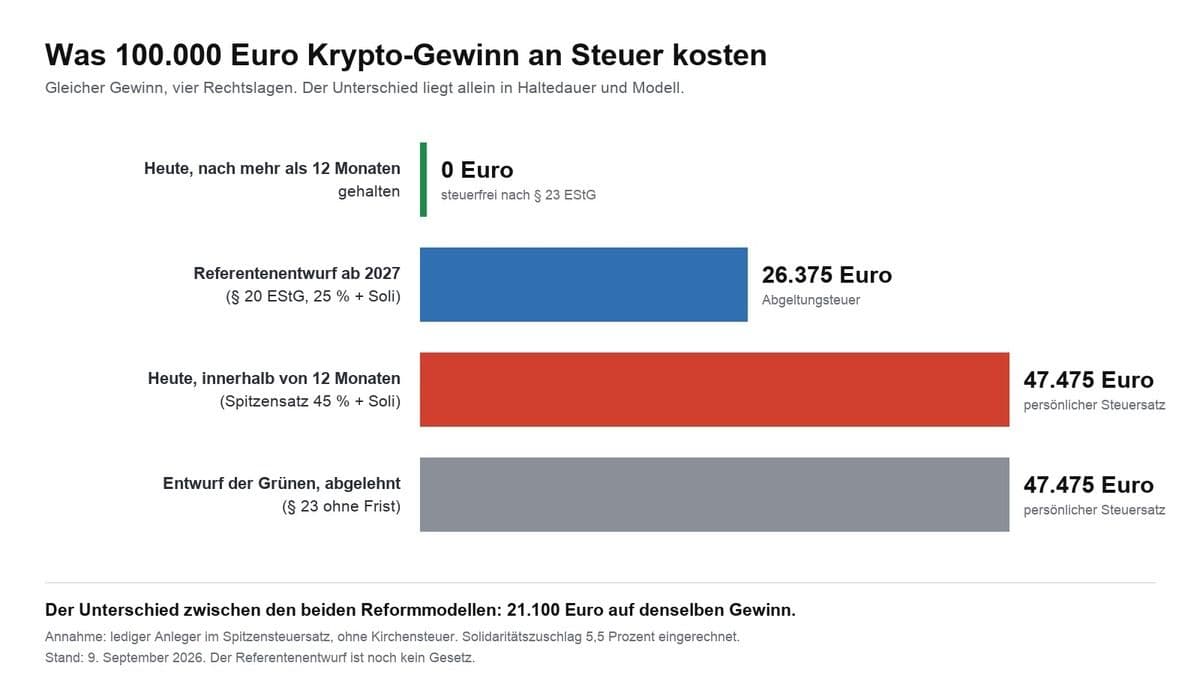
Under the draft bill from the Federal Ministry of Finance of 8 September 2026, the calculation would become considerably simpler: 25 percent withholding tax plus solidarity surcharge on the gain, regardless of the holding period, and in exchange without the question of the twelve-month window.
As the draft stands, only crypto assets acquired after 31 December 2026 would be affected. For everything before that, the calculation would stay exactly as it is set out here. Nothing has been decided; the details are in our article on the cutoff date and grandfathering.
Frequently asked questions
How do I calculate the tax on crypto gains?
Disposal proceeds minus acquisition cost minus fees gives you the gain. You pay tax on it at your personal rate if the sale happened within twelve months and the total gain is above 1,000 euros.
Is there a free crypto tax calculator?
For simple cases the formula in a spreadsheet is enough. Free online calculators mostly handle a single transaction and take into account neither the consumption order nor the exemption threshold across all transactions.
How high is the tax rate on crypto?
There is no separate rate. Your personal income tax rate of 14 to 45 percent applies. After a holding period of more than twelve months no tax arises.
Does the solidarity surcharge always come on top?
No. It only kicks in from an income tax of around 19,950 euros and therefore concerns higher incomes only.
How do I calculate a coin-to-coin swap?
You use the market value at the moment of the swap. The coin given up counts as disposed of, the one received as acquired, with a fresh twelve-month period.
Can I deduct fees?
Yes, as far as they can be attributed to the individual transaction. Buying fees increase the acquisition cost, selling fees reduce the gain.
Sources
- Section 23 of the German Income Tax Act on private disposal transactions
- Federal Ministry of Finance letter of 6 March 2025, file reference IV C 1 - S 2256/00042/064/043, on the consumption order and valuation
- Solidarity Surcharge Act 1995 in the version applicable from 2021, on the exemption threshold
- Details of the draft bill based on the reporting of 8 September 2026
(As of 9 September 2026. All examples are simplified and calculated without church tax. This article is not tax advice.)
Transparency note: This article was produced with the assistance of artificial intelligence and reviewed by our editorial team before publication. All figures and claims were checked against the primary sources linked in the text.
Related articles
- Swapping Bitcoin for Stablecoins: Does Austria Charge Tax?
- New US Senate Proposal Submitted For Crypto Tax Exemption
- Bitcoin Bought Before March 2021: Is the Sale Tax-Free in Austria?
- CoinTracking Review 2026 – Crypto Taxes, Portfolio Tracking & Full-Service Support
- Top Crypto Tax-Free Countries in 2024: A Guide for Crypto Investors
Which topics should we dive deeper into?
Select what genuinely interests you. Your picks feed directly into our editorial planning.
Crypto news that's actually worth your time.
Weekly. 60 seconds. Carefully curated by our editors: no hype, no promo flood, no spam.

August 18, 2026 7:13 AM

Bitcoin Tax Reporting in Austria 2026: What Applies
Bitcoin tax reporting in Austria: which data investors can request from crypto exchanges in 2026, and when the report matters for the tax return.
August 10, 2026 5:15 PM

Bitcoin Lending in Austria: When Tax Falls Due
Lending Bitcoin and earning interest: when lending income is taxed at 27.5 percent in Austria and which exchange rate counts.
September 11, 2026 10:18 AM

Bitcoin Tax Audit: What Proof Austria Requires
Which bitcoin records can the Austrian tax office examine? Purchase dates, wallet transfers, acquisition costs and sale proceeds are what count.
August 21, 2026 1:33 PM
Bitcoin With No Cost Basis: How Austria Taxes the Sale
Bitcoin purchase price no longer provable? How Austria works out the capital gains tax, when a flat-rate cost basis applies and what investors can do.
August 14, 2026 6:18 PM
Bitcoin From a Foreign Exchange to Austria: Which Tax Data You Need
Transferring Bitcoin from a foreign exchange to an Austrian platform: which tax data can be missing for the withholding tax. And what investors need to watch out for.
September 10, 2026 7:14 AM

Bitcoin Loan Liquidated: Tax Consequences in Austria
If a lender liquidates Bitcoin pledged as loan collateral, a taxable capital gain can arise in Austria. That holds even when the investor never chose to sell.
September 1, 2026 1:25 PM

Bitcoin Tax Report Wrong: What Austrian Investors Can Do
Errors in a Bitcoin tax report are not unusual. This is the data Austrian investors should check, and how a wrong capital gains tax deduction is put right.
August 27, 2026 10:16 AM
Bitcoin Tax Return in Austria: When You Must File
Even with a crypto exchange, a tax return can still be necessary in Austria. Foreign platforms, missing capital gains tax withholding and cross-provider losses are the typical triggers.
August 12, 2026 9:12 AM

Bitcoin Losses and Dividends in Austria: How the Tax Offset Works
Can a Bitcoin loss be offset against dividends? This is how loss offsetting works in Austria. It also shows when a tax return is needed for it.
September 4, 2026 1:34 PM

Bitcoin as Loan Collateral: When No Tax Applies in Austria
Pledging Bitcoin as collateral for a loan? As long as the coins are not realised, no sale arises in Austria in principle.
August 10, 2026 9:15 PM
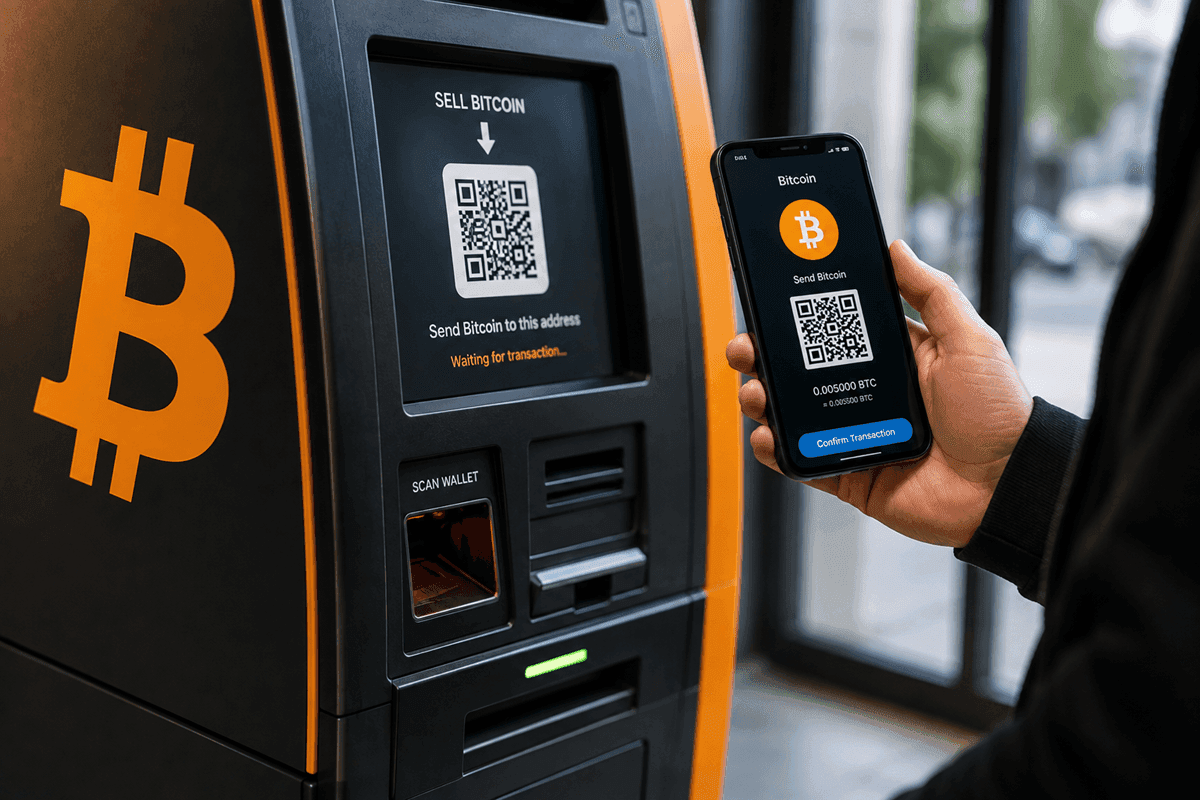
Selling Bitcoin at an ATM: Tax Rules in Austria
Selling bitcoin for cash at an ATM: when the 27.5 percent rate applies in Austria and which records you need to keep.
September 14, 2026 1:27 PM

Bitcoin Lost to a Scam: What Counts as a Tax Loss in Austria
Lost bitcoin to a scam? Why Austria generally does not recognise the damage as a tax loss for privately held assets, and when compensation payments start to matter.
August 26, 2026 10:25 PM
Selling Bitcoin at a Loss: Loss Offsetting in Austria
Sold Bitcoin at a loss? Austria allows the loss to be offset against certain investment income. When loss offsetting is possible and which limits apply.
August 20, 2026 4:24 PM
Bitcoin Across Multiple Wallets: How Austria Works Out the Acquisition Cost
Bitcoin spread across several wallets? How Austria works out the acquisition cost and the rolling average price for tax purposes.
September 19, 2026 7:12 PM

Bitcoin Sold Without Austrian Tax Withheld: What to Do Next
Sold Bitcoin but no Austrian capital gains tax was withheld? That does not make the sale tax free. When investors have to declare the gain themselves at 27.5 percent.
September 3, 2026 10:21 AM

Bitcoin Lost in a Wallet Hack: What Tax Applies in Austria?
Bitcoin lost to hackers? In Austria, the theft of privately held coins generally does not create a capital loss you can use for tax. Only a later payout can change that.
October 9, 2026 1:18 PM

Bitcoin Tax: One Year Past the $126,080 Peak, Losses No Longer Count
Bitcoin trades at $82,558 on Friday morning, 34.5 percent below an all-time high that is now a good year old. Anyone who bought back then loses more than the prospect of a quick recovery when the one-year period expires: the tax value of the loss goes with it.
August 20, 2026 4:12 AM

Wrapped Bitcoin in Austria: Is Converting BTC to WBTC Tax-Neutral?
Swapping BTC for Wrapped Bitcoin: when the move to WBTC can be tax-neutral in Austria, and which tax risks investors should know about. Acquisition costs carry over, but the classification of the token decides the outcome.
September 9, 2026 4:22 PM
Crypto Tax in Germany: What Applies in 2026 and What Is Set to Change in 2027
Crypto gains are tax-free after twelve months; before that your personal tax rate of up to 45 percent applies. What triggers tax, how the holding period is calculated, what happens with staking and losses, and what the draft bill would change from 2027.
September 23, 2026 4:26 PM

Paid in Bitcoin: How to Tax Crypto Income as a Self-Employed Freelancer
A fee in Bitcoin is perfectly ordinary business income, valued at the euro price on the day it reaches you. The decisive trap comes afterwards: business assets carry no one-year holding period, so every later price move stays taxable.
August 25, 2026 10:13 AM
Gifting Bitcoin in Austria: When You Must Report the Gift
Austria levies no general gift tax on bitcoin. Above certain value thresholds, however, a notification to the tax office can be required.
August 31, 2026 10:23 AM

Bitcoin Abroad: The Tax Duty Austrian Investors Carry Themselves
Sold bitcoin through a foreign platform? When Austrian investors have to declare gains themselves and account for the 27.5 percent tax rate.
August 22, 2026 4:47 PM

Offsetting Bitcoin Losses Against Stock Gains in Austria
Offset bitcoin losses against gains on shares? Austria allows it in principle, but only under certain conditions and usually via the tax return.
August 28, 2026 10:15 AM

Selling Bitcoin Privately: What Tax Applies in Austria
Selling bitcoin directly to another person? In Austria, private sales can still trigger 27.5 percent tax on the realised gain.
August 24, 2026 10:26 AM
Bitcoin Savings Plan in Austria: How the Purchase Price Is Calculated
Bought bitcoin through a savings plan? For multiple purchases Austria applies the moving average price as a matter of principle when working out taxable gains.
August 18, 2026 4:22 AM

Bitcoin for gold: is the swap taxable in Austria?
Swapping bitcoin directly for gold? In Austria this can already trigger 27.5 percent tax on the capital gain. What investors should know.
October 6, 2026 4:32 AM
Bitcoin for a gift card: what paying with crypto means for your holding period
Paying for a gift card with Bitcoin is a sale for tax purposes. What counts as the disposal proceeds, when the twelve-month holding period bites, and the four records the tax office expects.
More from CryptoTicker