


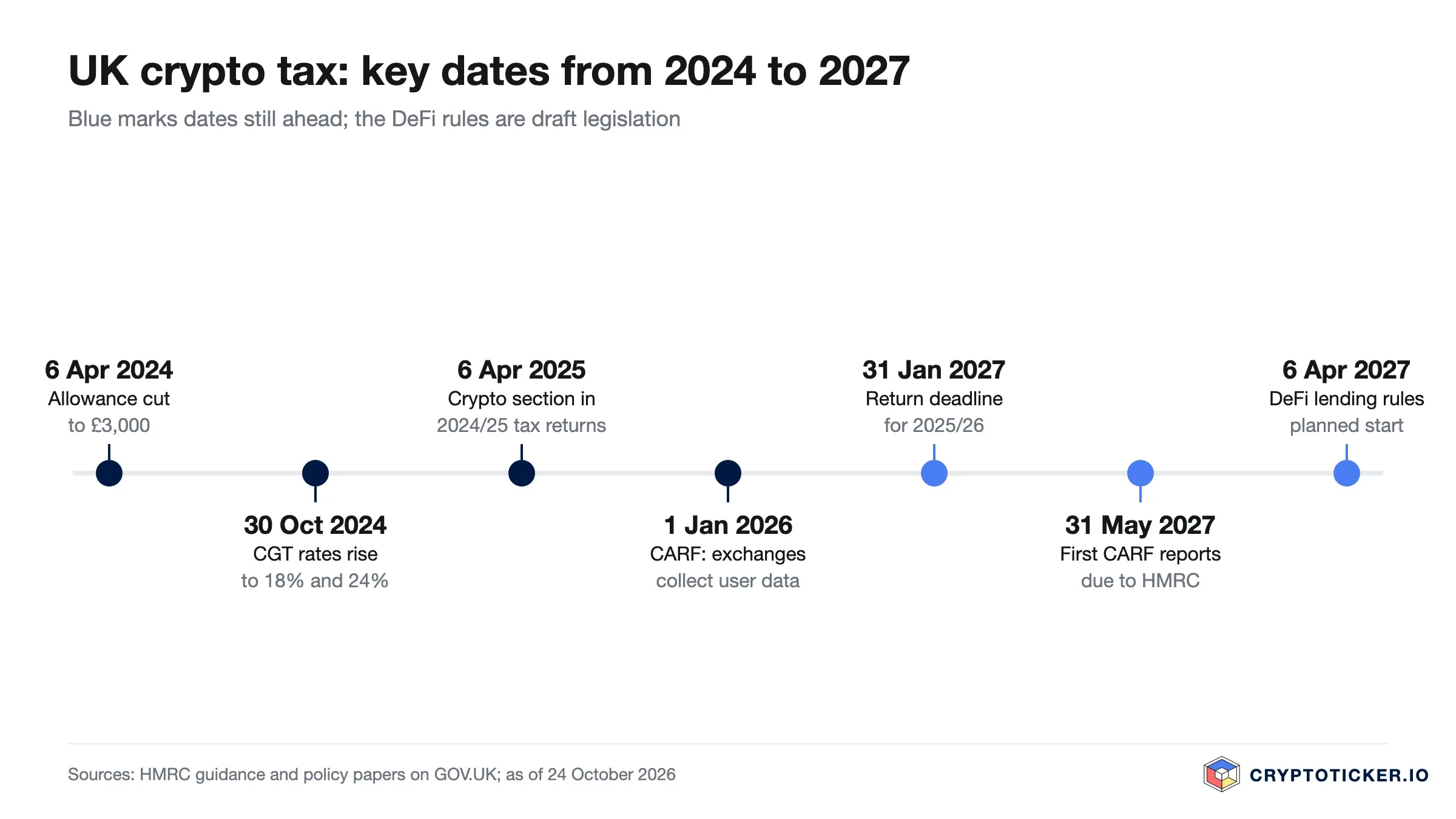
Crypto tax in the UK works mainly through Capital Gains Tax. When you sell, swap, spend or give away cryptoassets, HMRC treats it as a disposal, and any gain above the £3,000 annual allowance is taxed at 18% or 24% in the 2026/27 tax year, depending on your income. Tokens you receive from staking, mining, lending or as pay count as income and fall under Income Tax. Gains and income are reported through Self Assessment, which has a dedicated cryptoasset section, and the online deadline for the 2025/26 tax year is 31 January 2027.
HMRC is paying close attention. Its first official crypto statistics, published on 27 August 2026, show 17,600 people reporting £1.38 billion of taxable crypto gains for 2024/25. Since 1 January 2026, UK exchanges have also been collecting customer data under the Cryptoasset Reporting Framework, which reaches HMRC from 2027. This guide sets out the rules as of 24 October 2026, with worked examples.
Crypto tax UK: the key facts
- 18% and 24%: Capital Gains Tax rates on crypto gains from 6 April 2026 (the same rates have applied since 30 October 2024).
- £3,000: the annual exempt amount for 2026/27; only gains above it are taxed.
- £37,700: the basic rate band for 2026/27 that decides whether gains are taxed at 18% or 24%.
- £1,000: the trading and miscellaneous income allowance that also covers small staking or mining income.
- 31 January 2027: online Self Assessment deadline for gains and income from the 2025/26 tax year.
- 6 April 2027: planned start of "no gain, no loss" rules for crypto lending and liquidity pools.
When do you pay tax on crypto in the UK?
HMRC does not treat cryptoassets as money, so most transactions are a disposal of an asset. According to HMRC's guidance on selling cryptoassets, you dispose of tokens when you sell them, exchange them for a different cryptoasset, use them to pay for goods or services, or give them away. Gifts to a spouse, civil partner or charity are the exception.
| What you do | Tax that can apply |
|---|---|
| Sell bitcoin, ether or other tokens for pounds | Capital Gains Tax on the gain |
| Swap one cryptoasset for another (including stablecoins) | Capital Gains Tax, using the market value in pounds |
| Pay for goods or services with crypto | Capital Gains Tax |
| Give crypto to someone other than your spouse, civil partner or a charity | Capital Gains Tax at market value |
| Receive tokens from staking, mining, lending or DeFi | Income Tax (and, for employment, National Insurance) |
| Buy crypto, hold it or move it between your own wallets | No tax |
The swap rule surprises many investors: moving from bitcoin into a stablecoin to lock in profits is a taxable disposal in the UK, even though no pounds reach your bank account.

Capital Gains Tax rates on crypto for 2026/27
The rate depends on your taxable income. HMRC's rate guidance works it out in three steps: take your taxable income, add your taxable gains after the £3,000 allowance, and compare the total with the basic rate band.
- The part of your gains that fits within the basic rate band (£37,700 for 2026/27) is taxed at 18%.
- Anything above it, and all gains of higher and additional rate taxpayers, is taxed at 24%.
The figures come from HMRC's page on Capital Gains Tax rates and allowances. The allowance was cut from £12,300 in 2022/23 to £6,000 and then to £3,000 from 2024/25, which is why far more crypto investors now owe tax than a few years ago. If you live in Scotland, your Income Tax bands differ, but Capital Gains Tax still uses the UK-wide bands.
Worked examples for 2026/27
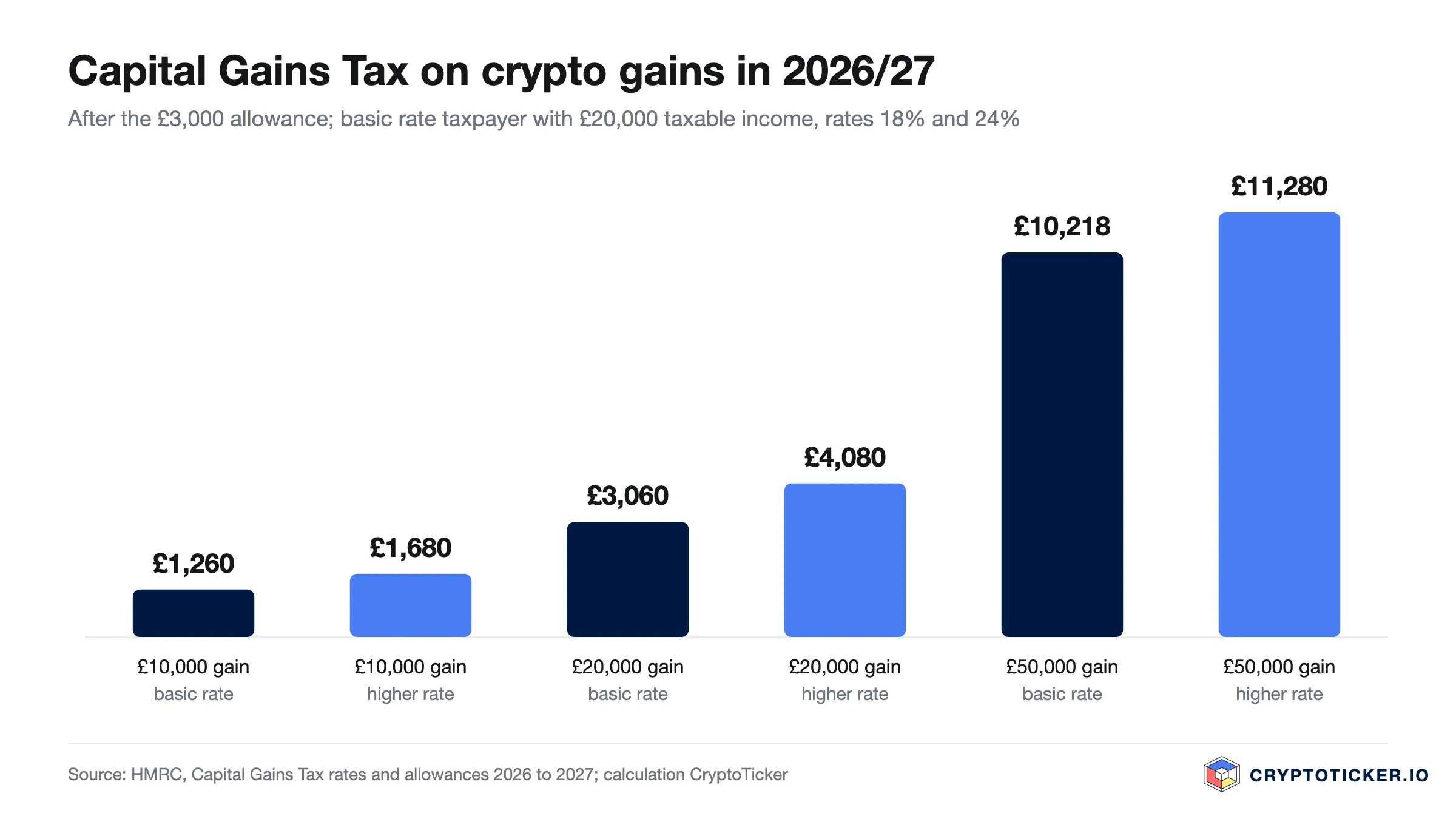
| Crypto gain in 2026/27 | Basic rate taxpayer (£20,000 taxable income) | Higher rate taxpayer |
|---|---|---|
| £10,000 | £7,000 × 18% = £1,260 | £7,000 × 24% = £1,680 |
| £20,000 | £17,000 × 18% = £3,060 | £17,000 × 24% = £4,080 |
| £50,000 | £17,700 × 18% + £29,300 × 24% = £10,218 | £47,000 × 24% = £11,280 |
In each case the £3,000 allowance is deducted first. With £20,000 of taxable income, £17,700 of the basic rate band is still free, so a gain of up to £20,700 stays at 18%.
How to calculate your crypto gain: pooling, same-day and 30-day rules
The UK does not use FIFO for crypto. Instead, HMRC requires pooling: each type of token sits in its own pool with an average cost. Every purchase adds its cost to the pool, every disposal takes out a proportional share.
Two exceptions apply, the same as for shares. Tokens bought on the same day as a sale are matched with that sale first. Tokens bought within 30 days after a sale are matched next, so selling and quickly buying back cannot be used to crystallise a loss while keeping the position.
Example: selling part of a bitcoin pool
| Step | Amount |
|---|---|
| Buy 1 BTC in 2021 | £20,000 |
| Buy 1 BTC in 2024 | £40,000 |
| Pool: 2 BTC, total cost | £60,000 (average £30,000 per BTC) |
| Sell 0.5 BTC in 2026/27 | Proceeds £35,000 |
| Allowable cost from the pool (0.5 × £30,000) | £15,000 |
| Gain | £20,000 |
| Tax for a higher rate taxpayer: (£20,000 − £3,000) × 24% | £4,080 |
After the sale, the pool holds 1.5 BTC at a cost of £45,000. Exchange fees and other costs of buying or selling are allowable and reduce the gain. Exchange statements help, but HMRC is clear that they are not tax calculations and do not track pooled costs, so you need your own records: date, number of tokens, value in pounds and the pool before and after each disposal.
With several exchanges and wallets, a crypto tax calculator for the UK rebuilds the pools from your transaction history and applies the same-day and 30-day rules automatically.
Crypto losses: how to use them
Losses on crypto disposals reduce your gains in the same tax year, before the £3,000 allowance is applied. Unused losses can be carried forward to later years, but only if you report them to HMRC, normally within four years of the end of the tax year in which the loss arose.
If you lose access to your tokens for good, for example after an exchange collapse or a lost private key with no prospect of recovery, a negligible value claim can crystallise the loss. Simply misplacing a key is not a disposal in itself.

Income Tax on staking, mining, airdrops and crypto pay
HMRC's guidance on receiving cryptoassets treats tokens from mining, staking or lending, including DeFi, as income when you are not running a trade. They are taxed as miscellaneous income at their value in pounds when you receive them.
- £1,000 allowance: the trading and miscellaneous income allowance covers small amounts of crypto income each tax year.
- £1,000 to £2,500: contact HMRC; above £2,500: register for Self Assessment.
- Crypto as pay: tokens such as bitcoin are readily convertible assets, so employers must run Income Tax and National Insurance through PAYE.
- Selling later: the value already taxed as income becomes your cost, and only any further gain falls under Capital Gains Tax.
Airdrops are taxed as income if you received them in return for doing something; tokens dropped on you without any action are generally only taxed when you dispose of them.
How to report crypto to HMRC
You report crypto gains above the allowance through Self Assessment. Since the 2024/25 tax year, the return has a dedicated cryptoasset section, completed in pounds sterling.
- Register for Self Assessment by 5 October after the end of the tax year if you do not already file a return.
- File and pay online by 31 January, according to HMRC's Self Assessment deadlines. For 2025/26 that is 31 January 2027.
- Alternative: eligible taxpayers can report gains with the real-time Capital Gains Tax service by 31 December after the tax year.
- Earlier years: unpaid tax from previous years can be put right with HMRC's Crypto Disclosure Service.
What HMRC's first crypto statistics show
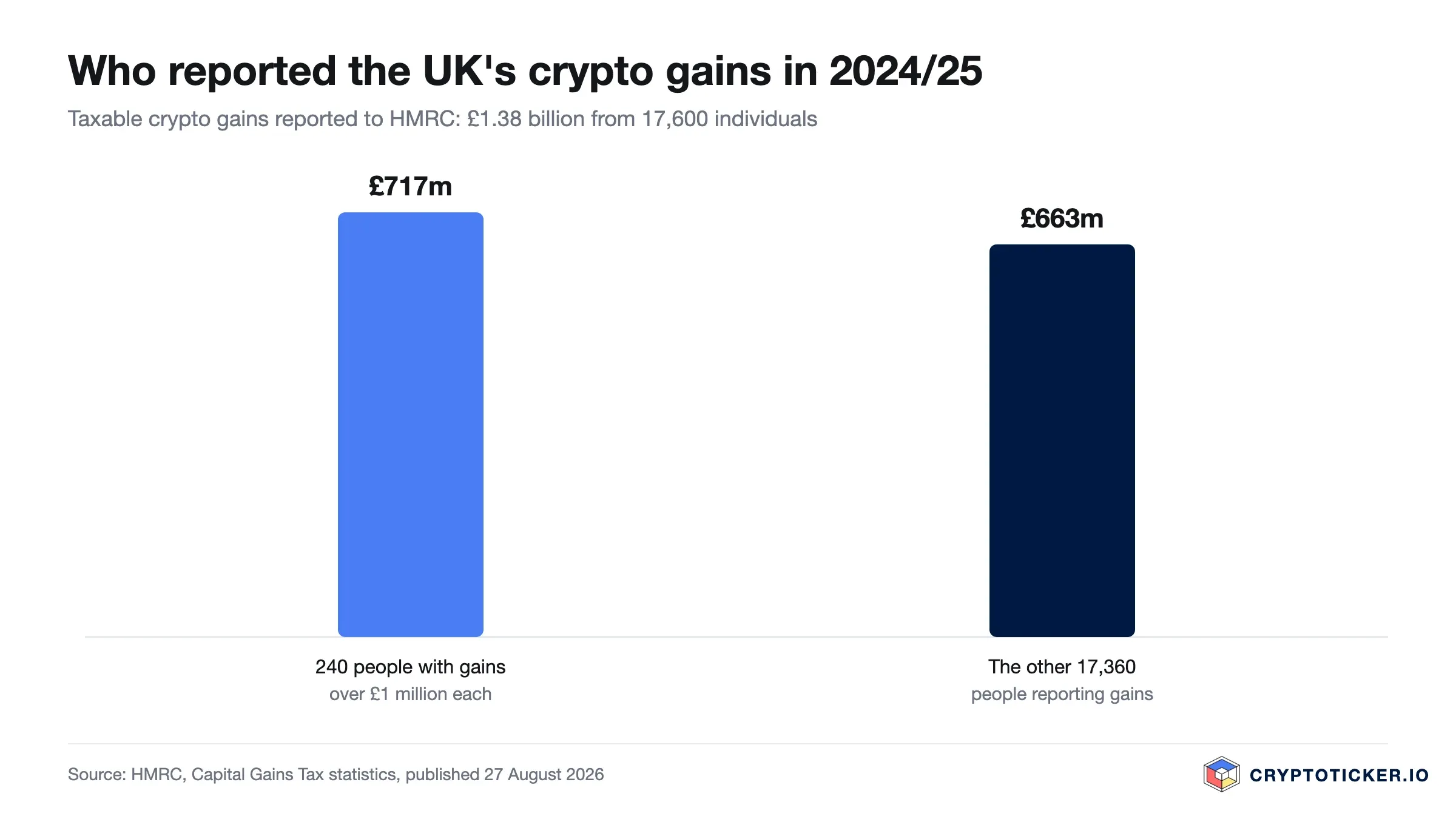
For the first time, HMRC has published figures from the cryptoasset section of the tax return. In 2024/25, 17,600 people reported Capital Gains Tax disposals of crypto, with total proceeds of £13.8 billion and gains of £1.38 billion, an average gain of £78,000 per person. Just 240 people reported more than £1 million each, together £717 million, which is more than half of all reported crypto gains. Around 87% of those reporting gains were men.
HMRC expects the new exchange data described below to help identify crypto gains and income that have not been declared. HMRC also estimates that its compliance and education work generated an extra £168 million of Capital Gains Tax in 2024/25.
CARF: HMRC sees exchange data from 2027
Since 1 January 2026, UK cryptoasset service providers collect information on their customers under the OECD's Cryptoasset Reporting Framework, as HMRC explains on its CARF guidance page. The first reports for the 2026 calendar year are due by 31 May 2027. Providers that fail to comply face penalties of up to £300 per user, and customers are asked for details such as their National Insurance number. EU providers report under DAC8, and EU tax authorities exchange that data with HMRC under the CARF.
DeFi lending and liquidity pools: "no gain, no loss" from April 2027
On 13 July 2026, HMRC published a policy paper and draft legislation for the Finance Bill 2026-27. From 6 April 2027, depositing tokens into qualifying lending, borrowing or liquidity pool arrangements would be treated as "no gain, no loss". Capital Gains Tax would be deferred until an economic disposal, such as selling the tokens or swapping them outside the arrangement. Until then, the current rules apply, and a deposit into a protocol can itself be a taxable disposal.
Crypto tax software for UK investors
Once you trade across several platforms, software saves hours: it imports exchange and wallet histories, applies pooling and the same-day and 30-day rules, separates staking income and produces the figures for the cryptoasset section of your return. Our crypto tax software comparison covers tools that support HMRC rules, with in-depth reviews of Koinly and Blockpit. If you are still choosing where to trade, our comparison of regulated exchanges and the Coinbase review are a good starting point. US readers will find the IRS rules in our US crypto tax guide.

Crypto tax UK: frequently asked questions
UK crypto tax updates, straight to your inbox
HMRC guidance, CARF reporting and new DeFi rules: get the changes that affect UK crypto investors, explained clearly.
Free, every week, unsubscribe any time.
Subscribe on SubstackThe signup form is provided by Substack and needs marketing cookies to load.

Dennis Weidner
Dennis Weidner is managing director of Cryptoticker.io GmbH in Berlin and runs the editorial operation behind CryptoTicker, published since 2017 in German, English, French and Spanish. A founder and investor, he has worked with digital business models for more than twenty years. His writing focuses on the point where regulation meets what investors actually do: MiCA authorisation of trading venues, taxation and DAC8, self-custody and staking. He works from verifiable primary sources rather than price speculation: supervisory registers, vendor post-mortems, original specifications. His articles are analysis, not investment advice.