
Ledger Confirms Implant in a Hardware Wallet as Reports Reach Europe: What Is Behind It
Ledger confirms an unauthorised additional circuit board in a tampered device and traces the confirmed cases to a reseller in South-East Asia. One report from European retail is still open, which makes the purchase route of your own device the criterion.




Which topics should we dive deeper into?
Select what genuinely interests you. Your picks feed directly into our editorial planning.
Crypto news that's actually worth your time.
Weekly. 60 seconds. Carefully curated by our editors: no hype, no promo flood, no spam.
Ledger has confirmed that at least one device belonging to an affected user contained an unauthorised hardware implant. According to the manufacturer, every confirmed case traces back to a single reseller in South-East Asia. Since 11 October, users have also been reporting devices bought from European retail, and that is where the case starts to matter for you: if the sales channel is the point of attack, the brand on the box counts for less than the question of whose hands your device passed through.
What Ledger confirmed on 11 October, and what it explicitly did not
In a status report 72 hours after the incident, Ledger wrote on X that all confirmed cases of the theft disclosed on 9 October involved devices sold through the South-East Asian reseller CryptoBilis. The security publication Help Net Security documents that wording. The manufacturer also confirmed that one affected device contained an unauthorised additional circuit board.
Two things Ledger did not do. It did not explain how the implant works technically. And it did not give the number of affected devices. The company does state that its own systems and its direct sales channel were not compromised. Ledger says it is working with the relevant authorities and is contacting affected users.
That distinction is no side note. An attack on manufacturing would affect every device in a production run. An attack on one station in the distribution chain affects the devices that passed through that station. The difference decides how many people have to act, and so far the evidence points to the second case. How the incident began, we set out on 10 October in our review of the CryptoBilis case.
CryptoBilis in Indonesia, Malaysia and the Philippines: the confirmed route into the device
CryptoBilis is an authorised reseller and serves customers in Indonesia, Malaysia and the Philippines. The company had changed owner shortly before. Ledger told the retailer to stop sales and shipping; on the manufacturer's account, CryptoBilis has ceased selling hardware wallets.
The instruction Ledger then issued to all authorised retailers is the notable part: source goods only through authorised channels, and never return a returned product to the shelf. The second half describes the likely lever. A returned device, opened and resealed, looks like new stock in a shop.
A supply-chain attack does not hit the product at the manufacturer. It hits a station on the way to the buyer: warehouse, transport, returns processing, shop shelf. For buyers, that means the security of a hardware wallet does not begin when the device is first switched on.
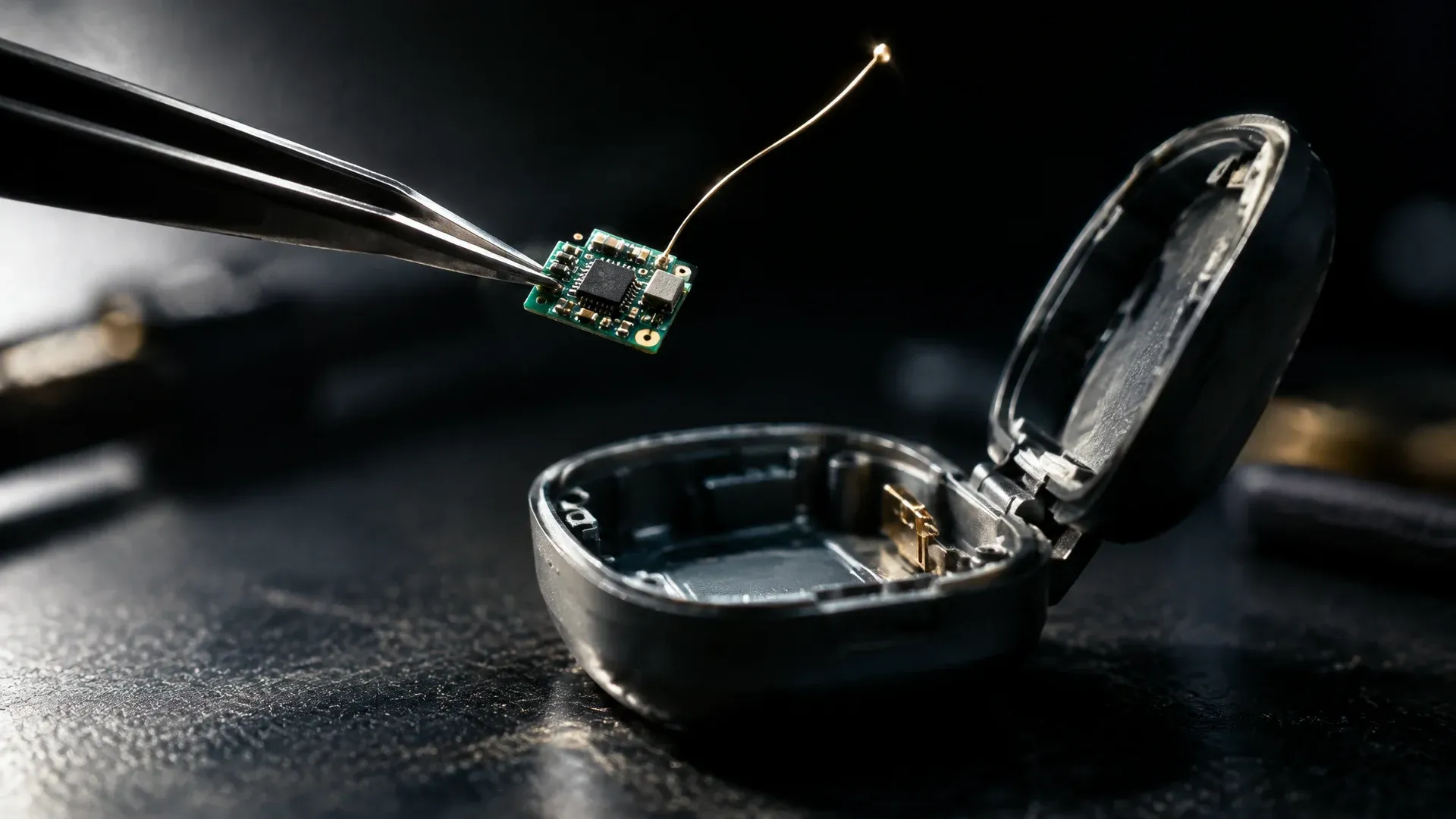
Hardware implant under the display: microcontroller, LTE chip and e-SIM
The most detailed technical description so far comes not from the manufacturer but from Mark Karpelès, the former head of the Mt. Gox exchange. He says he bought a tampered device himself in Malaysia and has published photographs and video. They show a small circuit board under the screen, in the place that otherwise holds only a piece of padding.
On his account, that board carries a microcontroller, an antenna, an LTE module and an e-SIM. An e-SIM is a permanently fitted, digitally writable SIM card; it needs no card slot and is invisible from the outside. Karpelès describes the component reading along with whatever the screen displays, capturing the recovery phrase in the process and sending it to the attacker over the mobile network.
The recovery phrase, also known as the seed phrase, is the sequence of 24 words from which every private key in your wallet can be recomputed. Anyone who knows it no longer needs your device. That makes setup, the moment when those words appear on the display once, the most valuable moment for an attacker. Ledger has not confirmed this account of how the implant works, and it rests so far on a single investigation, if a technically documented one.
Karpelès also reports a second suspect device, obtained through a listing on Amazon Japan with stock that came from Malaysia. That too points to the trade route rather than to manufacturing.
 Find a hardware wallet direct from the maker
Genuine Check passed: the real secure chip stays real, the extra board stays invisible
The most uncomfortable finding of the case concerns the very check buyers have relied on until now. The Genuine Check is the authenticity test in which Ledger's software runs a cryptographic key exchange with the secure chip inside the device and then confirms that the unit is genuine.
Karpelès says his tampered device arrived in intact shrink wrap and passed that test. The reason is obvious once you have heard it: the secure chip was real. The implant sits next to it and the check does not cover it. On his assessment, opening the device is the only reliable way to find the additional board.
There is an awkward consequence for everyday practice. A passed authenticity check is still a good sign, but it is not proof that nothing foreign sits inside the case. Anyone holding a second-hand device, or one from a channel with an unclear chain of custody, cannot rest on that signal alone. Which devices are built in what way, and where the differences lie, our hardware wallet comparison sets out.
$72 million to more than $93 million: why the damage estimates differ
There is no official damage figure. The on-chain analysts at Bitquery arrive at a suspected total of more than $93 million. Other independent assessments come out lower; the range of published estimates runs from around $72 million to more than $93 million, spread across hundreds of wallets. One analysis names $93.4 million across more than 300 addresses.
Balances on several blockchains are affected, with Bitcoin, Ethereum and Tron named. The figures diverge because of method: anyone attributing addresses to an incident has to decide which movements still belong to it. We therefore give the range and do not smooth the values into a single number.
Bitquery analysis: eight in ten drained wallets first received funds in June or later
The single finding that matters most to you is not the damage total. It sits in a time window. Bitquery traced the drained wallets back and finds that more than eight in ten first received a balance in June or later. That suggests devices bought at CryptoBilis as early as June can be affected too.
That reaches beyond Ledger's own advice. The manufacturer had told buyers from the past 90 days to move their holdings to a new device. Counting back from the incident on 9 October, that window ends in early July. The on-chain trail begins a month earlier. Anyone who bought a device through this retailer in June falls outside the manufacturer's recommendation, but not outside the data.

European retail: what the reports establish and what they do not
On 11 October a report from Europe became public. A user writing on X as @0xJohannes_ says he bought his device in a branch of an official European reseller; the channel Crypto Banter carried the case further the same day. On his description, the device held additional cables that do not appear in genuine units, and the build resembled an older variant of the implant even though the purchase was only weeks old. Karpelès, who posts on X as @MagicalTux, pointed to an antenna whose marking suggested a "Eurasian" version.
Care matters more than speed here. No balance was taken from this device. Which retail chain is meant does not emerge from the report itself. It is named only in adjacent coverage; the trade publication Crowdfund Insider writes exactly that and refrains from confirming the case itself. Ledger has not commented in detail on the European report and continues to attribute the confirmed cases to the South-East Asian retailer. Several observers regard the published images as insufficient evidence and warn against inferring broad contamination of European retail from individual cases.
Something is left for your decision all the same. There is one confirmed implant case, a documented route through the intermediate trade, and a manufacturer's instruction not to restock returns. That is enough to retrace your own purchase route once, and not enough to panic.
 Find a crypto exchange with an EU licence
Bought in a shop or direct from the maker: the purchase route is the criterion for buyers in Germany
Ledger's recommendations for affected customers are clearly worded. Anyone who bought at CryptoBilis and has not yet set the device up should not initialise it. Anyone who has already set it up should move their holdings to a new device with a newly generated recovery phrase, ideally one bought directly from the manufacturer. Contact should run through the official channels, and the company explicitly recommends filing a report with the local police.
For the German market there is no confirmed case. The reports from European retail do give reason, though, to make the purchase route the criterion. Buying a device directly from the manufacturer, or from a retailer with a traceable supply chain, costs nothing but a little patience. A device from a marketplace, from a classified ad or as a return from unclear hands carries a risk that cannot be checked from the outside.
What you should not do matters as well: opening your own device to look for a board destroys the warranty and, without reference images and measuring equipment, gives you no reliable answer. The route via a new recovery phrase on a cleanly sourced device is cheaper and safer than any tinkering with the case.
MiCA custody and self-custody: who is liable when something goes wrong
This incident touches a decision many investors take once and then never revisit: self-custody or custody by a service provider. Self-custody means that you hold the private key yourself and nobody else can dispose of your assets.
The price is that there is no counterparty when something goes wrong. Anyone who loses a seed through a tampered device has no claim against a custodian. What remains is a damages claim against whoever tampered with the device, and that person is usually unknown. With a custodian authorised under the EU's MiCA regulation, the customer by contrast holds a claim against a supervised company, with duties to segregate client holdings. In exchange, that customer gives up the key. Which providers hold an EU licence, our overview of regulated crypto exchanges shows.
Both are defensible, and most investors fare better with a split than with a pure solution. What counts is knowing which part of your assets you answer for yourself if the worst happens.
Phishing after the incident: Ledger does not call and never asks for the 24 words
Every major security incident is followed by a second wave, and it reaches more people than the incident itself. Ledger explicitly warns that fraudsters are exploiting the situation and makes one point clear: the company does not call, does not send direct messages and never asks for the 24-word phrase. Any message that does precisely that is an attack, however genuine the sender and the design may look.
The same incident has already pushed fake Ledger pages into search results. How to spot them, we set out in our analysis of the fake Ledger websites. The rule behind it is short: the phrase never leaves the device, on no channel, for no support agent.
In the market the news has moved little so far. Bitcoin trades at around $82,400 on CoinGecko data, a good one percent below the previous day, and the market as a whole lost about 3.7 percent in 24 hours. The incident is grave for those affected and, for the price, a side issue so far.
Ledger implant: a new seed is the only reliable answer
If a doubt about the purchase route remains, no test on the case will settle it. Only a fresh key on a device whose origin you know. These three steps get you there:
- Establish the purchase route. Check the invoice and the retailer of your device. If it came from the manufacturer or from a retailer with a clear supply chain, nothing needs doing as things stand. If you bought second-hand or from an unclear source, assume risk. Which devices are candidates is set out in the software wallet comparison for the interim and among the hardware models.
- Generate a new recovery phrase. Set up a cleanly sourced device from scratch, write the new words down offline and move your holdings across in full. The old phrase counts as burned from that moment, even if nothing has happened. For the interim, part of it can be parked with a regulated custodian holding an EU licence.
- Follow up on your accounts. Change the credentials everywhere the old device was connected, and set up two-factor protection again. Where you hold which accounts and at what fees, the exchange comparison puts in order.
(As of October 12, 2026. This article is not investment advice. Prices and fee structures change; check the terms with the provider before you buy.)
Frequently asked questions about the Ledger implant
Transparency note: This article was produced with the assistance of artificial intelligence and reviewed by our editorial team before publication. All figures and claims were checked against the primary sources linked in the text. The feature image was generated with AI.
Related articles
- Ledger Hack? $86 Million Drained: What Is Behind the Tampered Wallets From Southeast Asia
- Phishing Email From the Real Sender Address: How to Check a Wallet Security Warning
- SafePal Data Breach: 39,798 Customers Exposed With Names, Addresses and Phone Numbers
- How to Store a Seed Phrase Safely: What Steel, a Passphrase and Multisig Do for Your Wallet Backup
- Breaking: Trust Wallet Chrome Extension Hack Drains $7M, Full Reimbursements Promised
Which topics should we dive deeper into?
Select what genuinely interests you. Your picks feed directly into our editorial planning.
Crypto news that's actually worth your time.
Weekly. 60 seconds. Carefully curated by our editors: no hype, no promo flood, no spam.

August 25, 2026 10:31 PM
Crypto Wallet Phishing by Letter: Why the QR Code From Your Postbox Wants Your Recovery Phrase
Letters carrying a QR code urge a supposedly urgent wallet update on grounds of quantum resistance and lead to a page that asks for the recovery phrase. The Federal Office for Cybersecurity reported the ploy on August 18, 2026.
September 23, 2026 4:12 AM
How to Set Up a Crypto Wallet: Securing Your Coins in Seven Steps
Your own crypto wallet is set up in twenty minutes, yet a single step decides everything that follows. This guide takes you through wallet type, recovery words and the test amount, and sets out what BaFin and the tax office expect.
October 2, 2026 10:36 AM
Hot Wallet or Cold Wallet: the Private Key Decides How Safe Your Coins Are
Hot wallet or cold wallet: the difference rests solely on whether the private key is online. What separates the two forms, where the limits of hardware lie and why moving to your own device triggers no tax.
September 30, 2026 7:16 AM
Tangem Wallet: The Card Without a Seed Phrase vs the Classic Hardware Wallet
The Tangem Wallet secures crypto with two or three identical cards instead of 24 words. What the sets cost, what the EAL6+ chip delivers and why losing every card is final.
October 10, 2026 10:35 PM
Fake Ledger Site Tops Google Search: “Once the recovery phrase has been handed over, the wallet must be regarded as compromised”
A security researcher reports a rebuilt Ledger site high up in Google's results that asks for the 24-word phrase. Running alongside it are emails with an invented deadline of October 15.

September 10, 2026 9:13 AM
Trezor Hack Scare: That STM32 Entropy Email Is a Phishing Attack
Trezor users received a fake STM32 entropy warning sent from a real Trezor address. Here is what happened and what to do if you clicked.
September 20, 2026 4:15 PM
Crypto Phishing After a Data Breach: The Warning Signs in a Fake Exchange Email
After every major data breach, the number of phishing emails sent in the name of crypto exchanges and wallet manufacturers rises. This article shows you how to recognise such a message, which data a reputable provider never requests by email, and what to do in the first hour after a click.
October 12, 2026 10:41 AM
14.7 million swapped into USDD, 20 addresses frozen: what to check with your stablecoin
After the thefts among Ledger buyers, Tether has frozen more than 20 addresses and locked up around $10 million. Because part of the loot was swapped into USDD, the case shows exactly how far a stablecoin's freeze function reaches.
August 22, 2026 10:29 AM
Bitcoin Fork: What Happens to Your Coins When the Chain Splits
On October 31, 2026 a new chain called ECX splits off from Bitcoin, and every holder is credited automatically. Who actually receives the coins depends on the private keys, on voluntary replay protection and on a tax rule many overlook.
August 21, 2026 7:26 PM
Restoring a Seed on Another Manufacturer's Wallet: What BIP39 Guarantees and What It Does Not
Your seed is yours; the device belongs to a company. This article explains what the open BIP39 standard actually guarantees, why a wrong derivation path makes a full wallet look empty, and the test that settles both in twenty minutes.
August 4, 2026 1:21 PM
Coldcard Losses Near $114 Million as a Fourth Sweep Hits: Why Is Bitcoin Rising Anyway?
A fourth wave of Coldcard sweeps took another 449 BTC on Monday, yet Bitcoin climbed back toward $64,000. Here is what changed and who is still exposed.
July 31, 2026 3:54 PM
594 BTC Gone in 25 Minutes: The Coldcard Flaw That Made Seed Phrases Guessable
A firmware bug from March 2021 let an attacker drain $38 million from around 500 Bitcoin wallets. Here is what broke, who is exposed and what to do now.
September 17, 2026 4:14 PM
D'CENT App Wallet: How to Tell If Your Recovery Phrase Has to Move Now
Manufacturer IoTrust reports suspicious asset transfers in the D'CENT app wallet and asks users to move their holdings. One question decides the matter: has your recovery phrase ever been entered into the app?
August 24, 2026 1:22 PM
Phantom Wallet Ends Sui and Monad Support: What to Do Before the Deadlines
Phantom Wallet removes Monad from its app on August 26 and Sui on September 24. The balances are not lost, but only one of the two ways out leaves your tax position untouched.
October 5, 2026 1:36 PM
Paper Wallet with a Single Key: The Printed Storage Method Compared with the Seed Phrase
A paper wallet carries a single private key on paper, and that is exactly where its weaknesses lie: printers, change, misread characters. What the storage method achieves, where it fails and how to wind up an old sheet safely.
September 28, 2026 10:26 AM
Phantom Wallet and Solscan: What a Solana Transfer Really Costs and Where It Fails
A transfer on Solana costs 0.000005 SOL, a new token account ties up 0.00148844 SOL once — both values measured on-chain by us today. This practical guide shows how to set up Phantom, how to get there from the exchange, how to read Solscan and what applies for tax in Germany.
August 31, 2026 7:20 AM
Browser Extensions as Wallet Thieves: How a Sports App Became a Seed Phrase Collector
In August 2026 the security firm Socket disclosed two separate campaigns: 40 confirmed malicious Firefox extensions and 19 for Chrome and Edge, all of them from the official marketplaces. Nine of them were harmless sports apps that only turned into wallet thieves through an update.
September 4, 2026 10:17 AM
Cypher Shutdown on September 6: What Users Should Know Now the Withdrawal Deadline Has Passed
Recap as of September 27, 2026: Cypher had announced it would take its app, dApp and withdrawal window offline on September 6, 2026 and end the token protocol. This article describes the situation before the deadline, how the payout worked and what our own measurement showed at the time about what was left of the CYPR token.
September 1, 2026 7:27 AM

Clipboard Attack: How Malware Swaps the Wallet Address You Copied
A clipper replaces the receiving address between copying and pasting with the attacker’s, and your wallet’s checksum notices nothing. What Microsoft and the Federal Office for Cybersecurity have documented, and which check really makes the attack come to nothing.
August 31, 2026 1:22 PM
Cosmostation Wallet Shutdown on September 1: What Cosmos Wallet Users Should Know Now the Deadline Has Passed
Recap as of September 27, 2026: Cosmostation had announced it would discontinue its wallet apps on September 1, 2026, leaving only the export of the recovery phrase and the private key. This article describes the situation before the deadline and how to move Cosmos holdings, including delegated ATOM.
August 23, 2026 4:36 PM
Operation ASTERIX: How a Fake Support Call Delivers a Counterfeit Wallet App
Security researchers analysed an open server on which a phone system, phishing interfaces and cloned wallet programs all came together. The largest list of numbers was the German one.

December 22, 2020 3:49 PM

Crypto Wallet Provider Ledger Hacked: Data Leak Results in Phishing Scams
Ledger, a cryptocurrency wallet provider has encountered a data breach. The official Twitter account of the hardware wallet tweeted that they have been alerted to the dump of a client database.
October 11, 2026 4:50 AM
90 Crypto Kidnappings and Robberies in 7 Months: Why France Is the Most Dangerous Country for Bitcoin Holders
France logged 90 crypto kidnappings, extortions and violent thefts this year, one every 2.5 days. Leaked tax data is to blame. Here is how to protect yourself.
September 29, 2026 10:14 AM
Bitget discloses the flaw at its supplier and sets out the timetable for withdrawals
Bitget has disclosed how the attackers reached its withdrawal systems on September 24: through a previously unknown flaw in a security product it had bought in. The second stage of the withdrawal schedule opens today at 08:00 UTC, and for the balance you keep on any exchange the case changes the arithmetic.
September 19, 2026 10:11 PM
North Korean Hackers Drain 7,000 Crypto Wallets: What to Check on Job Offers and Coding Tests
Seven agencies, among them Germany's BND and BfV, warn about the WaterPlum group: 30,000 infected machines, more than 7,000 drained wallets. The bait is a job offer, the trap a coding test.
September 19, 2026 1:23 AM
Hardware wallet lost: how to rescue your coins and what the tax office accepts
Your hardware wallet is gone, your coins are still on the blockchain: all that matters is whether you still have your recovery phrase. What goes wrong during a restore, and why the tax office as a rule does not recognise permanently lost access as a loss under Section 23 of the Income Tax Act.
August 25, 2026 10:11 PM

Ledger Closes a Gap in the Ethereum App: When the Display Shows Something Other Than What You Sign
Ledger has closed a flaw in its Ethereum app that let a malicious application swap the reviewed transaction for a different one. Anyone holding Ether or ERC-20 tokens on the device should check the app version and clear out old token approvals.
More from CryptoTicker