
Tampered hardware wallet bought in a store: your rights as a buyer under German law
On October 28, Singapore police found malicious hardware components in hardware wallets sold in stores, with losses of around 3.5 million Singapore dollars. What German sales law gives you against the retailer, and why it does not replace the lost coins.





Which topics should we dive deeper into?
Select what genuinely interests you. Your picks feed directly into our editorial planning.
Crypto news that's actually worth your time.
Weekly. 60 seconds. Carefully curated by our editors: no hype, no promo flood, no spam.
If your hardware wallet contains foreign components, German law gives you two years of warranty rights against the retailer you bought it from: a new device, a refund of the purchase price or a price reduction. What you will almost never get is compensation for the coins that were drained through the device. That difference determines what a trip back to the store will get you, and since Wednesday it has become relevant for more buyers than before.
Singapore police have, for the first time, officially recorded what until now only the manufacturer and some media outlets had described: hardware wallets sold in stores contained malicious hardware components. Our article on the confirmed implant and how to check your own device explains how to narrow down the suspicion technically. This piece deals with the other half of the question: who is liable, for how long, and with what proof.
What Singapore police announced on October 28
The Singapore Police Force published an advisory on tampered hardware wallets on Wednesday afternoon. It states that at least two cases have been reported since September 10, 2026, with total losses of around 3.5 million Singapore dollars. At current exchange rates, that is about 2.7 million US dollars.
The core of the advisory: preliminary investigations found that hardware wallets bought from some retail stores in Singapore contained malicious hardware components. These components could capture users' recovery phrases or private keys, allowing unauthorised persons to access the wallets and drain holdings without the owners' knowledge or consent. The police say they are in contact with the manufacturer, which is reviewing the affected cases. Investigations are ongoing.
Two points of context belong here. First, this is a finding by an authority in an ongoing investigation, not a ruling and not a final determination of cause. The police explicitly speak of preliminary investigations. Second, the finding concerns devices from Singaporean stores. It says nothing about how many devices in Europe are affected.
What the police advise owners of a suspicious device
The authority's advice is short and practical. Do not enter a recovery phrase into a device under suspicion any more. Do not carry out further transactions with it. Contact the manufacturer through its official channels. And anyone who believes their phrase or private key has been compromised should transfer the remaining holdings, using an uncompromised device, to a new, trusted wallet with a newly generated phrase. Added to this is the warning every authority in this field gives: never share the phrase, not even with people claiming to be staff of the manufacturer, an exchange or a law enforcement agency.
Malicious hardware components: the technical core of the finding
A hardware wallet is a device that generates and stores your private key without handing it over to a computer or phone. Its entire purpose is that the key never leaves the device. How this works under normal conditions is set out in our explainer on how a hardware wallet works.
An extra component inside the casing undermines exactly that promise. It sits between the genuine components and can read what you enter or what the device displays. The timing is what matters: the tampering happens after manufacture and before purchase, on the way through distributors and stores. A supply chain attack is thus aimed not at the software, which you could update, but at the object in the box.
In practice, this means a reset does not help. If you generate a new phrase on the same device, you generate it on a device you can no longer trust. Earlier cases in this series were traced back to a reseller in Southeast Asia and showed the same pattern. That is why the police also recommend moving to a different device rather than cleaning up the old one.
The authenticity check in the manufacturer's app does not detect extra components
Many owners rely on the authenticity check that the manufacturer's app runs when the device is connected. The manufacturer itself made clear in October that this test does not detect hardware added afterwards. It checks whether the genuine secure chip responds, and the chip does so even when a foreign component sits next to it.
That is why a green tick in the app is no proof of innocence, and why looking at the packaging and the casing is worth more at the moment than any software message. If you also want to know how to spot a manipulated transaction in day-to-day use, see our article on blind signing and how to check it.
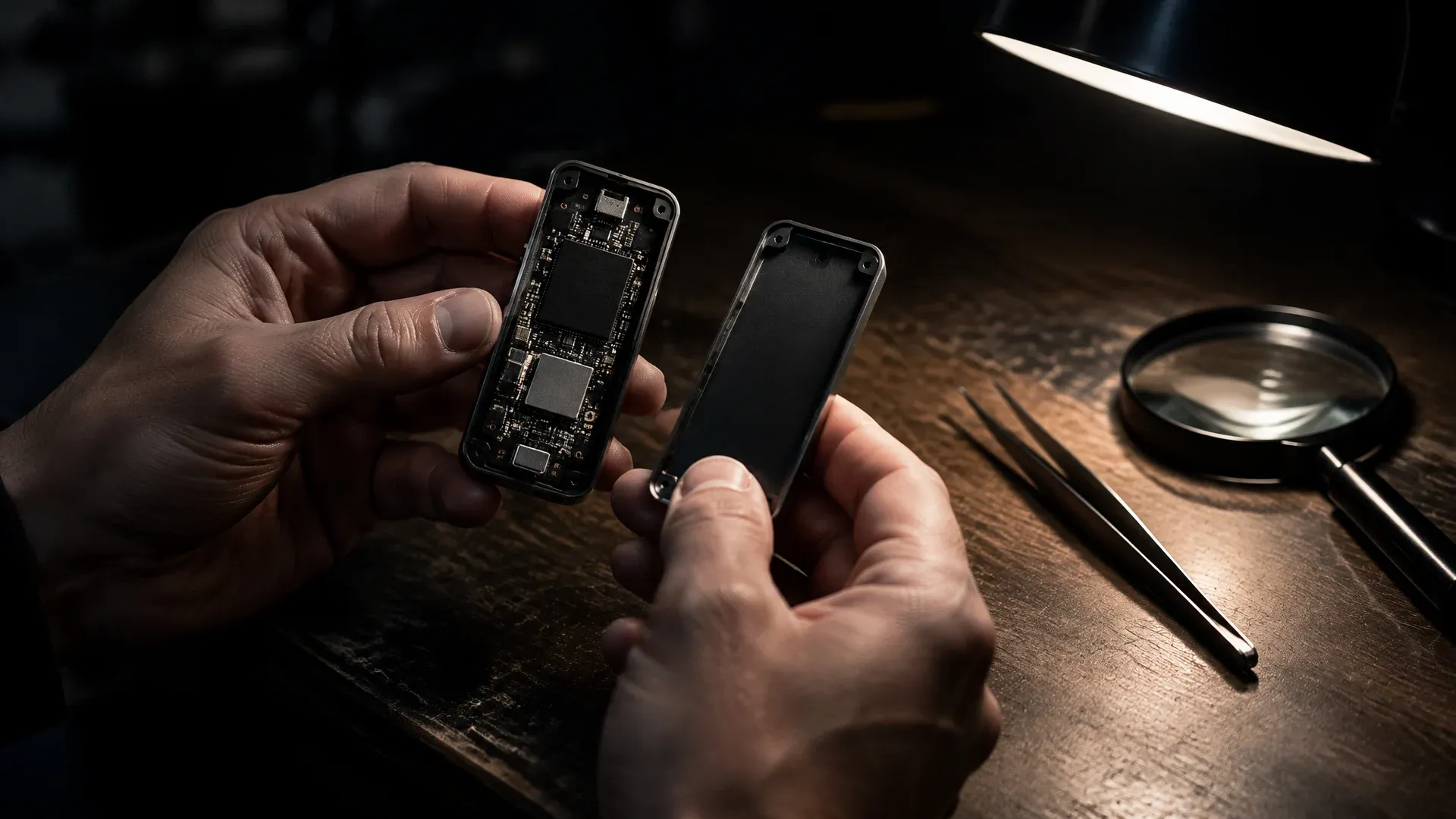
Material defect under Section 434 of the German Civil Code: a tampered device fails the objective requirements
Now to the legal position in Germany, which on this point is clearer than many expect. Under Section 434 of the German Civil Code (BGB), an item is free from material defects if, at handover, it meets the subjective requirements, the objective requirements and the installation requirements. The objective requirements include that the item is suitable for ordinary use and has the quality that is usual for items of the same kind and that a buyer can expect.
A hardware wallet containing a component that can capture the recovery phrase is not suitable for its ordinary use, and that use is the secure storage of a key. Such a device is therefore defective, regardless of whether the retailer knew about the tampering. Warranty under German sales law does not require any fault on the part of the seller; it only asks whether the goods were in order at handover.
If you are considering which device to switch to, you will find the current models and their differences in our comparison of hardware wallets. More important than the model is the purchase channel: directly from the manufacturer or from a partner it names itself.
 Compare the best hardware wallets
Repair or replacement, withdrawal, price reduction, damages: the four routes under Section 437 BGB
What you can demand as a buyer is listed in Section 437 of the German Civil Code. The provision has three numbered items, behind which there are in practice four routes.
Subsequent performance. Under Section 439, you choose whether the defect is remedied or a defect-free item is delivered. With a tampered device, replacement is the sensible route, because a repair would not restore trust in that particular device. The seller bears the costs involved, expressly including transport and labour costs. So you do not pay for return shipping.
Withdrawal. You return the device and get the purchase price back. As a rule, withdrawal requires that you have first set the retailer a deadline for subsequent performance. That deadline is not needed if subsequent performance has failed or is unreasonable.
Price reduction. You keep the device and pay less. For a wallet whose security promise has gone, this is rarely the right choice, because its usefulness does not decline, it disappears.
Damages. This route is set out in Section 437 No. 3, and it is the hardest. More on that below.
Who the right opponent is
The warranty is directed against your contractual partner, meaning the store or online retailer where you made the purchase. Not against the manufacturer. The manufacturer can voluntarily offer a guarantee or an exchange, and in this situation it makes sense to contact it in parallel. But that does not give rise to a claim under the sales contract.
Two-year limitation period and one year of reversed burden of proof under Section 477 BGB
The deadlines are in Section 438. Claims for defects in movable goods become time-barred after two years, counted from delivery of the item. So the purchase date on the receipt is the starting point, not the day you discover the defect.
On top of that comes a rule that is worth a great deal in this case. Under Section 477, for purchases by a consumer it is presumed that the goods were already defective at handover if the defect becomes apparent within one year. In that first year, you therefore do not have to prove that the foreign component was already in the device in the store. The retailer would have to prove the opposite. After the year has passed, this is reversed, and then it gets difficult, because proving when a component was installed is laborious.
There is one exception to the two-year period: if the seller fraudulently concealed the defect, the regular limitation period applies instead of the short one. That requires the seller to have known about it. With tampering in the supply chain, that is the rare exception, not the norm.
The retailer is usually not liable for lost coins
This is where the unpleasant news lies. Damages under Section 437 No. 3 require fault on the part of the seller, meaning intent or negligence. A store that sells a sealed device from the official supply chain and could not have detected the tampering with reasonable effort is generally not acting negligently. That rules out compensation for the drained holdings, even though the claim to a new device or to the purchase price remains.
That is the asymmetry that makes this case so expensive for investors: you will quite likely get back 79 or 149 euros for the device, but not the value of the bitcoin or altcoins stored on it. Whether a loss of this kind can be claimed for tax purposes is a separate question; we have written it up for the case of a lost device and tax.
Only legal advice can give a binding assessment of your individual case. What is set out here is the framework within which the question is decided.

The Product Liability Act does not cover pure financial loss
At this point many people think of the German Product Liability Act, because it provides for claims against the manufacturer without fault. In this case it does not apply. Section 1 (1) of the act requires that a defect in a product causes someone's death, injury to their body or health, or damage to an item. In the case of damage to an item, it must also be an item other than the defective product itself, and it must ordinarily be intended for private use.
Drained crypto assets are none of these but pure financial loss, and that is not covered by this provision. The Product Liability Act helps with an injured finger, not with an empty wallet balance. Anyone who wants to take action against the manufacturer therefore needs another route, and that runs via proof of a breach of duty, not via the mere defectiveness of the product.
 Find a licensed crypto exchange for your move
MediaMarkt and Saturn halted sales in October
For buyers in Germany, the case is not abstract. In mid-October, MediaMarktSaturn took the manufacturer's products out of its stores and off its own online platforms. The trigger was a report by a customer who says he found additional electronics in two devices from different branches. According to the reporting so far, this finding has not been independently verified; a spokesperson called it a precautionary measure. We covered the sales halt at MediaMarkt and Saturn on October 13, when it became known.
The manufacturer said at the time that no financial losses had been reported in connection with this German case. In parallel, it asked retailers and distributors in seven markets in Asia to suspend sales for the time being. A date for resuming sales in Germany has not been confirmed.
In practice this means two things. If you have an unused device from one of these stores at home, return it unopened instead of setting it up. And if you have one in use, you usually still have the receipt, which lets you prove the deadline under Section 438 cleanly.
Criminal complaint, securing evidence and the role of the police in Germany
Alongside sales law there is the criminal route, and it concerns the unknown perpetrators, not the retailer. Accessing someone else's wallet and draining holdings constitutes computer fraud and data espionage under German law. You can file a complaint at any police station and with the online police services of the federal states.
What a case needs documented
The value of a criminal complaint and of a warranty claim depends on the same material. This includes the receipt with date and branch, the original packaging including the adhesive seal, photos of the opened casing, the wallet addresses and the identifiers of the outflows with their timestamps. This material cannot be recreated after a fresh setup or after the box has been thrown away, and that is exactly why documenting comes before complaining.
A word on expectations: the clear-up rate for cross-border offences of this kind is low, and a complaint does not replace a claim against the retailer. It does, however, put the matter on record, and in many cases that is the precondition for an insurer or later proceedings to take the loss into account at all.
Hardware wallet: the two-year warranty runs from the purchase date
- Holdings first, complaint second. If your device is under suspicion, transfer the remaining coins using a different, uncompromised device to a new wallet with a newly generated phrase. An orderly intermediate step is an account with a licensed exchange; which providers in Germany hold a MiCA licence is shown in our comparison of regulated crypto exchanges.
- Document, then demand. Secure the receipt, packaging and photos, then ask the retailer in writing for a replacement or a refund, with a deadline. If you need custody without a new device in the meantime, the comparison of software wallets shows what the individual solutions offer and where their limits lie.
- Change the purchase channel. Buy the next device from the manufacturer itself or from a partner it names, not on the open market. The models and their differences are in the hardware wallet comparison.
(As of October 29, 2026. This article is not investment advice. Prices and fee structures change; check the terms with the provider before you buy.)
Frequently asked questions about tampered hardware wallets
Transparency note: This article was produced with the assistance of artificial intelligence and reviewed by our editorial team before publication. All figures and claims were checked against the primary sources linked in the text. The feature image was generated with AI.
Related articles
- Breaking: Trust Wallet Chrome Extension Hack Drains $7M, Full Reimbursements Promised
- Ledger Hack? $86 Million Drained: What Is Behind the Tampered Wallets From Southeast Asia
- Ledger Confirms Implant in a Hardware Wallet as Reports Reach Europe: What Is Behind It
- 90 Crypto Kidnappings and Robberies in 7 Months: Why France Is the Most Dangerous Country for Bitcoin Holders
- $6.5 billion in October: the infrastructure failed, not the smart contract
Which topics should we dive deeper into?
Select what genuinely interests you. Your picks feed directly into our editorial planning.
Crypto news that's actually worth your time.
Weekly. 60 seconds. Carefully curated by our editors: no hype, no promo flood, no spam.

September 1, 2026 7:27 AM

Clipboard Attack: How Malware Swaps the Wallet Address You Copied
A clipper replaces the receiving address between copying and pasting with the attacker’s, and your wallet’s checksum notices nothing. What Microsoft and the Federal Office for Cybersecurity have documented, and which check really makes the attack come to nothing.

August 13, 2026 4:59 PM

Trezor Data Breach: First 13,689 Customers, Then Roughly 67,000 More Exposed
A breach at Trezor shipping partner ShipMonk exposed names, phone numbers and home addresses of 13,689 customers in August; in September Trezor reported roughly 67,000 more in the US. Devices are safe, phishing risk is not.
October 20, 2023 9:53 PM
How to Keep Crypto Safe
After the $6.3 billion Binance hack: how to keep crypto safe. Hardware wallets compared, wallet scanners such as MetaMask security alerts, the exchange settings that matter and a seven-step checklist.
October 18, 2026 4:18 AM
Trezor cuts its authorized dealers: the authorizations end on January 1, 2027
After the supply chain attack on Ledger devices, Trezor is shrinking its dealer network and ending the authorizations on January 1, 2027. Until then, dropped partners may sell down their remaining stock, so the whole Christmas season still falls under the old list.
September 29, 2026 10:14 AM
Bitget discloses the flaw at its supplier and sets out the timetable for withdrawals
Bitget has disclosed how the attackers reached its withdrawal systems on September 24: through a previously unknown flaw in a security product it had bought in. The second stage of the withdrawal schedule opens today at 08:00 UTC, and for the balance you keep on any exchange the case changes the arithmetic.
August 22, 2026 4:13 AM
SafePal Data Breach: 39,798 Customers Exposed With Names, Addresses and Phone Numbers
SafePal confirmed a data breach on August 16, 2026: the names, delivery addresses, phone numbers and order details of 39,798 customers were exposed. Seed phrases and private keys were not affected, but the phishing risk is substantial.
March 31, 2026 5:13 PM

Quantum Threat to Bitcoin? Google Research Sparks Urgent Crypto Security Debate
Google’s quantum breakthrough raises fears for Bitcoin security. Can crypto survive quantum attacks—or is an upgrade urgent?

April 27, 2026 10:30 AM
Win $5,000 in BTC: Tangem Launches Exclusive 2026 Prize Draw
Tangem announces a massive prize draw with $5,000 in BTC and iPhone 17s up for grabs. Secure your crypto and enter today using our exclusive link.

December 22, 2020 3:49 PM

Crypto Wallet Provider Ledger Hacked: Data Leak Results in Phishing Scams
Ledger, a cryptocurrency wallet provider has encountered a data breach. The official Twitter account of the hardware wallet tweeted that they have been alerted to the dump of a client database.
October 19, 2026 1:14 AM

Qubic halts its mainnet after 1,404 wallets are drained: the seed was the weak point
An attacker drained 1,404 Qubic wallets on the night of October 18, roughly $1.3 million. The protocol was not to blame: seed generation in the browser supplied too little randomness.
October 2, 2026 7:16 AM

$1.26 Billion in Three Months: Crypto Hacks Hit Their 2026 High
The security firm CertiK counts around $1.26 billion in damage from 247 incidents for the third quarter of 2026. September was the worst month of the year with 99 cases, and this is the background and what it means for your custody.
October 19, 2026 1:32 AM

Crypto audits after $1.18 billion in losses: “The problem is always scope”
Hacken counts losses of $1.18 billion across 107 incidents for the third quarter of 2026. 77 percent of that fell on components that were not examined at all in the last audit.
October 5, 2026 1:29 AM

Chainalysis attributes $387 million from the Bitget hack to North Korea: what matters now for investors in Germany
The analytics firm Chainalysis attributes the theft of around $387 million at Bitget to actors with ties to the DPRK and puts the annual total above one billion dollars. What that means for custody, choice of exchange and record-keeping in Germany.
September 25, 2026 4:11 AM
Bitget Pauses Withdrawals: Where Existing Customers in Europe Stand
Bitget reports unauthorised outflows of around $351.6 million (later revised to $387.5 million) and has suspended withdrawals. For existing customers in Europe, that closes the one route MiCA had left them.
September 7, 2026 7:26 PM
Stolen Keys Beat Code Flaws: Why the Private Key Is the Way In for 2026 Crypto Hacks
Compromised private keys overtook smart contract code flaws as the most common attack route for the first time in 2026. What sits behind the shift, and how to check your own setup for its single point of failure.
August 25, 2026 10:31 PM
Crypto Wallet Phishing by Letter: Why the QR Code From Your Postbox Wants Your Recovery Phrase
Letters carrying a QR code urge a supposedly urgent wallet update on grounds of quantum resistance and lead to a page that asks for the recovery phrase. The Federal Office for Cybersecurity reported the ploy on August 18, 2026.
December 28, 2018 3:02 PM

How To Use a Trezor Wallet?
Trezor is a hardware wallet which gives exceptional security for managing Bitcoin and other cryptocurrencies private keys.It incorporates and deposits personal keys securely and enables users to carry trade without an Internet link. Trezor grants its users with numerous benefits, […]
October 14, 2026 1:36 AM

MediaMarkt and Saturn halt Ledger sales after a customer reports an implant
Since October 13 MediaMarkt and Saturn have sold no Ledger devices, neither in store nor online. The trigger is a customer's report of an implant. What Ledger confirms, why the authenticity check does not help, and which steps make sense for devices bought in a store.
October 1, 2026 7:16 AM

Bitway (BTW) hits a record $1.43: 27 percent in a week while the market stood still
Bitway marked an all-time high of $1.43 on Monday and trades at $1.32 after a weekly gain of around 27 percent, while the broader market stood still. What carried the jump, when the incentive campaign ends, and what applies to circulating supply, authorisation and tax in Germany.
September 10, 2026 9:13 AM
Trezor Hack Scare: That STM32 Entropy Email Is a Phishing Attack
Trezor users received a fake STM32 entropy warning sent from a real Trezor address. Here is what happened and what to do if you clicked.
September 4, 2026 10:15 PM
Trezor Data Breach: Am I Affected and What Should I Do Now?
Trezor widened the ShipMonk data breach on September 4, 2026: around 67,000 further people affected, just over 80,000 in total, from orders placed between November 2019 and August 2021. How to check in two minutes whether you are among them, and what an exposed home address means for self-custody.
August 24, 2026 10:29 AM
Buying More Bitcoin at $77,000: Savings Plan or Lump Sum
Bitcoin stands at $77,256 after gaining 22.78 percent in a week. This guide shows you how to buy more cleanly at this price and which method fits which starting position.
August 5, 2026 10:33 PM
$130 Million Gone Because the Randomness Was Predictable: Which Hardware Wallet You Can Still Buy
The Coldcard flaw proved the most respected wallet is not the safest. Which vendor has which track record – and why now is the wrong moment to pause your savings plan.
May 15, 2024 12:04 PM

Crypto Scams: How to Protect Your Cryptos?
With the rise of crypto scams, and while international efforts are still working to combat these threats and protect investors, some recent tactics have been identified, and here is your full guide.
October 19, 2026 4:15 AM

Crypto FIFO across several exchanges: each wallet counts on its own in Germany
Hold bitcoin on several exchanges and in wallets of your own, and the holding period is calculated per pot, not across the total holding. What paragraph 62 of the BMF guidance orders, and why 31 December 2026 hangs on it.
September 23, 2026 4:12 AM
How to Set Up a Crypto Wallet: Securing Your Coins in Seven Steps
Your own crypto wallet is set up in twenty minutes, yet a single step decides everything that follows. This guide takes you through wallet type, recovery words and the test amount, and sets out what BaFin and the tax office expect.

More from CryptoTicker