
Ledger sells the Atom at $849 through its own shop only: “For years, our customers have been asking us for a Ledger phone”
Ledger presented the Android device Atom on October 15 and sells it exclusively through its own shop. After tampered devices were found in the intermediate trade, the distribution route itself becomes a security question.




Which topics should we dive deeper into?
Select what genuinely interests you. Your picks feed directly into our editorial planning.
Crypto news that's actually worth your time.
Weekly. 60 seconds. Carefully curated by our editors: no hype, no promo flood, no spam.
At its own Op3n conference in Paris on October 15, 2026, Ledger presented a device that looks like a smartphone and does not want to be one: the Atom. The Founder's Edition costs $849, reserved with a refundable $100 deposit, with the regular price set to be $899 later. Shipping is due in 2027 at the earliest. The most important line of the announcement for you, though, is not in the spec sheet: Ledger sells the Atom exclusively through its own shop. The intermediate trade, through which you buy a Ledger device in an electronics store today, falls away for this product.
That is not a marketing decision. Since October 9, Ledger has been investigating tampered devices sold through a reseller in South-East Asia, and in Germany MediaMarkt and Saturn have halted sales of Ledger devices as a result. The distribution route has thereby become a security matter in its own right. This text sets out what Ledger has announced, what of it is substantiated, and what it means for a device already sitting in your drawer.
Ledger Atom: $849 for the Founder's Edition, shipping not before 2027
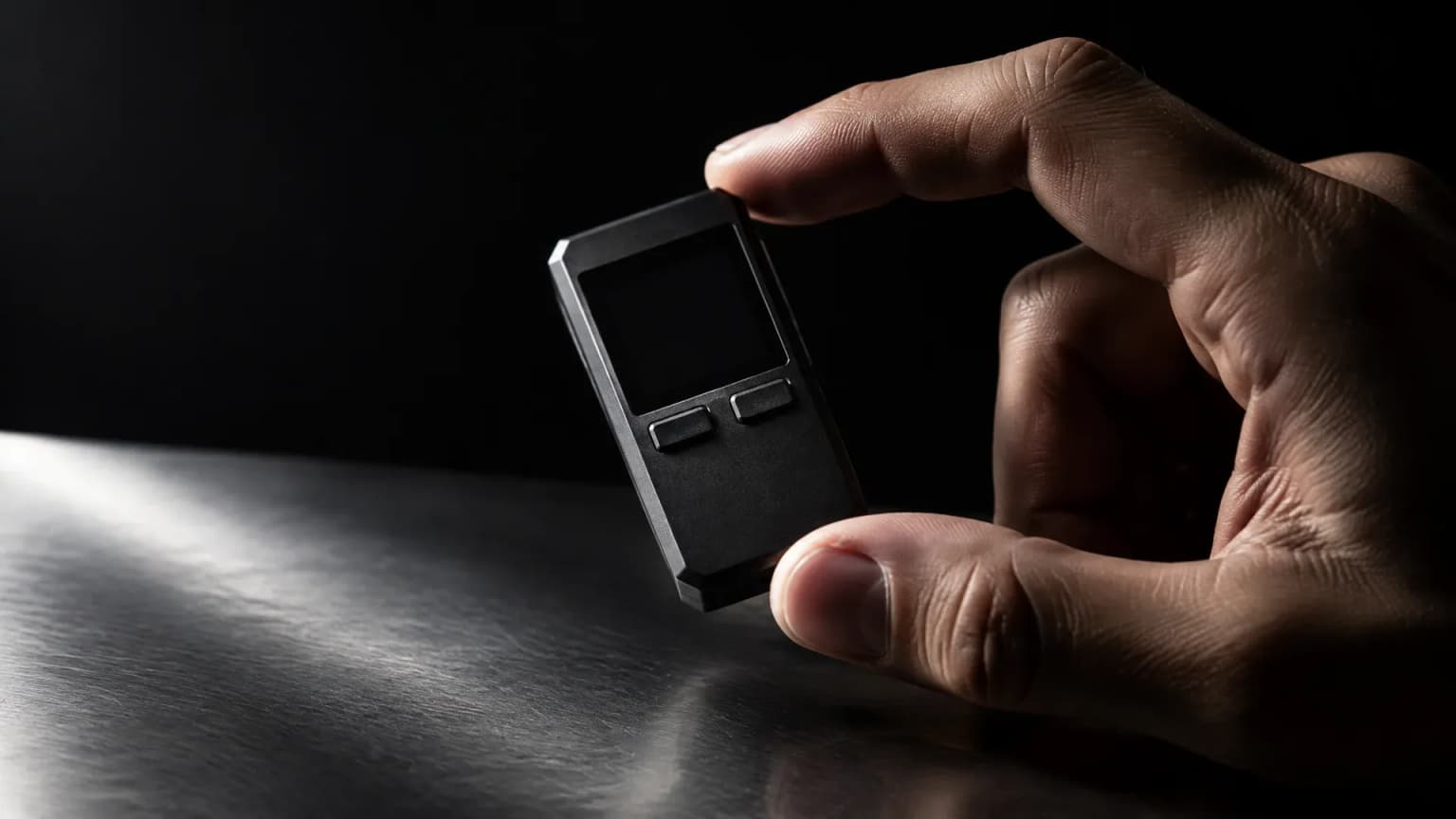
Ledger calls the Atom a signer. A signer is a device whose only security-relevant job is to sign a transaction without the private key ever leaving it. The term deliberately sets the Atom apart from the words hardware wallet, because the device is at the same time a fully functional Android phone.
The headline specifications from the presentation: a 6.77-inch OLED display, a rear camera, a 4,000 milliamp-hour battery, a Qualcomm processor from the Dragonwing line and an eSIM that carries data only. Calls and text messages are not part of the feature set. A mechanical switch physically cuts the camera and microphone off from the power supply.
On the delivery date the statements diverge. The second quarter of 2027 and the summer of 2027 are both cited, each subject to approvals still outstanding. Ledger has published no binding commitment. For you that means this: reserve today and you are putting $100 aside for a device whose delivery is more than a year away and not scheduled.
What the deposit is, legally
The $100 is refundable on Ledger's own account. A reservation is not a purchase: there is no product, no delivery date and therefore no warranty either. Reserve, and you are giving the manufacturer an interest-free loan for an indefinite period. That is common with pre-orders in consumer electronics and still a decision worth taking deliberately.
Secure element and Android side by side: how the signer separates the keys
Technically, two worlds run in parallel inside the Atom. On one side an Android system built on the Android Open Source Project, running perfectly ordinary apps. On the other side Ledger OS, the company's own operating system, running on a secure element. A secure element is a separate chip hardened against physical attack, which stores keys and computes signatures without surrendering the secret. Ledger states a security level of EAL6+ for the chip fitted.
As soon as a security-relevant action comes up, the device switches into secure mode. In that mode the secure processor takes control of the display, so that no tampered interface can show you a different recipient address from the one actually being signed. A dedicated FPGA component, a freely programmable logic chip, keeps the everyday apps out while that happens.
This is the clean answer to an old problem: move crypto-assets through an ordinary smartphone and you are trusting that none of the installed apps is reading along. With the Atom, that leap of faith is meant to disappear. Whether the separation holds cannot be judged today. No independent audit of the architecture exists, and Ledger has published no threat model against which the claim could be tested.
The active shield is meant to report the case being opened
The part of the announcement that matters most for the current situation is an active shield. What is meant is a sensor layer with its own power supply, intended to detect anyone opening the case, drilling into the board or applying probe tips. If it registers an intervention, it reports this to the secure element. Seals on the packaging and on the device itself come on top.
This shield aims squarely at the type of attack that has occupied Ledger since October 9. The company has given no technical data on it, and an independent assessment is outstanding. The objection heard among specialists is that a protection claim without a published threat model cannot be verified. That is a fair point and remains open for now.
Sales only through the company's own shop: the middleman drops out of the supply chain
According to several trade publications, the Atom will be sold exclusively through Ledger's website, not through authorised resellers. One source qualifies this with the word "initially", so whether the rule holds permanently is open. The thinking behind it is easy to follow: the shorter the route from the factory to you, the fewer stations at which someone can open a parcel.
For the German market that is a real change. Hardware wallets have been part of the range at large electronics chains here for years, and many buyers value exactly that: picking a device up in a shop without leaving a delivery address at which crypto-assets might later be suspected. That advantage falls away with the Atom. To weigh it up, our hardware wallet comparison sets out the devices still available through retail, along with their purchase routes.
The CryptoBilis case: a foreign component captured the recovery phrase during setup
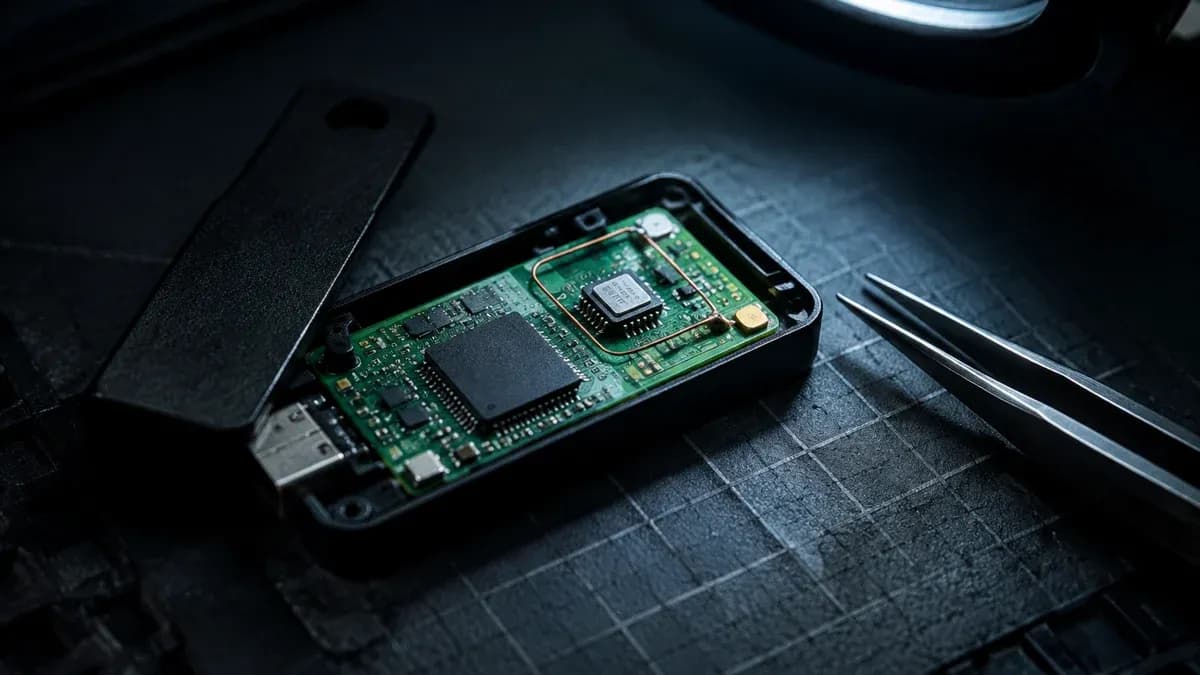
The occasion for the whole debate came from Ledger's own security laboratory, Donjon. In a device that had been sold through the South-East Asian reseller CryptoBilis, it found a built-in foreign component. That component captured the recovery phrase while the buyer was setting up the device for the first time, and transmitted it out over the mobile network. The recovery phrase is the sequence of words from which all of a wallet's keys can be restored; whoever holds it holds the balance.
What matters for placing the case is where the attack came in. On Ledger's account, the security chips and the operating system were left untouched. The attackers did not break the cryptography; they bought genuine devices, inserted components of their own and put the altered units back into distribution. Ledger speaks of months of preparation and an outlay running into the millions. Examinations of shop devices and warehouse samples produced no further finds.
Several figures are circulating for the scale of the losses. $86 million, around $90 million and $93 million are all cited. None of them is confirmed, and the reports draw partly on the same trail. One individual case is substantiated, traced by Chainalysis: the operator of a fraudulent job offer moved more than 60 bitcoin, worth about $4.8 million at the time, to three Ledger addresses on September 22 and cleared them out entirely on October 9 to a destination address that investigators attribute to the stolen funds. We have written up the details of the find in our report on the confirmed implant.
Sales halted in six South-East Asian countries and Hong Kong
After the find, Ledger asked its distribution partners in Indonesia, Singapore, Thailand, the Philippines, Vietnam, Malaysia and Hong Kong to withdraw the devices from sale. In parallel, new requirements apply to authorised resellers worldwide: returned devices may not be sold again, however untouched the packaging looks. Devices are no longer to lie openly on the shelf. Unusual customer reports go straight to Ledger.
These three requirements are the practically most important part of the whole story, because they affect German retail too. The returns rule closes the gap through which a prepared device can re-enter sale as a return. Keeping devices out of open display takes away the opportunity for attackers to handle them in the shop itself.
How competitors have reacted
Trezor, the second large provider in this market, said it had found no indication of tampered devices of its own, and is nonetheless ending partnerships with resellers. Two manufacturers are therefore drawing the same conclusion independently of each other: the intermediate trade is the weak point hardest to control.

MediaMarkt and Saturn in Germany: what now applies when buying in store
MediaMarkt and Saturn have halted sales of Ledger devices. In concrete terms: that purchase route is not available. Whether and when it returns depends on how the investigation ends and how the new reseller requirements are implemented.
The geographical placing matters, so that a news item does not turn into misplaced panic: on current knowledge, the tampering that has come to light concerns devices from South-East Asian intermediate trade. No find in a German shop unit is substantiated. The sales halt here is a precaution by retail, not a finding.
Origin, seals and first setup: the three points on your own device
Three things count now if a hardware wallet is sitting with you. First, the origin: a device ordered directly from the manufacturer has a short route behind it. A device from a marketplace listing, from the second-hand market or from a return has a long one. Second, the first setup: a new device generates the recovery phrase itself and shows it to you exactly once. If a ready-made word list came with the documents, or the device was already set up, the funds belong on a freshly created wallet with a new phrase immediately. Third, the behaviour: a device that looks for a mobile or radio connection unprompted during setup does not belong in service.
The hard part here is uncomfortable and should not be glossed over: a foreign component inside cannot be reliably spotted from the outside. Ledger's own laboratory found it only on taking the device apart. Anyone with serious doubts therefore does not rely on a visual inspection but moves the holdings to a wallet whose keys demonstrably originated on another device obtained through a trustworthy route.
Solana Mobile's Seeker app comes preinstalled: access to more than 1,500 applications
Ledger is the first hardware partner to which Solana Mobile is passing its software stack. The Seeker app comes preinstalled on the Atom, linking Solana Mobile's wallet with its own app store for decentralised applications, where the provider says more than 1,500 applications are available. Confirmations run through secure mode here too. Solana Mobile cites transaction volume of more than $13 billion across 154 million transactions for Seeker, and more than 200,000 devices sold across Seeker and the older Saga phone combined. What that means for the price of Solana is not thereby said: a distribution partnership is not an inflow.
$849 and a $100 deposit: the terms of the reservation
Place the price correctly. $849 is well above what a pure signing device costs, and roughly in the range of a high-end smartphone. The Atom is also both at once, and that is exactly where the open question lies: a device that hangs on the network daily, runs apps and carries a camera has a larger attack surface than a device without radio that spends most of its time in a drawer. Ledger answers that with the hard separation through the secure element. Whether that trade works out for you depends on how often you actually sign.
Add to that the gap in time. More than a year lies between reservation and delivery. Over that period prices, competing products and the state of the investigation all change. Nothing argues against deferring the decision until a delivery date and an independent audit are on the table.
What is substantiated and what is not
Substantiated: the presentation on October 15, the price of $849 for the Founder's Edition and $899 regular, the $100 deposit, the partnership with Solana Mobile, the sales halt in seven markets, the three new reseller requirements and the find of the foreign component by Ledger's laboratory. Not substantiated: the total scale of the losses, the effectiveness of the shield and a binding delivery date. Ledger's chief executive Pascal Gauthier summed the product decision up as follows: "For years, our customers have been asking us for a Ledger phone. Today, we answer." On the Seeker integration, Ian Rogers, who serves at Ledger as chief human agency officer, said the integration simply made sense, because it gives users access to the Solana ecosystem without giving ground on security.
 Find the right hardware wallet
Ledger Atom: until delivery in 2027, the device you have today is what counts
The Atom solves no problem you have today, because it arrives in 2027 at the earliest. What takes effect today are the reseller requirements and the halted sales in electronics retail. That is what you align your approach to.
- Settle the purchase route. While retail is suspended, the short route runs through the manufacturer. Which devices that concerns and how they differ is set out in the hardware wallet comparison.
- Sort out an interim solution. If no trustworthy device is available to you right now, you need a stopgap for smaller amounts. The options and their limits are in the software wallet comparison.
- Separate your custody. Amounts you move anyway do not belong on the same device as long-term holdings. For the active part, platforms with an EU licence are an option, listed under regulated crypto exchanges.
Sources on the presentation: Decrypt on the Atom announcement and Bitcoin.com News on price and distribution model.
(As of October 16, 2026. This article is not investment advice. Prices and fee structures change; check the terms with the provider before you buy.)
 Find a crypto exchange with an EU licence
Frequently asked questions about the Ledger Atom
Transparency note: This article was produced with the assistance of artificial intelligence and reviewed by our editorial team before publication. All figures and claims were checked against the primary sources linked in the text. The feature image was generated with AI.
Related articles
- What is a hardware wallet? How the device protects your keys
- Fake Ledger Site Tops Google Search: “Once the recovery phrase has been handed over, the wallet must be regarded as compromised”
- Fake Ledger firmware updates: SlowMist reports phishing pages with a replica Genuine Check
- 14.7 million swapped into USDD, 20 addresses frozen: what to check with your stablecoin
- MediaMarkt and Saturn halt Ledger sales after a customer reports an implant
Which topics should we dive deeper into?
Select what genuinely interests you. Your picks feed directly into our editorial planning.
Crypto news that's actually worth your time.
Weekly. 60 seconds. Carefully curated by our editors: no hype, no promo flood, no spam.

August 25, 2026 10:31 PM
Crypto Wallet Phishing by Letter: Why the QR Code From Your Postbox Wants Your Recovery Phrase
Letters carrying a QR code urge a supposedly urgent wallet update on grounds of quantum resistance and lead to a page that asks for the recovery phrase. The Federal Office for Cybersecurity reported the ploy on August 18, 2026.

September 10, 2026 9:13 AM
Trezor Hack Scare: That STM32 Entropy Email Is a Phishing Attack
Trezor users received a fake STM32 entropy warning sent from a real Trezor address. Here is what happened and what to do if you clicked.

December 18, 2023 10:05 AM
Exciting Airdrops for Solana Saga Phone Users
Solana Saga phone: Top airdrops for crypto fans, easy blockchain use, secure transactions, perfect for dApp users. Get yours now!
October 9, 2026 5:36 PM
Ledger Hack? $86 Million Drained: What Is Behind the Tampered Wallets From Southeast Asia
Since Friday, Ledger users in Southeast Asia have been reporting empty wallets, and analysts count more than $86 million. Ledger has halted the reseller CryptoBilis. An implant inside the device reportedly reads the seed phrase. What is known, what CZ advises and what you should do now.
October 13, 2026 1:16 AM
Ledger Confirms Implant in a Hardware Wallet as Reports Reach Europe: What Is Behind It
Ledger confirms an unauthorised additional circuit board in a tampered device and traces the confirmed cases to a reseller in South-East Asia. One report from European retail is still open, which makes the purchase route of your own device the criterion.
September 19, 2026 1:23 AM
Hardware wallet lost: how to rescue your coins and what the tax office accepts
Your hardware wallet is gone, your coins are still on the blockchain: all that matters is whether you still have your recovery phrase. What goes wrong during a restore, and why the tax office as a rule does not recognise permanently lost access as a loss under Section 23 of the Income Tax Act.
August 21, 2026 7:26 PM

Restoring a Seed on Another Manufacturer's Wallet: What BIP39 Guarantees and What It Does Not
Your seed is yours; the device belongs to a company. This article explains what the open BIP39 standard actually guarantees, why a wrong derivation path makes a full wallet look empty, and the test that settles both in twenty minutes.
September 28, 2026 10:26 AM
Phantom Wallet and Solscan: What a Solana Transfer Really Costs and Where It Fails
A transfer on Solana costs 0.000005 SOL, a new token account ties up 0.00148844 SOL once — both values measured on-chain by us today. This practical guide shows how to set up Phantom, how to get there from the exchange, how to read Solscan and what applies for tax in Germany.
September 17, 2026 4:14 PM
D'CENT App Wallet: How to Tell If Your Recovery Phrase Has to Move Now
Manufacturer IoTrust reports suspicious asset transfers in the D'CENT app wallet and asks users to move their holdings. One question decides the matter: has your recovery phrase ever been entered into the app?
August 11, 2026 1:32 PM
How to Store a Seed Phrase Safely: What Steel, a Passphrase and Multisig Do for Your Wallet Backup
The Coldcard case pushed the manufacturer question to the front, while barely touching on where the backup is kept. This guide places paper, steel, the passphrase and splitting methods against the BIP-39 and SLIP-0039 standards.
September 23, 2026 4:12 AM
How to Set Up a Crypto Wallet: Securing Your Coins in Seven Steps
Your own crypto wallet is set up in twenty minutes, yet a single step decides everything that follows. This guide takes you through wallet type, recovery words and the test amount, and sets out what BaFin and the tax office expect.
October 2, 2026 10:36 AM
Hot Wallet or Cold Wallet: the Private Key Decides How Safe Your Coins Are
Hot wallet or cold wallet: the difference rests solely on whether the private key is online. What separates the two forms, where the limits of hardware lie and why moving to your own device triggers no tax.
September 30, 2026 7:16 AM
Tangem Wallet: The Card Without a Seed Phrase vs the Classic Hardware Wallet
The Tangem Wallet secures crypto with two or three identical cards instead of 24 words. What the sets cost, what the EAL6+ chip delivers and why losing every card is final.
September 16, 2026 4:12 AM
Wallet Drops a Network: How to Rescue Your Coins Before the Deadline
Phantom is ending Sui support on September 24, 2026, and Trust Wallet has already removed 25 networks: five shutdowns of this kind in four weeks alone. What really happens to your balance, which two routes you have before the deadline and where the move most often fails.
September 4, 2026 10:17 AM
Cypher Shutdown on September 6: What Users Should Know Now the Withdrawal Deadline Has Passed
Recap as of September 27, 2026: Cypher had announced it would take its app, dApp and withdrawal window offline on September 6, 2026 and end the token protocol. This article describes the situation before the deadline, how the payout worked and what our own measurement showed at the time about what was left of the CYPR token.
October 6, 2026 4:29 PM
Setting up MetaMask: the twelve words that control your coins
MetaMask is set up in ten minutes, and in those ten minutes you make the decisions that later determine what happens to your balance. This guide walks through installation, the recovery phrase, networks, approvals, fees and the German tax position.
September 20, 2026 4:15 PM
Crypto Phishing After a Data Breach: The Warning Signs in a Fake Exchange Email
After every major data breach, the number of phishing emails sent in the name of crypto exchanges and wallet manufacturers rises. This article shows you how to recognise such a message, which data a reputable provider never requests by email, and what to do in the first hour after a click.
August 31, 2026 1:22 PM
Cosmostation Wallet Shutdown on September 1: What Cosmos Wallet Users Should Know Now the Deadline Has Passed
Recap as of September 27, 2026: Cosmostation had announced it would discontinue its wallet apps on September 1, 2026, leaving only the export of the recovery phrase and the private key. This article describes the situation before the deadline and how to move Cosmos holdings, including delegated ATOM.

December 22, 2020 3:49 PM

Crypto Wallet Provider Ledger Hacked: Data Leak Results in Phishing Scams
Ledger, a cryptocurrency wallet provider has encountered a data breach. The official Twitter account of the hardware wallet tweeted that they have been alerted to the dump of a client database.
September 10, 2026 1:14 PM
Phishing Email From the Real Sender Address: How to Check a Wallet Security Warning
An alleged security warning to wallet customers travelled through the manufacturer's genuine sending channel and passed every technical authenticity check. The test that still holds costs you four minutes.
August 25, 2026 10:11 PM

Ledger Closes a Gap in the Ethereum App: When the Display Shows Something Other Than What You Sign
Ledger has closed a flaw in its Ethereum app that let a malicious application swap the reviewed transaction for a different one. Anyone holding Ether or ERC-20 tokens on the device should check the app version and clear out old token approvals.
August 22, 2026 10:29 AM
Bitcoin Fork: What Happens to Your Coins When the Chain Splits
On October 31, 2026 a new chain called ECX splits off from Bitcoin, and every holder is credited automatically. Who actually receives the coins depends on the private keys, on voluntary replay protection and on a tax rule many overlook.
August 22, 2026 4:13 AM
SafePal Data Breach: 39,798 Customers Exposed With Names, Addresses and Phone Numbers
SafePal confirmed a data breach on August 16, 2026: the names, delivery addresses, phone numbers and order details of 39,798 customers were exposed. Seed phrases and private keys were not affected, but the phishing risk is substantial.
August 5, 2026 10:33 PM
$130 Million Gone Because the Randomness Was Predictable: Which Hardware Wallet You Can Still Buy
The Coldcard flaw proved the most respected wallet is not the safest. Which vendor has which track record – and why now is the wrong moment to pause your savings plan.
August 4, 2026 1:21 PM
Coldcard Losses Near $114 Million as a Fourth Sweep Hits: Why Is Bitcoin Rising Anyway?
A fourth wave of Coldcard sweeps took another 449 BTC on Monday, yet Bitcoin climbed back toward $64,000. Here is what changed and who is still exposed.
More from CryptoTicker