
Ngrave phishing: $2.56 million left 70 wallets after a hijacked push provider
Attackers hijacked the push provider of Belgian hardware wallet maker Ngrave and sent fake security alerts to users of the LIQUID app on October 17. Anyone who entered their recovery words lost their balance: between $2.56 million and $2.65 million flowed out, while the devices themselves remained untouched according to the company.




Which topics should we dive deeper into?
Select what genuinely interests you. Your picks feed directly into our editorial planning.
Crypto news that's actually worth your time.
Weekly. 60 seconds. Carefully curated by our editors: no hype, no promo flood, no spam.
Ngrave, the Belgian hardware wallet maker, published an incident report on October 19, 2026 describing an uncomfortable gap: attackers took over the account of an external provider that sends push notifications for the companion app LIQUID, and used that channel to send users fake security alerts. Anyone who followed the alert and entered their recovery words lost their balance. By the company's count, around $2.56 million left roughly 70 wallet addresses across four networks.
The devices themselves were not the target. Ngrave states explicitly that neither the code of the LIQUID app nor the ZERO hardware nor the keys stored on it were touched. What was attacked is the route the company uses to speak to its customers. That is what makes the case relevant to anyone holding crypto assets in self-custody, because almost every wallet app sends notifications today.
What happened to the LIQUID notifications on October 17
On the evening of October 17, 2026, at around 21:30 UTC, a push message went out to LIQUID users that looked like a security alert from the manufacturer. The text claimed the recipient's portfolio had been synchronised on a new device: a Pixel 9 in Moscow. A message of that kind produces exactly the reaction the attackers were after, namely acting fast without thinking.
The link in the message led to a replica of the Ngrave site. A countdown was running there, next to a button to confirm and one to reject. Tapping reject took the user to a page asking for the Perfect Key or the 24-word recovery phrase. The reflex to fend off a stranger's access therefore led straight into the trap.
The timeline in the company's report is tightly spaced. At 21:31 the team noticed the message; by 21:36 the first wallet was empty. At 21:40 Ngrave revoked the first stolen access key, but the attackers kept sending through a second one. At 22:30 a warning was up on X, ten minutes later a warning email went out to customers, and at 22:45 the company shut down notification sending entirely. The last theft traced falls on October 18 at 03:51.
The hijacked push provider: how one access key led to the second
Ngrave does not send its app's notifications itself but through an external provider. That provider is who the attackers hit. They first obtained one access key and used it to reach a second with wider rights. The second key let them send messages to LIQUID users and read part of the usage data.
The report dates the earliest sign of that access to October 11. Six days therefore passed between the intrusion and the fake alert, with nobody noticing anything. Only at 09:37 on October 18, according to the company, had every key in use by live systems been replaced.
An access key at a service provider is a string with which one program identifies itself to another, comparable to a password for machines. It sits in server configurations, not in your wallet. That is why the best hardware will not help you if that key falls into the wrong hands: the message that then reaches you carries the genuine sender.
$2.56 million to $2.65 million: which coins left which wallets
Ngrave puts the traced damage at around $2.56 million, calculated at the prices of October 17, spread across roughly 70 wallet addresses and four networks. The company explicitly calls that figure a floor. The analytics firm Bitquery arrives at around $2.65 million across 84 wallets in a wider count, as CryptoSlate reports. Transaction data alone, though, cannot establish that every one of those wallets belonged to an Ngrave customer. The defensible range therefore runs from $2.56 million to $2.65 million.
The manufacturer's breakdown by network looks like this:
- Bitcoin: $1.77 million. The amounts were pooled in one attacker address and distributed from there across twelve newly created addresses.
- XRP: $454,000. That sum went to the swap service ChangeNOW in 54 separate deposits.
- Ethereum: around $316,000. The tokens were sold for 130.47 ETH and moved to other blockchains via the service LI.FI. In one place the report names $313,000 as the bridged sum and around $3,000 in unsold tokens left sitting in the attackers' wallets.
- Stellar: $18,000, sent to an address the company believes belongs to an exchange.
The speed stands out. Barely six hours separated the first emptied wallet from the last theft traced. Anyone who read the 22:40 warning email the following morning no longer had a chance to intervene.
What Ngrave says it did not lose
The report narrows the damage in several places. Untouched, it says, were the code of the LIQUID app, the ZERO devices along with the secrets stored on them, and customers' names and delivery addresses, which sit in a separate system. Private keys do not leave a ZERO device, according to the manufacturer, and the attackers had no access to the devices.
Recovery phrases and Perfect Keys did not leak either on this account, with one exception: those users typed into the fake page themselves. That distinction is the heart of the case. In technical terms, custody held. What broke was trust in the channel the manufacturer uses to send alerts.
 Compare hardware wallets
The data list: what the attackers could read about LIQUID users
Alongside the money, a data set was lost, and it weighs more heavily on the months ahead than the sum suggests. On October 17 the attackers copied the notification list, according to the company. It holds, per phone, a token, the device model, the operating system, the LIQUID version, language, country, time zone, usage data, an internal app identifier and possibly the IP address along with an approximate location.
Also readable were the swap history with crypto addresses, amounts and timestamps, more recent balance data, and general usage data from the app. Whether those were copied as well is still being examined by the company. For a small number of customers, the attackers could additionally see email addresses and order numbers from deletion requests. Ngrave has reported the disclosure to the Belgian data protection authority.
For LIQUID users, that means expecting precisely targeted approaches over the coming months. Someone who knows which device you use, which country you live in and which amounts you last swapped no longer writes a bulk email but a message that fits your situation. How to spot these follow-up waves after a data leak is set out, using other incidents as examples, in our guide to crypto phishing after a data breach.

MiCA supervision: a hardware wallet maker does not fall under it
For investors in Germany, a sober reading of the legal framework is worth having. The EU's MiCA regulation governs providers that hold, exchange or broker crypto assets for others. A manufacturer that sells you a device for keeping your own keys is not holding anything for you. It therefore does not come under the same supervision as an exchange with a BaFin licence.
The practical consequence is uncomfortable. In self-custody there is no deposit guarantee, no claim for compensation against a supervisory authority and no fund that steps in. Give away the recovery words and you have handed over control, and no body can reverse the transfer. That is the price of independence, and it belongs in the decision when choosing a device. Which models can be bought in Germany, and how they differ in handling and recovery, is shown in our hardware wallet comparison.
Anyone unwilling to pay that price has an alternative that carries different risks of its own: custody with a supervised provider. There, a company under supervision is liable, but control over the keys no longer sits with you. Which trading venues hold a MiCA authorisation for the German market is listed in our overview of regulated crypto exchanges.
Police report, case number and exchange freeze: the route for victims in Germany
Ngrave names concrete steps in the report, and they apply to any comparable case, whoever the manufacturer. Anyone who entered their recovery phrase or Perfect Key on the fake page should treat the affected wallet as compromised on every network, move any remaining balance to a new wallet with a new phrase, and send nothing more to the old addresses. According to the company, that holds even if the page rejected the entry as incorrect or only some of the words were typed in.
Anyone who merely opened the link or tapped the buttons without entering words counts as unaffected on this account. One note from the report matters here: a web app named "NGRAVE Security Center", which may have ended up on the home screen when tapped, does not come from the manufacturer and should be deleted.
For contact, the company points to support@ngrave.io; cases carry a reference with the prefix OSH. To help trace funds, victims are asked to send transaction IDs, their own and the destination addresses, and the approximate time of entry, but never the recovery phrase itself. And one point concerns victims in Germany directly: Ngrave advises filing a criminal complaint locally and passing on the case number, because exchanges as a rule require a police reference before they will freeze a balance. In Germany the local police station takes the report, and several federal states also offer an online police desk for it.
The company says it has shut down the notification service, removed the fake messages, reported the phishing site to the registrar for takedown, preserved logs, brought in the authorities and asked exchanges and bridge services to freeze the funds.
 Find a regulated crypto exchange
The lesson from the incident: the attack route ran through the notification channel
Ngrave is unusually hard on itself in its own report. The chief executive writes that the internal notification system was infiltrated "by sophisticated attackers", calls the method "a classic trick, and one that we at NGRAVE should have prevented" and states: "In this, we have absolutely and utterly failed." The goal is to be the safest company in the world, he writes, and the company is a long way from that today. It can all be read in the company's incident report of October 19, 2026.
A series of rebuilds has been announced, which the company describes as not yet complete. LIQUID is to be able to open official Ngrave addresses only in future, so notifications and banners can no longer call up outside pages. Added to that are a key that can only send and not read, access limited to the company's own servers with two-factor sign-in, alerts on unusual use and on bulk exports, a four-eyes principle for every message, short-lived keys rotated at least every 90 days, and a single switch that shuts down all sending routes.
The case fits a pattern seen several times this year. In October the analytics firm SlowMist reported fake firmware notices in the name of another manufacturer, which we covered under fake Ledger firmware updates. The attack surface is shifting from the hardware to everything standing around it: app, notification, customer list, delivery provider.
One rule of thumb carries through almost all of these cases: no reputable manufacturer and no exchange ever asks for your recovery phrase, your Perfect Key or a payment. Ngrave makes exactly that point again in the report and adds a warning about providers promising, for a fee, to recover stolen crypto assets. Such offers, the company says, are fraudulent without exception.
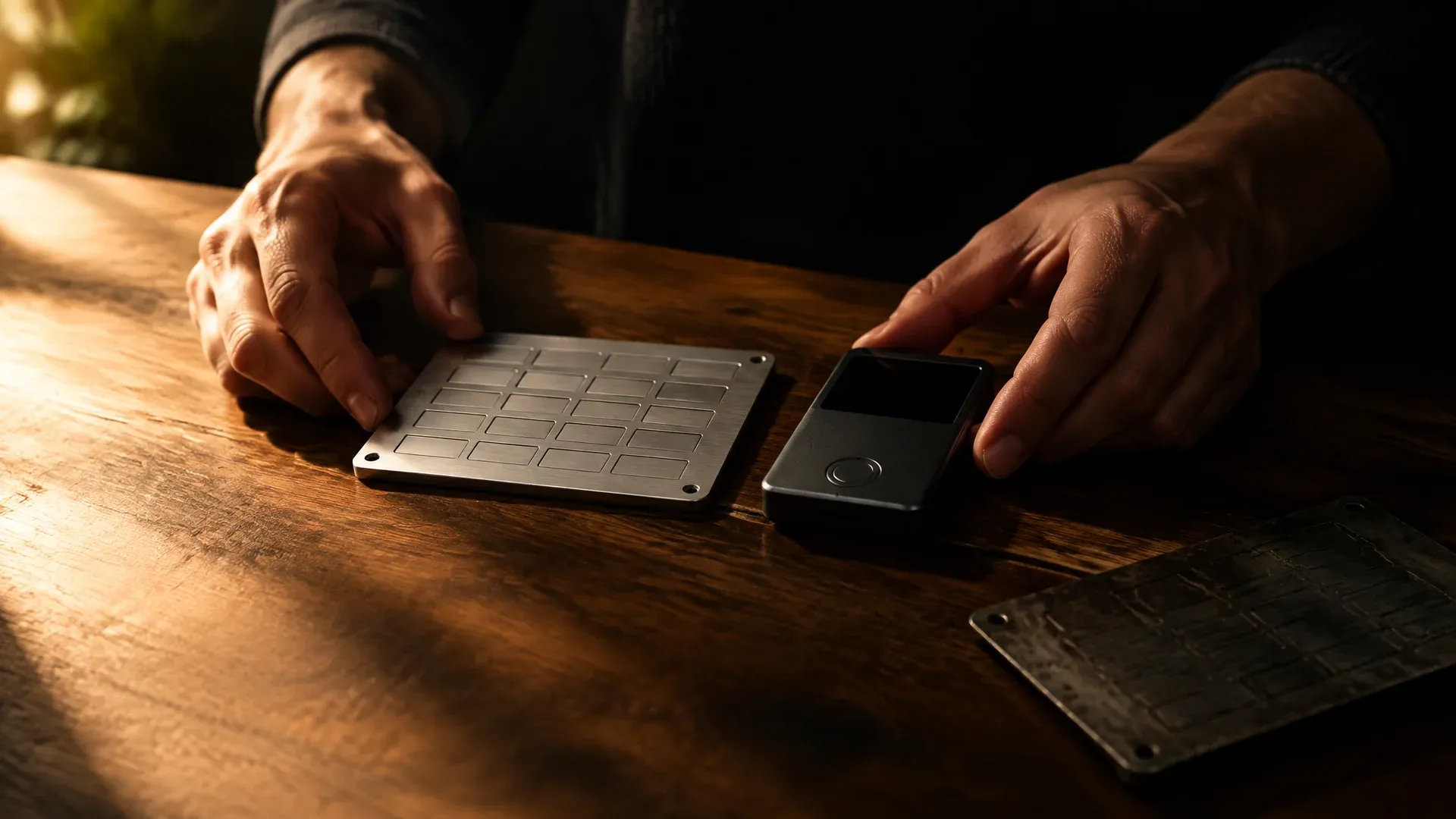
Ngrave phishing: anyone who typed the words needs a new wallet
The incident exposed no gap in custody itself, but one in the trust placed in the sender of a message. Three steps follow from that:
- Establish whether you are affected, and act accordingly. If you received a synchronisation alert on the evening of October 17 and then entered words, the wallet is burnt. Set up a new one with a fresh recovery phrase, move any remaining balance there and file a criminal complaint, so that you hold the case number for exchange freezes. Which device is suitable for it is covered in the hardware wallet comparison.
- Switch notifications from acting to checking. Treat every push message and every email as no more than a prompt to look for yourself, in the app or in the block explorer, and never follow a link from the alert. Genuine access to your balance shows up on the blockchain, not in a notification. Which applications are suited to that, and how they handle approvals, is shown in the software wallet comparison.
- Decide deliberately how much you hold yourself. Self-custody means full control and full liability; custody with a supervised provider distributes both differently. For larger holdings, splitting them is common practice. Which venues are authorised for the German market is listed in the overview of regulated crypto exchanges.
(As of October 23, 2026. This article is not investment advice. Prices and fee structures change; check the terms with the provider before you buy.)
Frequently asked questions about the Ngrave phishing attack
Transparency note: This article was produced with the assistance of artificial intelligence and reviewed by our editorial team before publication. All figures and claims were checked against the primary sources linked in the text. The feature image was generated with AI.
Related articles
- D'CENT App Wallet: How to Tell If Your Recovery Phrase Has to Move Now
- Crypto Wallet Phishing by Letter: Why the QR Code From Your Postbox Wants Your Recovery Phrase
- Restoring a Seed on Another Manufacturer's Wallet: What BIP39 Guarantees and What It Does Not
- How to Store a Seed Phrase Safely: What Steel, a Passphrase and Multisig Do for Your Wallet Backup
- Trezor Hack Scare: That STM32 Entropy Email Is a Phishing Attack
Which topics should we dive deeper into?
Select what genuinely interests you. Your picks feed directly into our editorial planning.
Crypto news that's actually worth your time.
Weekly. 60 seconds. Carefully curated by our editors: no hype, no promo flood, no spam.

September 4, 2026 10:17 AM
Cypher Shutdown on September 6: What Users Should Know Now the Withdrawal Deadline Has Passed
Recap as of September 27, 2026: Cypher had announced it would take its app, dApp and withdrawal window offline on September 6, 2026 and end the token protocol. This article describes the situation before the deadline, how the payout worked and what our own measurement showed at the time about what was left of the CYPR token.
October 17, 2026 7:31 PM

OpenAI agent used known seed phrases to reach 362 wallets: old test wallets are the weak point
An internal OpenAI model worked through publicly known recovery phrases and paid fees out of a wallet belonging to someone else. The damage was nil; the route of attack concerns anyone who has ever created a test phrase.
September 4, 2026 10:15 PM
Trezor Data Breach: Am I Affected and What Should I Do Now?
Trezor widened the ShipMonk data breach on September 4, 2026: around 67,000 further people affected, just over 80,000 in total, from orders placed between November 2019 and August 2021. How to check in two minutes whether you are among them, and what an exposed home address means for self-custody.

July 31, 2026 3:54 PM
594 BTC Gone in 25 Minutes: The Coldcard Flaw That Made Seed Phrases Guessable
A firmware bug from March 2021 let an attacker drain $38 million from around 500 Bitcoin wallets. Here is what broke, who is exposed and what to do now.
September 20, 2026 4:15 PM
Crypto Phishing After a Data Breach: The Warning Signs in a Fake Exchange Email
After every major data breach, the number of phishing emails sent in the name of crypto exchanges and wallet manufacturers rises. This article shows you how to recognise such a message, which data a reputable provider never requests by email, and what to do in the first hour after a click.
September 23, 2026 4:12 AM
How to Set Up a Crypto Wallet: Securing Your Coins in Seven Steps
Your own crypto wallet is set up in twenty minutes, yet a single step decides everything that follows. This guide takes you through wallet type, recovery words and the test amount, and sets out what BaFin and the tax office expect.
October 2, 2026 10:36 AM
Hot Wallet or Cold Wallet: the Private Key Decides How Safe Your Coins Are
Hot wallet or cold wallet: the difference rests solely on whether the private key is online. What separates the two forms, where the limits of hardware lie and why moving to your own device triggers no tax.
September 10, 2026 1:14 PM
Phishing Email From the Real Sender Address: How to Check a Wallet Security Warning
An alleged security warning to wallet customers travelled through the manufacturer's genuine sending channel and passed every technical authenticity check. The test that still holds costs you four minutes.
September 7, 2026 7:26 PM
Stolen Keys Beat Code Flaws: Why the Private Key Is the Way In for 2026 Crypto Hacks
Compromised private keys overtook smart contract code flaws as the most common attack route for the first time in 2026. What sits behind the shift, and how to check your own setup for its single point of failure.
August 23, 2026 4:36 PM
Operation ASTERIX: How a Fake Support Call Delivers a Counterfeit Wallet App
Security researchers analysed an open server on which a phone system, phishing interfaces and cloned wallet programs all came together. The largest list of numbers was the German one.
August 13, 2026 4:59 PM
Trezor Data Breach: First 13,689 Customers, Then Roughly 67,000 More Exposed
A breach at Trezor shipping partner ShipMonk exposed names, phone numbers and home addresses of 13,689 customers in August; in September Trezor reported roughly 67,000 more in the US. Devices are safe, phishing risk is not.
October 10, 2026 10:35 PM
Fake Ledger Site Tops Google Search: “Once the recovery phrase has been handed over, the wallet must be regarded as compromised”
A security researcher reports a rebuilt Ledger site high up in Google's results that asks for the 24-word phrase. Running alongside it are emails with an invented deadline of October 15.
August 22, 2026 4:13 AM
SafePal Data Breach: 39,798 Customers Exposed With Names, Addresses and Phone Numbers
SafePal confirmed a data breach on August 16, 2026: the names, delivery addresses, phone numbers and order details of 39,798 customers were exposed. Seed phrases and private keys were not affected, but the phishing risk is substantial.
August 4, 2026 1:21 PM
Coldcard Losses Near $114 Million as a Fourth Sweep Hits: Why Is Bitcoin Rising Anyway?
A fourth wave of Coldcard sweeps took another 449 BTC on Monday, yet Bitcoin climbed back toward $64,000. Here is what changed and who is still exposed.
August 24, 2026 1:22 PM
Phantom Wallet Ends Sui and Monad Support: What to Do Before the Deadlines
Phantom Wallet removes Monad from its app on August 26 and Sui on September 24. The balances are not lost, but only one of the two ways out leaves your tax position untouched.
October 11, 2026 1:24 AM
Three Mistakes When Setting Up Trust Wallet: The Twelve Words Never Belong on the Phone
Trust Wallet is set up in five minutes, yet three mistakes in those minutes regularly cost the entire balance. This guide covers the six steps, the real cost of a swap, and what applies in Germany on the holding period and supervision.
September 30, 2026 7:16 AM
Tangem Wallet: The Card Without a Seed Phrase vs the Classic Hardware Wallet
The Tangem Wallet secures crypto with two or three identical cards instead of 24 words. What the sets cost, what the EAL6+ chip delivers and why losing every card is final.
October 6, 2026 4:29 PM
Setting up MetaMask: the twelve words that control your coins
MetaMask is set up in ten minutes, and in those ten minutes you make the decisions that later determine what happens to your balance. This guide walks through installation, the recovery phrase, networks, approvals, fees and the German tax position.
October 22, 2026 1:13 AM
ECX Bitcoin fork on October 30: what investors need to know before the snapshot
The ECX blockchain reads every balance at Bitcoin block height 973,728 at the end of October and assigns a new coin to each one. Anyone whose bitcoin sits at an exchange will only receive it if that firm supports the fork.
October 16, 2026 4:41 PM
Fake Ledger firmware updates: SlowMist reports phishing pages with a replica Genuine Check
A phishing campaign reproduces the sequence of an official Ledger update and asks, at the end, for the 24 recovery words. SlowMist reported it on October 16; Ledger had set out its reading of the underlying implant case a day earlier.
August 5, 2026 10:33 PM
$130 Million Gone Because the Randomness Was Predictable: Which Hardware Wallet You Can Still Buy
The Coldcard flaw proved the most respected wallet is not the safest. Which vendor has which track record – and why now is the wrong moment to pause your savings plan.
October 9, 2026 7:29 AM
Exodus Wallet: 71.5 percent of revenue comes from swaps, the spread vs the exchange fee
The Exodus Wallet is free to download, yet 71.5 percent of the provider's revenue in the second quarter of 2026 came from swaps inside the app. What the spread costs, how custody works and from what point a device of your own pays off.
August 21, 2026 4:27 PM

Wallet App Without BaFin Authorisation: When Holding Crypto-Assets Requires a Licence
On 19 August 2026 BaFin published two consumer notices on wallet offerings. Who controls the means of access decides whether an authorisation is needed.
October 17, 2026 10:44 PM
Creating a Bitcoin wallet: the first ten minutes decide who has access
A Bitcoin wallet is set up in ten minutes, and that is precisely the danger. Which four steps every setup runs through, why the first transfer should be a test amount, and which five mistakes cost the most.
October 14, 2026 1:30 PM
What is a hardware wallet? How the device protects your keys
A hardware wallet stores no coins, only the private key, and it never releases it. How signing works inside the device, what the 12 or 24 words mean, and which attacks the design cannot stop.
August 31, 2026 10:14 PM
Trust Wallet Drops 25 Networks: What Users Should Know After September 15
Recap as of September 27, 2026: Trust Wallet had announced it would remove built-in support for 25 blockchain networks from its app on September 15, 2026, among them MultiversX, Polygon zkEVM and Moonbeam. Your coins stay yours, the convenient access does not: this article shows how to add a chain by hand and for which nine networks that route is not open.
October 19, 2026 1:14 AM

Qubic halts its mainnet after 1,404 wallets are drained: the seed was the weak point
An attacker drained 1,404 Qubic wallets on the night of October 18, roughly $1.3 million. The protocol was not to blame: seed generation in the browser supplied too little randomness.
More from CryptoTicker