
Securitize launches tokenized stocks with twelve names: how to check whether you can trade them in Germany
Securitize launched twelve tokenized US stocks on Solana on October 8, each backed one-to-one by a real share and settled in USDC. For investors in Germany everything hangs on one question the company leaves open: who counts as an eligible investor in the first place.





Which topics should we dive deeper into?
Select what genuinely interests you. Your picks feed directly into our editorial planning.
Crypto news that's actually worth your time.
Weekly. 60 seconds. Carefully curated by our editors: no hype, no promo flood, no spam.
Since October 8, 2026 the US provider Securitize has been trading twelve tokenized US stocks on the Solana blockchain. Behind each token sits a real share, dividends keep running, and settlement is in the stablecoin USDC. Whether you may use this offering from Germany is, however, not settled. Securitize speaks of "eligible investors" in the United States, the European Union and further approved markets, but does not define which investors it means. Your own due diligence begins at exactly that point, and only after that does it pay to look at tax, custody and trading hours.
Securitize Stocks: twelve tokenized US stocks on Solana since October 8
The product is called Securitize Stocks and launched on Wednesday, October 8, 2026. At the outset it covers twelve companies. Eleven of them are named consistently in the reports by Decrypt and CoinDesk: Apple, Microsoft, Nvidia, Alphabet, Tesla, Meta, Amazon, Netflix, Circle, Strategy and Palantir. The twelfth name is given in neither report, and anyone who needs the complete list will for now find it only at the provider itself.
Trading runs through the Securitize platform, which operates as a registered broker-dealer in the United States. Liquidity is supplied by an automated market on Solana, with CoinDesk naming the trading firm Jump Trading as market maker. Settlement, custody and clearing are handled by the service provider RQD, according to CoinDesk. For the onward use of the tokens in blockchain lending, Decrypt reports that Ripple Prime and Aave are envisaged, though the language there is one of review and intent rather than live operation.
Securitize is no newcomer to this field. The company is listed on the New York Stock Exchange under the ticker SECZ, has issued tokenized assets worth more than $4.5 billion to date according to CoinDesk, and brought BlackRock's first money market fund onto a blockchain. Around $300 million of its own listed shares already sit tokenized on Solana and Avalanche. For context: according to The Block, the value of tokenized stocks on blockchains recently passed $3 billion.
One-to-one backing: a real share sits in custody for every token
The technical core is quickly told. Each token is backed one-to-one by an actually existing share. Decrypt additionally reports that the deposited shares are not lent out. That commitment is no side note, because in securities lending the share moves temporarily to a third party, and if that third party becomes insolvent, clear backing turns into a claim.
Carlos Domingo, chief executive of Securitize, drew precisely that distinction on launch day. He told Decrypt: "Tokenized stocks should give investors more than a price on a wrapper that tracks a stock and is only offered offshore." Nick Ducoff of the Solana Foundation spoke in similar terms the same day, putting worldwide access at the centre.
Wrapper, certificate, backing: three terms that often get confused
A wrapper is a shell that merely replicates the price of an underlying asset, without the provider having to hold the share itself. Such a token can track the price and still convey no claim to the share. That differs from a structure with actual backing, where a share is held in custody for every token issued. Which variant you are dealing with is not something you can tell from the price chart, only from the provider's legal documents.

Security entitlement: why your name does not appear in the shareholder register
By its own account, Securitize issues the tokens as security entitlements. The term comes from the US Uniform Commercial Code and denotes a claim against an intermediary, not direct entry in the company's shareholder register. CoinDesk puts it in terms of the tokens precisely not establishing direct ownership in the register. Conversion into registered shares is to become possible once the respective issuer supports tokenization.
In practice that means a custody chain stands between you and Apple or Nvidia. As long as it holds, you notice nothing of it. If a link fails, the legal system of the custodian decides what remains of your claim, and in this case that is US law. This structure is entirely standard in the securities world; your German brokerage account also works through intermediaries. What is new is that the chain here runs via a US broker-dealer and a public blockchain rather than via the familiar combination of a house bank and Clearstream.
 Crypto brokers compared
Settlement in USDC: the detour via a stablecoin and its currency risk
Trading and settlement are in USDC, the dollar stablecoin issued by Circle. Anyone coming from Germany normally holds euros and therefore needs two conversion steps: from euros into USDC, and back again on selling. Each of those steps costs fees, and between purchase and sale sits a currency risk that has nothing to do with the share. If Apple rises by five percent while the dollar gives up four percent against the euro, little of the price move survives.
A second point concerns the stablecoin itself. USDC is authorised in the European Union as an e-money token and is therefore one of the few dollar stablecoins that may be offered here as a matter of course. That does not resolve the currency question, though; it answers only the authorisation question for the means of payment. The dollar exposure remains part of your calculation either way.
Eligible investors: what Securitize leaves open about access from the EU
Both reports name "eligible investors" in the United States, the European Union and further approved markets as entitled to access. What that term means concretely remains open. Neither Decrypt nor CoinDesk says whether retail investors are meant or only professional and qualified investors, and on the requirements for identity verification and anti-money-laundering checks neither report offers any detail. In US securities law an "eligible" or "accredited investor" is typically tied to wealth or income thresholds, and those hurdles sit well above what an average private portfolio meets.
That sets a clear order of priority for you. Before tax, fees or trading hours matter at all, you need the answer to the access question, and you need it in writing from the provider: are retail investors resident in Germany admitted, what evidence does registration demand, and on what legal basis is a German customer accepted. A provider that actively directs investment services at retail clients in the EU needs an authorisation under European law to do so. One that instead relies on the customer's own initiative shifts the risk onto you. If you would rather hold the same share without these open questions, the route runs through a regulated broker; which providers are available in Germany is shown in our crypto broker comparison.
MiFID II rather than MiCA: tokenized stocks are financial instruments, not crypto assets
This is where the most common misconception about this product type lies. The European crypto regulation MiCA governs crypto assets but excludes instruments that already count as financial instruments. A tokenized share remains legally a share, even when it is transferred on a blockchain. What applies, therefore, are the securities rules under MiFID II and national provisions, not the MiCA authorisation that many providers point to.
In practical terms that means two things. A MiCA licence says nothing about whether a provider may sell tokenized stocks to you. And the protections you know from securities, such as the appropriateness assessment or the information duties on distribution, depend on whether the provider is authorised as an investment firm in the EU. On the US side, the Securities and Exchange Commission introduced an exemption described as an innovation exemption in September 2026, opening an orderly route for trading venues dealing in tokenized securities. That exemption applies to the US market and replaces no European authorisation.

Extended trading hours: the NYSE platform and OKXICE are announced, not live
At launch, trading runs in extended hours, so beyond regular exchange hours, but not yet continuously. Securitize names round-the-clock operation as a goal. Also planned is an extension to the New York Stock Exchange's announced round-the-clock platform, in whose construction Securitize is involved, and to the OKXICE trading venue, a joint venture of the exchange operators Intercontinental Exchange and OKX, which filed an application in the same week.
Both are subject to conditions. The venues first have to launch and meet the regulatory requirements. For your decision today, therefore, only the one figure that already applies counts: trading in extended hours on one platform. Thin trading hours have a side effect that occurs in every young market. The gap between the bid and the ask price widens, and an order without a price limit can be executed at a price you did not expect. A limit protects against that; a market order does not.
To place the surroundings on launch day: Solana trades at $108.52 on October 8, 2026, around 7.1 percent below the previous day's level. The broad crypto market also gave ground that day. For the stock tokens themselves that is initially irrelevant, because their value hangs on the deposited share and not on the price of the blockchain they sit on. It becomes relevant for transaction costs, and when you use tokens as collateral in lending.
 Tax tools and portfolio trackers
Flat-rate withholding tax instead of a holding period: the tax break between share and coin
Anyone arriving from cryptocurrencies brings an expectation that does not hold here. With cryptocurrencies, section 23 of the German Income Tax Act on private disposals applies, and after a holding period of one year the gain stays tax-free. Shares do not fall under it. For them, section 20 of the Income Tax Act on income from capital assets applies: 25 percent flat-rate withholding tax, plus the solidarity surcharge of 5.5 percent on that tax, together around 26.4 percent, and church tax on top where applicable. The saver's allowance stands at 1,000 euros for single filers and 2,000 euros for joint assessment. There is no holding period after which it becomes tax-free.
Two further points arise with a foreign provider. Without a German paying agent, no capital gains tax is withheld automatically, and you declare the income yourself via the KAP schedule. And dividends from US companies first attract US withholding tax, which can be reduced to 15 percent under the double taxation treaty and credited against the German tax. For that you have to prove your tax residence to the provider. There is also an offsetting restriction: losses from the sale of shares may be offset only against gains from share sales, not against other investment income.
One caveat belongs here explicitly. Whether the German tax authorities treat a security entitlement under US law in the same way as a share, or classify it as another capital claim, depends on the specific structure and is not settled for this product. We have broken down the tax treatment of tokenized stocks in Germany in detail in a separate article. For an individual case, a tax adviser settles this before the first purchase takes place, not afterwards.
Dividends and voting rights: what the company commits to and where the limitation lies
According to Securitize, holders retain the economic benefits of their position, meaning dividends, and voting rights. Decrypt adds a limitation that is contained in the company's own wording: voting rights apply where applicable. That carries weight, because exercising a voting right presupposes that the chain from the token to the annual general meeting is organised. Whether and how that works in practice will only become clear in the first AGM season after launch.
The dividend is the easier part. As a payment process it can be passed along the custody chain, and USDC provides a settlement instrument for it. A voting right concerns the exercise of a membership right, and that depends on who stands in the register. According to CoinDesk, that is precisely where the tokens do not stand.
Tokenized stocks: without clarity on access, the rest is theory
The news is a genuine step: twelve well-known US names, backed one-to-one, on a public blockchain, through a broker-dealer registered in the United States. For investors in Germany, though, the decisive point remains unanswered, and it cannot be settled by reading, only by information from the provider. Three steps, in this order:
- Clarify access in writing. Ask Securitize whether retail investors resident in Germany are admitted and what evidence registration requires. If the answer comes back negative or unclear, your review ends here. For recording holdings and income across several platforms, a tracker helps, of the kind we set against each other in our overview of tax tools and portfolio trackers.
- Calculate the cost of the currency chain. Add up the conversion from euros into USDC, the trading fee and the way back, and hold the result against the cost of the same security in your existing brokerage account. Which trading venues offer USDC as a matter of course is set out in our crypto exchange comparison.
- Check the legal form of the position. Read in the contractual documents against whom your claim runs and what applies if the custodian becomes insolvent. Why entry in the register makes the difference is something we explained using the example of the transfer agent's role.
(As of October 8, 2026. This article is not investment advice. Prices and fee structures change; check the terms with the provider before you buy.)
Frequently asked questions about tokenized stocks
Transparency note: This article was produced with the assistance of artificial intelligence and reviewed by our editorial team before publication. All figures and claims were checked against the primary sources linked in the text. The feature image was generated with AI.
Related articles
- A Securities Account at the Crypto Exchange: Why Capital Gains Tax and Anlage KAP Are on You
- Solana DEX Trades Overtake the NYSE: What to Check on Swaps, Tax and Oversight
- Solana price 108.46 euros: a 2.4 percent gain in euros, a 2.5 percent loss in dollars: what to check now
- Tokenized US Stocks: What the SEC Exemption Changes for You in Germany
- Borrowing Against Bitcoin Instead of Selling: When German Tax Still Applies
Which topics should we dive deeper into?
Select what genuinely interests you. Your picks feed directly into our editorial planning.
Crypto news that's actually worth your time.
Weekly. 60 seconds. Carefully curated by our editors: no hype, no promo flood, no spam.

October 5, 2026 7:43 AM

Tokenized stocks as collateral: what the October 14 unlock changes for investors in Germany
On October 14, 2026, at 6:00 a.m. New York time, the next lock-up tranche at Cerebras comes free, up to 19.4 million shares. Anyone who has pledged a tokenized stock as collateral carries a different risk from a pure holder.
September 19, 2026 7:26 AM

Offsetting Crypto Losses Against Share Gains: What Is Really Allowed in Germany
Crypto losses and share gains sit in separate loss buckets in Germany, and there is no offsetting between them. Where the line runs, why crypto derivatives are the exception, and how you can still use losses through carryback and carryforward.
September 17, 2026 10:12 PM
Stock Tokens: How to Check Whether Yours Carries Real Shareholder Rights
The SEC allows US trading venues to handle tokenized stocks only if the token carries the same rights as the original. That condition does not automatically apply to the stock token you buy here, so here is how to check what is inside yours.
September 9, 2026 4:22 PM
Crypto Tax in Germany: What Applies in 2026 and What Is Set to Change in 2027
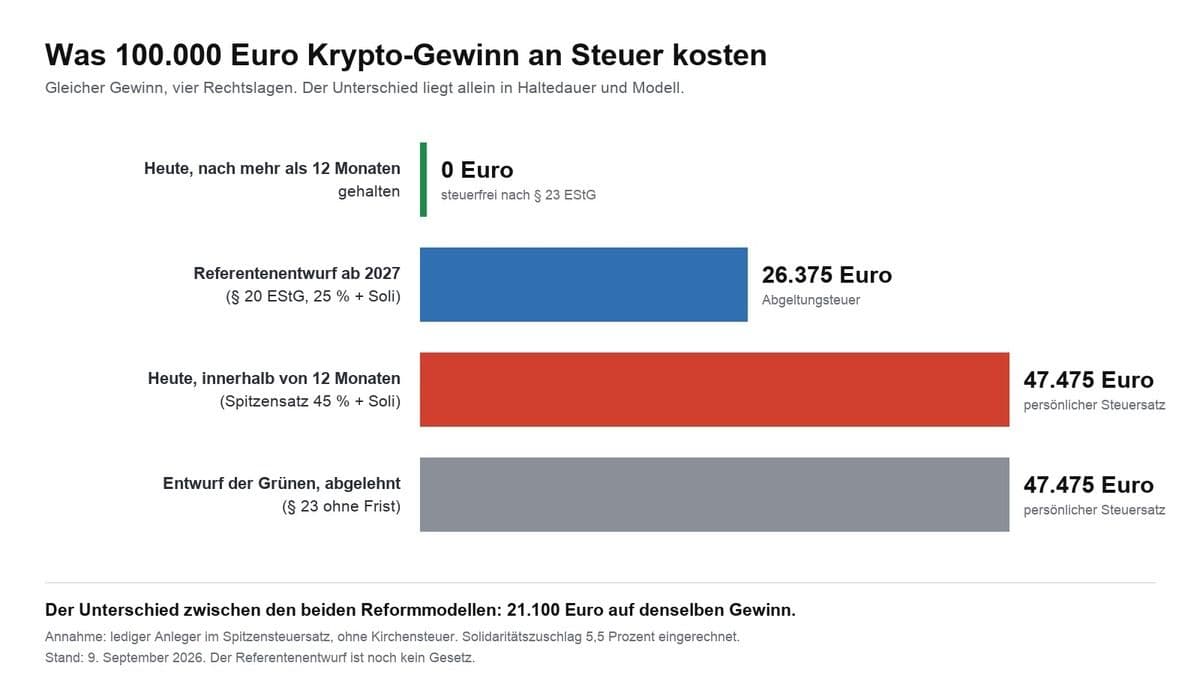
Crypto gains are tax-free after twelve months; before that your personal tax rate of up to 45 percent applies. What triggers tax, how the holding period is calculated, what happens with staking and losses, and what the draft bill would change from 2027.
August 12, 2026 6:24 PM

Tokenized Stocks and Tax in Germany: When the One-Year Holding Period Applies and When the Flat Tax Bites
If you buy a tokenized stock, you often apply the crypto rule: hold for a year, then the gain is tax-free. For these products that assumption usually does not hold, and this article shows from the wording of the law which feature decides the tax regime and how to find it in the issuer documents.
September 9, 2026 1:15 AM

Germany's Crypto Tax: 160 Million Euros for a 555-Billion Budget
The German finance ministry's draft bill puts a figure on the crypto tax for the first time: 160 million euros from 2028. What that number means in the 2027 federal budget, how 11.4 billion became 160 million, and what investors can read from it.
August 12, 2026 9:12 AM

Bitcoin Losses and Dividends in Austria: How the Tax Offset Works
Can a Bitcoin loss be offset against dividends? This is how loss offsetting works in Austria. It also shows when a tax return is needed for it.
August 19, 2026 4:33 AM

Tokenized Stocks: Why You Do Not Own a Share and Which Risk Hangs on the Issuer
Crypto.com launched tokenized stocks for the EEA on August 12, 2026, and the decisive sentence sits in the small print: buyers acquire no ownership of the underlying asset. What you hold instead, who ranks ahead of you in an insolvency and how to recognise genuine ownership of a security.
September 26, 2026 1:19 AM
Germany’s Crypto Holding Period Is Wobbling: What to Check Before December 31
A CDU member of the Bundestag makes it plain: the coalition agreement does not guarantee that the one-year holding period for crypto assets will survive. What that means for purchases made before the planned cutoff date of December 31, 2026.
August 26, 2026 10:25 PM
Selling Bitcoin at a Loss: Loss Offsetting in Austria
Sold Bitcoin at a loss? Austria allows the loss to be offset against certain investment income. When loss offsetting is possible and which limits apply.
August 22, 2026 4:47 PM
Offsetting Bitcoin Losses Against Stock Gains in Austria
Offset bitcoin losses against gains on shares? Austria allows it in principle, but only under certain conditions and usually via the tax return.
October 2, 2026 1:33 PM

Crypto tax before the cabinet on October 14: “Comments are only possible until October 6”
Germany's Federal Ministry of Finance sent the draft bill on crypto taxation to the associations on September 30, 2026, and the cabinet is to decide on October 14. For your holdings one date counts above all: December 31, 2026.

September 28, 2026 4:15 AM

NEAR Rises More Than 29 Percent in Seven Days: Why Ondo Stocks and Zcash Trading Are Driving the Price
NEAR gains 29.23 percent within seven days and is the strongest of the 25 largest cryptocurrencies on September 27. Two documented drivers sit behind the move: the launch of tokenised US equities and ETFs from Ondo on the chain, and growing Zcash trading through NEAR Intents.
September 25, 2026 10:14 PM
Sequans sells its last 314 bitcoin: what to check if you hold a treasury stock
Semiconductor maker Sequans has wound down its bitcoin reserve completely, 15 months after setting a target of one hundred thousand coins. What the case reveals about treasury stocks, and which tax rule applies to the share and to the coin.
September 8, 2026 10:21 PM

Crypto Holding Period and Grandfathering: Why December 31, 2026 Becomes the Cut-Off in Germany's Draft Bill
A ministerial draft bill from Germany's finance ministry names a cut-off date for the first time: crypto assets acquired after December 31, 2026 are to fall under the flat-rate withholding tax. What that means for legacy holdings, running savings plans and staking income, and why nothing has been decided yet.
August 31, 2026 10:30 PM

Taxing Crypto Lending: Your Personal Rate Instead of Withholding Tax, and the Right Federal Fiscal Court Case Number
According to the only tax court ruling so far, income from crypto lending falls under Section 22(3) of the German Income Tax Act and therefore under your personal tax rate. The appeal is pending at the Federal Fiscal Court under VIII R 22/25, not under the case number given in many professional articles.
October 1, 2026 7:36 PM

Crypto tax and withholding at source from 2028: what to check now
The German Federal Ministry of Finance’s draft bill goes to cabinet on October 14, 2026. The underexposed part of it is the deduction of tax from 2028: which providers are to withhold the tax on investment income, why self-custody and foreign platforms stay exempt from it, and what you should document by December 31.
August 21, 2026 4:24 AM

Forced Sale on a Crypto Exchange: Which Moment Counts for the Holding Period and What You Must Document
At Luno, Kraken and Valour the deadlines are running out, after which the provider realises the remaining holding itself. For tax purposes that is a disposal, and what governs it is the exchange's timestamp.
September 17, 2026 7:12 PM

Gifting Bitcoin to Children: Allowance, Holding Period and the Tax Office Report
Transferring Bitcoin to your child hands over your holding period and your entry price along with the coins. This guide sets out what really applies in Germany on the allowance, the reporting deadline, representation and custody.
September 7, 2026 7:22 AM

German Crypto Holding Period Set to Go After All: A Separate Draft Targets Purchases From 2027
Correction of 8 October 2026: The Income Tax Reform Act 2027, adopted by the German federal cabinet on 2 September, does not cover crypto assets. That did not mean the holding period stays. A separate draft bill from the Federal Ministry of Finance, dated 30 September, would abolish it for anything acquired after 31 December 2026. The cabinet is due to decide on 14 October.
October 6, 2026 4:32 AM
Bitcoin for a gift card: what paying with crypto means for your holding period
Paying for a gift card with Bitcoin is a sale for tax purposes. What counts as the disposal proceeds, when the twelve-month holding period bites, and the four records the tax office expects.
September 17, 2026 10:22 PM
Selling Bitcoin at a Loss and Buying It Straight Back: What That Does to Your Holding Period
Germany has no wash sale rule: the loss stays deductible even if you buy back immediately. The buyback, however, restarts the one-year period for every new unit.
September 8, 2026 1:19 AM

Germany's Crypto Holding Period: What Happens Now Signing for Petition 201716 Closed on September 15
Recap as of September 27, 2026: the signature period for German parliamentary petition 201716, which asks for the one-year crypto holding period to be preserved, closed on September 15, 2026. This article explains what ended that day, how the petitions committee proceeds and why no investor has to sell because of it.
October 7, 2026 4:28 PM

Shiba Inu Price at $0.00000538, Down 8.6 Percent in a Day: Hold or Sell?
Shiba Inu loses 8.6 percent on Wednesday afternoon and trades at $0.00000538. Whether a sale makes sense is decided in Germany less by the chart than by the purchase date of the individual tranche, because the one-year period hangs on it.

October 5, 2026 4:26 PM

Shiba Inu price up 4.4 percent: outperforms the market, but 88 trillion SHIB sit on exchanges
Shiba Inu adds 4.4 percent on Monday, making it the strongest of the six big names. At the same time 88.08 trillion SHIB worth $525 million sit on trading venues, almost five times a single day of turnover.
September 27, 2026 10:14 AM

Shiba Inu Price Prediction: What to Check on SHIB Before the December 31 Deadline
SHIB trades at $0.00000592 on September 27, 2026, around 93 percent below its all-time high. For German investors one date matters more than the chart right now: December 31, 2026.
September 25, 2026 10:26 PM

Selling bitcoin privately: the tax in Germany and the records you need
A direct sale to a private individual falls under the same one-year rule as an exchange sale, but there is no tax report to go with it. This guide walks through the calculation, the 1,000 euro threshold and the records the tax office wants to see.
More from CryptoTicker