
Tokenized stocks as collateral: what the October 14 unlock changes for investors in Germany
On October 14, 2026, at 6:00 a.m. New York time, the next lock-up tranche at Cerebras comes free, up to 19.4 million shares. Anyone who has pledged a tokenized stock as collateral carries a different risk from a pure holder.





Which topics should we dive deeper into?
Select what genuinely interests you. Your picks feed directly into our editorial planning.
Crypto news that's actually worth your time.
Weekly. 60 seconds. Carefully curated by our editors: no hype, no promo flood, no spam.
If you are holding a tokenized stock as collateral in a margin account, October 14, 2026 is a deadline for you, not a news item. At 6:00 a.m. New York time that day, the next lock-up tranche at chipmaker Cerebras comes free, covering up to around 19.4 million shares. The previous tranche of the same size was released on September 30. The share price closed 8.87 percent lower that day than the day before. An investor who merely holds the token sees a red number in the portfolio. An investor who has pledged it sees something else: a shrunken credit line, possibly in the middle of the night in Europe.
This article explains what actually happens to a pledged stock token on a date like this, which levers your provider pulls in the process, and which rules apply in Germany. The plain calendar with every Cerebras date through November is in our release schedule for the Cerebras lock-up. What follows is the mechanism behind it, which works the same way at every newly listed company.
What the Cerebras prospectus actually says about October 14, 2026
The source is not market chatter but the prospectus the company filed with the US Securities and Exchange Commission. It sets out a staged plan: 8.9 percent of the locked stock held by directors, officers, other employees and further existing shareholders comes free on each of three dates, September 30, October 14 and October 28, 2026, each at 6:00 a.m. New York time. Three smaller steps of 6.7 percent each preceded them in August and September. The document puts each of the three October steps at up to roughly 19.4 million shares.
That volume has to be set in proportion. The prospectus names 215,110,345 outstanding shares across all classes after the listing. That works out at 9.02 percent per tranche. Had the underwriters exercised their over-allotment option in full, the figure would be 219,610,345 shares and therefore 8.83 percent. Both calculations are defensible; mixing them is not. The final end of the lock-up lies further out still: it falls on the earlier of two points, either two trading days after third-quarter results are filed or 180 days after the date of the prospectus.
One phrase in the prospectus decides how far all this reaches: up to. What is released is permission to sell, not a sale. Whether those entitled actually bring their shares to market is written nowhere and cannot be forecast seriously either.
Tokenized stock, stock token, bStock, xStock: how the terms differ
A tokenized stock is an instrument recorded on a blockchain whose value is tied to the price of a listed share. As a rule you are not buying a share with it, but a claim against the issuer of the token. Depending on the provider, the legal substance is a bearer note, a certificate or a contractual promise of economic participation. A vote at the annual general meeting is almost never part of it. Why that is not a detail is something we took apart in tokenized stocks and issuer risk.
The common product families carry different names and work differently. xStocks come from Backed Finance, run as tokens on Solana and are legally tracker certificates in the form of bearer notes; the base prospectus was approved by Liechtenstein's financial market authority and then passported into the European Economic Area. bStocks are issued by a company in the Binance group; they are meant to be backed one to one by the underlying share, held in regulated custody. Robinhood runs its own tokens on US equities, among them one on Cerebras. Several tokens on the same company therefore exist side by side, differing in issuer, custodian and legal form, even though the quoted price looks almost identical.
In practice that means the ticker tells you nothing about the legal position. Two tokens on the same chipmaker can have entirely different debtors. Which questions you can put to the issuer, and how to recognise a solid answer, is set out in our guide to the rights behind a stock token.
Why the Cerebras share price fell 8.87 percent on September 30
September 30 provides the rare case of a measured run-up rather than a presumption. Cerebras closing prices stood at $194.95 on September 29 and at $177.65 on September 30, the day of the release. That is 8.87 percent down in a single trading session. The slide continued from there: $169.52 on October 1, $166.43 on October 2. From the interim high of $206.75 on September 25 through October 2 that adds up to 19.5 percent.
The series proves no cause. The listing fell into a phase in which stocks around artificial intelligence were already swinging hard, and reports on large customers along with analyst verdicts moved the price over the same days. What the series does show is the order of magnitude: a release on this scale can accompany double-digit percentage moves within a week. That order of magnitude is precisely what makes a pledged token in a margin account delicate.

Haircut, collateral value and margin calls: how a stock token counts towards your credit line
When you pledge an asset as collateral, the trading platform does not credit it at the full market price. Instead it applies a discount, the haircut. With a haircut of 30 percent, 1,000 euros of token value count as only 700 euros of collateral value. That collateral value and your open positions together produce your margin ratio. If it falls below a set threshold, the platform calls for more margin, and if that is not provided, it closes positions on its own.
Now comes the part many underestimate. In a price move of almost 9 percent in one day, it is not only the value of your position that falls, but at the same time the collateral value of your security. Both sides of the calculation move in the same direction, and their effect adds up. Anyone holding stock tokens and at the same time running positions secured with them carries the same price risk twice.
On top of that comes a lever that sits with the provider: platforms may change haircuts and lending limits when they reassess the volatility of an instrument. Raising the haircut ahead of a known release date is an ordinary risk measure and can narrow your room for manoeuvre before the price reacts at all. With such a date approaching, it is worth looking at your provider's list of eligible collateral, because that is where discounts change first.
 Compare crypto brokers and fees
Binance, Kraken and Robinhood: which routes are open to investors in Germany
For investors in Germany the first question is not whether a token exists, but whether it is tradable for you. This is where providers part ways. Kraken opened the xStocks range to customers in the European Economic Area last year and rests that offer on an authorisation under the European markets in financial instruments directive. The issuer, Backed Finance, now belongs to Kraken. On the other side stands Robinhood, whose token offer on US equities is aimed at a different audience and is not readily accessible in Germany.
Binance launched its bStocks range in the summer and widened the circle of those allowed to use such tokens as collateral at the end of September. Previously that was essentially reserved for accounts at the top trading tiers; since then all eligible users can pledge them in cross-margin and portfolio-margin accounts, though the lower tiers must first pass a suitability check. On September 30 further instruments joined the list of eligible collateral. Which stock tokens sit on that list changes continuously, and what counts is always the provider's own list, not a report about it.
A third route runs through regulated trading venues in Germany. On the 360X platform, which comes out of the Deutsche Börse orbit, several xStocks have been tradable against stablecoins since February, within a framework supervised by BaFin. The offer so far covers only a handful of instruments, but it shows the direction of travel: tokenized stocks are migrating out of the purely crypto-adjacent world into supervised structures. When you compare providers, look first at authorisation and registered office and only then at the fee; our overview of crypto brokers offering leverage ranks the houses by exactly those features.
Trading hours: the token runs around the clock, the Nasdaq does not
The release on October 14 takes effect at 6:00 a.m. New York time, that is noon in Germany, while the clock change has yet to happen in either country. The US exchange itself does not open until three and a half hours later. In between lies pre-market trading, which is thin and allows large price jumps.
A stock token knows no such pause. It trades on venues that run around the clock, weekends included. That sounds like an advantage and is in truth double-edged. Outside regular exchange hours the token lacks the reference price of the underlying instrument; the price then arises solely from supply and demand in the order book of the token market, which is usually far thinner than that of the share. Deviations from the later opening price are normal in such phases, and sales at the wrong moment land precisely in that gap.
For a margin account this has an uncomfortable consequence. A platform that values collateral around the clock can trigger a margin call at a time when you are not at your desk and the reference exchange is closed. Anyone leaving positions open across such a date should know which notifications their provider sends and whether there is a deadline before automatic closure.
MiFID II instead of MiCA: why regulators classify stock tokens differently
Many investors assume that the European crypto regulation MiCA applies to anything involving a blockchain. For tokenized stocks that is as a rule wrong. MiCA expressly excludes financial instruments from its scope. A token structured as a certificate or a note falls under the markets in financial instruments directive, MiFID II, and under securities supervision law, not under the crypto regime.
This is not an academic distinction; it determines what you may expect. Under the securities regime, prospectus obligations, investor-protection rules on suitability and supervision of the trading venue all apply. BaFin supervises providers active in Germany accordingly, and jurisdiction follows the classification of the product. Which obligations conversely apply to companies that do fall under the crypto regime, we have collected on our page on MiCA licensing duties.
In practice that means: check under which authorisation your provider is selling you the token. A house holding only a crypto permission may not simply offer you a financial instrument. If the small print names a registered office outside the European Union and a clause excluding distribution to European retail clients, that is not a formality but a statement about your legal recourse in a dispute.

Tax in Germany: capital income instead of a one-year holding period
Tax treatment is the point where most misunderstandings arise. For crypto assets such as Bitcoin or Ether, Germany has so far treated trading as a private disposal transaction: after a holding period of one year, a gain remains tax-free. For a tokenized equity instrument the prevailing view is that this is precisely not the case, because it is classified as an investment in the sense of income from capital assets. Withholding tax then applies, plus the solidarity surcharge and, where applicable, church tax, regardless of how long you have held the instrument.
Whether your provider withholds the tax straight away depends on whether it acts as a paying agent in Germany. With foreign trading venues that is usually not the case, and you then have to declare the income yourself in the annex for capital income. What a release such as the one on October 14 adds: if you sell under pressure, a loss arises, and that too needs to be allocated correctly, because losses from capital assets can only be offset against gains of the same kind. We have written up the details of the classification in paying tax on tokenized stocks in Germany. Since the classification depends on the specific design of the token, a trip to a tax adviser is no empty phrase here.
 Compare MiCA-regulated crypto exchanges
What the unlock does not say: “up to” is a ceiling
The caveat belongs at the end, the one that tends to get lost in the excitement around dates like this. The prospectus releases permission to sell, nothing more. Whether a single share is sold on October 14 nobody knows, and the size of any supply depends on decisions taken by hundreds of individual entitled holders. Several things argue against a sell-off: executives often sell through pre-arranged trading plans in small slices, the publication of quarterly figures is close at hand, and part of the released stock is tied up in options and employee claims that must first be exercised.
Conversely, it cannot be claimed that the market priced the date in long ago. Against that stands the measured move of September 30, which accompanied a known date that had been sitting in the prospectus for months. Taken together, that gives the honest position: the date is fixed, its effect is not. Anyone running a leveraged position with that uncertainty is placing a bet; anyone holding the token unencumbered is making a decision about conviction. Those are two different risks, and only one of them can cost you more than your stake.
One last point stays the same across all three October dates: the stock token tracks the price, not the voting position and not access to company information. Anyone who first reads news of a lock-up in the chat of a trading venue rather than in the prospectus has already given away the information advantage.
Tokenized stocks: Your next three steps
- Establish your provider's authorisation and registered office. Look in the customer agreement to see who issues the token, which authority supervises it and whether distribution to retail clients in the European Economic Area is envisaged at all. An overview of houses with European authorisation can be found under regulated crypto exchanges compared.
- Check the collateral list and the haircut before the date. Note the discount at which your stock token is currently credited and where the margin-call threshold sits. Work through what a price drop of ten percent does to your margin ratio. Document entry price, date and quantity cleanly so the income can be allocated later; the tax tools and portfolio trackers compared help with that.
- Decide whether the position stays open past October 14. Anyone who does not need the collateral can wind down the borrowing before the date and so defuse the double effect of losses on position and collateral. Anyone who needs the liquidity should compare the terms of secured loans, for instance in our overview of crypto lending.
(As of October 5, 2026. This article is not investment advice. Prices and fee structures change; check the terms with the provider before you buy.)
Sources for further reading: the Cerebras prospectus with the full release schedule and the Kraken announcement on the acquisition of Backed Finance.
Frequently asked questions about tokenized stocks
Transparency note: This article was produced with the assistance of artificial intelligence and reviewed by our editorial team before publication. All figures and claims were checked against the primary sources linked in the text. The feature image was generated with AI.
Related articles
- Stock Tokens: How to Check Whether Yours Carries Real Shareholder Rights
- Tokenized US Stocks: What the SEC Exemption Changes for You in Germany
- Solana back on top in tokenized equities with 31 percent of the week: What investors need to know
- Securitize launches tokenized stocks with twelve names: how to check whether you can trade them in Germany
- You Can Now Trade Tesla and Apple on Kraken... Here's How
Which topics should we dive deeper into?
Select what genuinely interests you. Your picks feed directly into our editorial planning.
Crypto news that's actually worth your time.
Weekly. 60 seconds. Carefully curated by our editors: no hype, no promo flood, no spam.

August 30, 2026 4:13 PM

SpaceX Lockup: What the Release Dates Through December 8 Mean for Tokenized SPCX Stock
The SpaceX lockup expires in five stages. Three have passed; the next falls on October 24, 2026, a Saturday, and the last on December 8. What that means for anyone holding a tokenized SPCX share.
August 19, 2026 4:33 AM

Tokenized Stocks: Why You Do Not Own a Share and Which Risk Hangs on the Issuer
Crypto.com launched tokenized stocks for the EEA on August 12, 2026, and the decisive sentence sits in the small print: buyers acquire no ownership of the underlying asset. What you hold instead, who ranks ahead of you in an insolvency and how to recognise genuine ownership of a security.

October 24, 2026 7:33 AM

2.07 to 22.6 million SUI: three unlock trackers name three dates in early November
The next lock-up at Sui expires in early November. The trackers name amounts from 2.07 to 22.6 million SUI and three different days. What is documented, and what applies in Germany.
September 26, 2026 10:33 AM

Monad Unlock on November 24: Why 10.7 Billion MON Equal Around 90 Percent of the Circulating Supply
At the first anniversary of the mainnet launch, Monad's one-year lock-up on team tokens ends. This tranche alone reaches around 90 percent of the amount circulating today. What the primary source evidences, which aggregator figure is wrong, and what you can check before the date.
October 19, 2026 10:24 AM

Token unlock and vesting explained: cliff vs monthly tranches
A token unlock frees tokens that have existed all along but sat locked in a contract. How a cliff differs from linear vesting, which four numbers make a vesting schedule readable, and what counts for tax when the tokens land with you.
October 14, 2026 4:28 AM

Morgan Stanley pushes tokenized equities to 2027: "The client demand really isn't there"
Morgan Stanley will bring tokenized equities to its own trading venue only in the first quarter of 2027, around half a year later than announced. Amy Oldenburg's explanation and the German legal framework show why equity tokens are something different here than there.

June 1, 2026 1:17 PM
Binance Launches US Stock Trading with Upcoming bStocks Tokenization on BNB Chain
Binance has introduced zero-commission US stock and ETF trading for non-US users, with plans to launch tokenized on-chain equities via bStocks.
September 2, 2026 1:31 AM
Cerebras Lockup and Tokenized Stocks: The Release Schedule Through November 2026
On September 16, 2026 a further 14.6 million Cerebras shares become freely sellable, and the dates through November 9 are set out in the IPO prospectus. What the release schedule means for the tokenized wrappers CBRSB, CBRSX and CBRSON, and what it does not.
October 24, 2026 10:24 AM

What is Ondo Finance? $4.0 billion in tokenized bonds and equities: what changes for investors in Europe
Ondo Finance brings US Treasuries, equities and ETFs onto the blockchain as tokens, around $4.0 billion of them on its own figures. For investors in Europe those products are only accessible with professional client status; the only freely tradable piece is the ONDO token.
October 9, 2026 1:28 PM

Coinbase Pro Returns With 10x Spot Margin, and Germany's CFD Rules Decide What Lands
Coinbase has completed the Deribit acquisition on the technical side and is bringing Coinbase Pro back by the end of the year, with spot margin of up to ten times leverage. How much of that arrives in Germany turns on whether supervisors classify such products as contracts for difference.
August 21, 2026 10:16 AM

24-Hour Trading on US Exchanges: What the SEC Roundtable Means for Tokenized Stocks
The US Securities and Exchange Commission takes up the path to round-the-clock trading on American equity markets on September 17, 2026. For tokenized stocks on Kraken and Binance, that puts their most important selling point back on the table.
September 7, 2026 7:14 AM
Stock Tokens: Who Actually Issues Them and What the SEC Wants to Change by November 3, 2026
Behind every stock token sit an issuer, a broker, a custodian and a blockchain, and today you will only find those names in the small print. The US Securities and Exchange Commission wants them written into an official form; the deadline for comments runs out on November 3, 2026.
September 2, 2026 10:30 AM

Tokenized Stocks: Who Owns the Share When the Register Sits on a Blockchain
The US Securities and Exchange Commission wants to allow the official share register to be kept on a blockchain. What the proposal of September 1, 2026 means for tokenized stocks and for your ownership.
October 16, 2026 10:41 AM
Bitcoin futures at 5 BTC per contract: what to watch on margin and the expiry date
A Bitcoin future gives you a price and a date, not coins. What contract size, margin and expiry on the last Friday of the month mean for your account, and why the route to the futures market in Germany runs through the broker.
October 13, 2026 10:47 PM

Polkadot vote 1954 stands at 73 percent against: what is behind the DOT DAO mandate
Referendum 1954 would require the DOT DAO to put user acquisition ahead of every other metric. After three hours, 73.2 percent are against, support stands at 0.00 percent, and for holders the ability to take part hangs on one question: where are the keys?
September 19, 2026 10:26 PM
World Liberty Financial: Trump's WLFI Stake Locked Until 2028, Voting Rewards From October
Donald Trump's WLFI stake, a good 14 billion tokens, is contractually locked until May 2028. From October 1, holders are to receive rewards for locking their tokens for 180 days and voting. What both mean for the price and what to check before you buy.
September 13, 2026 4:23 AM

Staking Lock-Up Period: How Long You Wait for Your Coins After Unstaking
Eight days on Ethereum, exactly 21 on Cosmos, not a single hour on Cardano: the lock-up period decides when you reach your coins again after unstaking. We queried the deadlines directly at the chains on September 13, 2026, and show you how to check them yourself before every decision.
September 10, 2026 7:14 AM

Bitcoin Loan Liquidated: Tax Consequences in Austria
If a lender liquidates Bitcoin pledged as loan collateral, a taxable capital gain can arise in Austria. That holds even when the investor never chose to sell.
September 8, 2026 10:12 PM

Bitcoin at $78,741: How to Calculate When Your Crypto Loan Gets Liquidated
Anyone who borrowed against their Bitcoin instead of selling it faces the same question with every drop: at what price does the lender seize the collateral? We retrieved the published liquidation thresholds of eleven providers and show how to work out your own limit in two lines.
June 13, 2026 11:45 AM
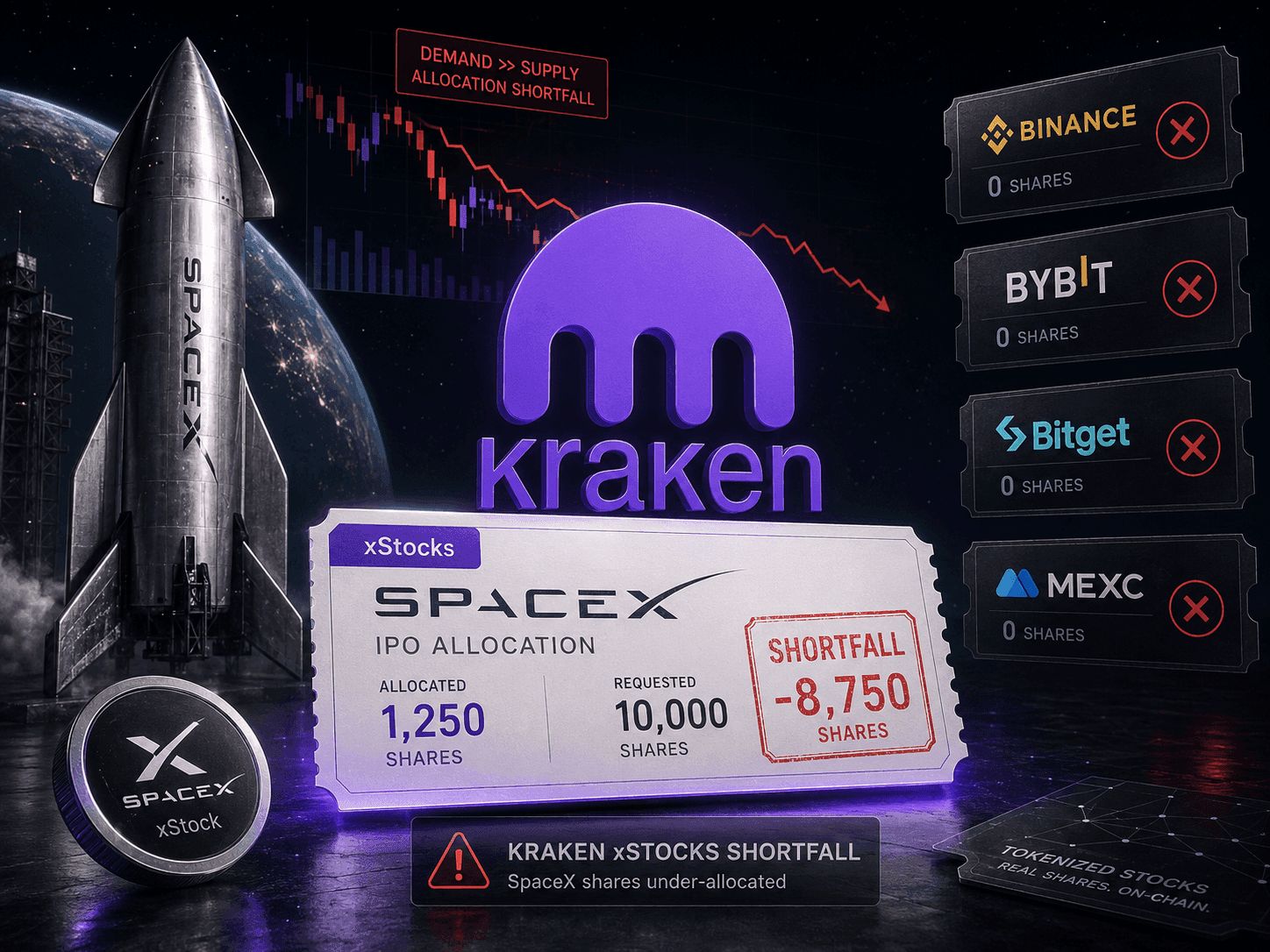
Why Binance, Bybit and Bitget Got Zero SpaceX Shares: Kraken's xStocks Came Up Short
xStocks — Kraken's own tokenized-equity arm — couldn't source SpaceX shares, leaving Binance, Bybit, Bitget and MEXC with zero. Here's why.
July 8, 2026 12:35 PM
Bitpanda Launches 20x Margin Trading on Real Stocks and ETFs — a First for Europe
Bitpanda just went live with leveraged trading on 875+ real stocks and ETFs at up to 20x — no CFDs, no synthetic contracts, just direct exposure.
December 26, 2024 1:08 PM
BGB News: Bitget Token Reaches New ATH Amid Market Momentum
Bitget Token (BGB) defies the market downtrend, hitting a new ATH of $7.32. What's driving this 368% surge and what the future holds for this top-performing cryptocurrency?
October 4, 2026 1:23 AM

Avalanche adds $266 million in new RWA in 30 days, price at $11.11: What to watch now
Avalanche took on more tokenised stocks in September than any other chain, and the price stands at $11.11. Nearly half of the increase, however, traces back to a single issuer.
August 12, 2026 6:24 PM

Tokenized Stocks and Tax in Germany: When the One-Year Holding Period Applies and When the Flat Tax Bites
If you buy a tokenized stock, you often apply the crypto rule: hold for a year, then the gain is tax-free. For these products that assumption usually does not hold, and this article shows from the wording of the law which feature decides the tax regime and how to find it in the issuer documents.
May 4, 2026 6:15 PM

DTCC Tokenized Securities: Is Wall Street About to Bring Stocks On-Chain?
DTCC plans tokenized securities trades in July 2026, signaling Wall Street’s next major step toward blockchain-based financial markets.
May 22, 2025 9:58 PM

Stocks vs. Crypto: Where Should You Invest Right Now?
With traditional stocks showing mixed signals and Bitcoin breaking new records, investors are torn: stick with equities or ride the crypto wave? Here’s a breakdown of what’s moving the markets.
April 4, 2025 10:54 PM
3 Crypto Stocks That Crashed Hard in the Wake of Market Turmoil
The global crypto market crashed hard. But while crypto took a hit, U.S. crypto-related stocks suffered even more severe losses. With the stock market in chaos, here are three crypto stocks that crashed hard recently.
More from CryptoTicker