
24-Hour Trading on US Exchanges: What the SEC Roundtable Means for Tokenized Stocks
The US Securities and Exchange Commission takes up the path to round-the-clock trading on American equity markets on September 17, 2026. For tokenized stocks on Kraken and Binance, that puts their most important selling point back on the table.





Which topics should we dive deeper into?
Select what genuinely interests you. Your picks feed directly into our editorial planning.
Crypto news that's actually worth your time.
Weekly. 60 seconds. Carefully curated by our editors: no hype, no promo flood, no spam.
On September 17, 2026, the US Securities and Exchange Commission meets in Washington to discuss something the crypto market has been able to do since its very first day: trading that never stops. The roundtable is filed under number 4-913 and carries the title “Preparations for 24-Hour Trading”. That sounds like American market plumbing, and like nothing that touches an investor in Germany. In fact, it decides how long tokenized stocks on crypto exchanges keep their only tangible edge.
That edge is a clock. Anyone looking to build an Nvidia position on a Sunday afternoon finds no counterparty on the Nasdaq, but does find a tokenized image of the share on Kraken or Binance. US exchanges are now closing exactly this gap, in several steps. The points the SEC calls up on September 17 are the same three on which tokenized stocks draw the harshest criticism today: operations, resilience and settlement in continuous mode.
What the SEC will discuss on September 17, 2026 under file number 4-913
The agency announced the date on July 23, 2026, published as Release 2026-69. Three blocks of topics are on the agenda: the preparations needed to carry overnight trading at all; operations and resilience in a market that never closes; and the opportunities and difficulties of extending trading hours further. The event takes place at SEC headquarters at 100 F Street NE, is open to the public and will be streamed live on sec.gov. The agency will make a recording available afterwards.
SEC chairman Paul Atkins summed up the direction in a sentence the agency itself put into its statement: “We are moving towards a new day – and night – in the U.S. equity markets.” In substance: the American equity market is to align itself with those markets that already run without interruption. What is meant, explicitly, are the trading venues for digital assets.
One distinction matters here. A roundtable is not a vote. The SEC will adopt no rule and change no law that day; it listens, and it records what the rebuild requires. Anyone waiting for a cut-off date from which Wall Street trades through the night is waiting for the wrong appointment.
Why overnight trading is already approved before the hearing begins
The actual rebuild has already gone through, in several separate proceedings. The SEC approved Nasdaq's application on April 10, 2026, having previously cleared comparable applications from 24X and NYSE Arca. The September roundtable therefore does not stand at the beginning of this development but in the middle of its implementation.
That is why the date carries more weight for you as a crypto investor than for a conventional shareholder. The equity market is currently taking over the very property with which crypto platforms advertise their tokenized stocks. How briskly that rebuild proceeds decides how much of the edge is left.
Nasdaq gets 23 hours: day session, night session and one maintenance hour
Nasdaq currently trades 16 hours a day in three separate segments: pre-market from 4:00 to 9:30 a.m. ET, the regular session from 9:30 a.m. to 4:00 p.m. ET, and post-market from 4:00 to 8:00 p.m. ET. Functionality is limited in the edge hours, the regulation differs, and members must alert their clients to the particular risks.
Under the approved model, two sessions remain. The day session combines pre-market, main trading and post-market into a single block from 4:00 a.m. to 8:00 p.m. ET. The new night session runs from 9:00 p.m. ET to 4:00 a.m. ET the following day. Between them, from 8:00 to 9:00 p.m. ET, sits an hour of downtime in which the exchange waits, tests, and processes corporate actions such as mergers, stock splits and dividends for the next trading day.
The trading week thus begins on Sunday evening at 9:00 p.m. ET with a night session and ends on Friday at the close of the day session. If Nasdaq closes on a given day, the closure takes effect from 8:00 p.m. ET on the previous day. Converted into German summer time, these hours give a day session from 10:00 a.m. to 2:00 a.m. CEST and a night session from 3:00 to 10:00 a.m. CEST. What remains is a single closed hour, and in Germany it falls in the middle of the night.
NYSE Arca plans 22 hours, but the launch hangs on market data and clearing
By the exchange's own account, NYSE Arca was the first established stock exchange to apply for extended trading hours in February 2025 and to obtain SEC approval for them. Weekday trading of 22 hours a day has been announced. As a date, NYSE names a targeted launch in 2026, without committing to a specific day so far.
That schedule comes with caveats, and those caveats are precisely the material of the September roundtable. The exchange says it is working with the other market participants to align market data, clearing and trading infrastructure with the additional hours; the Securities Information Processors, which supply consolidated price data, have so far only proposed a corresponding extension on their side. If one of these pieces fails, the launch shifts.
For anyone valuing tokenized stocks, that is the decisive uncertainty. A rebuild that gets under way in 2026 compresses the crypto rail's edge within a few months. A rebuild that slips by quarters extends it accordingly.
 Crypto brokers compared: who lists tokenized stocks
Tokenized stocks: the selling point of crypto exchanges is trading hours
Tokenized stocks are blockchain tokens that back a real share one to one. They are known under two brand names: xStocks, issued by the provider Backed and traded on Kraken among others, and bStocks from the Binance orbit on BNB Chain. Their appeal lies in properties that a share held in a securities account does not have: trading outside exchange hours, transferability into your own wallet, denomination in very small fractions, and settlement that does not hang on a banking day.
Of these properties, trading hours are the only one a supervisory authority can take back. Transferability, denomination and on-chain settlement are features of the technology and will remain. Trading hours, by contrast, are a matter of permission, and it is that permission the SEC is discussing on September 17.
If you are weighing whether to trade such instruments through a crypto platform at all, a sober look at the provider side is worth taking first. Which venue lists which tokenized assets, at what fees and under whose supervision, is set out in the comparison of the best crypto brokers. Product range and trading hours change there noticeably faster than at a classic custodian bank.
Kraken Pro trades ten xStocks around the clock, weekends included
Kraken has documented the extension itself. Previously, xStocks were tradable on Kraken Pro 24 hours a day on five days of the week, in exactly the rhythm Nasdaq and NYSE Arca are now heading for. The first expansion stage now runs with full 24/7 coverage, explicitly including weekends and public holidays.
This first stage covers ten assets: TSLAx, QQQx, SPYx, NVDAx, CRCLx, AAPLx, HOODx, MSTRx, GLDx and GOOGLx. The exchange justifies the selection by trading activity and liquidity, and says it will extend the list. Access requires verification at intermediate or pro level.
That allows the situation to be described precisely. As soon as Nasdaq and NYSE Arca run their night sessions, the time advantage of tokenized stocks shrinks to weekends and public holidays. That is still an advantage, but a considerably smaller one than today's gap between continuous trading and 16 hours on a weekday.
What an xStock is in legal terms: a debt security, not shareholder status
Before you take trading hours as an argument, the legal nature belongs alongside it. A tokenized image does not make you a shareholder in the company depicted. Voting rights, the annual general meeting and the direct claim against the company stay with the issuer of the tokens, who holds the real shares in custody. You hold a claim against that issuer, and its creditworthiness is a risk in its own right alongside the share's price risk. What this issuer risk looks like in detail, and how to spot it in the documents, is set out in our analysis of tokenized stocks and issuer risk.
The point gains weight as the time advantage narrows. As long as tokenized stocks were the only route into a Sunday evening, issuer risk could be booked as the price of admission. Once the advantage shrinks to weekends and public holidays, that risk stands there a good deal barer.
For tax, the holding period separates tokenized stocks from real portfolio holdings
In Germany the two routes diverge for tax purposes, and that is no marginal detail. A share held in a securities account falls under the flat-rate withholding tax; a price gain remains taxable regardless of how long it was held. If a tokenized image is instead classified as another asset within the meaning of Section 23 of the Income Tax Act, the one-year holding period applies, after which the disposal gain can be tax-free. Which classification holds in an individual case depends on how the instrument is structured, and it is disputed. We have written up the arguments and the open questions in paying tax on tokenized stocks in Germany.
For the question of this article, that means a tax difference remains even if the US exchanges take back the time advantage. Whether it falls in your favour is a question for your tax adviser, not one for trading hours.

What continuous trading means for spreads, liquidity and price gaps
Longer trading hours do not mean better executions. In today's edge hours the order book is thinner, the spread between bid and ask is wider, and individual orders move the price more than they do during main trading hours. That is precisely why a duty to inform clients applies to the existing edge hours, and the same mechanics will apply to the planned night session.
Two effects matter in practice. First, the available liquidity spreads across more hours without any additional liquidity arising; the night stays thin. Second, continuous trading removes part of the opening gaps, because news from the night no longer hits an opening auction all at once. Both have characterised tokenized stocks since their launch, there with even thinner books.
Anyone who trades regularly in the edge hours is therefore better served by limit orders, and should keep track of their own execution quality. A market order at three in the morning is a different instrument from a market order at 3:45 p.m.
What German investors actually see of US overnight trading
Access is decided not at the US exchange but at your broker. From a German perspective, the regular session of Nasdaq and NYSE falls between 3:30 and 10:00 p.m. CET, shifted accordingly in summer time. The planned night sessions change that only once your own provider offers them.
The question you have to settle is technical in nature: does your broker route a US order to a German trading venue or to a market maker, or does it actually reach the American exchange? Neobrokers with domestic routing offer long German trading hours, which is something other than execution in the US night session. The answer is in the execution policy and the price list, rarely in the advertising.
In practice that means the reform changes nothing about your trading day for as long as your broker offers no direct US routing. The competitive pressure on tokenized stocks builds regardless, because it is decided on the American market and feeds through from there into product design.
How to follow the roundtable and file a comment yourself
The roundtable is public. The SEC streams it live on sec.gov and will make a recording available afterwards; the agenda and the speaker list go up on the event page in advance. Anyone wanting to attend in person should reckon with limited seats and a security check. The agency published the announcement with all the arrangements itself: SEC Announces Roundtable on Preparations for 24-Hour Trading.
The agency accepts comments independently of the event, electronically through the Commission's comment form or by e-mail to rule-comments@sec.gov. In both cases the file number 4-913 must be stated, in the subject line in the case of an e-mail. Two things are worth knowing beforehand: every submission is published unchanged, and personal details are not redacted in the process.
You can run the counter-check on the crypto side directly with the provider. Kraken has described the switch to continuous trading in a post of its own: xStocks: now trading 24/7 on Kraken Pro.
24-hour trading: what to take away
- Check who supervises your trading venue before you buy tokenized stocks. The time advantage is shrinking, while the issuer and platform risk remains unchanged. Which platforms can show a European licence is set out in the comparison of regulated crypto exchanges.
- Compare the cost of the edge hours, not just the headline fee. A wide spread in a thin night session can cost more than the order fee itself; the terms of the individual venues are in the crypto exchange comparison.
- Document every transaction with a timestamp once you trade around the clock. With tokenized assets, the one-year holding period hangs on the purchase and sale dates. A tax tool or portfolio tracker spares you the search at the turn of the year.
(As of August 19, 2026. This article is not investment advice. Prices and fee structures change; check the terms with the provider before you buy.)
Transparency note: This article was produced with the assistance of artificial intelligence and reviewed by our editorial team before publication. All figures and claims were checked against the primary sources linked in the text. The feature image was generated with AI.
Related articles
- You Can Now Buy US Stocks on Kraken – Here’s How
- Binance Launches US Stock Trading with Upcoming bStocks Tokenization on BNB Chain
- Solana back on top in tokenized equities with 31 percent of the week: What investors need to know
- You Can Now Trade Tesla and Apple on Kraken... Here's How
- Securitize launches tokenized stocks with twelve names: how to check whether you can trade them in Germany
Which topics should we dive deeper into?
Select what genuinely interests you. Your picks feed directly into our editorial planning.
Crypto news that's actually worth your time.
Weekly. 60 seconds. Carefully curated by our editors: no hype, no promo flood, no spam.

August 12, 2026 6:24 PM

Tokenized Stocks and Tax in Germany: When the One-Year Holding Period Applies and When the Flat Tax Bites
If you buy a tokenized stock, you often apply the crypto rule: hold for a year, then the gain is tax-free. For these products that assumption usually does not hold, and this article shows from the wording of the law which feature decides the tax regime and how to find it in the issuer documents.
September 19, 2026 4:33 PM
Tokenized US Stocks: What the SEC Exemption Changes for You in Germany
On September 17, 2026 the SEC cleared trading in tokenized US stocks for five years, capped at 75 symbols per venue and only with full shareholder rights. What the decision regulates, what it leaves open and the four points you should check as an investor in Germany.

January 26, 2025 1:24 PM
From Skeptic to Advocate: How BlackRock and Larry Fink Are Leading the Crypto Revolution
How are BlackRock News and Larry Fink shifting towards Bitcoin and tokenized assets shaping a crypto revolution?
October 5, 2026 7:43 AM

Tokenized stocks as collateral: what the October 14 unlock changes for investors in Germany
On October 14, 2026, at 6:00 a.m. New York time, the next lock-up tranche at Cerebras comes free, up to 19.4 million shares. Anyone who has pledged a tokenized stock as collateral carries a different risk from a pure holder.
September 17, 2026 10:12 PM
Stock Tokens: How to Check Whether Yours Carries Real Shareholder Rights
The SEC allows US trading venues to handle tokenized stocks only if the token carries the same rights as the original. That condition does not automatically apply to the stock token you buy here, so here is how to check what is inside yours.
September 7, 2026 7:14 AM
Stock Tokens: Who Actually Issues Them and What the SEC Wants to Change by November 3, 2026
Behind every stock token sit an issuer, a broker, a custodian and a blockchain, and today you will only find those names in the small print. The US Securities and Exchange Commission wants them written into an official form; the deadline for comments runs out on November 3, 2026.
September 2, 2026 10:30 AM
Tokenized Stocks: Who Owns the Share When the Register Sits on a Blockchain
The US Securities and Exchange Commission wants to allow the official share register to be kept on a blockchain. What the proposal of September 1, 2026 means for tokenized stocks and for your ownership.
October 14, 2026 4:28 AM

Morgan Stanley pushes tokenized equities to 2027: "The client demand really isn't there"
Morgan Stanley will bring tokenized equities to its own trading venue only in the first quarter of 2027, around half a year later than announced. Amy Oldenburg's explanation and the German legal framework show why equity tokens are something different here than there.
September 18, 2026 10:24 PM
CLARITY Act Fails, the CFTC Takes Over: What the New US Crypto Rules Change for Investors in Germany
The CLARITY Act has failed in the US Senate, yet regulation moves on: the CFTC has filed two rule proposals of its own and the SEC has opened trading in tokenised stocks. What that means for Bitcoin, XRP and the rest, and what you should check as an investor in Germany.
July 11, 2026 6:49 PM
Crypto Price Today: Bitcoin Holds $64K as Robinhood Lets AI Bots Trade Crypto
The market is green again as BTC clings to a key level — but the bigger shift is that AI bots may soon be placing your trades for you. Here's today's snapshot.

June 13, 2026 10:33 AM

SpaceX IPO Recap: SPCX Closes +19% in a Record Debut, While Tokenized Stocks Stumble
SPCX jumped 19% to a $2T+ valuation on day one — but the tokenized SpaceX trade split in two, and the difference is the real lesson.
May 12, 2026 9:19 AM
Senate Banking Committee Unveils 309-Page Crypto Clarity Act Draft
The US Senate Banking Committee released a 309-page Crypto Clarity Act draft. It defines SEC and CFTC roles while adding strict stablecoin yield rules.

September 10, 2018 3:25 PM

US SEC Suspends Bitcoin Tracker One and Ether Tracker One
US SEC, the securities and exchange commission has temporarily suspended Bitcoin Tracker One (CXBTF) and Ether Tracker One (CETHF).

July 8, 2026 12:35 PM
Bitpanda Launches 20x Margin Trading on Real Stocks and ETFs — a First for Europe
Bitpanda just went live with leveraged trading on 875+ real stocks and ETFs at up to 20x — no CFDs, no synthetic contracts, just direct exposure.
August 19, 2026 4:33 AM

Tokenized Stocks: Why You Do Not Own a Share and Which Risk Hangs on the Issuer
Crypto.com launched tokenized stocks for the EEA on August 12, 2026, and the decisive sentence sits in the small print: buyers acquire no ownership of the underlying asset. What you hold instead, who ranks ahead of you in an insolvency and how to recognise genuine ownership of a security.
October 4, 2026 1:23 AM

Avalanche adds $266 million in new RWA in 30 days, price at $11.11: What to watch now
Avalanche took on more tokenised stocks in September than any other chain, and the price stands at $11.11. Nearly half of the increase, however, traces back to a single issuer.
May 4, 2026 6:15 PM

DTCC Tokenized Securities: Is Wall Street About to Bring Stocks On-Chain?
DTCC plans tokenized securities trades in July 2026, signaling Wall Street’s next major step toward blockchain-based financial markets.
August 29, 2024 9:45 AM

Breaking News Today: SEC Targets NFTs!
The SEC's crackdown on NFTs threatens to reshape the digital collectibles market. How will this impact OpenSea, creators, brands, and the future of NFTs?
May 14, 2024 12:51 PM
SEC Decision on Spot Ethereum ETF in 9 Days: What to Expect?
In anticipation of the SEC's decision on Ethereum ETFs, here is the unique trading strategy proposed by a crypto hedge fund...
June 7, 2023 6:17 PM
BIG NEWS: Binance US Streamlines Trading Pairs and Halts OTC Operations
Binance US, has announced significant changes to its trading operations. The exchange will remove 40 trading pairs.
September 28, 2026 4:15 AM
NEAR Rises More Than 29 Percent in Seven Days: Why Ondo Stocks and Zcash Trading Are Driving the Price
NEAR gains 29.23 percent within seven days and is the strongest of the 25 largest cryptocurrencies on September 27. Two documented drivers sit behind the move: the launch of tokenised US equities and ETFs from Ondo on the chain, and growing Zcash trading through NEAR Intents.
August 19, 2026 10:37 AM

Who Regulates Crypto in the US? CFTC and SEC Compared
On 20 August 2026 the new innovation advisory committee of the US derivatives regulator CFTC meets for the first time, staffed with the chief executives of Coinbase, Kraken, Gemini and Ripple. What separates the two US agencies, and why MiCA and BaFin still count for your portfolio.
July 30, 2026 11:54 AM
Bitcoin and Ethereum Beat Every Major Market in July as Chip Stocks Crash
Crypto quietly won July. Ethereum gained 20% and Bitcoin 9%, while chip stocks fell 22% and the Nasdaq 100 slid 9%. Here is what actually happened.
June 13, 2026 11:45 AM
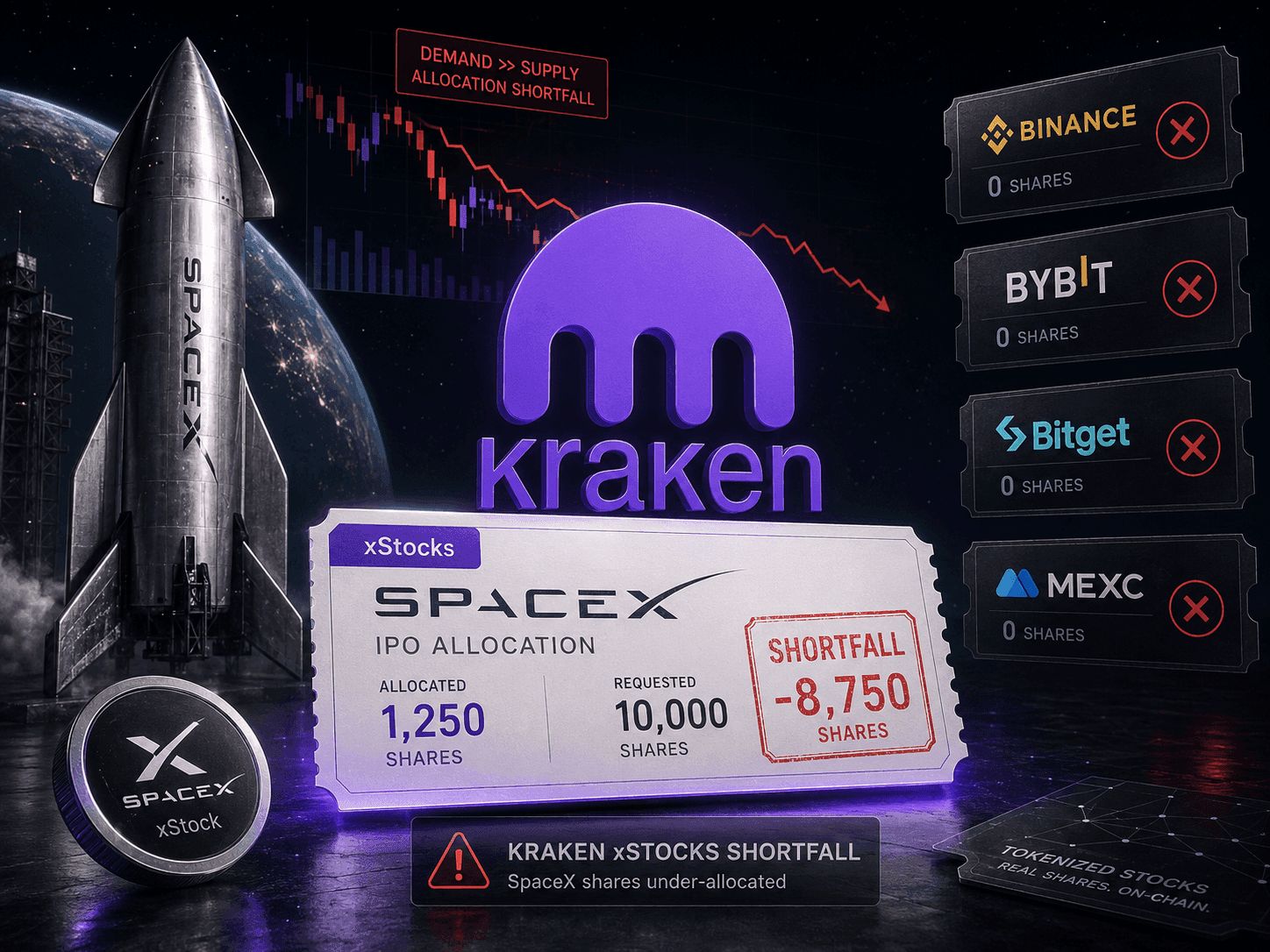
Why Binance, Bybit and Bitget Got Zero SpaceX Shares: Kraken's xStocks Came Up Short
xStocks — Kraken's own tokenized-equity arm — couldn't source SpaceX shares, leaving Binance, Bybit, Bitget and MEXC with zero. Here's why.
November 5, 2025 1:16 PM

$1 Trillion Wiped: Risk-Off Storm Engulfs Stocks & Crypto
Global markets plunge as tech stocks and crypto crash, wiping over $1 trillion in value amid AI bubble fears and investor risk-off panic.

More from CryptoTicker