
Cerebras Lockup and Tokenized Stocks: The Release Schedule Through November 2026
On September 16, 2026 a further 14.6 million Cerebras shares become freely sellable, and the dates through November 9 are set out in the IPO prospectus. What the release schedule means for the tokenized wrappers CBRSB, CBRSX and CBRSON, and what it does not.



Which topics should we dive deeper into?
Select what genuinely interests you. Your picks feed directly into our editorial planning.
Crypto news that's actually worth your time.
Weekly. 60 seconds. Carefully curated by our editors: no hype, no promo flood, no spam.
If you hold a tokenized Cerebras share, the figure that matters most over the coming weeks is not a price target but a date. On September 16, 2026 at 10:00 UTC, which is midday in central Europe, a further 14.6 million shares in Cerebras Systems become freely sellable for the first time. That date appears in no press release. It sits in a table on page 190 of the IPO prospectus the company filed with the US Securities and Exchange Commission.
This article turns that table into a readable calendar and answers a question almost nobody is asking: what does the Cerebras lockup mean for tokenized stocks, meaning the wrappers CBRSB, CBRSX and CBRSON that trade on crypto platforms? The short answer first. The schedule governs the supply of real shares. It reaches the tokens only indirectly, through the price they track. Confuse the two and you will budget for a dilution that does not exist on the blockchain.
What the Cerebras lockup is and why it concerns holders of tokenized stocks
A lockup is a contractual undertaking by existing shareholders and employees, given to the underwriting banks, not to sell their holdings for a set period after the IPO. The purpose is to prevent an overhang of supply in the days after the first trading session, which would deter new investors. When a lockup expires, the number of shares that may be sold at all rises. The number of shares in issue does not change.
A tokenized stock is a claim against an issuer, recorded on a blockchain, that tracks the price of a real share. You are not buying a security and you do not become a shareholder. What you hold is a receivable against the house that issues the wrapper and deposits the underlying shares. That is where this subject connects to the crypto market: Cerebras has traded in four such wrappers since spring 2026, and their price follows the Nasdaq quote. Whatever changes supply in the equity market reaches you as a price move, without a single new token being created. Cryptoticker described the mechanics in detail when Binance launched its offering in June 2026.
Cerebras Systems is a US AI chipmaker based in Sunnyvale that builds data centre accelerators for artificial intelligence. Its distinguishing feature is the Wafer Scale Engine, a chip that occupies an entire semiconductor wafer rather than the usual fingernail-sized area. Those AI chips are the reason the company went public at all. The IPO took place in May 2026 and the stock trades on Nasdaq under the ticker CBRS. At an offer price of $185.00 per share, the prospectus shows gross proceeds of $5.55 billion for the base offering; after full exercise of the over-allotment option, the company cites $6.4 billion in its own quarterly release. Both figures are correct, and they refer to different scopes.
The release schedule from the IPO prospectus: every tranche through November 9, 2026
The prospectus dated May 13, 2026 contains a table headed "Earliest Date Available for Sale in the Public Market". For each step it lists a date and a maximum number of Class A shares. The wording that matters is "up to approximately": the table gives ceilings on what may be sold, not a forecast of what will be sold. That distinction carries the rest of this article.
| Date | Released (ceiling) | Status on September 1, 2026 |
|---|---|---|
| First trading day after the IPO | 2.5 million shares | passed |
| Second trading day, if the price trigger was met | 2.5 million shares | passed |
| Second trading day after first-quarter results | 27.7 million shares | passed (June 25, 2026) |
| Second trading day after second-quarter results | 36.4 million shares | passed (August 14, 2026) |
| August 19, 2026 | 14.6 million shares | passed |
| September 2, 2026 | 14.6 million shares | imminent |
| September 16, 2026 | 14.6 million shares | open |
| September 30, 2026 | 19.4 million shares | open |
| October 14, 2026 | 19.4 million shares | open |
| October 28, 2026 | 19.4 million shares | open |
| Earlier of Q3 results or November 9, 2026 | all remaining locked shares | open |
All the fixed dates carry a time of 6:00 a.m. Eastern in the prospectus, which is 10:00 UTC in September and October and midday in Germany. The release therefore happens before US trading opens, not in the middle of the session.
The cross-check that makes the schedule reliable
The ten numbered tranches add up to 171.1 million shares. The prospectus itself cites exactly that total elsewhere, where it estimates the early releases: "an aggregate of up to approximately 171.1 million shares", of which up to 15.0 million come from the holdings of executive officers and directors. The table therefore balances on both sides, and that is why you can rely on this calendar.
The residual works out as well. After the offering, 215,110,345 shares are outstanding, or 219,610,345 on full exercise of the over-allotment. Subtract from the larger figure the 34.5 million freely tradable shares from the IPO and the 171.1 million early releases, and 14,010,345 shares remain for the final date. An independent issuance dataset lists exactly that number for November 9, 2026. Two sources that do not derive from one another arrive at the same remainder.

Why September 4 in the issuance dataset does not match the prospectus
Look the calendar up at an aggregator and you will find a tranche of 36.4 million shares for September 4, 2026. Against the prospectus that date cannot be right, and the reason lies in the clause itself. The 36.4 million hang on an event rather than on a calendar day, namely the "second trading day after the release of our results for the quarter ended June 30, 2026". Those results are long since out: according to its own filing with the SEC, Cerebras published them after the close on August 12, 2026. The second trading day after that was Friday, August 14, 2026.
The cross-check against the first quarter confirms the mechanism. The same dataset carries the 27.7 million for June 25, 2026, which is the second trading day after the Q1 release. For the second quarter, by contrast, it carries a date three weeks later than the results actually appeared. For you that means the tranche has already passed, and anyone building a plan around a 36.4 million share release in early September is planning for an event that took place in August.
That leaves 87.4 million shares from September 2 onwards, in five numbered steps, plus the unnumbered final date. Measured against the 215.1 million shares outstanding, the five steps together come to a good 40 percent.
 Trading tokenized stocks: the providers compared
What the quarterly results that triggered the 36.4 million tranche contained
Because one of the largest steps hangs on a date set by the quarterly figures, the release itself is worth a look. For the second quarter of 2026 the company reported revenue of $180.1 million under US accounting rules, up 74 percent on the year-earlier quarter, and $209.9 million on its own core basis, which strips out certain items. The cloud business reached $127.7 million on that core basis and grew by 287 percent. Co-founder and chief executive Andrew Feldman called the quarter "outstanding" in the release.
Those growth rates are one half of the picture. The other half sits in the same release: the operating margin was minus 265 percent under US accounting rules and minus 16 percent on the core basis. The business does not yet make money, and against that it sets cash and short-term investments of $8.6 billion and remaining performance obligations of $25.4 billion. Read the valuation optimistically and you lean on the order book; read it sceptically and you lean on the margin. For the release schedule neither matters. For sizing your own position, both do.
Where can I buy Cerebras shares, and how does the tokenized wrapper differ?
You get the real share from any broker with Nasdaq access, which in Germany means the usual custodian banks. You get the tokenized wrapper on crypto platforms, and in law it is a different thing altogether. The difference comes down to three points you should know before your first purchase.
Trading hours
Nasdaq closes. The wrapper trades around the clock. When a tranche is released at 10:00 UTC, the token reacts immediately, while regular US trading only begins at 13:30 UTC. In that window the wrapper's price forms without the reference market it tracks, and volatility rises on exactly those days.
Legal standing
The wrapper buys you neither a share nor a vote. In law you hold a claim against its issuer. How far that claim reaches and what it depends on is something cryptoticker took apart in a separate piece on ownership and issuer risk in tokenized stocks.
Market depth
Trading in the wrapper is thinner than on Nasdaq by orders of magnitude. If you want to move larger sums, the question of the right venue matters more than the question of the date. A comparison of the houses that offer tokenized instruments alongside conventional securities is in the overview of the best crypto brokers.
CBRSB, CBRSX and CBRSON: how big the tokenized market for Cerebras really is
Four wrappers currently track CBRS: the bStocks version from Binance on its own chain, the xStock from Backed, the Ondo issue and the Robinhood token. The size of those four is the part of the story that is easily overestimated. On September 1, 2026 the bStocks wrapper had a market capitalisation of around $2.1 million on daily turnover of about $1.8 million. The Ondo version stood at roughly $0.39 million and the Robinhood token in the low five figures. No market data was available for the xStock at the same moment.
For comparison: the September 16 tranche alone covers 14.6 million shares. At a price in the region of $175 that is a value in the billions. The entire tokenized supply for this stock is therefore smaller than a thousandth of the shares that become sellable on a single date. Anyone trying to turn the release schedule into a market-moving crypto event would have the proportions upside down.
The reverse holds too. Because the tokenized market is so thin, a move in the share price comes through with a wider gap between bid and offer. The three wrappers with available data were quoted between $174.77 and $177.87 on the same day, a spread of a good three dollars for the same underlying. That is the normal consequence of separate venues with different depth, and it belongs among the risks to price in with thinly traded wrappers. For choosing a venue, the comparison of the best crypto exchanges is worth reading.
Why a lockup attaches to the issuer and not to the blockchain
In crypto, an unlock is an event on the chain: a contract releases tokens, the circulating supply rises, and anyone can verify it in the block. An equity lockup does nothing of the sort. No new shares come into existence, and not a single entry on the blockchain changes. What changes is only the permission of certain holders to sell shares that already exist.
For the tokenized wrapper the consequence is clear. The issuer deposits real shares and issues tokens against them. If the supply of real shares rises and the price gives way, the value of the wrapper falls with it. The number of tokens stays the same. Your position is not diluted; it can certainly lose value. The distinction sounds academic, but it decides whether you watch the token's circulating supply or the share price. In this case only the second figure helps you.
Cryptoticker worked through the same mechanism in late August for a second stock whose lockups also land in tokenized wrappers: the release dates for tokenized SPCX shares. Put the two cases side by side and the pattern shows more clearly than it does in any single company.

What the $185 offer price has to do with the second tranche
One step of the calendar works with a price threshold instead of a calendar day, and it explains a number you would otherwise stumble over. The second tranche of 2.5 million shares was released only if the closing price on the first trading day exceeded 133 percent of the offer price. At an offer price of $185.00 that is a threshold of $246.05.
For the later Q1 step the prospectus table gives two variants: 27.7 million shares if the price trigger was met, and 30.2 million if it was not. Since the issuance dataset carries the 27.7 million for June 25, the threshold was exceeded on the first trading day. Nothing follows from that about the company's valuation or about the further course of the share price. The trigger merely explains why the smaller of the two figures appears in the calendar.
How to read the release schedule as a holder of a tokenized wrapper
No price direction can be derived from these dates. What can be derived is an expectation of when the news flow and the trading depth turn choppier. Three points help.
The release falls before the US open
Between 10:00 and 13:30 UTC the wrapper trades without its reference market. Anyone placing an order in that window should expect wider gaps between bid and offer, and should set a limit rather than buy at market.
The ceiling is not the quantity that will be sold
"Up to" means permitted, not announced. Executive officers and directors are additionally bound by US securities Rule 144 and by internal trading policies. Part of the released stock will not reach the market for the foreseeable future.
The final date is a ceiling, not a fixed date
The last step reads "the earlier of" in the prospectus: the second trading day after the Q3 results, or 180 days after the date of the prospectus. The second branch falls on November 9, 2026. Because the two preceding quarters both reported in the middle of the following month, the first branch may bite earlier. Note November 9 as the latest possible point and allow for it to be brought forward.
Tax and records: what to document with tokenized stocks in Germany
The tax treatment of tokenized stocks in Germany is not conclusively settled, and this article is no substitute for advice. The practical side is not in dispute: you need records. For every position, note the time of purchase, the price in euros, the platform, the exact name of the wrapper and the chain address it sits on. Because the same share exists in four different wrappers, the ticker CBRS is not enough to identify it.
Two points are regularly overlooked. First, swaps and onward sales within the crypto sphere are events in their own right and belong in your records, even when no euro changes hands. Second, whether your gain arises from a security or from some other asset can depend on how the wrapper is structured. Anyone using several platforms is better served by continuous capture than by account statements at the year end. Tools for that are in the comparison of crypto tax software and portfolio trackers.
What this calendar does not say
The prospectus is a good source for dates and ceilings. It says nothing about whether anyone will sell, at what price, and what the market will make of it. Historically, lockup expiries have cut both ways, and individual companies have gained ground after one. No forecast can be won from this table.
Nor does the calendar say anything about the creditworthiness of the issuers behind the wrappers. That is a separate question you have to answer independently of the date, and it weighs more heavily in thinly traded instruments than in large positions. Finally: the market figures cited here are snapshots from September 1, 2026. At a market capitalisation in the low single-digit millions they can shift markedly within days.
Cerebras lockup: what to take away
- Note the remaining dates and check your access. September 2 and September 16, then September 30, October 14 and October 28, each at midday central European time, and finally November 9 at the latest. Whether you can trade sensibly in that window depends on the venue; the options are in the overview of the best crypto brokers.
- Check which wrapper you actually hold. CBRSB, CBRSX, CBRSON and the Robinhood token differ in issuer, chain and trading depth. Compare the venues and their terms in the overview of the best crypto exchanges before you build or rotate a position.
- Document every movement with date, euro price and chain address. With four wrappers sharing a name, clean attribution is hard to reconstruct later. A tool that records it automatically is in the comparison of crypto tax software and portfolio trackers.
The primary sources for this article are the Cerebras Systems IPO prospectus of May 13, 2026, with the release table on pages 190 and 191, and the quarterly release of August 12, 2026, filed as an exhibit to the company's report to the SEC, which documents both the date and the second-quarter figures.
(As of September 1, 2026. This article is not investment advice. Prices and fee structures change; check the terms with the provider before you buy.)
Transparency note: This article was produced with the assistance of artificial intelligence and reviewed by our editorial team before publication. All figures and claims were checked against the primary sources linked in the text. The feature image was generated with AI.
Related articles
- SpaceX Lockup: What the Release Dates Through December 8 Mean for Tokenized SPCX Stock
- Tokenized stocks as collateral: what the October 14 unlock changes for investors in Germany
- Tokenized Stocks: Who Owns the Share When the Register Sits on a Blockchain
- 92.6 Million ARB Every Month: When the Arbitrum Lockup Runs Out
- SpaceX Stock (SPCX): From $211 Record to $104.83 Low in 5 Phases
Which topics should we dive deeper into?
Select what genuinely interests you. Your picks feed directly into our editorial planning.
Crypto news that's actually worth your time.
Weekly. 60 seconds. Carefully curated by our editors: no hype, no promo flood, no spam.

June 22, 2026 6:08 PM
SpaceX (SPCX) Crashes 10% as Bond Spree and Lockup Fears Spook Investors — Here's Why
SpaceX shares are sliding hard after a historic Nasdaq debut. We break down what's behind the SPCX pullback, where the stock trades now, and what comes next.

May 22, 2025 11:00 PM
You Can Now Trade Tesla and Apple on Kraken... Here's How
Crypto exchange Kraken is launching tokenized stocks for Tesla, Apple, and Nvidia—giving non-U.S. users 24/7 access to some of the world’s biggest companies.

August 19, 2026 4:33 AM

Tokenized Stocks: Why You Do Not Own a Share and Which Risk Hangs on the Issuer
Crypto.com launched tokenized stocks for the EEA on August 12, 2026, and the decisive sentence sits in the small print: buyers acquire no ownership of the underlying asset. What you hold instead, who ranks ahead of you in an insolvency and how to recognise genuine ownership of a security.
October 8, 2026 7:45 PM

Securitize launches tokenized stocks with twelve names: how to check whether you can trade them in Germany
Securitize launched twelve tokenized US stocks on Solana on October 8, each backed one-to-one by a real share and settled in USDC. For investors in Germany everything hangs on one question the company leaves open: who counts as an eligible investor in the first place.

October 4, 2026 1:23 AM

Avalanche adds $266 million in new RWA in 30 days, price at $11.11: What to watch now
Avalanche took on more tokenised stocks in September than any other chain, and the price stands at $11.11. Nearly half of the increase, however, traces back to a single issuer.
August 12, 2026 6:24 PM

Tokenized Stocks and Tax in Germany: When the One-Year Holding Period Applies and When the Flat Tax Bites
If you buy a tokenized stock, you often apply the crypto rule: hold for a year, then the gain is tax-free. For these products that assumption usually does not hold, and this article shows from the wording of the law which feature decides the tax regime and how to find it in the issuer documents.
May 4, 2026 6:15 PM

DTCC Tokenized Securities: Is Wall Street About to Bring Stocks On-Chain?
DTCC plans tokenized securities trades in July 2026, signaling Wall Street’s next major step toward blockchain-based financial markets.
September 19, 2026 4:33 PM
Tokenized US Stocks: What the SEC Exemption Changes for You in Germany
On September 17, 2026 the SEC cleared trading in tokenized US stocks for five years, capped at 75 symbols per venue and only with full shareholder rights. What the decision regulates, what it leaves open and the four points you should check as an investor in Germany.
June 12, 2026 6:23 PM
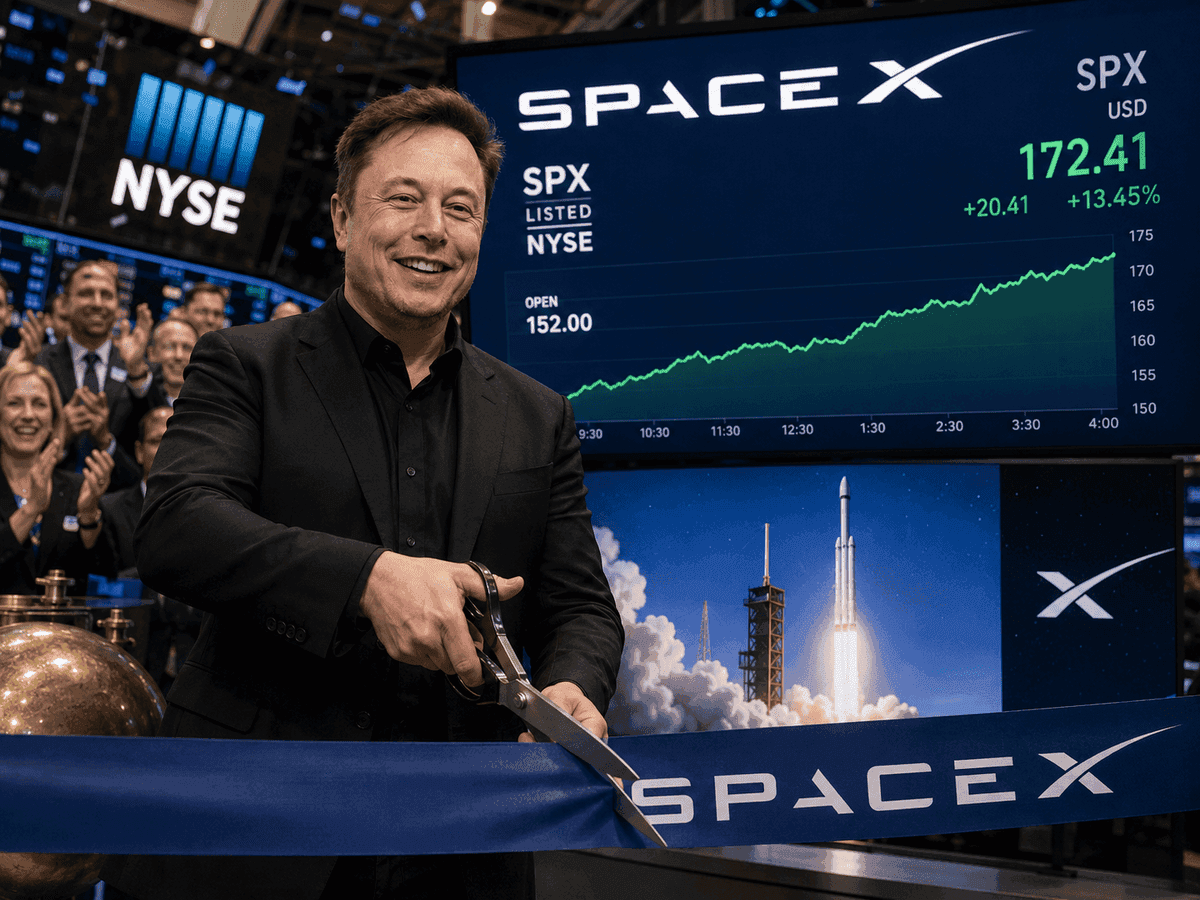
SpaceX IPO Today: SPCX Stock Opens Near $152 and Jumps Toward $172 — What Happens Next?
SpaceX stock opened around $152 and surged toward $172 after its historic IPO. Is SPCX heading for a bigger rally, or could a sharp post-IPO crash be next?
June 1, 2026 1:17 PM
Binance Launches US Stock Trading with Upcoming bStocks Tokenization on BNB Chain
Binance has introduced zero-commission US stock and ETF trading for non-US users, with plans to launch tokenized on-chain equities via bStocks.
September 9, 2025 11:00 PM
You Can Now Buy US Stocks on Kraken – Here’s How
Kraken brings tokenized US stocks to Europe with xStocks. Trade equities like Nvidia and Google onchain, reshaping the future of crypto and finance.
January 26, 2025 1:24 PM

From Skeptic to Advocate: How BlackRock and Larry Fink Are Leading the Crypto Revolution
How are BlackRock News and Larry Fink shifting towards Bitcoin and tokenized assets shaping a crypto revolution?
September 17, 2026 10:12 PM

Stock Tokens: How to Check Whether Yours Carries Real Shareholder Rights
The SEC allows US trading venues to handle tokenized stocks only if the token carries the same rights as the original. That condition does not automatically apply to the stock token you buy here, so here is how to check what is inside yours.
September 7, 2026 7:14 AM
Stock Tokens: Who Actually Issues Them and What the SEC Wants to Change by November 3, 2026
Behind every stock token sit an issuer, a broker, a custodian and a blockchain, and today you will only find those names in the small print. The US Securities and Exchange Commission wants them written into an official form; the deadline for comments runs out on November 3, 2026.
August 21, 2026 10:16 AM

24-Hour Trading on US Exchanges: What the SEC Roundtable Means for Tokenized Stocks
The US Securities and Exchange Commission takes up the path to round-the-clock trading on American equity markets on September 17, 2026. For tokenized stocks on Kraken and Binance, that puts their most important selling point back on the table.
June 17, 2026 9:41 AM

SpaceX vs Bitcoin: Which Was the Better Investment?
SpaceX stock vs Bitcoin: who actually won? See what investing at SpaceX's launch versus buying Bitcoin a year ago would be worth today.
June 13, 2026 11:45 AM
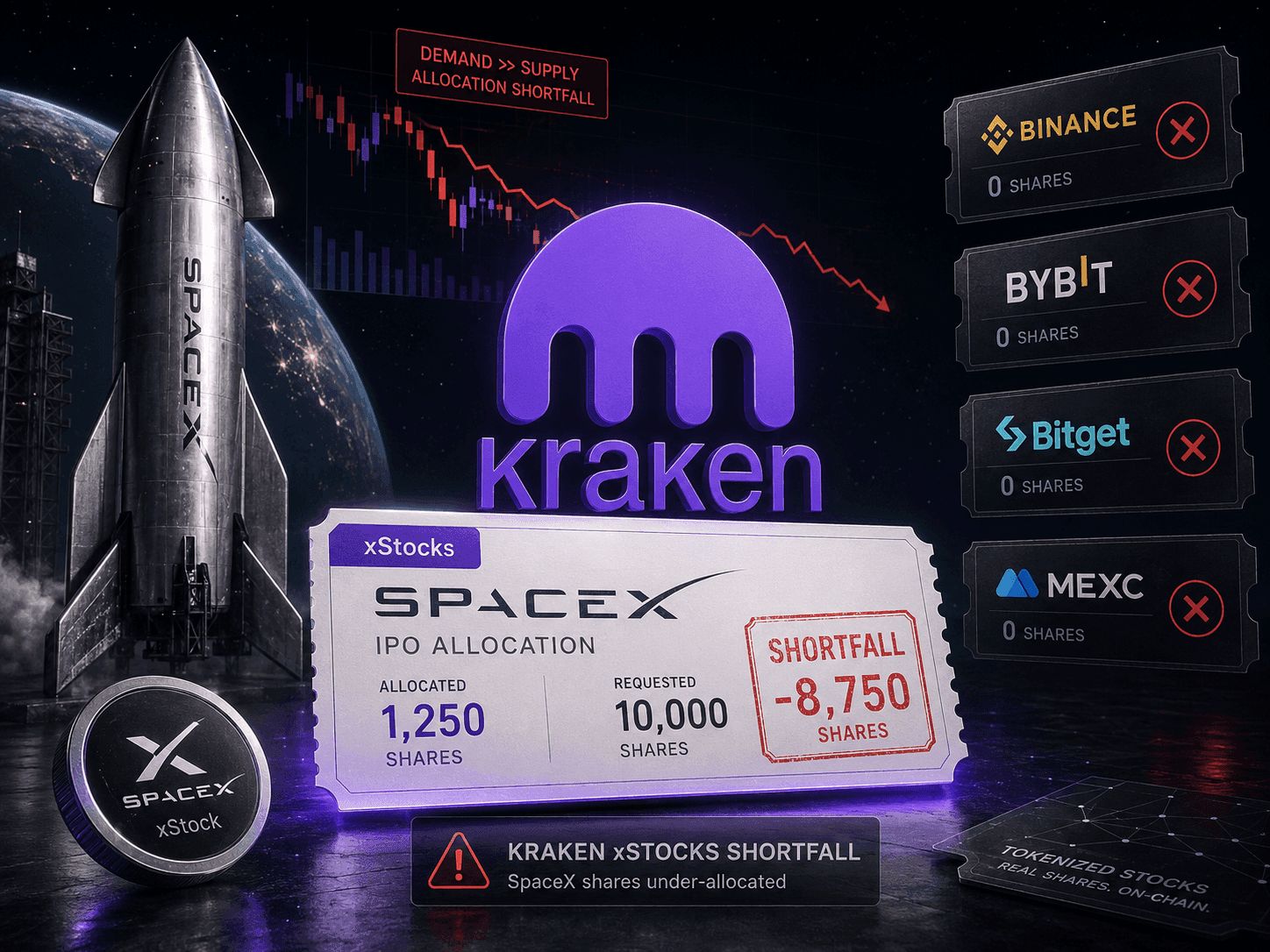
Why Binance, Bybit and Bitget Got Zero SpaceX Shares: Kraken's xStocks Came Up Short
xStocks — Kraken's own tokenized-equity arm — couldn't source SpaceX shares, leaving Binance, Bybit, Bitget and MEXC with zero. Here's why.
September 1, 2026 7:21 PM

Solana Alpenglow: Activation Starts September 28, and What Delegators Should Check Now
The release schedule for Agave v4.3 names September 28, 2026 as the start of feature activation on Solana mainnet. We measured how much stake already runs on the new version today, and explain what delegators need to draw from it.
August 17, 2026 6:18 AM
Robinhood Chain NFTs: How StonkBrokers Turned a JPEG Into a Brokerage Account
An NFT collection on Robinhood Chain now has a higher floor price than Bored Ape Yacht Club. It has 630 owners. And its price is not really a price at all - it is a formula.
August 6, 2026 1:00 PM

Robinhood Built a Blockchain for Stocks. The Cat Memecoins Took It Over.
$13 million in tokenised equities, memecoins worth ten times that: what Robinhood Chain is, why CASHCAT flooded it, and how investors actually get access.
July 11, 2026 6:49 PM
Crypto Price Today: Bitcoin Holds $64K as Robinhood Lets AI Bots Trade Crypto
The market is green again as BTC clings to a key level — but the bigger shift is that AI bots may soon be placing your trades for you. Here's today's snapshot.
June 17, 2026 1:30 PM
SpaceX or Ethereum: Which Delivered the Better Return?
SpaceX stock versus Ethereum, one year on. We compare the returns, the dollar outcomes, and which is better positioned from here.
June 16, 2026 11:16 AM

How to Buy SpaceX Stock (SPCX): Step-by-Step Trading Guide
SpaceX stock (SPCX) jumped to $192 on its second trading day. Here's the price action — and exactly how to trade SPCX step by step.
June 13, 2026 10:33 AM
SpaceX IPO Recap: SPCX Closes +19% in a Record Debut, While Tokenized Stocks Stumble
SPCX jumped 19% to a $2T+ valuation on day one — but the tokenized SpaceX trade split in two, and the difference is the real lesson.
July 8, 2026 12:35 PM
Bitpanda Launches 20x Margin Trading on Real Stocks and ETFs — a First for Europe
Bitpanda just went live with leveraged trading on 875+ real stocks and ETFs at up to 20x — no CFDs, no synthetic contracts, just direct exposure.

More from CryptoTicker